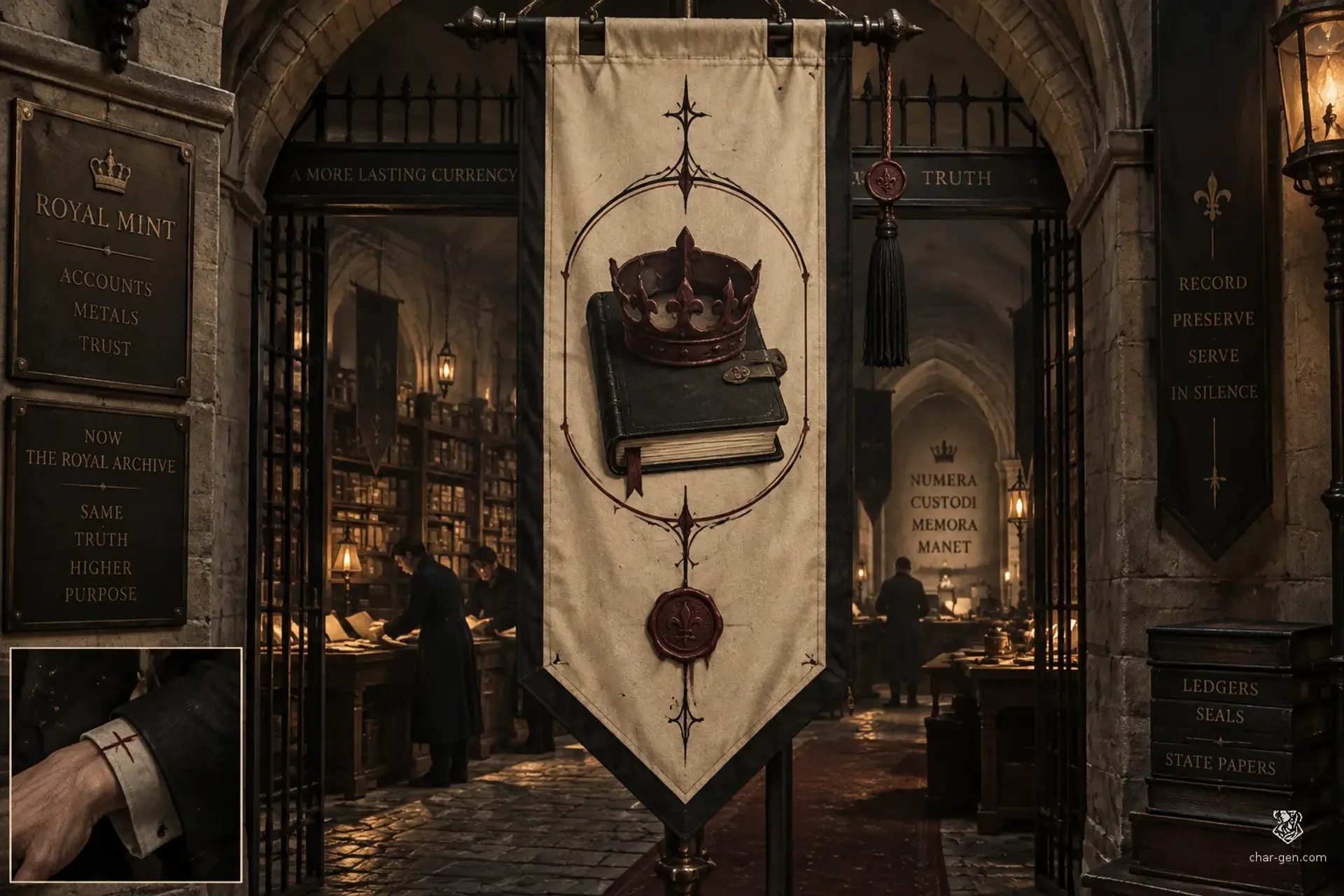
The Crown's Quiet Ledger
The Quiet Ledger began as a famine-era effort to reconcile royal orders and prevent grain from being diverted by corrupt officials. Its first triumph was a set of verified accounts that exposed a minister's hoarding and forced the crown to reopen several storehouses. The institution grew from useful clerks into a quiet instrument of state: it authenticated land grants, tracked debts, investigated forged titles, and advised the throne on which promises could safely be kept. Its defining watershed came during the Succession Crisis, when two claimants each possessed plausible legal documents and substantial support. The Ledger discovered that both claims rested on forged records, but revealing that fact would have collapsed the royal administration and likely invited invasion. Its leaders chose one claimant, altered the surviving chain of evidence, and arranged for several witnesses to vanish. The selected monarch won the capital and later became the founder of the current dynasty. The crown rewarded the Ledger with permanent authority over royal archives, while the faction concealed the price of its intervention. In the decades afterward, the Ledger expanded into provincial tax offices and built informal relationships with couriers, household staff, and local judges. It became more disciplined, but also more secretive. The Unreturned Bell entered the picture when the crown needed intelligence that royal officials could not safely gather. The Ledger sponsored discreet contracts and later helped manage the Company's access to court. Today the institution claims to defend reliable records and orderly government. In practice, it preserves a political settlement founded on a lie, while its members argue about whether a lie that prevented civil war can ever be allowed to end.
The Crown's Quiet Ledger
- Type
- Royal administrative…
- Size
- 386 members
- Reach
- Very high in the capital…
- Base
- The capital, in the old mint district.
Overview
The Quiet Ledger began as a famine-era effort to reconcile royal orders and prevent grain from being diverted by corrupt officials. Its first triumph was a set of verified accounts that exposed a minister's hoarding and forced the crown to reopen several storehouses. The institution grew from useful clerks into a quiet instrument of state: it authenticated land grants, tracked debts, investigated forged titles, and advised the throne on which promises could safely be kept. Its defining watershed came during the Succession Crisis, when two claimants each possessed plausible legal documents and substantial support. The Ledger discovered that both claims rested on forged records, but revealing that fact would have collapsed the royal administration and likely invited invasion. Its leaders chose one claimant, altered the surviving chain of evidence, and arranged for several witnesses to vanish. The selected monarch won the capital and later became the founder of the current dynasty. The crown rewarded the Ledger with permanent authority over royal archives, while the faction concealed the price of its intervention. In the decades afterward, the Ledger expanded into provincial tax offices and built informal relationships with couriers, household staff, and local judges. It became more disciplined, but also more secretive. The Unreturned Bell entered the picture when the crown needed intelligence that royal officials could not safely gather. The Ledger sponsored discreet contracts and later helped manage the Company's access to court. Today the institution claims to defend reliable records and orderly government. In practice, it preserves a political settlement founded on a lie, while its members argue about whether a lie that prevented civil war can ever be allowed to end.
How it began
The Ledger's own account credits its creation to Nera Vask, a royal copyist whose name survives only in a damaged docket. During the winter famine known as the Thin Grain, rival ministers issued contradictory orders on grain levies and relief. Vask gathered clerks, couriers, and household accountants to make a single verified record of what the crown had ordered, what it had paid, and who had received it. The early network became known as the Quiet Ledger because it promised that no honest account needed a trumpet. Its members began by correcting records. They learned that correcting a record could also decide who owned an estate, who inherited a title, and which claimant had a lawful path to the throne.
How to know them
- Dull red, the color of sealing wax after it has been handled
- Parchment cream
- Ink black
- A red wax seal impressed with a closed book
- A narrow black thread tied around a wrist or document corner
- A blank page displayed as a sign that a matter is still under review
Standing
What they say they want
What they are doing now
Where it leads
A realm whose government can survive a ruler's death, a minister's corruption, or a disputed inheritance because its records are trustworthy. The Ledger's members disagree on whether this requires the institution to become transparent, or merely to place its secrets in more careful hands.
How others see them
To officials, the Ledger is a dependable but unnerving office whose clerks remember every debt and contradiction. Ordinary people value its certified records when they need to challenge a corrupt landlord or prove an inheritance, but many fear that a petition may place them under scrutiny. The crown describes it as a sober administrative service and denies that it directs political decisions.
People
5 ranks
First Custodian
Patient, precise, and difficult to read. She prefers a written disagreement to a verbal promise and often pauses before answering, as if checking the answer against a second, private record.
- First Custodian1 member
Directs the central archive, appoints senior auditors, and decides which records can be shown to the crown. The First Custodian cannot alter a sealed record alone.
- The Seven Hands7 members
Senior officers responsible for royal accounts, succession records, provincial offices, intelligence liaison, legal authentication, internal discipline, and courier security. Major decisions require five votes.
- Keepers of Measure28 members
Regional supervisors who inspect branch records, certify disputed claims, and carry sealed instructions between the capital and provincial offices.
- Counters110 members
Trained clerks, auditors, interrogators, and case officers. They gather information, compare records, and maintain the faction's public services.
- Hands in Service240 members
Couriers, copyists, translators, household informants, and temporary agents. Many serve without knowing the whole purpose of their assignments.
Other key members
- Oru Daz Hand of the Royal Account
- Tbil Keeper of Measure for the western provinces
- Mireth of Southbank Counter and legal authenticator
- Koba Hand of Internal Discipline
How they are organised
- Demonstrate exceptional care with records, accounts, or testimony.
- Accept that accurate information can be dangerous and that members may not always be told why a record is needed.
- Swear not to destroy or alter a sealed entry without the required witnesses.
- Show discretion under pressure; discretion is tested through staged disputes and conflicting instructions.
Relations
7 factionsThe crown relies on the Company's discreet intelligence and political reach, while publicly treating it as an ordinary military contractor. The arrangement is useful, tense, and vulnerable to the monarch learning what was done to secure the throne.
Operations
What they do
How they do it
Services for hire
- Record VerificationA modest fee, a verifiable identity, and patience for the inquiry.The Ledger compares copies of deeds, grants, inheritances, and court rulings, then issues a certified finding where possible.
- Quiet AuditA substantial fee or a favor of comparable value; politically sensitive matters require a sponsor.An auditor discreetly examines a household, office, or business for missing funds, forged orders, and unexplained transfers.
- Petition DeskUsually free for common petitioners, but the Ledger retains a copy of the claim and may ask follow-up questions.A clerk helps parties understand which documents are needed to contest a debt, title, or inheritance. The service does not guarantee a favorable ruling.
What they can do
What they have
Where they are weak
Territory
Headquarters
The capital, in the old mint district.The Ledger's central archive occupies the lower floors of a former royal mint. Its public rooms are plain, carefully lit, and open to petitioners who need certified copies. Behind them lie narrow record vaults, sealed stairwells, a courier yard, and a reading room whose books are never catalogued. The building's old mint name was a boast: the crown once claimed it could turn any metal into money. The Ledger has no sign outside, and its servants refer to it only as the Counting House.
Lands they hold
Outposts
- Always OpenA port city whose name means 'the place that never closes,' an old boast left over from its once-busy royal customs house.Track cargo declarations, naval contracts, and the movement of political exiles.
- Sava's MeasureA provincial market town named for Sava, a forgotten surveyor who mapped its boundary stones.Reconcile land disputes and maintain duplicate tax and inheritance records.
- Old Vard's SeatA fortified border settlement named after an obsolete royal title held by a long-dead governor.Monitor troop supplies, border claims, and the reliability of local reports.
Secrets
Plot hooks
4 hooks- 1The Second OriginalLow to moderate; investigation, negotiation, and a personal choice about family history.Reward: A legal claim, a useful contact, or proof that changes the character's understanding of their past.A character receives a certified inheritance record that contradicts their family's version of events. A Counter privately admits that both documents may be genuine copies of different originals and asks the character to find the missing witness before the Ledger seals the case.
- 2The Box Without a SealModerate; travel, social conflict, and possible pursuit.Reward: Payment, a regional ally, or access to a document that exposes a powerful land fraud.A provincial branch asks the party to escort a box of duplicate land records to the capital. The box is being pursued by local officials, Ledger agents, and people whose families were dispossessed by the records inside. The party must decide who has the strongest claim to see them.
- 3One Page Too ManyHigh; espionage, political negotiation, and competing explanations.Reward: Leverage over the crown, a dangerous alliance, or the chance to prevent political violence.A copied page from the sealed Succession Book appears in a broadsheet. The Ledger blames The Unreturned Bell, while the Company claims the page was planted to provoke a purge. The monarch orders Sheshi to recover it quietly, and multiple factions race to identify the source.
- 4A Throne on ReceiptsCampaign scale; court intrigue, faction diplomacy, and a decision with lasting consequences.Reward: A changed political order, royal favor, or the power to decide which version of the realm's history becomes public.The monarch discovers fragments of the founding crime and demands a full account from Sheshi. Oru Daz urges the Ledger to bury the evidence and rely on The Unreturned Bell. Reformers want to reveal everything before the Company can dictate the story. The party may serve as investigators, witnesses, or the only people trusted by both sides.
Work they offer
What gets in the way
Rumours
Media
0 imagesNo images yet.
Turn The Crown's Quiet Ledger into a sheet
A high-res, share-ready sheet you can post or print.
