The Meridian Flight Collegium
The Collegium's first decades were defined by public service. Its pilots carried medicine and grain when roads were impassable, and its instructors taught local watch crews to use signal kites. After the famine, the institution accepted wealthy sponsors to replace worn equipment and expand its school. The decision brought better craft, larger hangars, and influence at court, but it also shifted the academy's attention from public routes to private prototypes. The disastrous trial thirty-one years ago made the Collegium famous and gave it authority to certify tests. Its directors treated that authority as both a safety duty and a bargaining chip. In the following years, successful demonstrations enriched patrons and attracted students from distant regions. A sequence of minor accidents, quiet settlements, and disputed records damaged trust among working pilots. Six years ago, an experimental craft vanished during a storm; the official report blamed a sudden wind shear, but its flight recorder was never recovered. Today, the Collegium remains the region's most respected flight school, though even its admirers wonder whether it serves the public, its patrons, or the idea of flight itself.
The Meridian Flight Collegium
- Type
- Prestigious flight academy…
- Size
- 184 members
- Reach
- High in civic
- Base
- The Ninth Landing, a busy cliffside settlement. The name refers to a specific emergency landing made by a supply balloon during the famine, not to the nine steps at the harbor that visitors often assume gave the place its name.
Overview
The Collegium's first decades were defined by public service. Its pilots carried medicine and grain when roads were impassable, and its instructors taught local watch crews to use signal kites. After the famine, the institution accepted wealthy sponsors to replace worn equipment and expand its school. The decision brought better craft, larger hangars, and influence at court, but it also shifted the academy's attention from public routes to private prototypes. The disastrous trial thirty-one years ago made the Collegium famous and gave it authority to certify tests. Its directors treated that authority as both a safety duty and a bargaining chip. In the following years, successful demonstrations enriched patrons and attracted students from distant regions. A sequence of minor accidents, quiet settlements, and disputed records damaged trust among working pilots. Six years ago, an experimental craft vanished during a storm; the official report blamed a sudden wind shear, but its flight recorder was never recovered. Today, the Collegium remains the region's most respected flight school, though even its admirers wonder whether it serves the public, its patrons, or the idea of flight itself.
How it began
The Collegium began after two rival traditions, the cliff pilots and the observatory scholars, were forced into a partnership by a disaster outsiders still misdescribe as the Great Fall. In truth, no one fell: a test balloon broke its mooring during a calm night and drifted into a crowded market, where its hanging anchor tore through roofs. The survivors disagreed over the cause. Pilots blamed bad instruments; scholars blamed an untrained crew. The city's council ordered them to share a school, equipment, and responsibility for every public trial. The first instructors taught in a converted signal tower, and their earliest graduates flew supply lines during a winter famine. That rescue established the Collegium's reputation. Its watershed moment came thirty-one years ago, when a patron's prototype lost control over a crowded district. The pilots steered it into an empty canal at the cost of their own lives, preventing mass casualties. The Collegium was praised as a civic protector, then granted the legal privilege to certify experimental flights. Wealthy patrons soon learned that the institution able to certify a craft could also make its failures disappear from public view. The Collegium grew from a school into a political power, and the old argument about who bears the risk has never been settled.
How to know them
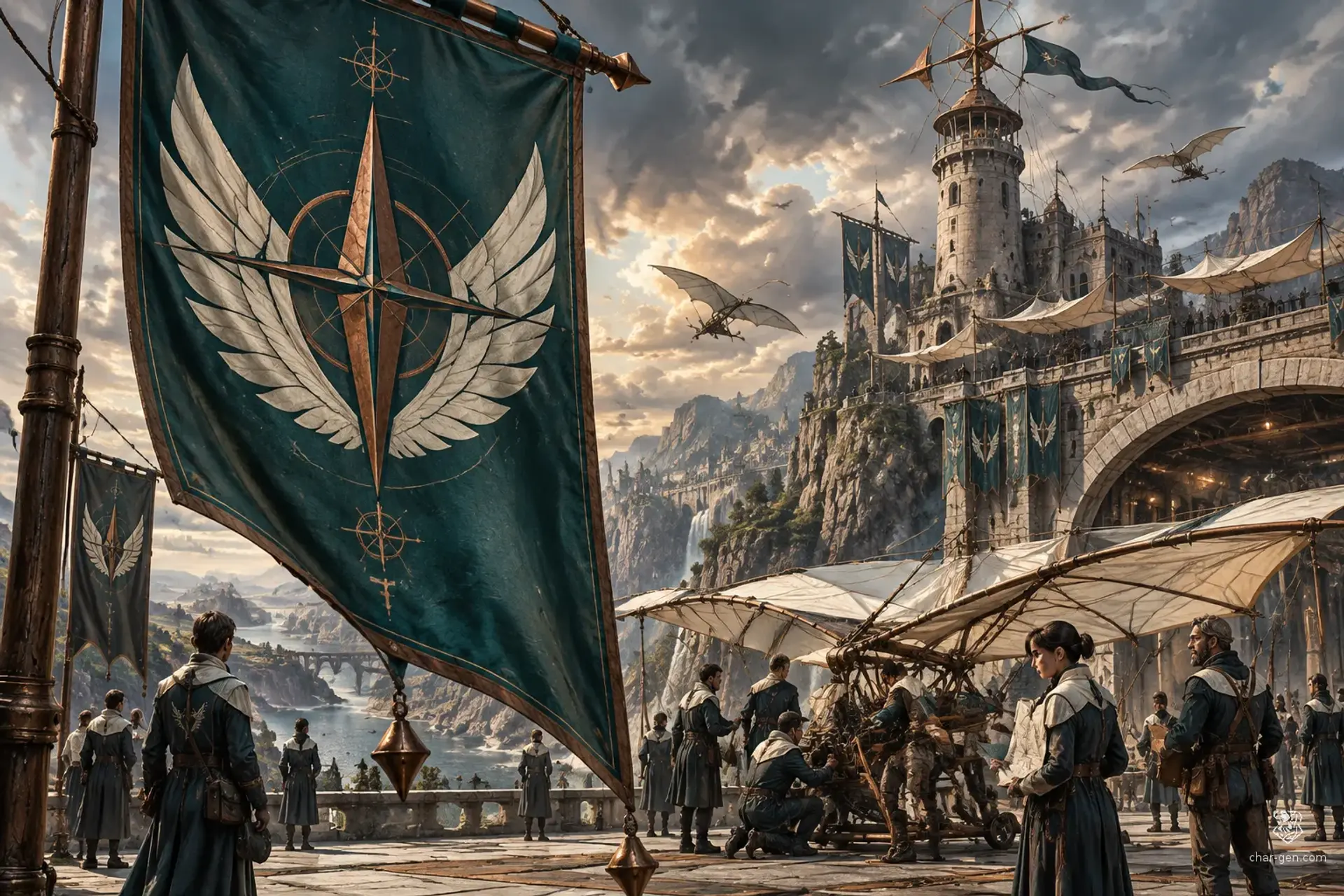
Deep teal, Ivory, Copper
- The upward-pointing compass needle
- A single copper thread sewn into a pilot's sleeve after their first supervised flight
- A small ivory wing worn by graduates who have completed rescue duty
Standing
What they say they want
What they are doing now
Where it leads
A future in which experimental flight is governed by shared standards, open accident records, and pilots who can refuse an unsafe trial without losing their livelihood. The Collegium's leadership disagrees about whether this requires reforming patronage or ending it.
How others see them
Respected as a center of skill, discipline, and rescue service. Common people admire its pilots but suspect that wealthy patrons receive special treatment. Officials value its expertise and worry about how much political influence its certification carries.
People
5 ranks
First Pilot
Blunt, disciplined, and more compassionate than his public manner suggests. He dislikes being treated as a hero because he believes praise makes people ignore the cost of his decisions.
- First Pilot1 member
Directs the institution, represents it before civic authorities and patrons, and has final authority over flight schedules. The First Pilot can be overruled by a two-thirds vote of the Review Table on safety grounds.
- Review Table7 members
A council of senior pilots, instructors, mechanics, and one public trustee. Approves trials, investigates accidents, and votes on discipline. The patronage office has no formal seat but has substantial informal influence.
- Chartmasters18 members
Experienced instructors and trial assessors who write routes, inspect craft, and supervise flight crews. They can delay a test but cannot cancel a contract.
- Licensed Pilots46 members
Graduates authorized to pilot Collegium craft or oversee trials. Many take private commissions, and their varied obligations are a continuing source of tension.
- Scholars and Ground Crew112 members
Apprentices, mechanics, riggers, healers, record keepers, and instrument makers. They keep the institution operating and often know more about a prototype's flaws than its patron.
Other key members
- Ailune Sere Senior Chartmaster and chair of the safety review
- Pella Lead mechanic and representative of the ground crew
- Tavi Oru Rising licensed pilot and likely successor
How they are organised
- Demonstrate competence in a relevant craft, discipline, or support role. Applicants need not be pilots.
- Complete supervised training in emergency signals, crew duties, and the Collegium's custom flight-safety procedures.
- Declare financial obligations or service contracts that could affect a Collegium assignment.
- Accept that a pilot may refuse a trial on safety grounds without being punished, a rule honored inconsistently in practice.
Relations
6 factionsThe Collegium trains their navigators and occasionally tests their signal kites. The partnership is strained because the Collegium will not reveal which trials were funded by private patrons.
Operations
What they do
How they do it
Services for hire
- Pilot TrainingTuition, service contract, or a negotiated feeInstruction in piloting, navigation, emergency signaling, and crew coordination. The Collegium's procedures are custom setting material, not official D&D 5E rules.
- Trial and CertificationHigh fee, plus a written agreement on liabilityA supervised assessment of a craft's handling and reliability. The Collegium may refuse to certify it, though a patron can still test it elsewhere.
- Route ConsultationPayment, a reciprocal favor, or civic authorizationA route consultation based on charts, observation logs, and local reports. The Collegium does not guarantee safe passage.
What they can do
What they have
Where they are weak
Territory
Headquarters
The Ninth Landing, a busy cliffside settlement. The name refers to a specific emergency landing made by a supply balloon during the famine, not to the nine steps at the harbor that visitors often assume gave the place its name.A broad, terraced academy built around an old signal tower, with a sheltered launch court, instrument rooms, lecture halls, and a roofline designed for tethered gliders. Copper wind vanes and patched canvas mark the upper levels. The public galleries display rescue craft and memorial plaques; behind them, a locked hangar houses prototypes whose sponsors have paid for discretion.
Lands they hold
Outposts
- The Split MastA windswept ridge beyond the settlement's outer farmsA remote rigging yard where crews test tether strength and emergency release systems away from crowded streets.
- The Quiet BellA roof above the central marketA signal post used to warn residents when a trial craft is returning or an emergency landing is expected.
Secrets
Plot hooks
5 hooks- 1No Ground CrewPersonal to localReward: A pilot ally, access to academy records, or a disputed flight licenseA new graduate asks the characters to witness a private flight trial. The craft seems sound, but the pilot has been ordered not to bring the Collegium's usual emergency crew. The characters must decide whether to expose the contract, protect the pilot, or help secure the test.
- 2The Missing WrenchLocal investigationReward: Evidence, a rescued witness, or leverage over the patronage officeA repair worker disappears after claiming to have found a defect in a patron's craft. The official story says they stole a valuable instrument. The trail leads through the Collegium's workshops, a sponsor's counting house, and the homes of crew members afraid to speak.
- 3Signal After the StormRegional expeditionReward: The recorder, payment, and influence over the coming inquiryThe Collegium hires the party to recover an old flight recorder from a storm-cut ravine. A rival inspector has been sent to retrieve it as well, and both teams suspect the other has been paid to destroy it.
- 4The Empty CanalHigh-stakes crisisReward: Public trust, a saved crew, or proof against a powerful patronA prototype loses control above a crowded district. The crew can still guide it toward an empty landing ground, but doing so may destroy the only device capable of proving the craft's defect. The party must choose between immediate rescue and preserving evidence that could prevent future disasters.
- 5Who Certifies the Sky?Campaign-scale political conflictReward: A change in regional law, lasting allies, or a powerful institutional enemyA civic council is preparing to grant the Collegium exclusive authority over all experimental flight. The party is asked by competing sides to investigate the Collegium's record, testify at the hearing, or uncover who has been bribing witnesses.
Work they offer
What gets in the way
Rumours
Media
0 imagesNo images yet.
Turn The Meridian Flight Collegium into a sheet
A high-res, share-ready sheet you can post or print.
