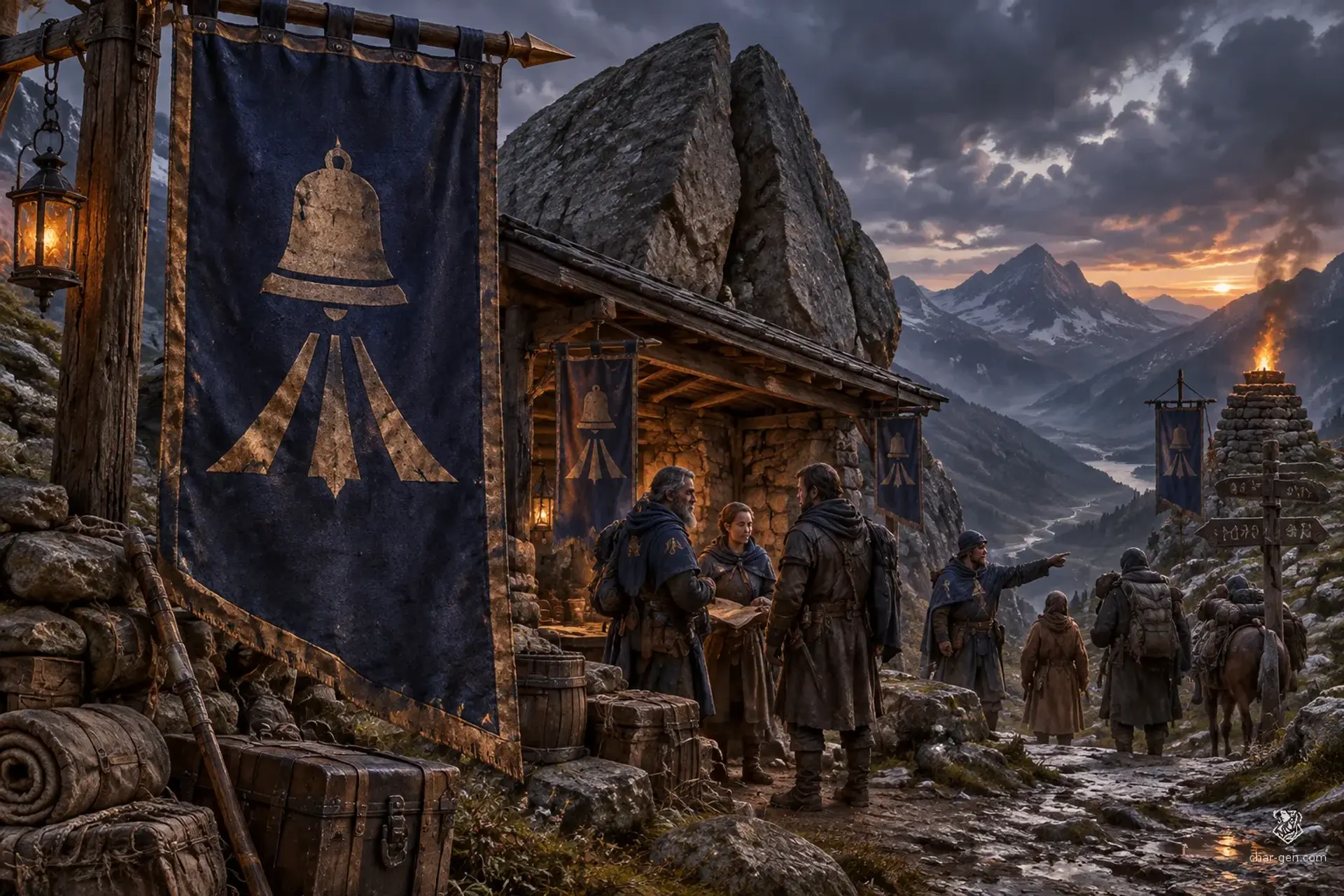
Lost Bell Council
The original compact was a practical agreement among people who knew that no caravan could survive the high roads alone. For decades, its wardens kept signal fires, marked safe crossings, and maintained shelters without claiming ownership of the land. As trade through Nimba grew, caravan masters began paying regular dues in exchange for reliable guides and maintained trails. The Council's watershed moment came during the Winter of Three Slopes, when wardens shared route knowledge across rival caravans and led a rescue that saved dozens of stranded travelers. The survivors' merchants backed a common charter and accepted Council tolls as the price of coordinated upkeep. Over time, the Council began deciding which trails counted as official roads. This gave it influence, but also made it a gatekeeper. It survived a later challenge when a wealthy tax office tried to replace its local guides with distant surveyors; the Council exposed errors in their maps and won temporary authority to inspect road works. Today its members still rescue travelers and repair paths, but they argue over whether the Council serves the roads or the roads serve the Council.
Lost Bell Council
- Type
- Roadwardens' assembly and…
- Size
- 424 members
- Reach
- Moderate among guides
- Base
- Nimba Highlands
Overview
The original compact was a practical agreement among people who knew that no caravan could survive the high roads alone. For decades, its wardens kept signal fires, marked safe crossings, and maintained shelters without claiming ownership of the land. As trade through Nimba grew, caravan masters began paying regular dues in exchange for reliable guides and maintained trails. The Council's watershed moment came during the Winter of Three Slopes, when wardens shared route knowledge across rival caravans and led a rescue that saved dozens of stranded travelers. The survivors' merchants backed a common charter and accepted Council tolls as the price of coordinated upkeep. Over time, the Council began deciding which trails counted as official roads. This gave it influence, but also made it a gatekeeper. It survived a later challenge when a wealthy tax office tried to replace its local guides with distant surveyors; the Council exposed errors in their maps and won temporary authority to inspect road works. Today its members still rescue travelers and repair paths, but they argue over whether the Council serves the roads or the roads serve the Council.
How it began
The Council traces its beginning to a night when a landslide buried a caravan and its warning bell somewhere above the pass. The bell was widely believed to have vanished with the road. Survivors from several caravans argued over who had failed to post a lookout, then spent the next day clearing a path together. Their first compact required every caravan to contribute labor or supplies to road maintenance and required every guide to report dangerous conditions, even when doing so cost them business. The compact had little authority beyond its signatories until a winter storm trapped three rival caravans on separate slopes. Council wardens organized a rescue by sharing route knowledge that each group had previously guarded. The rescued merchants recognized the Council's authority to set common signals and collect repair dues. In later generations, that temporary authority hardened into toll rights. The Council's name preserves the mistaken belief that the bell was lost, though old members insist the mistake is useful: travelers who think the bell gone do not know where to look.
How to know them
Bell-bronze, Rain-dark indigo, Road-dust ochre
- A bronze bell without a clapper.
- Three short cuts carved into a waymarker to indicate a Council-maintained route.
- A strip of indigo cloth tied around a traveler's pack after a verified weather warning.
Standing
What they say they want
What they are doing now
Where it leads
A highland network in which every recognized pass has maintained shelters, trained guides, and common emergency signals under Council supervision. The question is whether that vision means dependable shared infrastructure or a Council monopoly over movement.
How others see them
Among guides and caravan crews, the Council is respected for getting people through terrain that defeats official maps. Small merchants appreciate its shelters but complain that its tolls are unpredictable. Outsiders often mistake a locally accountable assembly for a single powerful road authority.
People
5 ranks
First Warden
Measured and reassuring in public, ambitious in private. Tarek prefers agreements that create dependence gradually rather than commands that invite open resistance.
- First Warden1 member
Chairs the seasonal assembly, speaks for the Council in disputes, and coordinates emergency responses. The First Warden cannot unilaterally set tolls or declare a road closed.
- Pass Speakers9 members
Represent recognized pass districts, submit road accounts, and propose repairs or closures. Each district's speaker is selected locally, by a method that varies from election to consensus.
- Bellwardens34 members
Maintain signals, inspect shelters, escort travelers, and report hazards. Their authority is strongest during an officially declared road emergency.
- Licensed Guides120 members
Guide caravans, carry route reports, and train apprentices. They are affiliated members, not a standing force, and many work independently.
- Road Kin260 members
Toll keepers, shelter hosts, repair crews, and caravan masters who contribute dues or labor. They may attend local meetings but have no automatic vote at the full assembly.
Other key members
- Bako Pass Speaker for the southern approaches and chief critic of hereditary toll rights
- Sheshi Senior Bellwarden and advocate for public hazard reports
- Duma of the Upper Switchbacks Local toll keeper and potential swing vote
How they are organised
- Demonstrate practical knowledge of a route, a repair trade, caravan work, or highland shelter keeping.
- Complete a season of service under an established member, unless the assembly waives the requirement after an emergency.
- Agree to report serious hazards to the Council and not deliberately direct travelers into known danger.
- Contribute labor, supplies, or a locally agreed fee. Poverty alone is not grounds for exclusion, though this principle is unevenly applied.
Relations
7 factionsMost members of the Seven-Post Carriers' Compact rely on Council guides to move messages through the high passes. The Compact quietly wants the Council to standardize tolls, though its couriers resent being searched.
Operations
What they do
How they do it
Services for hire
- Pass GuidanceA negotiated fee, labor contribution, or reciprocal favorA guide familiar with the season's conditions and the current state of the recognized trails.
- Storm ShelterRepair dues or a recorded contribution of materialsUse of stocked shelter space during a declared storm emergency. Supplies are limited, and wardens prioritize those who heed posted warnings.
- Road ReportA small fee or an exchange of reliable local informationA copy of recent route notes, hazard reports, and likely water sources. Reports may omit routes considered too dangerous or politically sensitive.
What they can do
What they have
Where they are weak
Territory
Headquarters
Nimba HighlandsThe Council has no permanent fortress. Its assembly meets in a stone shelter at a junction of high trails, where each roadwardens' district maintains a locked chest, a weather board, and a place for travelers to leave messages. The shelter is built around a split boulder said to have been thrown downhill by the founding landslide. The Council keeps the location off most public maps and announces meetings by messenger.
Lands they hold
Outposts
- Marker Three ShelterA shelter on the northern approach, its name taken from the third marker on an obsolete military survey.Stores blankets, dry fuel, and a route log for travelers caught by early snow.
- The Spilled LoadA narrow ledge where a storm once scattered a caravan's loads; outsiders mistakenly say the wagons were swallowed by the mountain.Serves as a guide exchange and a discreet meeting place for negotiations with caravan masters.
Secrets
Plot hooks
5 hooks- 1The Markers TurnedPersonal to localReward: Council introductions, a guide's favor, or access to a little-known trailA new apprentice guide asks the characters to escort them on their first independent route. Their mentor vanished after reporting that someone had moved the warning markers, and the Council wants the matter settled quietly before a caravan arrives.
- 2A Fee on the Old FootpathLocal political disputeReward: Payment, local goodwill, or a lasting change to the toll arrangementA hamlet claims the Council's latest toll station blocks its only path to market. Tarek offers the party payment to negotiate a compromise; the hamlet's elders ask them to find records proving the path was used before Council tolls existed.
- 3The Road That Was ClosedRegional investigation and rescueReward: A significant salvage share, a dangerous secret, or leverage over the First WardenA caravan disappears after choosing a route the Council publicly declared closed. Survivors insist they saw a Bellwarden directing traffic that way. The party must find the caravan, establish who issued the order, and decide whether the Council's report should be believed.
- 4The Missing ClapperCampaign-scale political crisisReward: Influence over the Council's future, access to the lost bell, or a new allianceA fragment of the original compact surfaces in the hands of a rival surveyor. It could reveal that the founding bell was deliberately hidden and that a prominent caravan master suppressed its warning. The Council wants it recovered; the shrine keepers want it read aloud before any deal is made.
- 5A Better Road, A Worse BargainRegional choice with long-term consequencesReward: A valuable mapping contract, Council trust, or support from displaced local tradersThe Third Ledger offers the party a generous contract to map an unregistered pass. The route is genuinely safer than the Council's official road, but its opening would cut off income that funds several shelters. The party must decide who gets to define public safety.
Work they offer
What gets in the way
Rumours
Media
0 imagesNo images yet.
Turn Lost Bell Council into a sheet
A high-res, share-ready sheet you can post or print.
