The Dwarves of Honeydew
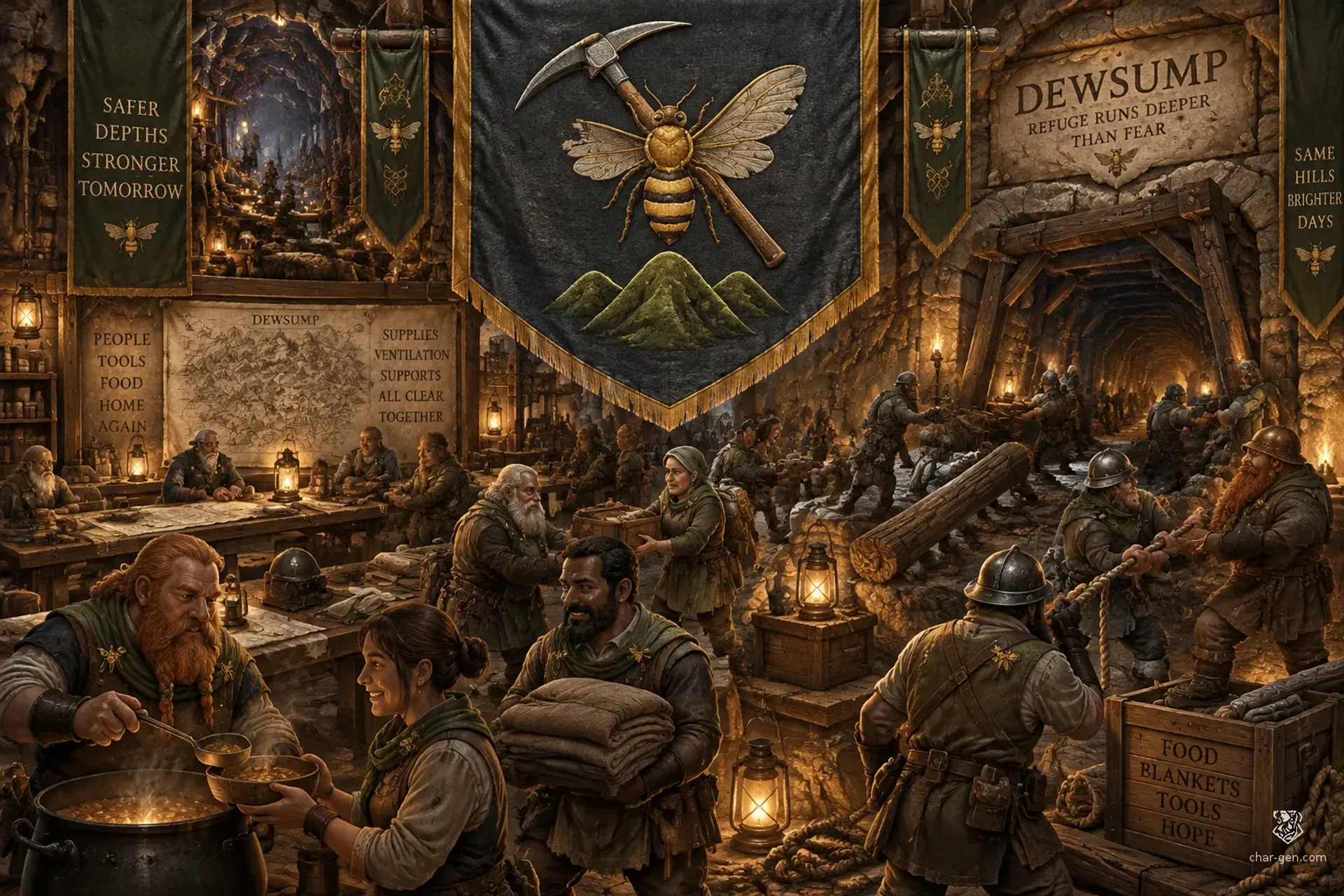
The Dwarves of Honeydew began as a handful of miners and support workers who refused to abandon people trapped by a mine-owner's decision to hide an illegal water diversion. Their first triumph was not a battle, but the reopening of the spring and the safe return of the trapped crew. In the decades that followed, they became known for practical rescues: shoring up a collapsed road, escorting famine grain, and carrying people out of monster-haunted workings. Their numbers grew as their work crossed from mines into villages and trade roads. Their defining watershed came 61 years ago, during the Night of Falling Lamps. A mercenary force pursued striking miners into Honeydew's tunnels. The dwarves dropped a prepared stone gate to halt the attackers, but a misread signal trapped civilians and soldiers on the wrong side. Members risked their lives to reopen a breach. Most civilians escaped; several mercenaries died before rescue teams reached them. The incident made the faction's reputation: brave, stubborn, and far less tidy than its stories suggest. It also established their rule that no plan is called a rescue until someone has checked who might be left behind. Later, the faction made allies among market towns and earned the Crown's occasional cooperation. It also developed a taste for difficult expeditions, strange discoveries, and ambitious engineering. A recent expedition brought home a bronze mechanism from a sealed chamber. It has not been publicly displayed. Today, the Dwarves of Honeydew are a large, loose-knit organization whose members genuinely care for one another, while arguing fiercely over what their duty requires and who gets to decide.
The Dwarves of Honeydew
- Type
- Dwarven mutual-aid society
- Size
- 520 members
- Reach
- Regional
- Base
- Dewsump, a damp hillside settlement named for the dew that gathers in its sunken gardens
Overview
The Dwarves of Honeydew began as a handful of miners and support workers who refused to abandon people trapped by a mine-owner's decision to hide an illegal water diversion. Their first triumph was not a battle, but the reopening of the spring and the safe return of the trapped crew. In the decades that followed, they became known for practical rescues: shoring up a collapsed road, escorting famine grain, and carrying people out of monster-haunted workings. Their numbers grew as their work crossed from mines into villages and trade roads. Their defining watershed came 61 years ago, during the Night of Falling Lamps. A mercenary force pursued striking miners into Honeydew's tunnels. The dwarves dropped a prepared stone gate to halt the attackers, but a misread signal trapped civilians and soldiers on the wrong side. Members risked their lives to reopen a breach. Most civilians escaped; several mercenaries died before rescue teams reached them. The incident made the faction's reputation: brave, stubborn, and far less tidy than its stories suggest. It also established their rule that no plan is called a rescue until someone has checked who might be left behind. Later, the faction made allies among market towns and earned the Crown's occasional cooperation. It also developed a taste for difficult expeditions, strange discoveries, and ambitious engineering. A recent expedition brought home a bronze mechanism from a sealed chamber. It has not been publicly displayed. Today, the Dwarves of Honeydew are a large, loose-knit organization whose members genuinely care for one another, while arguing fiercely over what their duty requires and who gets to decide.
How it began
The name began as a practical label for the dwarven crew that worked the honey-colored caverns beneath the settlement of Dewsump. Travelers shortened 'the dwarves from Honeydew' to 'the Dwarves of Honeydew,' and the crew kept it. Their founder, Brakka, was a tunnel surveyor who discovered that a wealthy mine-owner had diverted the spring feeding three villages. When the owner sealed the lower passages to hide the theft, Brakka led miners, cooks, and shepherds through an unfinished drainage shaft, opened the blocked watercourse, and brought the trapped workers out alive. The rescued people called the crew back whenever trouble came. The name stuck, and so did the habit of treating useful work, not noble birth, as a claim to leadership.
How to know them
Honey gold, Moss green, Slate gray
- A golden bee, honoring the honey-colored stone and the idea that small contributions sustain a whole community.
- Three green hills, representing the villages that first shared the spring.
- A crossed pick and spoon, a common badge worn by members who have taken both a field shift and a kitchen shift.
Standing
What they say they want
What they are doing now
Where it leads
A network of communities that can feed, defend, and rescue one another without needing permission from distant rulers. Some members imagine a loose mutual-aid compact; others want the faction to remain small enough that a person can still know who is responsible for each decision.
How others see them
To working people, they are noisy, generous, and reliable in a crisis. To merchants, they are useful until they decide a contract is unjust. To officials, they are brave meddlers who mistake good intentions for legal authority. Their members share skills, meals, and credit readily, but their open defiance can turn a solvable dispute into a public feud.
People
5 ranks
First Pick
Affectionate, decisive, and irreverent. Hask is good at making strangers feel included, but can treat a vote as a formality once a plan seems urgent.
- First Pick1 member
The elected coordinator, currently Hask, convenes meetings, represents the faction, and resolves urgent disputes between crews. The title grants no absolute command; a major decision can be challenged at the next table-meeting.
- Bench of Picks9 members
Senior members responsible for safety, stores, diplomacy, records, and expedition planning. They can authorize emergency action, but must report it to the whole faction.
- Crew Leads54 members
Experienced members who organize small work crews, train apprentices, and take responsibility for a particular route, workshop, settlement, or recurring duty.
- Hands286 members
Full members, including miners, cooks, scouts, smiths, healers, porters, and negotiators. Each member has a voice at the table and is expected to take a share of communal work.
- Runners and Neighbors170 members
Probationary members and allied locals who carry messages, assist with relief work, or train with a crew. They may speak at meetings and can earn full membership through service.
Other key members
- Bruni of Dewsump Keeper of stores and senior tunnel engineer
- Tesh Record-keeper and advocate for reform
- Qorren Scout captain and possible successor to Hask
- Zulfa Sorn Artificer and relic specialist
How they are organised
- Show that you can be trusted with another person's safety, whether through a rescue, a season of service, or a respected reference.
- Accept that members may challenge a plan, including a leader's plan, without being treated as disloyal.
- Contribute according to your abilities. The faction values cooks and messengers as much as miners and fighters.
- Keep the location of vulnerable refuges private unless the people sheltering there consent to disclosure.
Relations
8 factionsThe dwarves helped rebuild their flood-damaged granaries and still sell them tools at cost. The reeve dislikes their habit of letting village meetings run until dawn.
Operations
What they do
How they do it
Services for hire
- Shoring and SurveyA modest fee, a future favor, or supplies of equivalent valueA trained crew assesses and braces a damaged mine, tunnel, cellar, or small structure. They do not promise that every site can be saved.
- Safe PassageUsually free to those in immediate danger; otherwise negotiatedGuides help people cross known mountain routes, old roads, and mapped underground passages. They refuse to guarantee safety in unexplored territory.
- A Bowl and a BlanketDonation, repayment when able, or labor in the communal kitchenA warm meal, a place to sleep, and basic care for travelers and displaced people. The faction may ask guests to keep a refuge's location confidential.
- Trouble BelowA negotiated fee and a clear account of the dangerA crew investigates a local hazard, missing worker, unstable ruin, or suspected sabotage. For especially dangerous work, the crew may require the client to help with evacuation first.
What they can do
What they have
Where they are weak
Territory
Headquarters
Dewsump, a damp hillside settlement named for the dew that gathers in its sunken gardensA broad, lived-in complex of workshops, bunkrooms, kitchens, and meeting halls excavated into the honey-colored rock beneath Dewsump. Its central chamber has a long table assembled from mismatched doors. The walls carry old maps, rescued tools, and notes correcting earlier maps. A low tunnel called the Warm Crawl connects the infirmary to the kitchens, because the founders learned that injured people recover better when someone can bring them stew.
Lands they hold
Outposts
- The Last Dry LoftA roadside barn above the old eastward trade routeA shelter for stranded travelers, a message drop, and a place to store blankets and grain. Locals call it that because the loft stays dry after the surrounding fields flood.
- RattlecutA disused quarry near the northern ridgeA training ground for rescue drills and a staging point for tunnel expeditions. Its name comes from the hollow clatter made by loose stones in the wind.
- The Warm CupA rented cellar beneath a market districtA low-profile kitchen and meeting place where members can distribute meals, exchange news, and hear requests for help.
Secrets
Plot hooks
5 hooks- 1Names Under the TablePersonal, low to moderateReward: A trusted contact, safe lodging, and access to the faction's local networkA Runner asks the characters to deliver a sealed packet to Tesh. The packet contains a list of members who were present during an illegal demolition, and someone has begun hunting those names. The characters can protect the witnesses, expose the old crime, or discover who wants the account buried.
- 2Smoke at the LoftLocal, moderateReward: Payment in supplies, a favor from a settlement, or faction supportThe Last Dry Loft has been burned, and its stored grain is missing. Evidence points to hungry locals, but Qorren suspects a company agent staged the theft to turn the village against the dwarves. The faction needs the characters to investigate before Hask retaliates against the wrong people.
- 3The Second SpringRegional, moderate to highReward: A dangerous relic clue, an alliance with the crew, and possible access to hidden routesA rescue crew has vanished in the honey caves. Their last message mentions a second watercourse and a sound like a great bell below the rock. Bruni wants a careful rescue; Zulfa wants to bring back the bronze mechanism; the Gilt Vein Company is already sending a drilling team.
- 4The Missing VerseFaction-wide, social and investigativeReward: Influence over the faction's future and a meaningful political allyTesh discovers that the faction's account of the Night of Falling Lamps omits a decision that helped cause the deaths. She asks the characters to find the surviving mercenary witness before the Bench of Picks can suppress the record. Revealing the truth may repair trust with the dead's families or split the faction apart.
- 5When the Water TurnsCampaign-scale, highReward: A region-changing outcome, lasting allies, and access to custom dwarven engineeringThe bronze mechanism is failing. The characters must decide whether to help repair it, evacuate the settlements above, or destroy it before the Gilt Vein Company claims the chamber. Each option protects some people and endangers others, while Hask, Bruni, and Zulfa disagree about what the mechanism actually does.
Work they offer
What gets in the way
Rumours
Media
0 imagesNo images yet.
Turn The Dwarves of Honeydew into a sheet
A high-res, share-ready sheet you can post or print.
