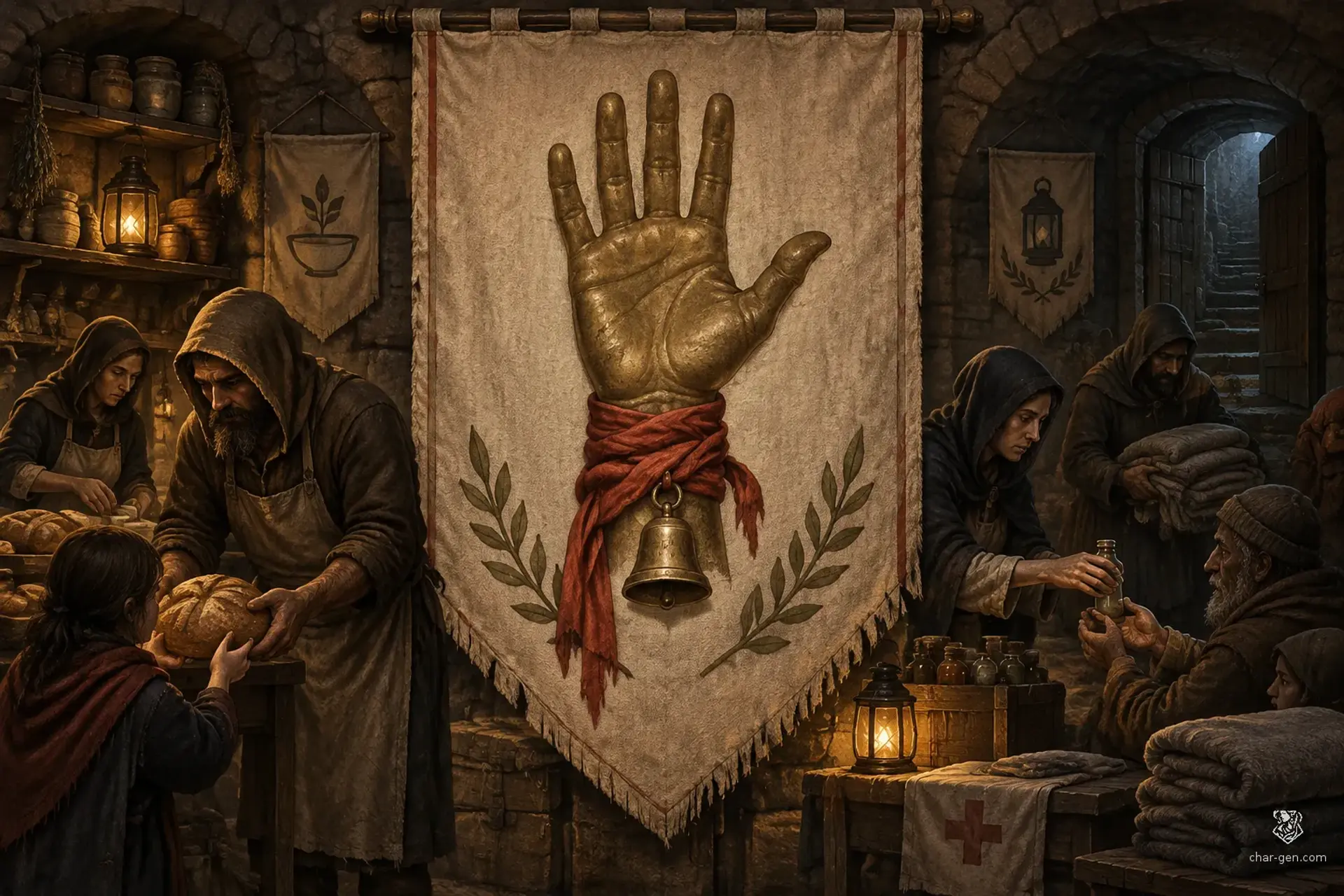
The Ninth Bell Hands
The fellowship first gained public attention when its members redistributed grain during the Bread Tax Riots. For several years it focused on food, medicine, and debt records, and it earned a reputation for leaving a portion of every haul for servants and laborers. Its first major setback came when an informant sold a safehouse location to the revenue office; three members were arrested and one died in custody. The fellowship responded by splitting into neighborhood cells and limiting what any one cell knew. Its defining watershed was the Winter of Empty Bells, when a fire destroyed a crowded tenement after a landlord ignored repeated warnings. The fellowship stole building inspection records and proved that officials had accepted bribes to certify the structure as safe. The resulting scandal forced repairs across several poor wards, but also led the authorities to outlaw unlicensed relief stores. Since then, the fellowship has grown from a rescue network into a political force. Some members still see every operation as an act of mercy; others believe mercy without power merely delays the next disaster.
The Ninth Bell Hands
- Type
- Religious mutual-aid…
- Size
- 270 members
- Reach
- Significant in the poorer…
- Base
- The city ward listed as Ninth Survey on the old crown tax map
Overview
The fellowship first gained public attention when its members redistributed grain during the Bread Tax Riots. For several years it focused on food, medicine, and debt records, and it earned a reputation for leaving a portion of every haul for servants and laborers. Its first major setback came when an informant sold a safehouse location to the revenue office; three members were arrested and one died in custody. The fellowship responded by splitting into neighborhood cells and limiting what any one cell knew. Its defining watershed was the Winter of Empty Bells, when a fire destroyed a crowded tenement after a landlord ignored repeated warnings. The fellowship stole building inspection records and proved that officials had accepted bribes to certify the structure as safe. The resulting scandal forced repairs across several poor wards, but also led the authorities to outlaw unlicensed relief stores. Since then, the fellowship has grown from a rescue network into a political force. Some members still see every operation as an act of mercy; others believe mercy without power merely delays the next disaster.
How it began
During the Bread Tax Riots, an avaricious grain factor locked his storehouses while families starved outside. A lay healer named Hessa Kett, then a young devotee of Ilmater, broke into the factor's counting room with several dockhands. They took his grain tallies, sold the grain at its old price, and left the proceeds with neighborhood kitchens. The factor's men caught Hessa and beat her in the square. She refused to name her accomplices, and the crowd carried her to an Ilmatari hospice. Those who had eaten gathered there that night and swore that no one would suffer alone while they had the means to intervene. Outsiders say the fellowship began with a daring grain heist. Members insist it began with Hessa choosing not to betray the frightened people who trusted her.
How to know them
Brick red, Unbleached linen, Dull brass
- The open brass hand
- A strip of brick-red cloth tied inside a sleeve
- A single bell drawn without a clapper, representing a warning that must be heard even when no one has authority to sound it
Standing
What they say they want
What they are doing now
Where it leads
A city where food, medicine, and fair hearing are not privileges controlled by wealth, and where the fellowship can disband because no one needs to steal necessities from those who hoard them.
How others see them
To poor residents, they are daring thieves who sometimes bring dinner when the law brings another bill. To merchants, they are a threat whose targets are difficult to predict. To the authorities, they are a criminal sect hiding behind a faith of mercy. Priests of Ilmater often respect their compassion but are divided over their methods.
People
5 ranks
The Burden-Bearer
Patient and deliberate, but inclined to carry blame that belongs to the whole council
- The Burden-Bearer1 member
Coordinates the fellowship, hears appeals between crews, and answers publicly for its actions. The title is an office, not a claim to religious authority.
- The Palm Council7 members
Sets broad policy, approves major operations, and assigns relief funds. Decisions require five votes, though urgent rescues can be authorized by any two council members.
- Lantern Keepers28 members
Lead neighborhood cells, maintain safehouses, and judge whether a proposed target is genuinely exploiting others.
- Open Hands74 members
Trusted active members who scout, steal, transport goods, provide medical care, or manage distribution.
- The Neighbors160 members
Informants, cooks, carriers, and occasional helpers who are not expected to know the full network. Many consider themselves supporters rather than members.
Other key members
- Tamsin Kett Founder and former Burden-Bearer, now an infirmary keeper
- Sszeth Lantern Keeper overseeing intelligence and high-value thefts
- Brik Gant Cell leader and expert climber
- Shirin Keeper of accounts and custodian of evidence
How they are organised
- Show a record of helping someone without demanding payment or praise.
- Accept that no member may keep a share of stolen goods for personal enrichment.
- Agree to avoid unnecessary injury and to make restitution when a target is wrongly judged.
- Keep the identities of vulnerable neighbors secret, even under pressure.
Relations
6 factionsMany local priests of Ilmater shelter the injured and hear confessions, though the church has never formally endorsed theft. Their alliance strains whenever stolen wealth includes temple donations.
Operations
What they do
How they do it
Services for hire
- Emergency shelterA contribution of food, medicine, useful information, or service; never a fixed feeA discreet place to sleep for a night or two, provided the guest does not bring immediate danger to the kitchen.
- Kitchen infirmaryA promise to help another person in need when ableBasic treatment for wounds and illness, with a referral to an Ilmatari healer when the injury is beyond the kitchen's skills.
- Street inquiryEvidence, a favor, or a share of recovered goods returned to their rightful ownersHelp tracing a stolen person, medicine shipment, or debt record through neighborhood contacts.
What they can do
What they have
Where they are weak
Territory
Headquarters
The city ward listed as Ninth Survey on the old crown tax mapA disused dye cellar beneath an active soup kitchen. Its public rooms smell of onions, vinegar, and wet wool; concealed doors lead to a small infirmary, a meeting chamber, and a cramped archive. The cellar has three exits, but one opens into a bricked-up drain that only the oldest members know how to clear.
Lands they hold
Outposts
- Fourteenth Lot WashhouseA washhouse recorded as Lot 14 on the old municipal property rollA meeting point and place to pass messages inside bundles of clean linen
- The Empty TollThe abandoned toll booth at the boundary of the river roadA temporary shelter for fugitives and a handoff point for stolen food
Secrets
Plot hooks
5 hooks- 1The Bottle with Two NamesLow to moderate, personal and social investigationReward: A trusted contact, medical supplies, and a difficult moral choiceA character's relative is accused of stealing medicine from a wealthy apothecary. The fellowship asks the party to find out whether the apothecary was hoarding supplies or whether the theft endangered other patients.
- 2A Hand That TookModerate, investigation and urban pursuitReward: Coin, safehouse access, and a relationship with a neighborhood cellA brass hand token appears at the scene of a violent robbery against a poor merchant. The fellowship denies responsibility and asks the party to identify who is counterfeiting its mark before public anger turns against the kitchens.
- 3The Paper TenantsModerate to high, political negotiation and protectionReward: Local allies, recovered homes, or leverage over a powerful officialA stolen property ledger reveals that a district's homes were seized through forged debts. The party must decide whether to publish the evidence immediately, risking arrests, or help the fellowship use it to force restitution first.
- 4Ashes Before DawnHigh, negotiation under time pressureReward: A chance to reshape faction policy and access to sensitive recordsA member plans to burn a tax archive that contains proof of corruption as well as records needed to establish poor families' legal claims. The party is asked to stop the arson without handing the member to the authorities.
- 5The Road of Open HandsCampaign scale, travel, diplomacy, and threatsReward: Broad regional influence, lasting public gratitude, or a dangerous political bargainA regional famine exposes the limits of the fellowship's local network. The council asks the party to escort a caravan, while a rival power offers food in exchange for the names of the kitchens and their supporters.
Work they offer
What gets in the way
Rumours
Media
0 imagesNo images yet.
Turn The Ninth Bell Hands into a sheet
A high-res, share-ready sheet you can post or print.
