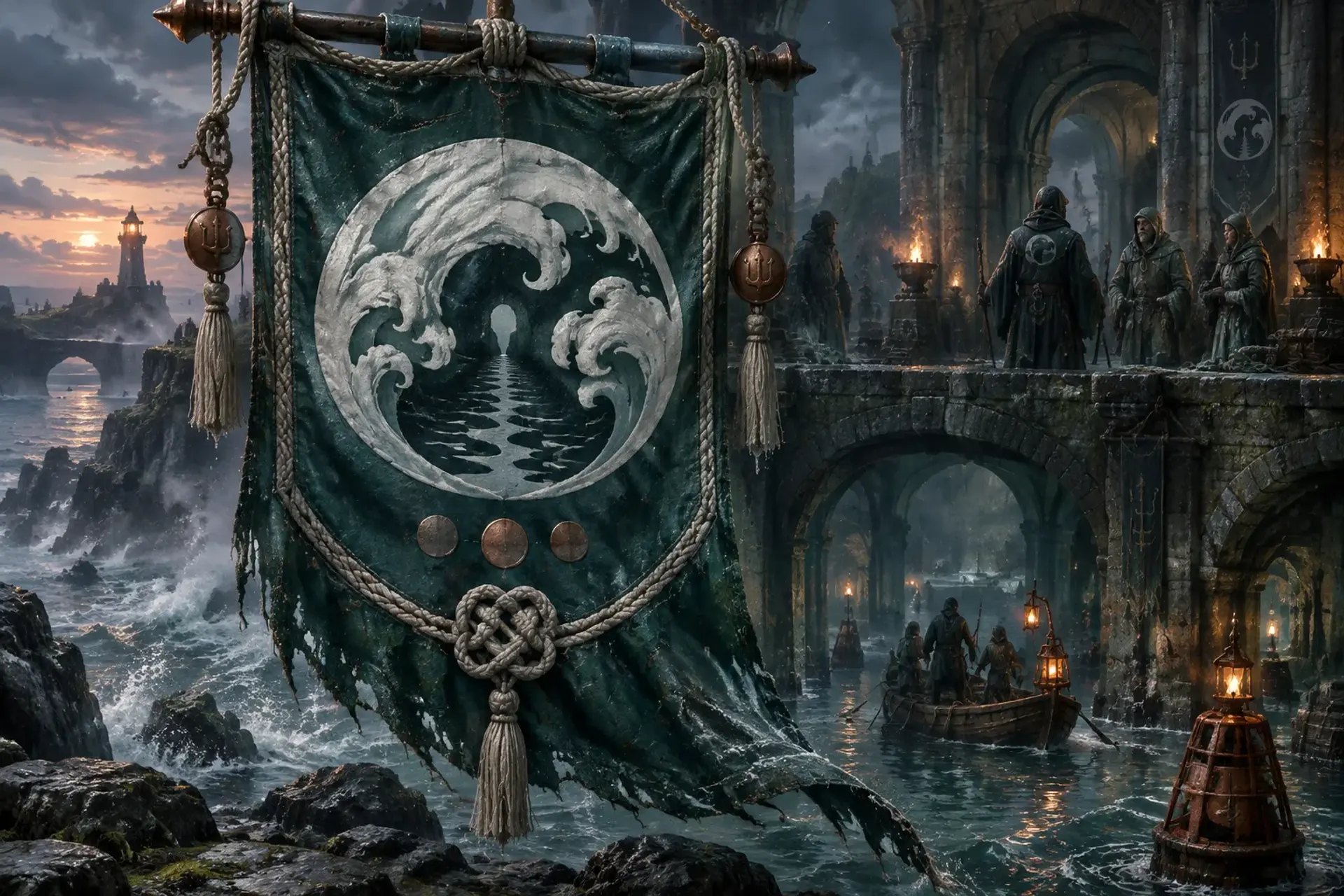
The Tideward Circle
The Circle began as a small association of pilots, fishers, and ritual practitioners who shared observations about currents after the winter crossing remembered in its founding story. Its first generations recorded safe routes with knots, carved marks, and seasonal songs rather than maps. As coastal traffic increased, settlements began asking the Circle to bless boats and arbitrate fishing boundaries. The order grew from a local rescue fellowship into a coast-wide authority. Its first great triumph came when its pilots guided a crowded evacuation through a passage that other crews considered impassable. Survivors from several settlements credited the Circle's readings and the spirits' goodwill. The Circle gained the right to maintain shared passage markers, and its members became welcome in harbors where outsiders were turned away. The defining watershed was the Drowned Lantern crossing, when a senior negotiator promised a sea spirit that no vessel would carry iron hooks through a particular channel. A wealthy trading flotilla ignored the warning. The boats were wrecked, but so was a small relief vessel carrying families who had no part in the bargain. The Circle rescued many survivors and kept the channel safe afterward, yet its reputation changed: people began asking whether its promises protected the coast or merely transferred danger to whoever had the least power. The event also established the current custom that any compact affecting civilian passage must be witnessed by at least two local residents. In later decades, the Circle expanded its rescue stores, trained settlement pilots, and built a reputation for reliable warnings. It also grew more political. Wealthy captains sought favorable readings; settlements fought over who could post markers; and some priests came to see the order's authority as a necessary defense against reckless outsiders. Today it remains indispensable during dangerous crossings, respected but not universally trusted. Its records are richer than ever, and its oldest obligations are less understood than the Circle admits.
The Tideward Circle
- Type
- Tide-priest order and…
- Size
- 79 members
- Reach
- High along the Reefcut Coast
- Base
- The main harbor settlement of the Reefcut Coast
Overview
The Circle began as a small association of pilots, fishers, and ritual practitioners who shared observations about currents after the winter crossing remembered in its founding story. Its first generations recorded safe routes with knots, carved marks, and seasonal songs rather than maps. As coastal traffic increased, settlements began asking the Circle to bless boats and arbitrate fishing boundaries. The order grew from a local rescue fellowship into a coast-wide authority. Its first great triumph came when its pilots guided a crowded evacuation through a passage that other crews considered impassable. Survivors from several settlements credited the Circle's readings and the spirits' goodwill. The Circle gained the right to maintain shared passage markers, and its members became welcome in harbors where outsiders were turned away. The defining watershed was the Drowned Lantern crossing, when a senior negotiator promised a sea spirit that no vessel would carry iron hooks through a particular channel. A wealthy trading flotilla ignored the warning. The boats were wrecked, but so was a small relief vessel carrying families who had no part in the bargain. The Circle rescued many survivors and kept the channel safe afterward, yet its reputation changed: people began asking whether its promises protected the coast or merely transferred danger to whoever had the least power. The event also established the current custom that any compact affecting civilian passage must be witnessed by at least two local residents. In later decades, the Circle expanded its rescue stores, trained settlement pilots, and built a reputation for reliable warnings. It also grew more political. Wealthy captains sought favorable readings; settlements fought over who could post markers; and some priests came to see the order's authority as a necessary defense against reckless outsiders. Today it remains indispensable during dangerous crossings, respected but not universally trusted. Its records are richer than ever, and its oldest obligations are less understood than the Circle admits.
How it began
The Circle traces its beginning to a winter crossing in which a flotilla of fishing boats was caught between reef and storm. According to the oldest account, an ordinary net-mender named Asha heard a voice in the water and answered it with a promise: the boats would carry no iron hooks through the narrow passage, and the survivors would leave a share of every first catch on the reef. The boats found a safe channel. The story is told as a founding miracle, though the Circle's records suggest that several experienced pilots were aboard and that the promise was made only after a boat had already grounded. The name of the original settlement has been lost; the Circle preserves Asha's name but disagrees about whether she was its first priest, first negotiator, or first useful symbol.
How to know them
Deep green-blue, Salt white, Dull copper
- Three copper dots below a curled white wave
- A knotted white cord worn at the wrist during crossings
- A smooth stone placed in a boat's bow before a witnessed parley
Standing
What they say they want
What they are doing now
Where it leads
A coast where every settlement can understand its own waters, no boat is forced to trust a single authority, and agreements with sea spirits are witnessed and remembered by the people they affect. The Circle's actual leadership is divided over whether this vision is compatible with retaining its own special authority.
How others see them
Respected, sometimes gruff, and widely regarded as essential when the coast turns dangerous. Many boatfolk credit the Circle with saving lives; many also resent being told that a route, boat, or promise is beyond their control. In small settlements, Circle members are often welcomed as rescuers and watched as political actors.
People
4 ranks
First Listener
Patient, attentive, and difficult to hurry. Sava is compassionate without being sentimental and can make a compromise sound like a question. She dislikes public displays of authority, but her caution can become a way of postponing necessary choices.
- First Listener1 member
Leads the Circle, negotiates its most consequential compacts, and gives the final ruling when interpreters disagree. The position carries authority but does not override the consent required from local tide-priests for dangerous rites.
- Deep Readers6 members
Experienced interpreters who maintain regional current records, advise the First Listener, and oversee disputes between settlements. Together they can challenge a leader's decision by calling a full reckoning.
- Channel Keepers24 members
Resident tide-priests and pilots who maintain markers, teach safe passage, conduct warding rites, and negotiate with local sea spirits.
- Wakehands48 members
Apprentices, rescuers, boat tenders, and record-keepers. They learn by accompanying crossings and are expected to serve in rescue work before taking vows.
Other key members
- Kett Vardun Senior Deep Reader and likely successor
- Suri Channel Keeper and organizer of the younger rescue bloc
- Tomas Hedd Master of passage records
How they are organised
- Demonstrate practical knowledge of local waters, whether through piloting, fishing, rescue work, or careful observation.
- Complete a season of service on rescue duty before being allowed to conduct a warding rite.
- Accept that a member may not promise another person's life, cargo, or passage to a spirit without that person's consent.
- Learn at least one local method of recording current changes and share those observations with the Circle.
- Acknowledge that the Circle's readings are fallible. This requirement is often recited more faithfully than practiced.
Relations
8 factionsThe coast's small fishing settlements trust the Circle to read dangerous water and settle disputes over shared nets. That trust frays whenever Circle members demand payment during a lean season.
Operations
What they do
How they do it
Services for hire
- Passage readingA modest fee, a share of provisions, or equivalent labor; waived for rescue and hardship casesA practical reading of a planned crossing, including known hazards and likely changes. The Circle makes no guarantee that conditions will hold.
- Boat wardingSupplies, service, or a witnessed promise appropriate to the riskA boat is marked and a local rite is performed before departure. The service may reassure a crew or fulfill a custom, but it is not a guaranteed magical shield.
- Rescue and shelterUsually free in emergencies; later repayment may be requested from those able to payRescue assistance, temporary shelter, and help contacting nearby crews after a wreck or sudden change in conditions.
- Witnessed parleyA fair offering agreed upon in advance, plus the risk of obligations that cannot be reduced to coinA negotiated approach to a sea spirit. The Circle can arrange witnesses and interpreters, but cannot promise that the spirit will accept the terms.
What they can do
What they have
Where they are weak
Territory
Headquarters
The main harbor settlement of the Reefcut CoastThe Circle keeps its principal hall in a stone storehouse built above a natural tidal pool. Its lower chamber floods twice each day, and members meet there to compare current readings, settle ritual obligations, and hear petitions. The hall is deliberately plain. Boat crews can shelter in its upper rooms, but no one is permitted to enter the lower chamber carrying an unsheathed blade or an iron hook.
Lands they hold
Outposts
- The Split MarkerA low headland overlooking a frequently used coastal crossingStores warning flags, spare marker stones, and emergency provisions. Its name comes from a worn local corruption of an older term for a split-current beacon.
- Net and KeelA sheltered cove used by small fishing crewsA joint rescue shelter maintained reluctantly by two neighboring settlements that could not agree on a name. It serves as a meeting place for pilots, fishers, and Circle members.
Secrets
Plot hooks
5 hooks- 1The Page That Went MissingPersonal to local; investigation, negotiation, and a hazardous recoveryReward: A trusted Circle contact, access to passage records, or a favor owed by a rescue crewA Wakehand asks the characters to recover a missing bundle of current records from a damaged boat. One page appears to show that a coming crossing is safe, while another warns that the same route may be the site of a spirit's demand. The Circle needs the bundle before a crowded evacuation departs.
- 2A Channel DividedLocal; social pressure and potentially dangerous travelReward: Settlement goodwill, a safe passage, or leverage in the Circle's internal debateA fishing settlement asks the party to escort a boat through a route the Circle has declared closed. The independent pilot who knows the route says the warning is political, while a Channel Keeper insists the current has changed. The characters must choose whether to test the passage, investigate the dispute, or find another way to move urgently needed supplies.
- 3What the Wreck KeptRegional; competing claims, underwater or coastal hazards, and a consequential choiceReward: Evidence about the Circle's founding compact, salvage rights, or a negotiated truceA salvage crew has disturbed a wreck beneath a spirit-marked reef and found a sealed chest bearing an old Circle symbol. The Circle wants it returned unopened. The salvagers claim it contains proof that the order promised away a vessel during the Drowned Lantern crossing.
- 4The Price of the Turning WaterCampaign-scale; travel, diplomacy, investigation, and an ethical decision with lasting consequencesReward: A new compact, a changed Circle, lasting coastal alliances, or a dangerous debt to a sea spiritThe currents reverse around several crossings at once, stranding boats and isolating settlements. Sava asks the party to carry a message to a sea spirit, but the required offering would be taken from people who never agreed to the compact. Kett argues the old terms must be honored; Suri asks the party to help expose them before the Circle acts.
- 5The Witness in the FamilyPersonal; roleplay and investigation, with wider political consequencesReward: A family revelation, Circle standing, or proof that can shift coastal loyaltiesA character with a maritime background is recognized by a Circle member as the descendant of someone who witnessed the Drowned Lantern crossing. The Circle offers protection in exchange for a private family testimony, while a rival pilot offers payment for the same account. Neither side admits that the testimony could settle whether the old compact was fulfilled.
Work they offer
What gets in the way
Rumours
Media
0 imagesNo images yet.
Turn The Tideward Circle into a sheet
A high-res, share-ready sheet you can post or print.
