The Brass Latch Compact
The Brass Latch Company earned its first lasting reputation during the Succession of Three Seals, when its locksmiths protected the treasury and several royal claimants without openly choosing a side. The victor rewarded them with a charter to provide personal guards and pursue those who attacked their clients. For decades they were a small, respected service, known for keeping careful records and recovering stolen property. Their transformation came during the Ash Ledger Affair, a watershed moment forty-seven years ago. A minister's household was attacked while under Compact protection. The guards claimed the minister had been killed by the raiders, but an apprentice found a second account book showing that the minister had paid the Compact to make a rival disappear. The records proved that the attackers had been let inside by a senior guard. Rather than expose the entire company, the founders' descendants burned the original ledgers, executed the implicated officers, and recast the scandal as a triumph of internal discipline. The charter was expanded to include bounty work, and the name Brass Latch Compact became official. After the affair, the Compact developed a doctrine of absolute obedience: members were taught that hesitation endangered every client and that mercy toward a fugitive invited future bloodshed. The doctrine made them effective and feared. During the Border Rebellions, Compact teams captured several rebel commanders alive and returned them for trial, earning the Crown's trust. In the years that followed, the company grew into a national institution with houses in major towns and a near-monopoly on elite magical escorts. The modern Compact presents itself as a disciplined safeguard against assassination and lawlessness. Privately, it has revived the practice that caused the Ash Ledger Affair. Its senior council secretly chooses a handful of clients for death each year, usually people whose survival threatens the Crown or the Compact itself. The practice is now more sophisticated, but it carries the same risk: every protected client is a potential victim, and every member who discovers the truth becomes a liability.
The Brass Latch Compact
- Type
- Chartered magical…
- Size
- 296 members
- Reach
- National
- Base
- The capital city
Overview
The Brass Latch Company earned its first lasting reputation during the Succession of Three Seals, when its locksmiths protected the treasury and several royal claimants without openly choosing a side. The victor rewarded them with a charter to provide personal guards and pursue those who attacked their clients. For decades they were a small, respected service, known for keeping careful records and recovering stolen property. Their transformation came during the Ash Ledger Affair, a watershed moment forty-seven years ago. A minister's household was attacked while under Compact protection. The guards claimed the minister had been killed by the raiders, but an apprentice found a second account book showing that the minister had paid the Compact to make a rival disappear. The records proved that the attackers had been let inside by a senior guard. Rather than expose the entire company, the founders' descendants burned the original ledgers, executed the implicated officers, and recast the scandal as a triumph of internal discipline. The charter was expanded to include bounty work, and the name Brass Latch Compact became official. After the affair, the Compact developed a doctrine of absolute obedience: members were taught that hesitation endangered every client and that mercy toward a fugitive invited future bloodshed. The doctrine made them effective and feared. During the Border Rebellions, Compact teams captured several rebel commanders alive and returned them for trial, earning the Crown's trust. In the years that followed, the company grew into a national institution with houses in major towns and a near-monopoly on elite magical escorts. The modern Compact presents itself as a disciplined safeguard against assassination and lawlessness. Privately, it has revived the practice that caused the Ash Ledger Affair. Its senior council secretly chooses a handful of clients for death each year, usually people whose survival threatens the Crown or the Compact itself. The practice is now more sophisticated, but it carries the same risk: every protected client is a potential victim, and every member who discovers the truth becomes a liability.
How it began
The Compact began when a group of locksmiths from the capital were hired to secure the doors of the royal treasury during a succession crisis. They found that a good lock could keep an assassin out, but a trusted guard could decide who was allowed in. After the crisis, the locksmiths turned that insight into a business: they supplied discreet escorts for officials, merchants, and heirs, and tracked down anyone who breached a protected household. Their first charter named them the Brass Latch Company, after the trade that built their reputation. As their work expanded from doors to people, the name remained, though almost no member now knows how to make a lock.
How to know them
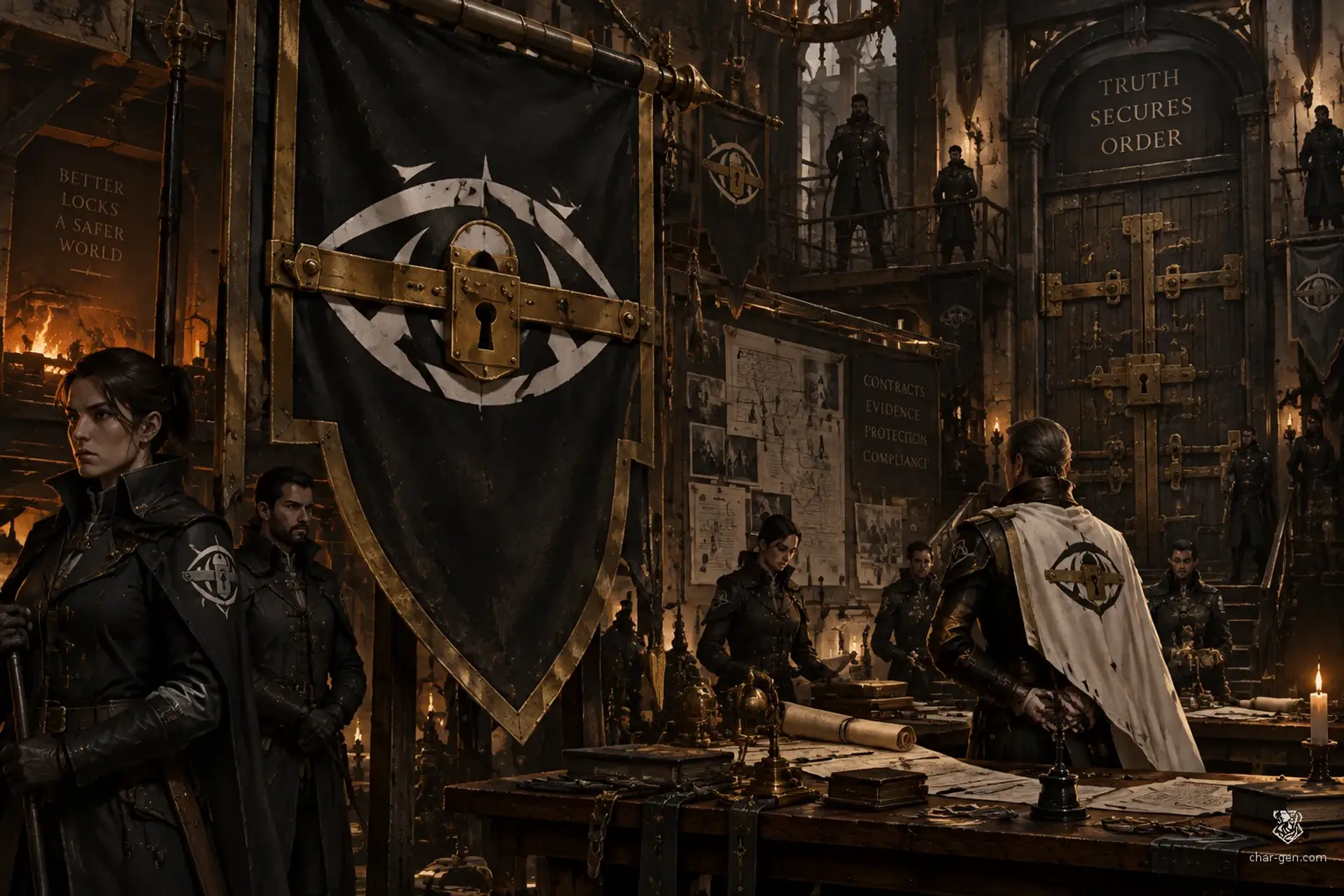
Dull brass, Ink black, Bone white
- A brass latch worn on the belt by full members
- A closed white eye on black cloth, used on formal contracts
- Three short knocks followed by one long knock, the Compact's traditional safe-entry signal
Standing
What they say they want
What they are doing now
Where it leads
Olek wants a kingdom where every important officeholder must accept a Compact guard, and where every fugitive can be pursued under the Compact's own rules. He believes this would prevent civil war by making political violence predictable and contained. His opponents see a private army with a license to decide who is allowed to live.
How others see them
To nobles and wealthy merchants, the Compact is expensive but dependable: its guards are disciplined, its wards are practical, and its contracts are honored. Ordinary people see a harsher institution. A Compact warrant can bring armed strangers into a home, and a refused request for information may be treated as obstruction. The faction's members are admired for professionalism and feared for their lack of mercy.
People
5 ranks
First Latch
Controlled, courteous, and unsentimental. He rarely threatens anyone directly; instead, he calmly explains the consequences of refusing him.
- First Latch1 member
The head of the Compact. Sets policy, approves the most sensitive contracts, and controls the private list of clients marked for elimination.
- Inner Hinges7 members
A council of senior officers who govern finance, magical practice, recruitment, intelligence, and bounty operations. They vote on major changes, but the First Latch may veto a decision.
- Brass Captains24 members
Command regional houses and field teams. Each is responsible for contract delivery, discipline, and keeping local authorities cooperative.
- Latchkeepers168 members
Trained bodyguards, bounty hunters, warders, trackers, and investigators. Most work in pairs or small teams under a Brass Captain.
- Keyhands96 members
Clerks, messengers, scouts, stable workers, healers, and junior apprentices. They handle the practical work that keeps the Compact's operations running.
Other key members
- Nadiya Brass Captain and likely reformist successor
- Farid Salk Head of bounty operations
- Zora Intelligence officer and keeper of the private client archive
- Petru Dain Senior field captain in the northern provinces
- Ilia Chief warder and expert in counter-magic
How they are organised
- Applicants must demonstrate discipline under threat and willingness to follow a lawful contract even when personally distasteful.
- Magically trained applicants must disclose their known abilities and accept supervised testing.
- All applicants undergo a probationary year and are assigned a sponsor responsible for their conduct.
- Members swear to preserve client confidences, obey the chain of command, and never abandon a contract without formal release.
Relations
7 factionsThe Crown relies on the Compact to protect royal officials, recover fugitives, and keep politically dangerous witnesses within reach. The alliance is practical, not affectionate: the Crown wants results and the Compact wants legal cover.
Operations
What they do
How they do it
Services for hire
- Closed Route EscortHigh fee, usually paid in advance; nobles may negotiate a retainer.A trained escort team assesses routes, builds a protection plan, and guards a client for a specified journey or period.
- Chartered RecoveryA fixed fee plus expenses, with a success premium for a live capture.A team investigates a named fugitive, gathers evidence, and attempts lawful capture under the Compact's charter.
- Latchward SurveyVery high, with a written contract and strict limits on access.Warding specialists inspect a home, court chamber, or travel carriage for magical intrusion and recommend custom defenses.
What they can do
What they have
Where they are weak
Territory
Headquarters
The capital cityA former lockworks converted into an austere command hall. Its old fitting benches now serve as evidence tables, its furnace room houses a warded interview chamber, and a line of brass latches from the founding shop is displayed above the contract desk. No windows open onto the street. Visitors are received in a public hall, while the private levels are accessible only through doors whose keys are held by different officers.
Lands they hold
Outposts
- West Gate HouseA fortified countinghouse near the capital's western gateIntake for high-value bounty contracts and a staging point for royal escorts.
- Milepost HouseA former coaching post on the northern roadFresh mounts, secure lodging, and pursuit teams for fugitives traveling between provinces.
- Court RoomsA rented townhouse beside the provincial courtsContract hearings, witness interviews, and discreet contact with local officials.
Secrets
Plot hooks
5 hooks- 1The Guard at the DoorPersonal, moderateReward: A trusted insider, protection, or access to Compact recordsA newly hired Latchkeeper asks the characters to help prove that her assigned client is being marked for death by her own captain. She has only a copied order and does not know whether the evidence is genuine.
- 2A Warrant Without a WitnessLocal, challengingReward: Legal favor, information, or the healer's aidA wanted healer is accused of killing a Compact bounty hunter. The Lantern Court claims the healer was framed, while the Compact demands immediate surrender under its charter. The characters must discover what happened before a regional captain makes an example of the town.
- 3The Protected GovernorRegional, high stakesReward: Political influence, a dangerous ally, or proof of the hidden kill programA provincial governor hires the party to investigate threats against her life. Their inquiries reveal that the Compact's assigned guards are carefully controlling who can reach her, and one guard appears to be preparing the very attack they were hired to prevent.
- 4What the Ash Ledger BurnedCampaign scale, very challengingReward: A major shift in political power, the Compact's archives, or a chance to force reformAn escaped former captain offers the party the Ash Ledger evidence in exchange for safe passage. The ledger can expose the Compact's killings, but its release would also implicate officials whose sudden removal could destabilize the kingdom.
- 5The Brass OathCharacter-focused, moderateReward: Training, legal status, and access to the Compact's resourcesThe First Latch offers a character a place in the Compact after a public act of courage. The invitation is sincere, but the oath binds the recruit to protect a client already listed for secret elimination.
Work they offer
What gets in the way
Rumours
Media
0 imagesNo images yet.
Turn The Brass Latch Compact into a sheet
A high-res, share-ready sheet you can post or print.
