The Chalk-Ridge Shadows
The society formed after the Treaty of Three Ashes, first as a loose circle of people who had seen how a forged order could save lives as easily as it could destroy them. Its earliest years were spent arranging ceasefires, finding missing heirs, and making sure rulers received the same warning before armies marched. Its first great success was the settlement of a grain dispute between two river states without a siege. Its methods grew less defensible as its influence grew. About forty years after its founding, the society arranged the exposure of a genuine plot against a ruler, then quietly blamed an innocent rival to preserve the political balance. The ruler survived, the rival was executed, and the Seven Hands declared that stability had been maintained. That decision became the watershed known as the Quiet Verdict. From then on, members disagreed over whether the society prevented abuses of power or merely decided who was allowed to commit them. The next century brought chapters in several nations, supported by theater troupes, legal offices, and courier routes. A failed operation to prevent a famine revolt left an entire district under military occupation. The council denied responsibility, while local members preserved evidence that the society had withheld relief to weaken a popular governor. In the present day it remains influential but divided. It can still alter the course of a treaty or succession, yet even its leaders cannot be certain that every chapter obeys the same purpose.
The Chalk-Ridge Shadows
- Type
- Secret Society
- Size
- 557 members
- Reach
- Continental
- Base
- Hearthmarket
Overview
The society formed after the Treaty of Three Ashes, first as a loose circle of people who had seen how a forged order could save lives as easily as it could destroy them. Its earliest years were spent arranging ceasefires, finding missing heirs, and making sure rulers received the same warning before armies marched. Its first great success was the settlement of a grain dispute between two river states without a siege. Its methods grew less defensible as its influence grew. About forty years after its founding, the society arranged the exposure of a genuine plot against a ruler, then quietly blamed an innocent rival to preserve the political balance. The ruler survived, the rival was executed, and the Seven Hands declared that stability had been maintained. That decision became the watershed known as the Quiet Verdict. From then on, members disagreed over whether the society prevented abuses of power or merely decided who was allowed to commit them. The next century brought chapters in several nations, supported by theater troupes, legal offices, and courier routes. A failed operation to prevent a famine revolt left an entire district under military occupation. The council denied responsibility, while local members preserved evidence that the society had withheld relief to weaken a popular governor. In the present day it remains influential but divided. It can still alter the course of a treaty or succession, yet even its leaders cannot be certain that every chapter obeys the same purpose.
How it began
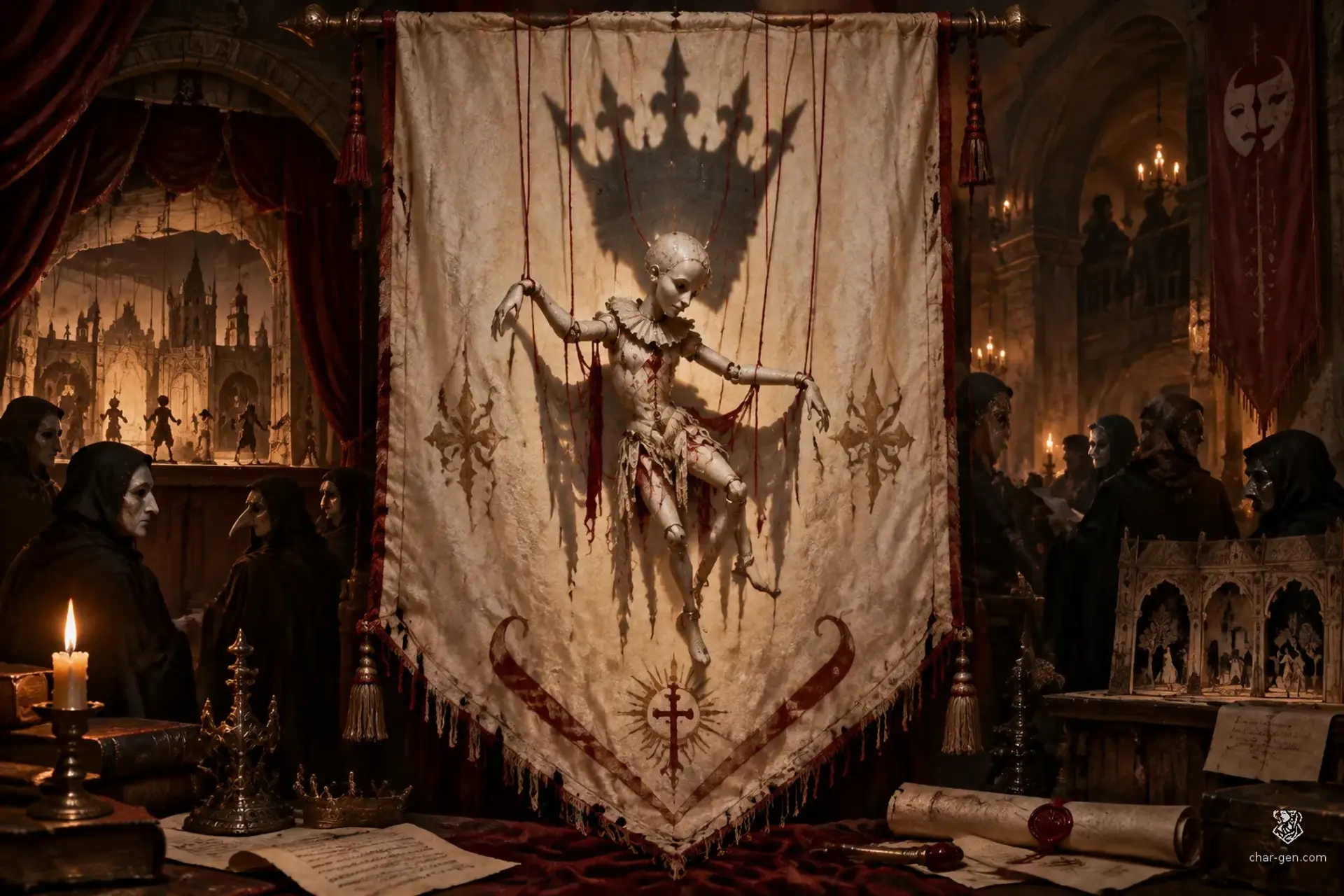
The society says it began after the Treaty of Three Ashes, when a failed succession dispute brought three armies to the same river ford. According to its preferred account, a group of clerks, stagehands, and minor courtiers used forged orders and staged messengers to make each army believe the others had withdrawn. The battle never happened. The founders then swore to guide public decisions from behind the curtain, claiming that a managed peace was better than a righteous war. The true account is uglier: the first ledger lists payments from all three claimants, each of whom believed the society had secured the throne for them.
How to know them
Ivory, Soot black, Dull red
- A hand puppet casting a crown-shaped shadow.
- A red thread stitched inside an ivory cuff.
- A small empty rectangle marked on the inside of a sealed letter.
Standing
What they say they want
What they are doing now
Where it leads
A continent in which rulers settle disputes through dependable councils rather than war. The society intends to design, staff, and quietly control those councils, telling itself that good outcomes matter more than accountable methods.
How others see them
To most people, the society does not exist. Among those who suspect it, it is described as a useful rumor, an old court conspiracy, or a cautionary tale about performers who know too much. A few rulers privately regard it as an unofficial peacekeeping service.
People
5 ranks
First Hand of the Seven
Patient, restrained, and attentive to other people's fears. He dislikes cruelty for its own sake but accepts cruelty as an instrument when he can claim the alternative would be worse.
- The Seven Hands7 members
Set continental policy, approve high-risk interventions, and appoint chapter stewards. Decisions require five votes, but emergency orders can be issued by three and reviewed later.
- Scene Stewards24 members
Direct regional chapters, cultivate officials, and report local developments. They compete for influence and may conceal failures from the council.
- Stringkeepers96 members
Manage cells, coded correspondence, informants, and the careful movement of people and documents.
- Shadows270 members
Ordinary members embedded as clerks, actors, tutors, servants, advocates, and commercial agents. Many know only their local cell.
- Unbound160 members
Paid informants, occasional collaborators, and recruits under observation. They are not counted as full members and rarely know the society's name.
Other key members
- Toma Veld Scene Steward for the western chapters
- Nadi Keeper of the courier network
- Barek Master of chapter funds and likely successor
How they are organised
- Demonstrate a useful skill in records, performance, law, travel, intelligence, or mediation.
- Keep a confidence for one year without being told its full significance.
- Accept that no member may know the full structure of the society.
- Agree to obey lawful local authority in public unless a Scene Steward issues a specific exception.
Relations
8 factionsThe republic's magistrates quietly accept the faction's help finding witnesses and preventing unrest. Their cooperation is useful, conditional, and dangerous to expose.
Operations
What they do
How they do it
Services for hire
- A Door Opened QuietlyA favor of comparable risk, reliable information, or a substantial donationA discreet introduction to a negotiator, clerk, or official in one of the society's active regions.
- The Measured TruthA sworn confidence and a promise not to investigate the society's methodsVerification of a rumor or document, without a guarantee that the full truth will be shared.
- A Road Without QuestionsA serious obligation owed to a Scene StewardSafe passage along one of the society's courier routes for a person carrying no openly declared arms.
What they can do
What they have
Where they are weak
Territory
Headquarters
HearthmarketThe central chapter meets beneath an old playhouse built into a low chalk ridge. Its public rooms host ordinary performances; its concealed chambers hold records, message routes, and a puppet stage with doors behind the scenery. Visitors are led through different corridors depending on who they are meant to believe is in charge.
Lands they hold
Outposts
- Blackthorn YardA market district where a blackthorn grows through the old pavingRegional meeting place disguised as a puppet workshop and rehearsal room.
- White Stone PassA narrow pass marked by a pale standing stoneA courier stop for exchanging sealed packets and checking whether a route has been watched.
- Reed LandingA riverside ward where reeds choke the smallest landingA discreet arrival point for people who need to enter or leave the capital without using its gates.
Secrets
Plot hooks
5 hooks- 1The Wrong ShadowPersonal, low to moderateReward: Reputation, a favor, or a clue to the local cellA character's relative is accused of selling a military route. The accusation is false, but the evidence is convincing. A local Shadow offers to help clear the name in exchange for one seemingly harmless favor.
- 2Strings at the BorderLocal, moderateReward: Allies, access to a courier route, or a dangerous secretA traveling puppet troupe asks the party to escort its props across a tense border. One puppet contains a coded message; rival agents believe it names the society's next target, while the troupe insists it is only a play.
- 3The Quiet VerdictRegional, highReward: Political influence, evidence, or protection for vulnerable witnessesA provincial governor plans to publish proof that the society manufactured a recent riot. The governor's evidence is authentic, but publishing it will also expose informants who helped prevent a massacre. The party must choose what to preserve, reveal, or suppress.
- 4The Ledger Beneath the CurtainCampaign-scale, highReward: A changed political order, a powerful alliance, or the destruction of the faction's old legitimacyThe first ledger has surfaced in an archive whose caretakers do not know what they possess. Rafi wants it recovered, Toma wants it copied and released, and Barek wants to sell its most damaging pages to competing claimants.
- 5A Crown Made of ShadowsCampaign-scale, very highReward: A treaty, a new patron, or the chance to reshape the societyTwo heirs are being maneuvered toward a succession conflict that the society claims it can prevent. The party discovers that one crisis was invented by the Curtains, while the Measures are using the same crisis to remove a genuinely dangerous official.
Work they offer
What gets in the way
Rumours
Media
0 imagesNo images yet.
Turn The Chalk-Ridge Shadows into a sheet
A high-res, share-ready sheet you can post or print.
