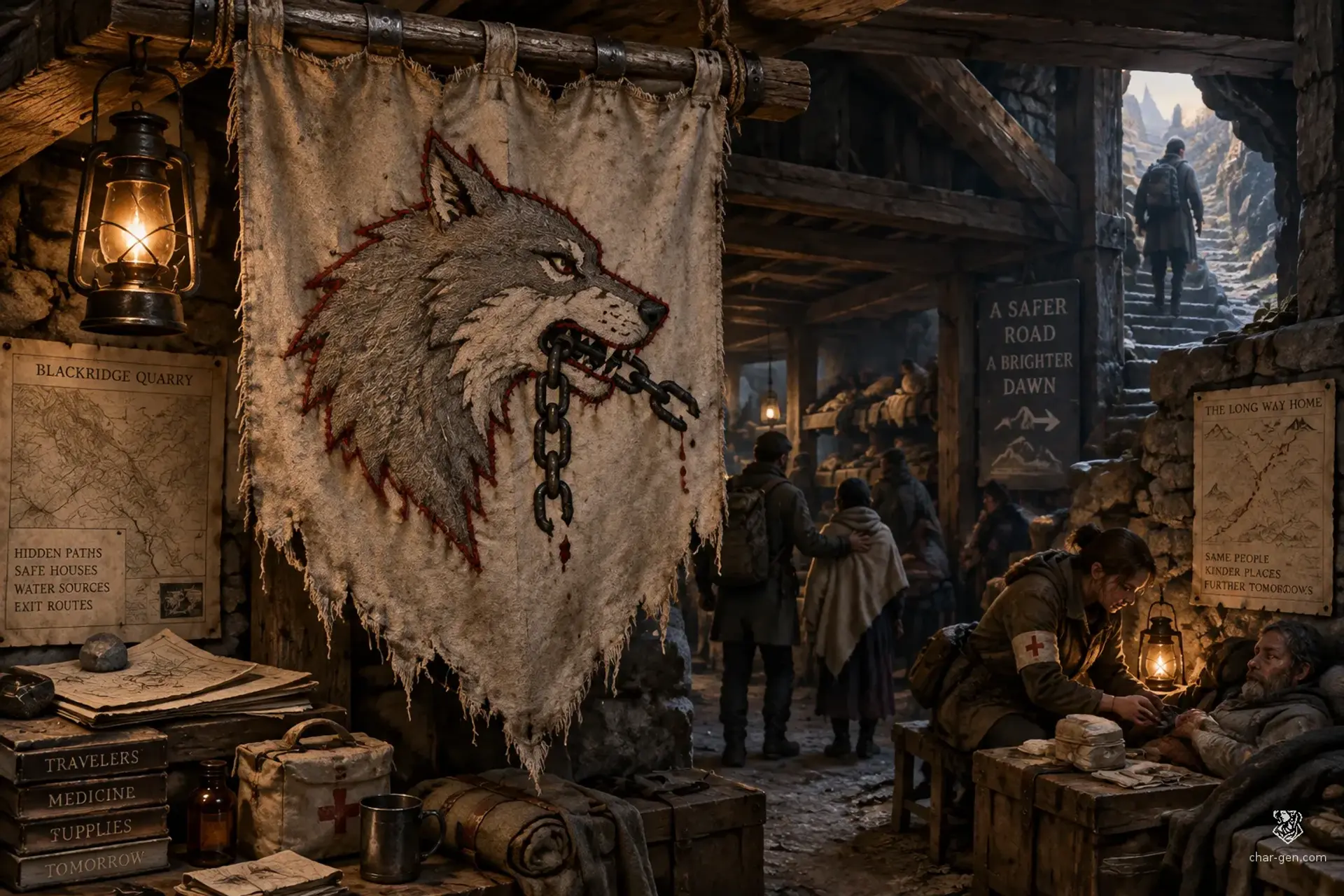
The Wolves Of Reval Delachi
The Wolves began as a handful of quarry workers and escapees, then grew along roads used by debt collectors and private guards. Their first years were small and improvisational: a stolen key here, a hidden child there, a broken wagon axle that delayed a transfer. Their first major triumph came when they emptied the Bracken Slate Company's holding pens in one night and spirited nearly a hundred laborers to scattered villages. The company retaliated by burning the homes of suspected helpers, and the Wolves learned that a successful rescue could endanger everyone who had made it possible. Their defining watershed was the Red Ledger Winter, eleven years ago. A baronial clerk offered the Wolves a complete list of prisoners in exchange for his family's safe passage. The Ashen Table accepted the list, but a separate cell freed the clerk's family before the names could be verified. Several listed prisoners were in fact violent criminals, and their release led to a deadly raid on a village. The Wolves publicly acknowledged their mistake, changed their rescue protocols, and began recording who authorized each operation. The crisis also split the faction between those who believe any cage must be opened and those who insist that rescue requires judgment. In the years since, the movement has become larger and more disciplined without becoming a single army. It has survived raids, informants, and the destruction of three safe-house chains. Today it is known across the borderlands as both a lifeline and a source of upheaval.
The Wolves Of Reval Delachi
- Type
- Decentralized rescue…
- Size
- 545 members
- Reach
- Regional
- Base
- The Delachi Cut, a disused slate-quarry road and tunnel network outside the border settlement of Tallowgate
Overview
The Wolves began as a handful of quarry workers and escapees, then grew along roads used by debt collectors and private guards. Their first years were small and improvisational: a stolen key here, a hidden child there, a broken wagon axle that delayed a transfer. Their first major triumph came when they emptied the Bracken Slate Company's holding pens in one night and spirited nearly a hundred laborers to scattered villages. The company retaliated by burning the homes of suspected helpers, and the Wolves learned that a successful rescue could endanger everyone who had made it possible. Their defining watershed was the Red Ledger Winter, eleven years ago. A baronial clerk offered the Wolves a complete list of prisoners in exchange for his family's safe passage. The Ashen Table accepted the list, but a separate cell freed the clerk's family before the names could be verified. Several listed prisoners were in fact violent criminals, and their release led to a deadly raid on a village. The Wolves publicly acknowledged their mistake, changed their rescue protocols, and began recording who authorized each operation. The crisis also split the faction between those who believe any cage must be opened and those who insist that rescue requires judgment. In the years since, the movement has become larger and more disciplined without becoming a single army. It has survived raids, informants, and the destruction of three safe-house chains. Today it is known across the borderlands as both a lifeline and a source of upheaval.
How it began
The Wolves say their name began at the Delachi Cut, a narrow quarry road cleared through a ridge for slate and toll traffic. During the winter of 31 years ago, a landslide trapped a chain gang of debtors in a disused haul tunnel while the local reeve refused to risk workers for people he considered property. A quarry medic, a toll clerk, and a discharged scout cut a second entrance through the spoil bank. They smuggled out forty-three prisoners over six nights, using wolf howls as signals because the quarry dogs answered them and confused the guards. The three founders never agreed on what Reval Delachi meant. One said it was the name on a ruined boundary stone; another claimed it was the clerk's code for the cut itself. They let the mystery stand, since argument kept outsiders from identifying the first rescuers. The original crew had no plan beyond the next escape. The Wolves' first rule was simple: no one fleeing captivity would be asked to earn rescue before receiving it.
How to know them
Wolf-gray, Dried-blood red, Unbleached linen
- A gray wolf's head, stitched with uneven red thread
- Three short scratches beside a door, meaning food, medicine, or shelter is available
- A snapped chain drawn beneath a road mark, warning that the route is watched
Standing
What they say they want
What they are doing now
Where it leads
A borderland where no person can be owned through debt, inherited sentence, or private force, and where communities have enough shared power to protect one another without needing the Wolves.
How others see them
To the poor and displaced, the Wolves are daring rescuers who arrive when the law will not. To merchants and officials, they are criminals who make contracts and court orders unenforceable. Even people who approve of their cause may fear that a Wolf rescue will bring armed reprisals to their door.
People
5 ranks
Trailkeeper
Measured, compassionate, and difficult to provoke. She can seem cold when she is actually calculating how many people a choice will endanger.
- The Trailkeeper1 member
Coordinates urgent operations, negotiates between cells, and may call a conclave. The Trailkeeper cannot command a cell to accept a mission.
- The Ashen Table7 members
A council of route-keepers, medics, quartermasters, and veteran rescuers. It sets common principles, shares resources, and reviews actions that endangered civilians.
- Pack Leads34 members
Trusted cell organizers who arrange local rescues, select safe houses, and decide which requests their people can safely accept.
- Runners120 members
Scouts, guides, couriers, healers, counterfeiters, and rescuers who carry out the movement's work. Most operate in cells of three to eight.
- Hearthfolk390 members
Noncombatant supporters who provide food, rooms, information, and care. Many never meet a senior Wolf and do not know the full extent of the network.
Other key members
- Jori Pack Lead for the Delachi Cut
- Katsen Vale Quartermaster and record keeper
- Mori Historian and keeper of the Delachi Cut routes
How they are organised
- A recruit must complete a period of useful, nonviolent service before being offered sensitive work.
- Members must not sell the location of a safe house or reveal a route under pressure when a warning could save lives.
- No one is required to take part in armed operations.
- Members are expected to explain the likely danger to civilians before accepting a risky rescue.
Relations
8 factionsThe Lantern Sisters hide refugees in their hospice network. They admire the Wolves' courage but fear the faction's habit of turning rescue into open rebellion.
Operations
What they do
How they do it
Services for hire
- Hearth ShelterNo fixed fee; food, information, or future mutual aid is welcome but never required for emergency rescue.A short stay in a safe house, basic treatment, and help determining a next destination.
- Quiet RoadA favor of comparable risk, or a contribution to supplies when the traveler can afford it.A guide moves a person or small group through a monitored road or border crossing.
- Borrowed NameMaterials, time, and a promise not to endanger the people whose names appear on the papers.The Wolves arrange forged work orders, travel letters, or replacement identity documents. These are custom, nonmagical tools and are not guaranteed to defeat scrutiny.
What they can do
What they have
Where they are weak
Territory
Headquarters
The Delachi Cut, a disused slate-quarry road and tunnel network outside the border settlement of TallowgateThe Wolves have no permanent headquarters. Their closest thing is a concealed network of rooms beneath an abandoned slate sorting shed near the old Delachi Cut. The shed's upper floor looks unsafe and is kept that way; below it are a map room, a sickroom, hidden bunks, and three separate exits. No member knows every entrance.
Lands they hold
Outposts
- Cut HouseThe upper floor of a disused slate sorting shed at the Delachi CutEmergency shelter, medical care, and coordination for routes through the old quarry.
- Cask CellarA cooper's cellar beneath the market lanes of TallowgateShort-term hiding place and handoff point for people traveling toward the river.
- Dry BasinA drained millpond beyond the border roadA fallback meeting place where guides exchange route information and supplies.
Secrets
Plot hooks
4 hooks- 1The Apprentice at the DoorLow to moderateReward: Safe passage, local contacts, or a modest paymentA Hearthfolk family asks the characters to hide a runaway apprentice accused of setting a fatal fire. The apprentice insists the fire was an accident caused by unsafe machinery, while the Wolves' local Pack Lead wants to move them immediately.
- 2Names in the Toll BookModerateReward: Allies, intelligence, and a choice that changes the faction's trustThree captured Wolves will be publicly sentenced unless someone retrieves a list of prisoners from a Crown Office archive. The list contains names of people already living under new identities, so simply stealing it could expose them.
- 3The Ledger Beneath the SpoilHighReward: Political leverage, historical evidence, or a major shift in the Wolves' leadershipA baron offers the characters a map to the Delachi Cut in exchange for recovering a missing ledger. Teki wants the ledger secured; Mori believes it may reveal the truth behind the faction's founding.
- 4A Gate Too WideCampaign scaleReward: The fate of a region's labor system and the Wolves' future directionJori's rebel contacts plan to seize the Rillgate debt camp during a festival. Their assault may free hundreds, but the camp's crowded storehouse is rigged to burn if guards lose control. The characters must mediate, change the plan, or choose which risk to accept.
Work they offer
What gets in the way
Rumours
Media
0 imagesNo images yet.
Turn The Wolves Of Reval Delachi into a sheet
A high-res, share-ready sheet you can post or print.
