Wellward Circle
The Circle grew from the first compact into a network of well keepers, repairers, and household witnesses. For decades it managed only Salt Pan's public sources, relying on consent and a reputation for even-handed measures. As trade expanded, the Circle began maintaining roadside cisterns and negotiating access with neighboring settlements. Its defining watershed came during the Red Wind Siege, when raiders cut the exposed channels that fed Salt Pan's outer cisterns. The Three Measure-Keepers ordered a strict ration: children, the sick, and the crews repairing the channels received priority, while commercial workshops were shut off. The choice prevented the cisterns from running dry, but several families lost their livelihoods and a number of people left the settlement. In the years afterward, the Circle gained authority because it had kept the water alive, and earned lasting resentment because of how it had done so. Later, the Circle formalized inspections, posted public tallies, and trained wardens to recognize taint and structural failure. It also became more political. Caravans sought its seal of safe water; salt crews demanded fair access; private diggers challenged its right to regulate new shafts. Today the Circle is both a practical civic service and a power broker. Its members still invoke the first compact, but argue over whether it means equal access, equal sacrifice, or simply the survival of the greatest number.
Wellward Circle
- Type
- Civic association and…
- Size
- 294 members
- Reach
- High wherever settlements…
- Base
- Salt Pan
Overview
The Circle grew from the first compact into a network of well keepers, repairers, and household witnesses. For decades it managed only Salt Pan's public sources, relying on consent and a reputation for even-handed measures. As trade expanded, the Circle began maintaining roadside cisterns and negotiating access with neighboring settlements. Its defining watershed came during the Red Wind Siege, when raiders cut the exposed channels that fed Salt Pan's outer cisterns. The Three Measure-Keepers ordered a strict ration: children, the sick, and the crews repairing the channels received priority, while commercial workshops were shut off. The choice prevented the cisterns from running dry, but several families lost their livelihoods and a number of people left the settlement. In the years afterward, the Circle gained authority because it had kept the water alive, and earned lasting resentment because of how it had done so. Later, the Circle formalized inspections, posted public tallies, and trained wardens to recognize taint and structural failure. It also became more political. Caravans sought its seal of safe water; salt crews demanded fair access; private diggers challenged its right to regulate new shafts. Today the Circle is both a practical civic service and a power broker. Its members still invoke the first compact, but argue over whether it means equal access, equal sacrifice, or simply the survival of the greatest number.
How it began
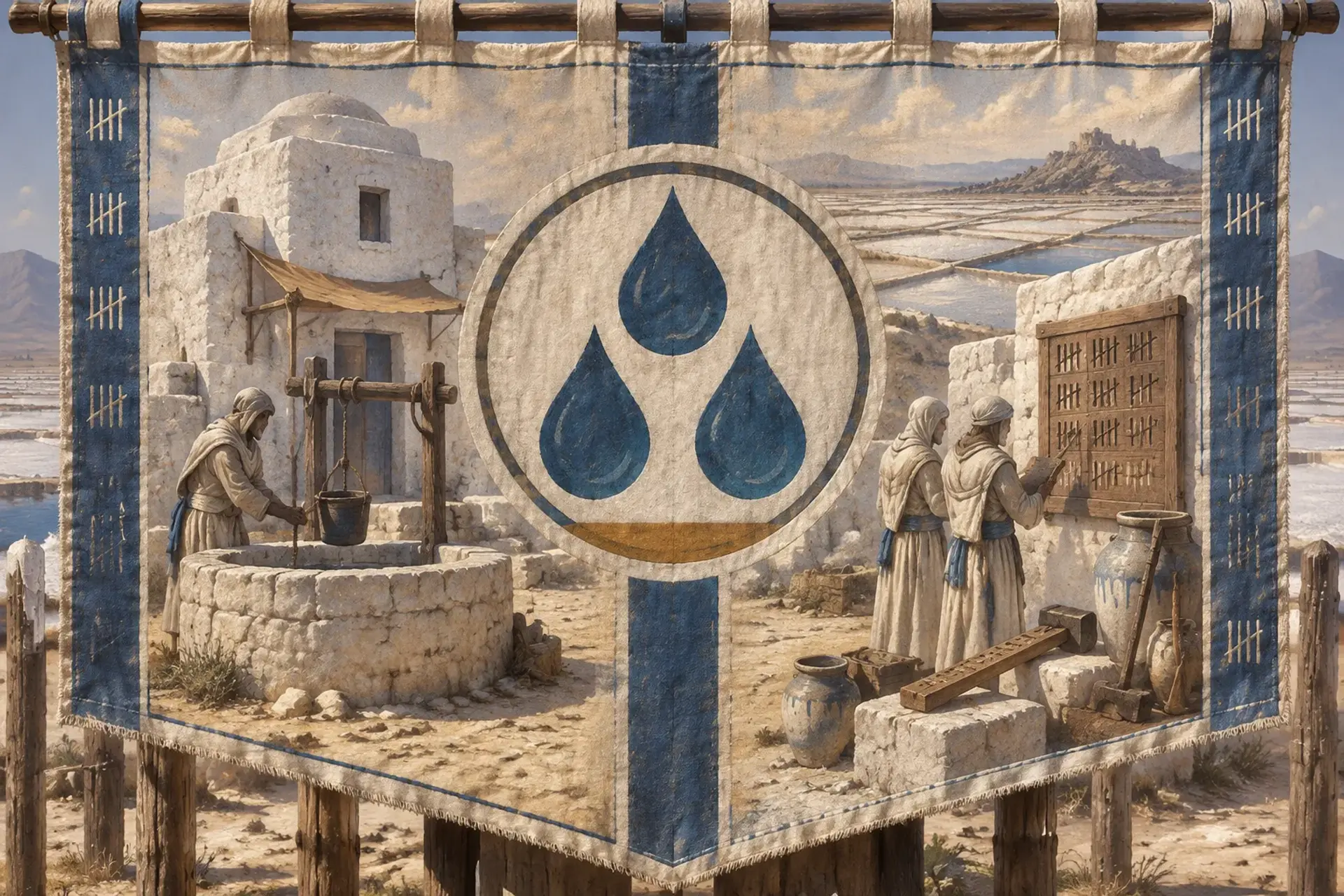
The Circle's founding account begins during the Year of Bitter Silt, when Salt Pan's shallow wells turned brackish after a long dry season. According to the oldest version, three well keepers met at the broad stone lip now called the Old Ring and agreed to open their private stores by household count rather than by wealth. The first compact was scratched onto a limestone slab and witnessed by residents from every quarter. Whether the three keepers truly acted together is disputed: surviving family records each credit a different ancestor. What matters to the Circle is the rule they left behind: water drawn from a shared source carries a shared duty.
How to know them
chalk white, deep well blue, sun-faded ochre
- Three blue drops painted above public well doors
- A white cord tied around a cistern key
- The broken circle mark used on ration boards
Standing
What they say they want
What they are doing now
Where it leads
A network of clean, reliable shared wells governed by compacts that no single household, employer, or settlement can quietly rewrite. The Circle's deeper ambition is to make its inspection seal the standard for safe water across the basin, giving it influence beyond Salt Pan.
How others see them
Most residents regard the Circle as necessary, competent, and tiresomely strict. Travelers appreciate the reliable cisterns and posted measures. People who have lost work or access under a ration order see the same officials as distant arbiters who can turn a household's survival into a number on a board.
People
5 ranks
First Measure-Keeper
Calm, attentive, and protective. She avoids threats, but can make a refusal sound final without raising her voice.
- The Three Measure-Keepers3 members
Set basin-wide policy, approve emergency rationing, and resolve disputes between settlements. Decisions require two votes, but custom expects all three to publish their reasons.
- Cistern Stewards9 members
Oversee major cisterns, assign repair crews, review water tallies, and report local shortages to the Measure-Keepers.
- Well Wardens24 members
Inspect wells, witness draws, maintain seals, and settle ordinary disputes at the water line.
- Drawers and Keepers68 members
Operate pumps, clean channels, carry water, keep household tallies, and train in basic contamination response.
- Compact households190 members
Contribute labor, report damage, and receive recognized access to Circle-managed wells. Membership counts households as well as active workers.
Other key members
- Tomas Varek Cistern Steward responsible for major repairs
- Ketti Well Warden and organizer of the reform bloc
- Oskan of the Silt Steps Archive keeper and investigator of disputed compacts
How they are organised
- Accept the shared-well compact and acknowledge that emergency rationing may limit individual draws.
- Complete a season of supervised service or provide an equivalent contribution approved by the local Steward.
- Declare any private well, cistern, or water-trading interest that could create a conflict of duty.
- Agree not to break seals or falsify tallies, even when a household believes its allotment is unfair.
Relations
7 factionsThe Circle keeps the salt workers' drinking cisterns clean, while the workers repair its pumps and provide labor during emergencies. Tension flares when water rationing slows the pans.
Operations
What they do
How they do it
Services for hire
- Well inspectionA small fee or one day of household laborA public inspection of a well or cistern, including a written report of visible structural problems.
- Cistern repairMaterials plus the repair crew's food and wagesA trained crew can patch a cracked cistern, clear a channel, or restore a manual pump when parts are available.
- Compact witnessA household contribution to the local compactThe Circle records access rights, witnesses a shared-well agreement, and keeps a copy in the archive.
- Emergency drawUsually free in emergencies; otherwise a contribution of labor or clean containersThe Circle can provide a measured emergency allotment to travelers, displaced people, or households cut off by damaged wells.
What they can do
What they have
Where they are weak
Territory
Headquarters
Salt PanThe Circle meets in a low, whitewashed building beside Salt Pan's oldest public cistern. Its floor slopes gently toward a drain so spilled water can be collected rather than wasted. The main room holds ration boards, repair tools, and a limestone copy of the first compact. A barred archive below the floor stores old well maps and sealed testimony.
Lands they hold
Outposts
- Three-Step CisternAt the western caravan road outside Salt PanProvides a resting supply for travelers and serves as a test point for water moving toward the settlement. Its name comes from the three stone steps descending to its draw ledge.
- Silt GateAmong the salt pans north of Salt PanStores water for the crews and holds spare pump parts. The name comes from its low gate, where windblown silt collects.
- Kelm's MouthOn the boundary between two outer hamletsMarks a shared well whose older name was worn down from a word no current resident understands. It is staffed by witnesses from both hamlets.
Secrets
Plot hooks
5 hooks- 1The Doubled MarkPersonal, low to moderateReward: Restored access, local trust, or evidence against a Circle officialA character's household allotment is suddenly cut in half after a tally is marked as already collected. The Well Warden insists the record is correct, but a missing witness mark suggests either theft or deliberate falsification.
- 2Cloud in the BucketLocal, moderateReward: Payment, a favor from the Circle, or a lasting ally among the well crewsA public well turns cloudy after a night of unusual repairs. The Circle closes it and asks the party to escort a sample to an independent examiner, while the Dry Hands accuse the Circle of poisoning it to justify tighter control.
- 3Seals in the DustLocal to regional, moderateReward: A service from the Circle, access to repair stores, or leverage over a faction disputeTomas Varek hires the party to recover stolen copper seals before the next ration cycle. The trail points toward the Deep Cutters, but Ketti suspects a Circle official is selling seals to create a reason for emergency rule.
- 4The Red Wind LedgerRegional, highReward: A major political ally, proof of a historic injustice, or a dangerous secretOskan offers the party a copied siege tally and asks them to find the families named on it. Their testimony could expose the Circle's founding leaders' choice, vindicate them as lifesavers, or fracture public confidence in water rationing.
- 5The Unclaimed VeinCampaign-scale, highReward: Influence over the basin's future, control of a strategic resource, or a new settlement's survivalA new shaft promises enough water to transform the basin, but its underground course may cross beneath several settlements. The Circle wants a controlled survey, the Deep Cutters want immediate drilling, and the White Road carriers are quietly financing both sides.
Work they offer
What gets in the way
Rumours
Media
0 imagesNo images yet.
Turn Wellward Circle into a sheet
A high-res, share-ready sheet you can post or print.
