A Cut-Marks
The company was founded forty-three years ago by children abandoned in a flood-struck workhouse. For its first decade it survived as escorts, scavengers, and occasional thieves, moving between vacant forts and towns that had no reason to trust it. Its reputation changed during the Red Ford winter, when a local lord's soldiers demanded that the children surrender their food stores and several of their youngest. The company killed the soldiers and their paymaster, took the tollhouse, and held the crossing through the spring. That watershed moment taught its members that a home could be defended only if others feared the cost of taking it. During the following years, the Cut-Marks became hired guards and raiders in equal measure. They adopted the carved-name tradition after losing their original plank of the dead. At first, the marks were cut into wood and leather. A captain later carved a name into a living captive to make an example, and the practice spread as a sign of authority and a method of intimidation. The company grew quickly by taking in orphans, deserters, and the displaced, but its promise of family increasingly came with a demand for obedience. The company's greatest triumph was the seizure of the Three Roads forts, a string of neglected strongpoints that let its captains move troops across several kingdoms. Its greatest setback came two years later, when the captains fought over who controlled the tolls and burned one of the forts rather than let a rival keep it. The split was settled by a bloody moot, but the argument over centralized rule has never ended. Today the Cut-Marks operate worldwide through hired companies, roadside camps, and a network of former members. Some are disciplined soldiers; others are extortionists who invoke the family name to excuse cruelty. The First Hand claims the company protects the abandoned. Critics point out that it sometimes creates the very fear and loss that leave people with nowhere else to go.
A Cut-Marks
- Type
- Mercenary Company
- Size
- 526 members
- Reach
- Global
- Base
- The abandoned tollhouse at a narrow ford locals call the Red Ford
Overview
The company was founded forty-three years ago by children abandoned in a flood-struck workhouse. For its first decade it survived as escorts, scavengers, and occasional thieves, moving between vacant forts and towns that had no reason to trust it. Its reputation changed during the Red Ford winter, when a local lord's soldiers demanded that the children surrender their food stores and several of their youngest. The company killed the soldiers and their paymaster, took the tollhouse, and held the crossing through the spring. That watershed moment taught its members that a home could be defended only if others feared the cost of taking it. During the following years, the Cut-Marks became hired guards and raiders in equal measure. They adopted the carved-name tradition after losing their original plank of the dead. At first, the marks were cut into wood and leather. A captain later carved a name into a living captive to make an example, and the practice spread as a sign of authority and a method of intimidation. The company grew quickly by taking in orphans, deserters, and the displaced, but its promise of family increasingly came with a demand for obedience. The company's greatest triumph was the seizure of the Three Roads forts, a string of neglected strongpoints that let its captains move troops across several kingdoms. Its greatest setback came two years later, when the captains fought over who controlled the tolls and burned one of the forts rather than let a rival keep it. The split was settled by a bloody moot, but the argument over centralized rule has never ended. Today the Cut-Marks operate worldwide through hired companies, roadside camps, and a network of former members. Some are disciplined soldiers; others are extortionists who invoke the family name to excuse cruelty. The First Hand claims the company protects the abandoned. Critics point out that it sometimes creates the very fear and loss that leave people with nowhere else to go.
How it began
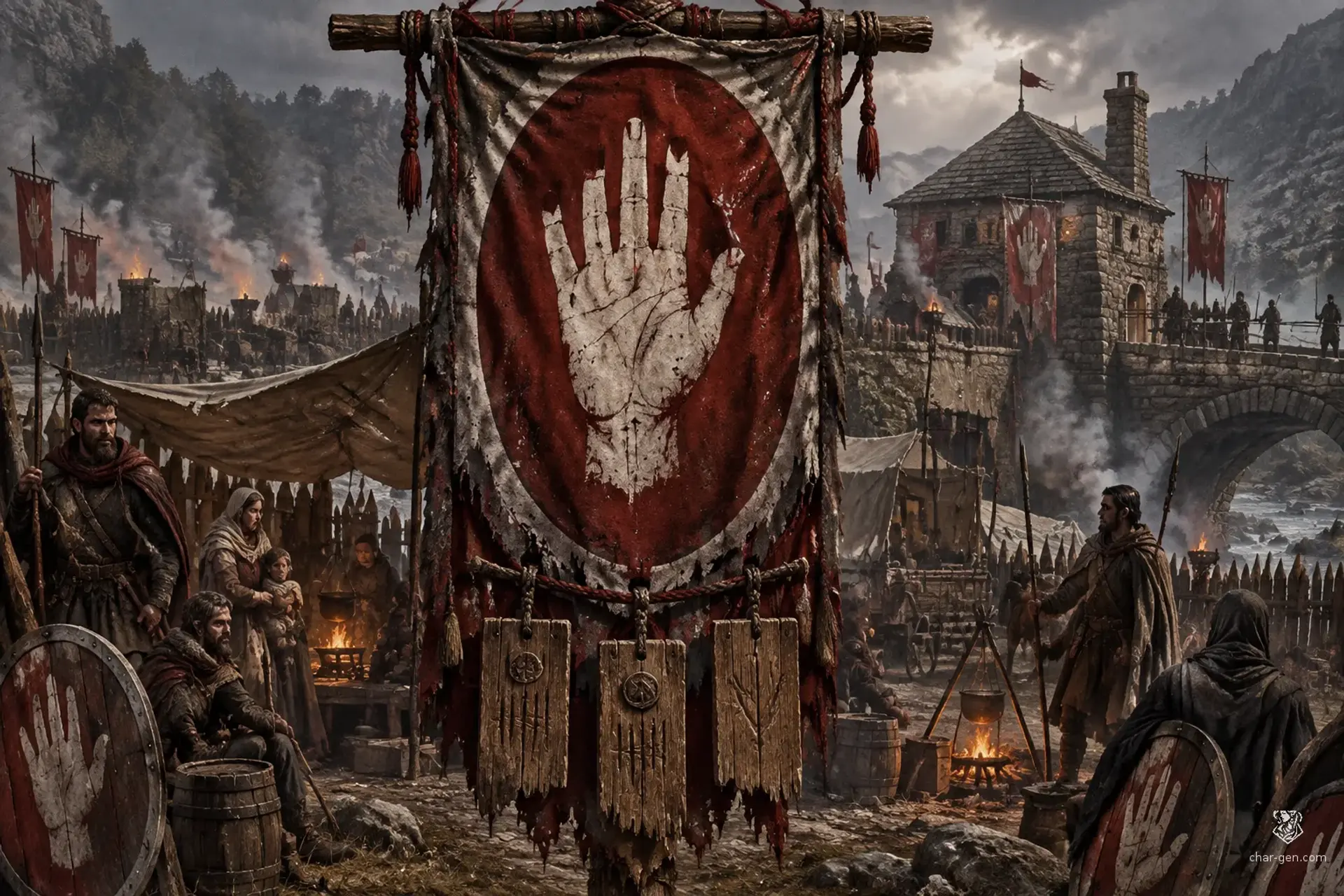
The Cut-Marks began in a flood-struck workhouse whose owners fled during a winter fever. The children who survived were left without kin, food, or anyone willing to claim them. A deserter named Tegan Rusk found them shelter in an abandoned tollhouse and taught the older children to guard its doors. Their first leader, a hard-bitten orphan called Kett, made a rule: anyone who ate at their fire belonged to the family, and anyone who threatened that family would be answered without mercy. The first marks were cut into a plank, not people: names of children who had died before the company could protect them. Years later, after Kett's death, the plank was stolen and the list was carved onto the arms of captive raiders as a warning. The practice became a brutal tradition, then a source of power. The name Cut-Marks is a warning, and members say changing it would invite the old hunger back.
How to know them
Dried-blood red, Ash gray, Bone white
- The white hand with one shortened finger
- A red cord tied around the wrist or belt, signifying a shared meal and obligation
- The cut-name boards, kept in some camps as memorials to lost members
Standing
What they say they want
What they are doing now
Where it leads
Sella's vision is a network of recognized company territories, safe roads, and fortified homes where the abandoned can find shelter without depending on local lords. Her critics fear that this will become a border-spanning state built on forced loyalty, private prisons, and a claim that the company owns everyone it rescues.
How others see them
To some desperate people, the Cut-Marks are a rough shelter that will take in anyone who has nowhere else to go. To merchants, they are dangerous but predictable when paid. To settlements they have raided, they are bandits who dress cruelty in the language of family. Their scarred emblem is often enough to make a village pay before a single sword is drawn.
People
6 ranks
First Hand
Patient, observant, and persuasive. Sella knows how to make a threat sound like an offer. Her care for the company's vulnerable is genuine, but she can justify almost any cruelty as the price of keeping the whole family alive.
- First Hand1 member
The nominal leader. Sets broad strategy, assigns the largest contracts, and can call a full company moot. The First Hand cannot safely govern without the captains' support.
- Road Captains7 members
Command regional companies, negotiate local contracts, and control routes, pay, and discipline. They vote on war, succession, and punishments likely to divide the family.
- Table Keepers18 members
Maintain supplies, debts, names, and the records of members taken in or lost. They also act as witnesses at company disputes. Their control of the records gives them influence beyond their formal station.
- Knots64 members
Veteran squad leaders and specialists who train recruits, lead small crews, and carry messages between distant contracts.
- Hands292 members
The bulk of the company: fighters, scouts, drivers, cooks, healers, spies, and camp workers. A member's practical value matters more than a formal rank.
- Little Hands151 members
Children and young dependents raised within the company. Many learn camp trades and some train as scouts or fighters. A growing minority of adults argues that they should be protected from recruitment and allowed to choose a life beyond the company.
Other key members
- Bregan Tusk Road Captain and Sella's chief political rival
- Mairg Infirmary keeper and informal protector of the Little Hands
- Gethrin Pike Senior Table Keeper
- Tavi Young scout and possible defector
How they are organised
- New adults must complete a season of work or service before gaining full standing.
- Applicants must accept the company's shared stores, common obligations, and rules of camp conduct.
- A member must name a sponsor who will answer for their behavior during their first year.
- The company accepts people with no living family, but it also recruits people who have family and are willing to sever or conceal those ties.
- Children raised inside the company are treated as members in its public claims, though whether they may leave freely is bitterly disputed.
Relations
8 factionsThe company sells protection and discreet muscle to the Salt Ledger's shipping concerns. The Ledger values reliable violence; the Cut-Marks resent being treated as hired tools and may turn on it if payment or leverage shifts.
Operations
What they do
How they do it
Services for hire
- Armed CompanyNegotiated fee, commonly half in advanceA trained crew for guard duty, convoy escort, scouting, or an ordinary battlefield contract. Reliability depends on the captain and the terms of employment.
- Road EarsHigh fee, usually paid through a trusted intermediaryLocal route information, rumor gathering, and discreet observation. Information may be incomplete or deliberately angled to serve a captain's private agenda.
- A Place at the FireFood, shelter, labor, or a favor owedTemporary shelter and basic aid for displaced people. This service can become exploitative when the company claims that assistance creates an obligation of loyalty.
- Taking Back What Was TakenRare goods, substantial coin, or a future serviceRecovery of a stolen person, weapon, or company asset. The company may demand retaliation against whoever took it.
What they can do
What they have
Where they are weak
Territory
Headquarters
The abandoned tollhouse at a narrow ford locals call the Red FordA sprawling encampment and fortified yard assembled from salvaged walls, wagons, and the stone shell of an abandoned tollhouse. The place has a crowded cookfire hall, a weapons yard, locked cells, a rough infirmary, and a wall of names cut into reused door planks. It is not fixed: when threatened, the company can dismantle much of it and move. Visitors are watched constantly, and the children's sleeping quarters are kept behind two guarded gates.
Lands they hold
Outposts
- The Split RockA disused watchtower above a mountain passStores weapons and food, watches a trade route, and gives wounded members a place to recover.
- The White FordA collapsed customs house near a broad river crossingServes as a meeting place for agents, recruiters, and captains operating in the river kingdoms.
- The Dead CutA derelict quarry on the edge of a large cityHides a reserve of equipment and provides a discreet place for exchanges, interrogations, and contract negotiations.
Secrets
Plot hooks
6 hooks- 1A Name in the AshPersonal, low to moderate danger; the party must decide whether to trust a child, a company healer, or a suspicious record keeper.Reward: A rescued family member, a useful guide, and the trust of an internal reformerA Little Hand slips a character a map and begs for help finding a living aunt. The child claims Mairg can prove the aunt exists, but the Table Keepers say the records were destroyed.
- 2The Toll at Red FordLocal, moderate danger; violence could endanger the villagers and the children alike.Reward: Payment, local support, and leverage over either Sella or BreganA village hires the party to stop the Cut-Marks from collecting protection money. Bregan's crew is responsible, but its members are also feeding several abandoned children. Sella offers the party a lawful contract to expose Bregan rather than attack the company.
- 3The Missing RollRegional, high danger; multiple factions are searching for the same record.Reward: A major payment, sensitive intelligence, or a powerful ally among the Table KeepersA merchant offers the party a fortune to retrieve a stolen company ledger. The ledger contains routes and military secrets, but also the names of people the company claims as dead. Gethrin Pike asks the party to return it unopened.
- 4A Seat at the MootRegional, high danger; the party must uncover the plot without handing a brutal mercenary company legitimacy it may abuse.Reward: Political influence, a treaty favor, or a chance to change the company's charterSella asks the party to escort a delegation seeking recognition for a company-held territory. The talks are sincere, but Bregan has arranged a staged attack that could discredit Sella and restore captain autonomy.
- 5The Hand That LeftPersonal to local, moderate danger that can escalate into a regional pursuit.Reward: A new contact, proof of company corruption, or a negotiated settlementA former company member now lives under a new identity and has a quiet family. The Cut-Marks have found them and demand that they return to answer for desertion. Tavi wants the party to help the former member escape, while Sella claims the person stole money needed to feed the camps.
- 6The Family That Was TakenCampaign-scale, severe political and physical danger.Reward: The truth about the company's founding, lasting alliances, and the power to reshape or fracture the Cut-MarksFragments of the original roll surface in separate cities. The names could reunite people with living relatives, expose old crimes, and provoke powerful patrons to silence witnesses. Sella, Gethrin, and the Burnt Acre Witnesses each want the fragments for different reasons.
Work they offer
What gets in the way
Rumours
Media
0 imagesNo images yet.
Turn A Cut-Marks into a sheet
A high-res, share-ready sheet you can post or print.
