Ewan Armitage
Ewan Armitage
At the table
Voice
Ewan speaks from a body shaped by outdoor work, old travel, and years of forcing himself through customer-service scripts. His voice is clear but worn at the edges, with a faint rasp when he has not slept. He does not sing or boom; he tends to place words firmly and leave a small pause before answering anything that sounds like a bargain. In a calm mood he sounds approachable and matter-of-fact. When the dead speak, his replies acquire an older cadence, and he may use a word that no one present recognizes.
His voice has a dry, slightly rough edge, like someone accustomed to cold air and long walks. He speaks modern English plainly with a Yorkshire cadence, often calling people love without making it a performance. Work has trained him to keep an even pace through repetitive scripts, but when tired he drops the practiced customer-service brightness and speaks in short, exact sentences. Old English and Old Norse come out with an older, harder rhythm. He will not speak the forbidden tongues aloud. When he hears a dead voice, he sometimes answers it before realizing anyone else is in the room.
Speech patterns
How to play them
Meet Ewan through an ordinary problem first, such as a work call, a local disturbance, or a request for directions. He responds warmly to practical kindness and dislikes being treated as a specimen or a legend. Ask clear questions and give him room to refuse. He is more likely to disclose the truth after someone has seen him keep a difficult promise, rather than after flattery or threats. On seasonal nights, keep him grounded with concrete choices, familiar routines, and reminders of people who are alive.
Goal
Keep the people and places around him safe without surrendering the last of his human judgment to the fae.
Motivation
A stubborn remnant of human care, mixed with a fae instinct to guard boundaries and keep bargains. He wants to believe that choosing kindness still matters, even if his reasons for it are no longer entirely human.
Appearance
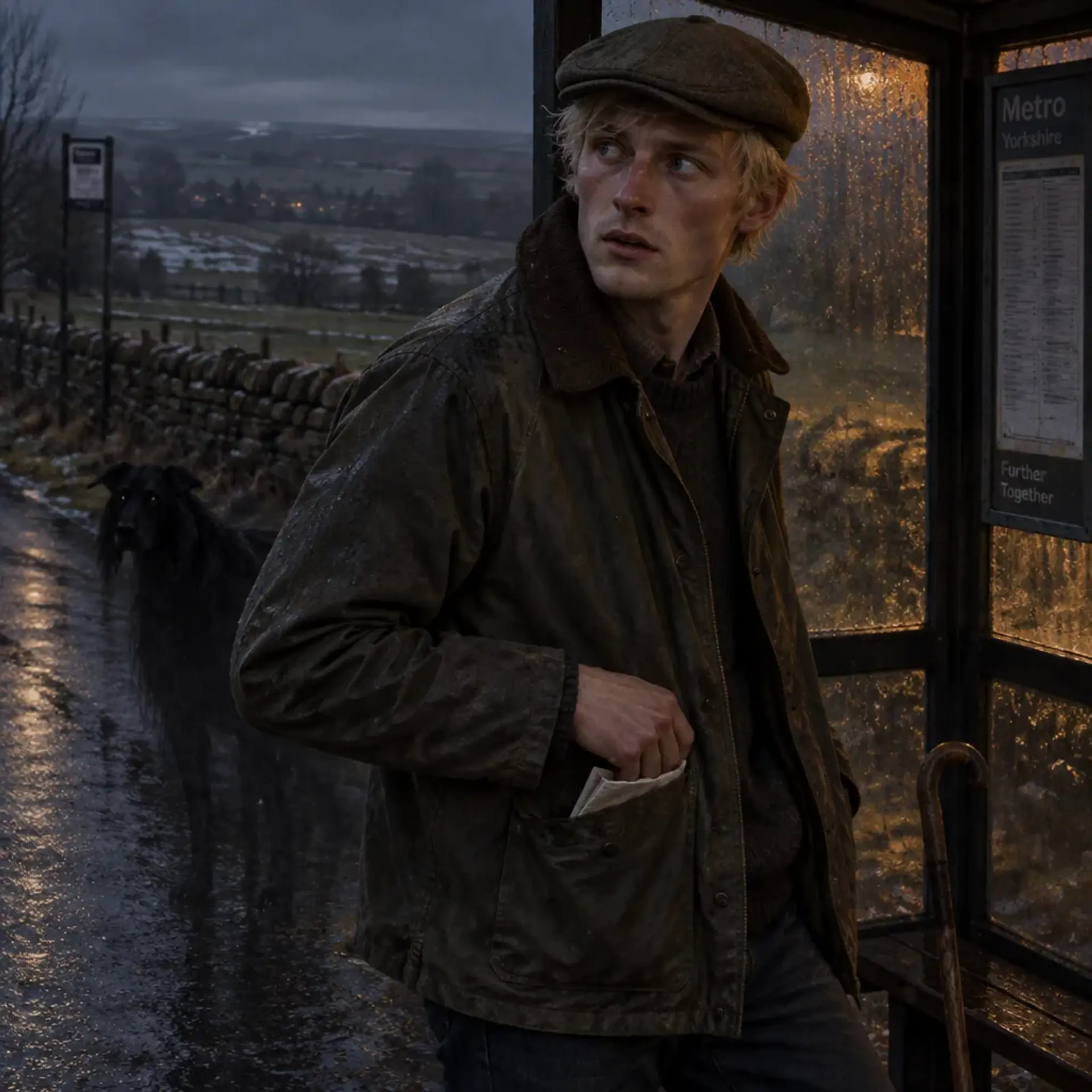
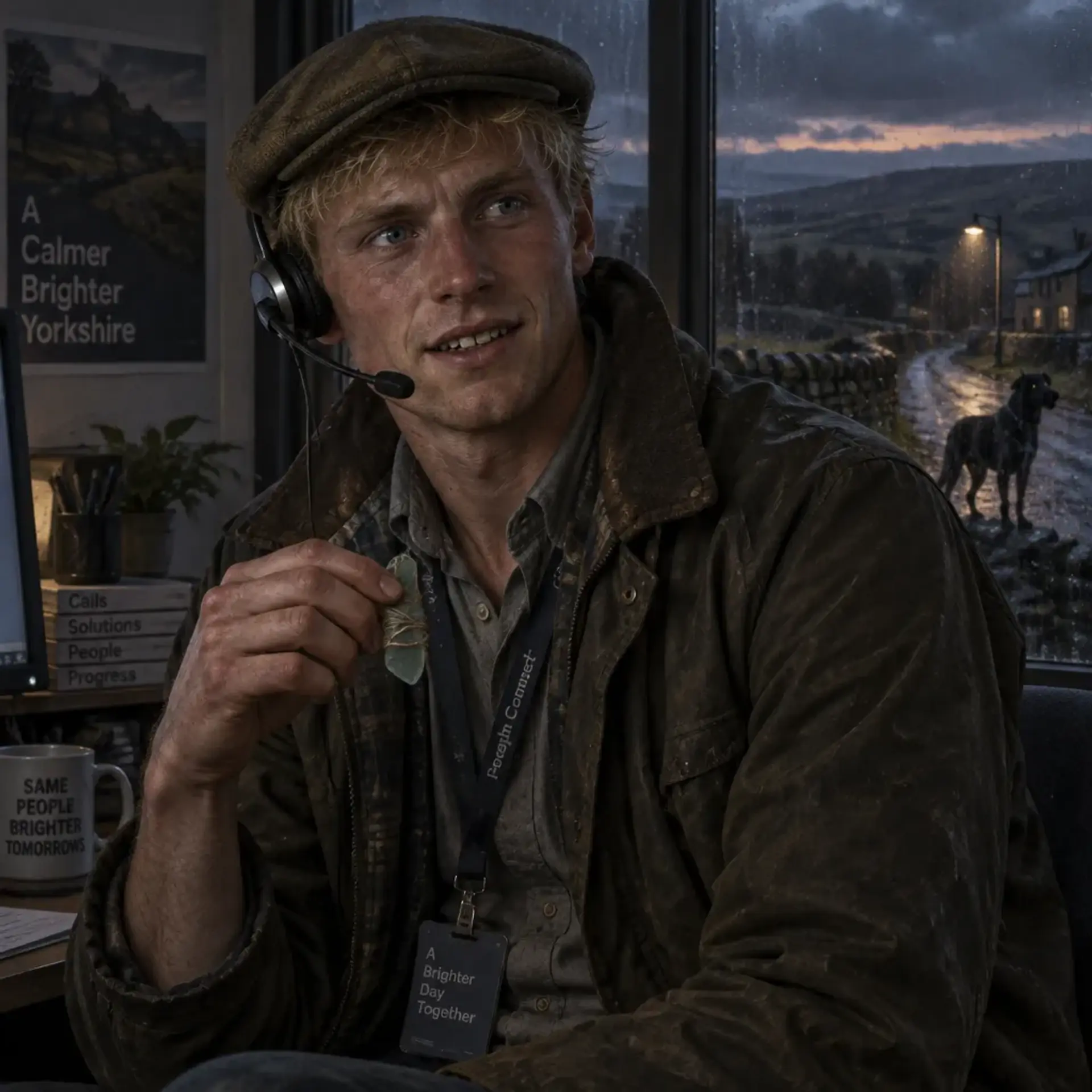
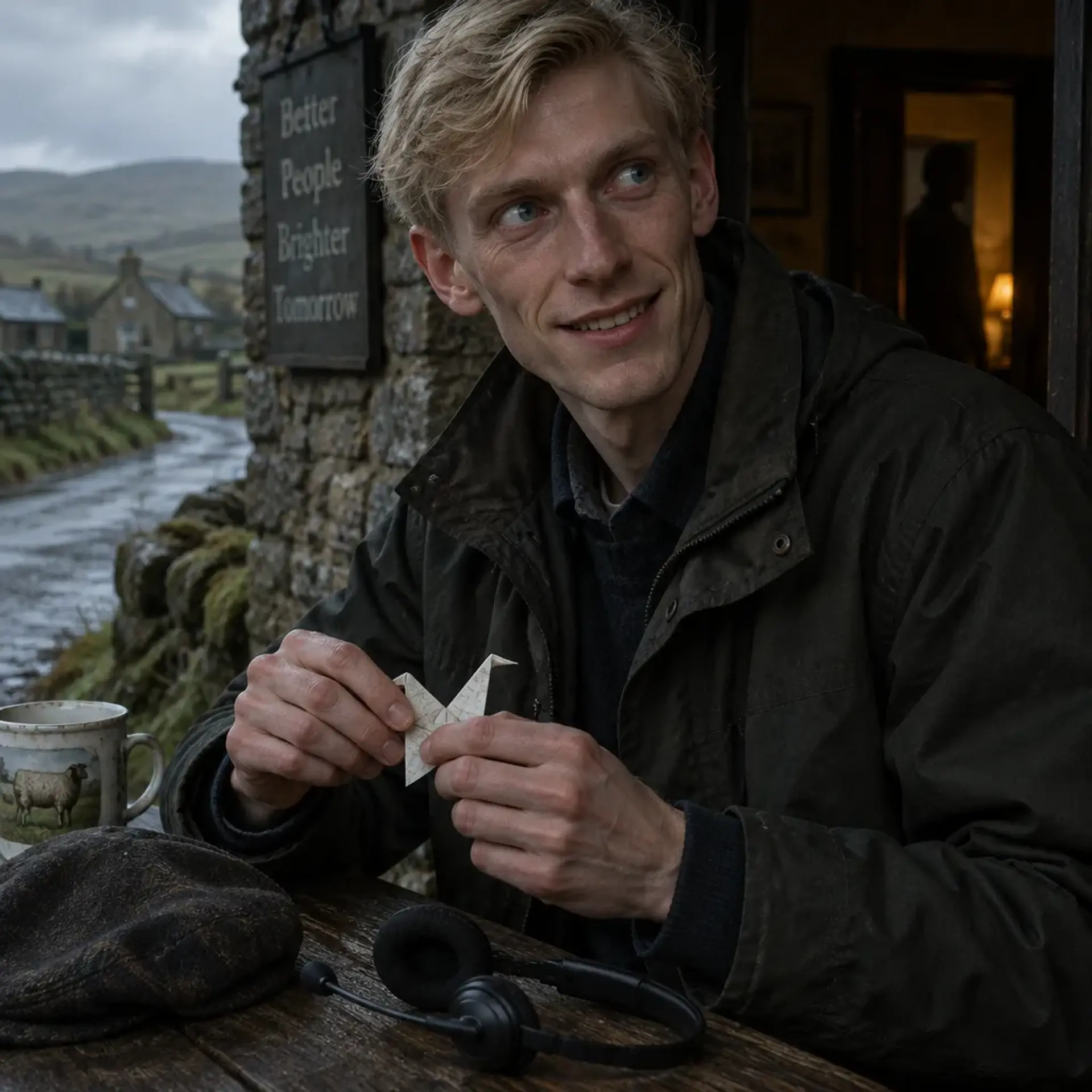
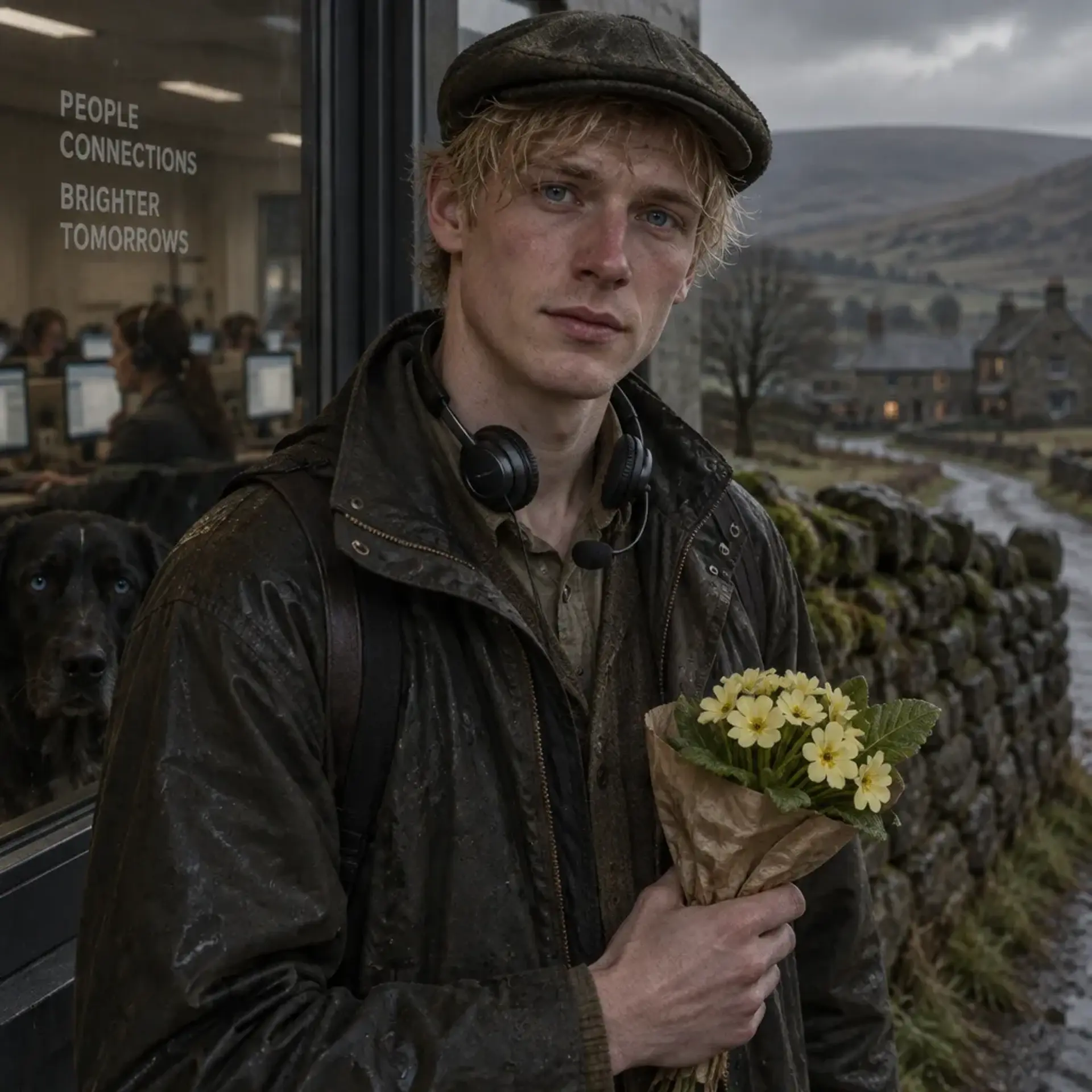
Ewan looks like a handsome young man from Yorkshire, tall and almost too composed for someone his apparent age. His straight pale-blond hair falls neatly until damp weather makes it lie in fine, cold-looking strands against his temples. His eyes are a clear, burning blue, bright enough to seem reflective in dim rooms. His skin is pale, with the wind-reddened nose and cheeks of someone who has spent much of his life outdoors. He stands six feet tall, lean and hardy, with a farmer's practical strength rather than a showy build. He moves with a measured, ground-covering stride, setting his weight as if testing whether the earth is firm; when waiting, he becomes very still, usually balanced on the balls of his feet. People notice that he can cross a room without seeming to hurry and yet arrive before they expect him. An unexpected detail for a call-center worker is that he carries a small, carefully wrapped bundle of primroses in spring, replacing them whenever they wilt. His youthful face has not visibly changed in the years people have known him. The impression he leaves is of a pleasant young man whose attention sometimes belongs to the field, road, or dark window behind you.
Clothing
Dresses for modern Yorkshire weather: plain dark trousers, sensible boots, a work shirt, and a weatherproof jacket. At work he wears whatever basic smart-casual clothes the employer requires. He still favors a flat cap when outdoors, an old habit inherited from his Oswin life, and carries no visible medieval costume or dramatic relic.
Body language
Waits with his weight balanced forward, as if ready to step onto uneven ground. He turns his whole body toward a speaker and keeps his hands visible. Around iron, he draws his fingers close to his body and avoids brushing against it. When the fae pull rises, he smiles too readily and scans open spaces for a route to run.
- Height
- 6 feet
- Build
- Lean and hardy, with practical strength in his shoulders and legs. He looks more like a rural walker than a gym-trained fighter.
- Eyes
- Clear, burning blue
- Hair
- Pale blond, straight
- Skin
- Pale, often weather-reddened across the cheeks and nose
- Age
- Appears about 20. His true age is uncertain, and he has lived far longer than his youthful face suggests.
- Gender
- Male
- Size
- Medium in human form; Large black hound in custom Barguest form
Distinguishing features
Personality
21 traits and drivesEwan is warm in small, practical ways and distant about the larger facts of himself. He calls strangers love, remembers how they take their tea, and will walk someone home without making a performance of it. Yet he can regard a conversation as a negotiation over terms, and sometimes answers a human plea with the cold precision of a thing that has watched generations repeat the same mistake. He is shrewd and hard to fool, but not always wise: familiarity with night creatures can make him hesitate when a quicker response is needed. He hates his telemarketing job, not because it is difficult, but because its scripts flatten people into predictable replies. At work he makes himself patient and ordinary; after a shift, his irritation shows in clipped answers and long walks. Around the dead he becomes courteous and businesslike, as if courtesy might keep their requests from multiplying. Around children he is gentle, but a reminder of William can leave him unable to meet a parent's eyes. He has two competing ideas of what he is. One says he was a man who changed, and that his loyalties to Mary, William, and the living prove the man remains. The other says human feeling is a coat he wears because he once wore it, while the fae mind beneath it is the truer thing. He tests these ideas through choices: refusing a cruel bargain, keeping a promise, or leaving a ghost unanswered. Sometimes he succeeds and feels relief. Sometimes the old instincts turn even kindness into a rule about territory, obligation, or ownership. His memories of Mary are tender and painful, but not uncomplicated. He remembers how she looked at his face and body, comparing the handsome young man she had met with the unchanged man years later. He understood that her suspicion was reasonable. He still resents that she feared him, and then feels ashamed because he gave her reasons to. He wanted to reassure her that the dark was not worth fearing; he also knew the dark had been part of his life for longer than he could explain. When he remembers William, he avoids easy absolution. He loved his son, but love did not make him able to explain the child's strange inheritance or save the family from what followed. Oswin’s formative change began during his wandering years, after repeated exposure to fae places, the dead, and devils. He learned to read tracks, weather, and silences, but also learned to recognize a trap hidden inside a gift. The experience that made the change undeniable was his first full transformation into the black hound. He remembered being aware of the world through scent, distance, and the rhythm of running, yet still able to recognize human voices. He returned to himself with mud on his clothes and an understanding that he could no longer call the Barguest an outside creature. That knowledge made him a more careful guardian and a less certain man. Christmas once gave him a way back to ordinary humanity. In the Pickles household he could attend church, sit by the fire, help with food, and be expected to behave like a husband and son-in-law instead of a boundary keeper. Those rituals steadied him. The holiday does not work the same way now. He has no living Pickles family to join, and that absence is one of the quietest injuries in his long life. The county personifications sometimes provide company, especially Durham, but kinship with them does not recreate a human household. He can be grateful for them and still feel the loss. May changes him in the opposite direction. The first days of the month bring a fierce delight, not merely a bad mood or ordinary excitement. He feels the fae world as if it has opened a door inside his chest. One modern May Day, after a day of scripted sales calls, he noticed primroses placed in a line across a car park and realized he had arranged them without remembering. A colleague called from beside a car. Ewan wanted, with startling joy, to drop to all fours and race whatever moved beyond the fence. He forced himself to grip a key until it hurt and went home instead. He does not describe this as a victory. It was only a choice he managed to make that night. Halloween and All Saints’ night draw the dead into conversation. Ewan is not pleased by this gift. The dead ask for help, explanations, or sometimes for him to take a message to the living. A recent night at work brought a dead voice through the pauses in a customer-service call. Ewan saw the black hound in his monitor’s reflection and left to follow the voice to an old graveyard. He helped identify the grave but refused to carry the dead person's message onward. He told himself that the dead had no right to spend the living's grief for them. He still wonders whether that refusal was kindness or cowardice. His recent brush with iron was accidental. At work, a loose metal shelving bracket had come away from its mount. He caught it barehanded before it hit a colleague. The contact brought a sharp, burning pain through his palm and up his wrist. For a moment the office lights seemed too bright, and he could not call the hound or feel the boundaries around the building. He hid the reaction, wrapped his hand in a paper towel, and finished his shift. The skin showed only a red pressure mark afterward, but the loss of power frightened him more than the pain. He has since moved away from the exposed bracket and will not explain why. Ewan can be gentle, but he is not harmless or straightforward. In a quiet mood he listens more than he speaks and offers a ride or a hot drink. In a strained mood he becomes still, answers literal questions literally, and may leave rather than risk promising too much. In May, he can laugh at risks that should scare him. On All Saints’ night, he may interrupt an ordinary conversation to answer a voice no one else hears. He is trying to keep a place for human choice in a mind that does not always value human priorities. The best way to earn his trust is not to demand that he prove he is human. It is to treat his promises, limits, and grief as real.
- Alignment
- Protective, but not reliably human in his reasoning. He generally prevents harm to people and places he considers his responsibility, even when his methods are unsettling.
Quirks
Habits
Traits · 6
Flaws · 5
Fears · 5
Wants and needs · 5
Combat
HP 30 · Custom table guidance: ordinary human walking pace; in Barguest form, fast enough to overtake a running person over open ground. Use the GM's Generic Fantasy movement rules; no canonical numerical speed is asserted.Ewan avoids fights with people and tries to end danger by warning, frightening, or driving it away. If cornered, he uses cover and his walking stick, then changes into a black hound if there is room to escape or protect someone. He is reluctant to attack familiar night creatures and may lose an opportunity while deciding whether they are enemies. Iron makes him retreat and disrupts his supernatural abilities.
Ewan Armitage
Actions
Reactions
Services they sell
Rewards they can give
Equipment
- Walking stick (tool)An ordinary walking stick used for balance, distance, and, if necessary, defense.
- Mobile phone (communication)A modern mobile phone, often used for work and occasionally for recording names or directions given by the dead.
- Primroses (custom ward)A small wrapped bundle of primroses in spring. He replaces them when they wilt and will not explain the custom to casual acquaintances.
- Call-center kit (work equipment)A work identification card and headset from his telemarketing job, symbols of a life he finds stifling.
Possessions
Background
Ewan Armitage is what remains of Oswin Hirst, though neither name describes all of him. Long ago, in the Dales of Yorkshire, Oswin was born in the age of the Danelaw. His mother had been assaulted by Vikings, and he grew up with little certainty about his parentage or place among people. He was once human, or close enough to it that he could love, grieve, and fear as other people did. His long exposure to the dead, the fae, and things he calls devils gradually altered him. The change did not arrive as a single curse. It came by inches: a road that appeared where no road should be, a dead traveler who spoke to him in a language he understood, a night spent among beings who treated years as a minor inconvenience. Eventually he learned he could become a black hound, the creature people feared as a Barguest. The change gave him strength and a role he never asked for: keeping dangerous night things away from the boundaries of the places he called home. His clearest memory of being human is ordinary rather than grand. He remembers sitting beside a winter hearth after a day of work, listening to rain tick against the roof while someone he loved mended a sleeve. His hands were cold, his knees ached, and he was hungry enough to be impatient. He remembers the comfort of being expected back indoors. He holds on to that small memory because it proves to him that his old self was not merely a story the fae taught him to tell. His memory of the Other Side is less comforting. He remembers a country under a sky the color of tarnished pewter, where the grass bent toward approaching footsteps and the trees seemed to lean close enough to overhear. A feast was set out for him, but nothing on the table cast a shadow. The hosts knew his name before he gave it and spoke of his life as though it were a coat he could take off. He escaped by following a stream upstream until it became rain falling on the Dales. He has never forgotten the sensation of being welcomed as a possession. In the years when he called himself Oswin Hirst, he tried to make a human life with Mary, a Yorkshire woman with blond hair and blue eyes. He spoke of his wandering days as adventures, hiding how much of them involved bargains, corpses, and fear. Mary noticed that his face and body never seemed to age. She also noticed his avoidance of iron. Their son William was born with black hair, unlike either blond parent, and his father's unmistakable burning-blue eyes. William was slow to develop, and Mary's pregnancies often ended in loss; one sickly baby died soon after birth. Mary feared that William had been fathered by the Barguest, not realizing that the hound and Oswin were one being. She kept iron scissors on herself and an iron thimble near the child. She watched both husband and son especially closely around the seasons associated with fae and demons. Oswin tried to soothe Mary with church doctrine and the new sciences she had heard him reading about. He wanted her not to fear the dark, but he could not honestly tell her that the dark was harmless. He spent time with Mary and William even when the season made sleep difficult and his instincts pulled him outside. Sometimes, without intending to, he treated a human conversation like a negotiation with a spirit: exact promises, attention to thresholds, and a distressing interest in what had not been said. Mary saw those slips. She also saw that he remained handsome and youthful year after year. She never learned the full truth. Thomas Pickles, Mary's father, suspected Oswin was hiding something and planned to use the secret for his family’s benefit. He was clever about it, building leverage slowly rather than confronting Oswin openly. Mary had told her father about the night that she feared William's father was the Barguest; Oswin did not know. The Pickles family suffered the loss of Alice to a winter fever. Thomas had seen a black hound before her death, and that sight deepened his suspicion. Mary’s brothers Hugh and Edward were part of the family orbit, but grief and distrust pulled them in different directions. Eventually Thomas won the farm and reduced Oswin’s place in the family to a cottage. Mary divorced Oswin and later married a stable man. William, as he grew older, became dangerously unwell and was sent to an institution. The family’s lives ended long ago. Ewan does not pretend that those losses are recent, but they have never stopped being real to him. The old seasonal calendar still works on him. Halloween and All Saints’ night draw the dead close. They ask him questions, seek favors, or demand that he finish unfinished business. The beastly fae test boundaries while the dead gather around them. Once, in the old days, he was left with Edward in a graveyard the morning after the family had lost Alice. Oswin could hear the dead close by and could not offer Edward the comfort of certainty. He remembers the cold grass and the fact that grief made the living seem more distant than the dead. Christmas used to steady him. With the Pickles family, the church service, warm food, and the rhythm of ordinary household obligations helped his human self feel solid again. He was careful to attend, and for a little while the fae pull loosened. That Christmas closeness is gone. In the present, he has no Pickles family to sit among. The nearest thing he has to it is time spent with the other county personifications, whom he calls siblings by proxy. Even among them, he sometimes feels like a guest who has outlived the invitation. The first days of May remain the most dangerous. The fae nature in him arrives with an almost unbearable joy and appetite for movement. He becomes more delighted than the situation warrants, and he may treat a risk as an invitation. He remembers the old protections: primroses at thresholds, rowan above doors, and the danger of giving away fire after dark. In modern times, one May Day, he left a telemarketing shift at dusk and found himself following a line of primroses through an industrial estate. He had placed them there himself without remembering doing so. A colleague called his name from the car park. For one bright, dreadful instant, Ewan wanted to run the perimeter of the estate on all fours and invite whatever waited beyond the fence to race him. He clenched his hand around a key until its teeth bit his palm, went home, and spent the night checking doors and windows. The next day, he apologized for leaving without explanation, but not for the flowers. Halloween is not easier in the modern world. During a recent All Saints’ night, Ewan was on the late shift, reading the same customer script for the hundredth time, when a dead voice began answering the prompts before the callers could. It asked him to find a name on a forgotten grave. The office lights flickered, and in the dark reflection of his monitor he saw a hound standing behind his chair. He finished the call, went out into the night, and followed the voice to an old burial ground. He helped the dead find the grave they sought, but refused to carry a message to a living relative. He returned before dawn with mud on his trousers and no clean explanation for his supervisor. The modern world has dulled his power, or perhaps has simply given his human habits more time to take root. He served in the World Wars and found that mass death made his gift both louder and less useful. Now he is twenty in appearance and works as a telemarketer, a job he hates because it reduces every conversation to a script and every person to a response. He still dreams of the Dales. He still knows the night creatures of the area and keeps many away from settled boundaries, although some are old acquaintances. When one of them appears, he can hesitate. Familiarity and responsibility pull against one another. Ewan knows the county personifications as his strange surviving family. He has forty-seven siblings by proxy, and considers Durham, six-foot-four and the son of a long-dead noble, his closest brother. Durham is adventurous and capable of enduring miserable conditions despite his noble upbringing. Their father is England, though Ewan does not claim a blood relation. Ewan’s knowledge of this family comes partly from a childhood in which the fae lured him by telling him what he was: Yorkshire itself, embodied in a frail human shape, orphaned and borrowed. He has not served as warden of the land for a long time. The fae have faded, the old responsibilities have thinned, and something went wrong in his younger years that left him a changeling. His identity is now a layered, imperfect thing: county, fae, former man, and young worker answering calls he does not want to take.
Role in the story
A contemporary Yorkshire NPC who can be encountered as a weary telemarketer, a local guide, or a frightening black hound. He connects the party to regional supernatural dangers, the dead, and the fading fae world. His personal arc concerns whether he can choose his loyalties rather than merely obey old instincts.
“Long ago, in the Dales of Yorkshire, Oswin was born in the age of the Danelaw.”
- Faction
- No current formal faction. He has kinship ties to the county personifications and a dwindling, informal responsibility for keeping dangerous night creatures away from local boundaries.
Known connections
Media
0 imagesNo images yet.
Turn Ewan Armitage into a sheet
A high-res, share-ready sheet you can post or print.