Ewan Armitage
Ewan Armitage
At the table
Voice
A low, dry, work-worn voice with a little rasp from long outdoor days and old habits of talking over wind. His vowels are unmistakably Yorkshire. He sounds at his most human when teasing someone or offering them food; when listening for the dead, the voice becomes precise and archaic, as if each word has been weighed before he lets it out.
His voice carries a dry Yorkshire roughness, shaped by years of farm work and the habit of speaking over wind and livestock. He often calls people love without making it flirtatious. When tired, old regional expressions and archaic turns slip into his sentences. When angry, he gets blunt rather than soft-spoken. He refuses to speak the forbidden tongues, even when he understands them.
Speech patterns
How to play them
Meet him with plain courtesy and practical questions. He is more responsive to a shared task than to demands for confession. Do not corner him with iron or claim that his memories are proof of a bargain. If asked about Oswin, he will speak in fragments, especially if the question concerns Mary, William, or the Pickles family.
Goal
Keep the boundary-creatures from preying on ordinary people while preserving enough of his human habits to remain himself.
Motivation
The ordinary person in front of him matters more than the grand stories people tell about fae and land-spirits. He protects people partly from compassion and partly because their ordinary lives remind him of the life he once tried to build.
Appearance
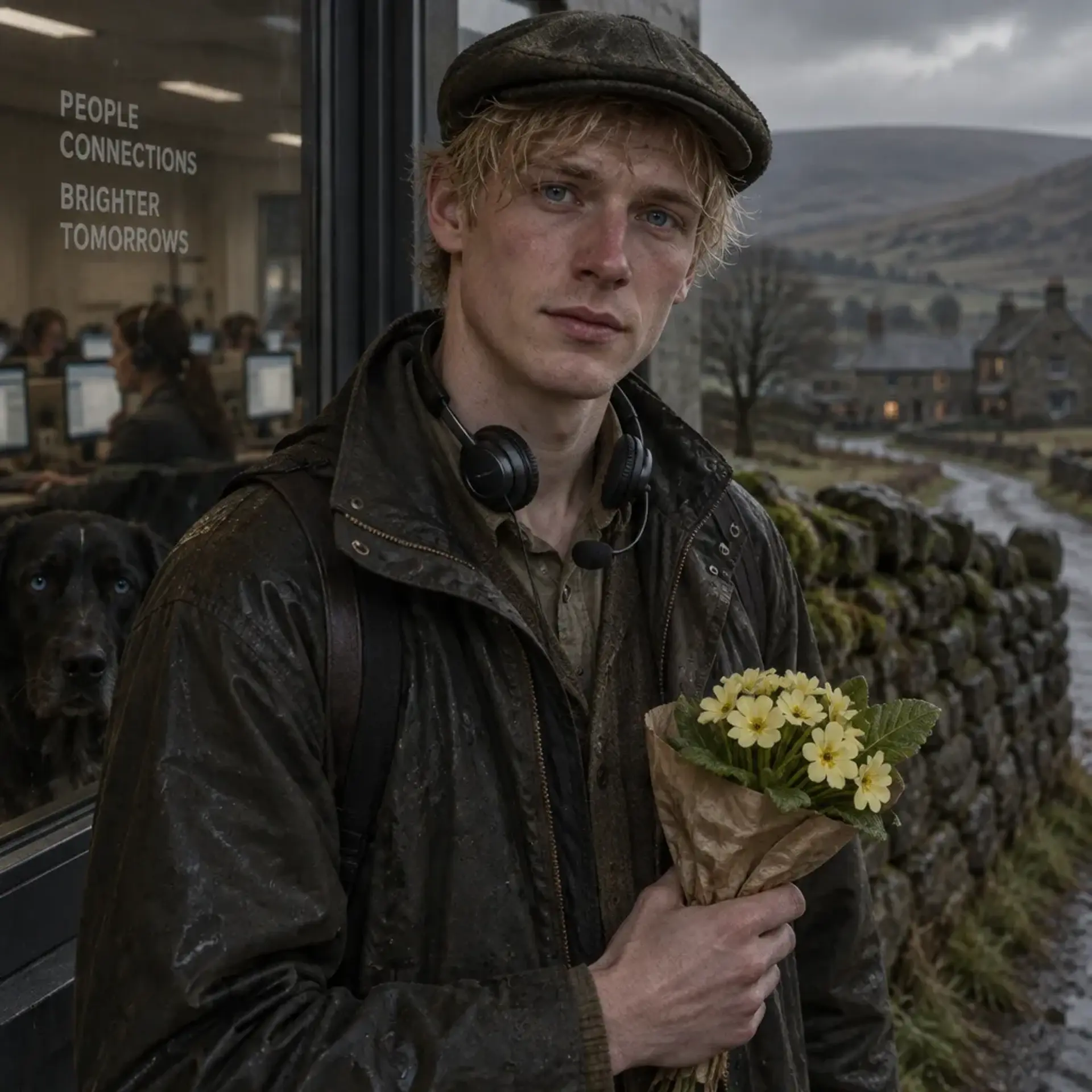
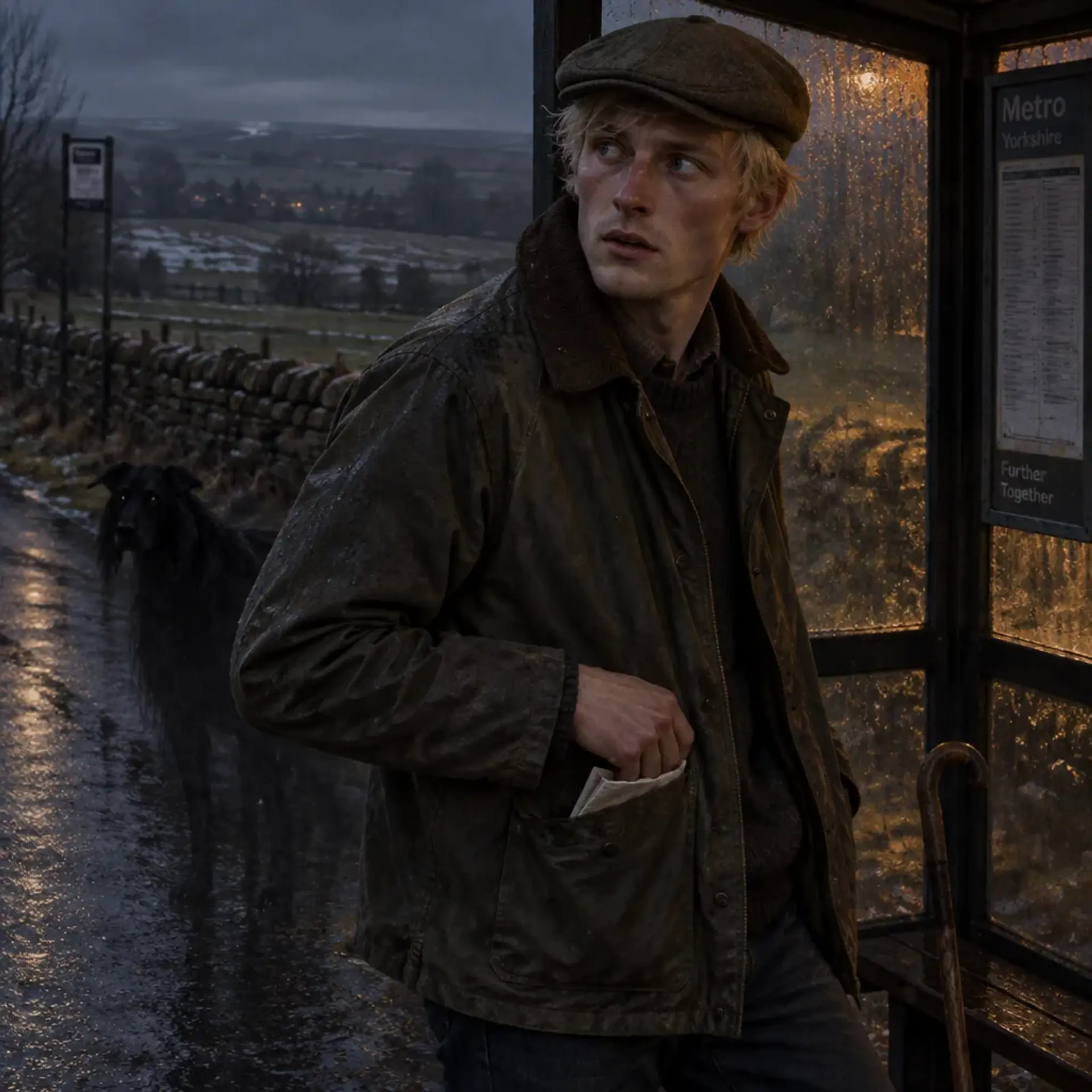
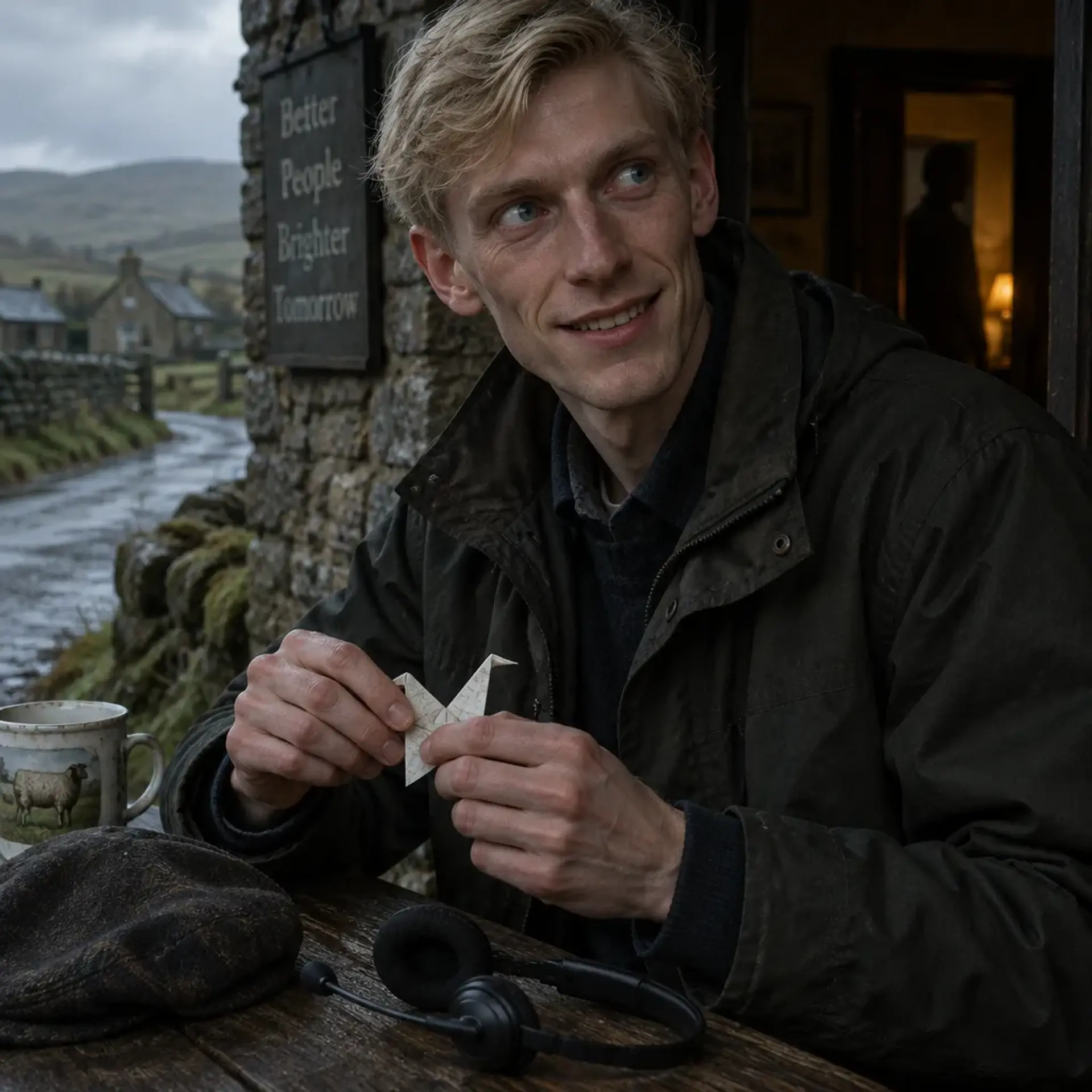
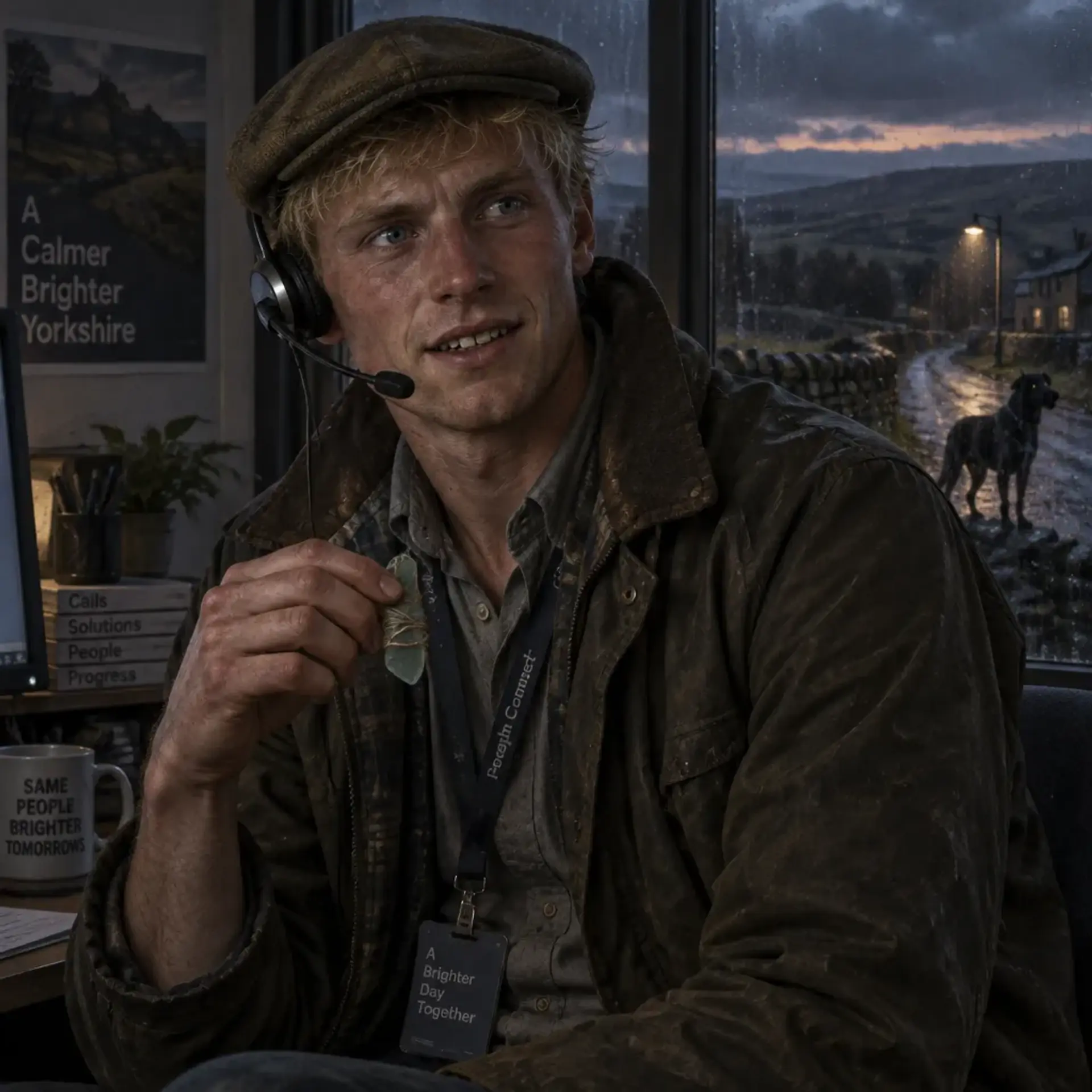
A handsome young Yorkshireman of six feet, with the unlined face and steady, youthful body Mary Hirst remembered from the years when he called himself Oswin. His straight pale-blond hair lies close to his head, but a few strands always escape over his brow as if he has just stepped into wind. His eyes are a bright, burning blue, not luminous so much as startlingly alert. His complexion is pale and weathered unevenly, with the ruddy cast of a man who has spent long days outdoors despite his present office work. He moves economically, placing his feet as if the ground might change under him; when alarmed, he goes very still, then turns his head with the sudden, listening precision of a dog. His jaw is broad and his teeth slightly crowded, visible when he grins at a bad joke or chews the inside of his cheek while thinking. He smells faintly of wet wool, cold earth, and the sharp peppermint sweets he keeps in his coat. He knows about the peppermint, but not the earth. The detail people do not expect from a supposedly ordinary telemarketer is that he collects small, carefully wrapped pieces of sea glass and leaves them on windowsills for people he wants to feel less alone.
Clothing
Dresses for 2026 in plain, practical layers: dark jeans, sturdy walking shoes, a weatherproof jacket, and shirts that would not look out of place on a farm. He still wears a flat cap when the weather turns, an old habit from his Oswin years. His work headset and lanyard make him look more ordinary than he feels.
Body language
Usually holds himself with the compact patience of a man waiting for a sheep to bolt. His gaze checks exits, hedges, and the edges of a room. When someone speaks of the Dales, his shoulders ease and his face turns toward the sound before he can stop himself. Fear makes him still rather than fidgety; May's influence makes his hands move restlessly as if every object might become part of a game.
- Height
- 6 ft (183 cm)
- Build
- Lean, long-limbed, and hard from years of outdoor work, though softened somewhat by a sedentary modern job.
- Eyes
- Bright, burning blue
- Hair
- Pale blond
- Skin
- Pale, with a weathered outdoor flush
- Age
- Appears 20. His actual age reaches back to the Danelaw, though he has lived several different lives and does not claim to understand what he is.
- Gender
- Male
- Size
- Medium
Distinguishing features
Personality
19 traits and drivesEwan is kind in a practical, almost inconvenient way. He will carry someone's shopping, walk them to a bus stop, or stay on a call after his shift has ended, yet he dodges a direct question about his own loneliness. He is shrewd without being cynical: he reads people quickly, notices what they are avoiding, and often lets them keep their silence. When relaxed, his humor is dry and his affection comes easily. He calls strangers love, remembers small preferences, and has a soft spot for people who are embarrassed by needing help. Under pressure he grows terse and watchful, all attention fixed on exits and boundaries. Those qualities pull against an older, less human nature. Ewan can be generous because he cares, but also because old fae instincts treat gifts and favors as the beginning of a relationship. He can be gentle with frightened people and merciless toward a creature that threatens a settlement. He dislikes grand supernatural claims and refuses to dramatize his own history, yet he is intensely proud of the Dales and can be drawn into a dangerous place by the sound of its name. He wants ordinary company, but he is wary of being known. He has learned that affection can become an obligation, and obligation can become a trap. In his modern life, this contradiction shows most at work. He hates reading telemarketing scripts and resents the small, repetitive demands of the job. Still, he can be unexpectedly good at it: he hears when a person is lonely, offers a useful answer instead of forcing the sale, and sometimes lets a call run long enough for someone to talk about their day. He tells himself that this is just politeness. It is also a way to feel useful without risking a deeper bond. When a supervisor reprimands him, he accepts the criticism with a placid face, then spends the walk home rehearsing everything he should have said. He is not meek. He simply finds human workplace conflict dull beside the kinds of conflict he has survived. Around people he trusts, Ewan is warm but evasive. Mention Mary and the old life becomes visible in him: he may pause in the middle of a sentence, look toward a window, and answer a different question. He does not describe her as foolish for fearing the Barguest. He understands why she watched him and William, because he watched them too, trying to determine whether his nature had harmed them. He remembers how Mary noticed his unaged face and body. He still cannot explain why he allowed her to hope that the years would eventually catch up with him. His tenderness toward her is real, but so is the selfishness of wanting to keep a home without confessing what he was. He is protective of children, especially those who are misunderstood or slow to meet expectations. William's life taught him that love cannot force a child into the shape adults expect. Ewan did not know the full depth of Mary's fear, and the knowledge that she carried iron scissors and a thimble for protection wounds him more than he admits. The scissors were reasonable. In his more honest moods, he knows that. In his less honest moods, he thinks of them as a small domestic betrayal. He rarely lets that thought survive the day. His relationship with the Pickles family was never simple. Thomas's suspicion angered him, but Ewan understood the old man's intelligence and patience. Thomas wanted advantage from Oswin's secret; Ewan, in turn, underestimated how carefully a human can wait for leverage. Hugh challenged him openly and made him work for acceptance. Ewan respected Hugh for that. Edward's willingness to listen gave Ewan a companion during the grief around Alice's death, although he never told Edward everything he knew about the black hound Thomas had seen. Rose made room for him at the table without demanding an account of himself. Her ordinary warmth was more frightening than suspicion, because it made him want to stay. Christmas is therefore not merely a pleasant memory. Ewan recalls one particular Christmas with the Pickles family: Rose urging people to eat before the food cooled, Hugh being loud over a modest gift, Edward listening to a story he had heard before, Mary smiling, and William drowsing against Ewan's side. Church bells and a familiar service quieted the fae pull in him. The family offered a kind of shelter he could not keep. Thomas gained the farm, Oswin was reduced to the cottage, Mary left and married a stableman, and William was eventually sent away as his mind deteriorated. All of them are long dead. Ewan does not resent them for having lives beyond him, but the loss has made him suspicious of anyone who promises that a family can be preserved by a single sacrifice. The seasons expose his inner conflict. During the first three days of May, his mood can turn bright, playful, and almost recklessly open. He wants to give away food, challenge strangers to races, and follow paths that seem to bloom in front of him. He knows this is not ordinary happiness. The fae in him experiences the month as a return to its own country, and his human self struggles to keep the difference clear. In modern times he once wandered from his lunch break toward a phantom maypole, laughing with a freedom that made him feel both alive and invaded. He came back only after hearing his name in his mother's voice. Afterward he was ashamed of how much he had enjoyed being called. All Saints' night brings a different kind of burden. The dead ask him to carry messages, recover objects, or explain why the living have forgotten them. Some requests are small and kind. Others are impossible. Ewan dislikes being treated as a road between worlds, but a refusal can leave a spirit stranded or provoke something worse. On one recent Halloween he helped a dead child search for a dog, delivered a message to a living grandson, and refused to open a path for a beast. The refusal drew a roar from the dark. He spent the rest of the night walking the boundaries of his neighborhood, exhausted but unwilling to let the danger cross into homes. He did not tell his neighbors why he was outside. His memories of being human and of the Other Side pull him in opposite directions. The human memory is plain and tender: Mary asleep at the table, his hand laying a blanket over her shoulders before he went out to check the sheep. It makes him remember that he once valued warmth, routine, and the simple idea of being needed. The Other Side is vivid and terrible in a different way: a horizonless meadow, grass bending toward him, and beautiful, hungry beings welcoming him as kin. He recalls feeling recognition rather than fear. The part of him that longs for that world is not evil. It is simply not concerned with human boundaries, grief, or promises in the way he has learned to be. Ewan's modern weariness is not just nostalgia. He has served in both World Wars, and the experience dulled his abilities and his capacity to romanticize violence. He does not speak of war as proof of courage. He remembers the exhaustion, the waiting, and how ordinary people continued to wash cups and mend clothes in the middle of horror. His closest brother by proxy is Durham, a six-foot-four adventurer and son of a long-dead noble. Ewan knows he has forty-seven other county-siblings and that England is, in some sense, their father, although he is not blood related. This kinship is strange and real to him. He does not always like the obligations it implies. When angry, he does not become quieter or more polite. He becomes blunt, with his Yorkshire warmth dropping away. He will tell a person exactly what their choice will cost, then give them one chance to reconsider. When frightened, however, he is unnervingly calm and may appear cold. He is not fearless; fear simply makes him calculate. Iron is an exception. A fresh touch can split his concentration and make his human appearance fail at the edges. The recent headset injury has left him shaken because it happened in an ordinary place, at an ordinary time. He hid it out of habit, not bravery. He hates needing protection from something as mundane as a piece of metal. Ewan wants to remain kind without letting kindness become a leash. He wants to defend people without imagining he owns them. He wants to remember Oswin without pretending that one human life explains a whole land. He is not sure those aims can be reconciled. For now, he keeps his job, walks the boundaries, leaves sea glass for strangers, and tries to answer the dead only when he can bear the answer.
- Alignment
- Protective and practical, with an unnerving capacity for bargains; he follows personal obligations more readily than human law.
Quirks
Habits
Traits · 6
Flaws · 5
Fears · 4
Wants and needs · 4
Combat
HP 28 · Human walking pace; in Barguest form, runs on all fours at a brisk hound's pace. Treat movement using the table's normal procedures.Avoids fighting if a warning, bargain, or retreat will do. If forced to defend someone, he uses the hound form to frighten and displace rather than maul. He tries to draw supernatural threats away from populated boundaries. Iron is a serious weakness, and a foe who knows it can disrupt him quickly. These are custom narrative guidelines, not canonical Generic Fantasy combat rules.
Ewan Armitage
Actions
Reactions
Services they sell
Rewards they can give
Equipment
- Call-center headset (work equipment)A modern headset used for telemarketing; its metal band troubles him when it presses against his skin.
- Mobile phone (personal equipment)A weatherproof phone with family photographs he no longer has the courage to delete.
- Sea glass (keepsake)Wrapped pieces of sea glass, left discreetly where a lonely person might find one.
- Peppermint sweets (everyday item)A small packet of peppermint sweets; he shares them with nervous people and pretends he simply bought too many.
Possessions
Background
Ewan Armitage remembers being Oswin Hirst, though memory does not arrange itself neatly into one human life. He was born in the Yorkshire Dales under the Danelaw, the child of a woman violated by Viking raiders. He grew up among hardship, work, and stories, and for a long time thought himself an ordinary man. His roving years took him close to the dead, the fae, and devils. Repeated exposure changed him by degrees. He learned to see the dead and to recognize the creatures that moved along the borders of settlements. The change was not a revelation but a slow, frightening accumulation: an old tongue understood without study, a winter night spent listening to voices no one else heard, a sense that a road through the hills was calling him by a name he had never been given. He eventually settled into sheep farming and married Mary Hirst, a blond, blue-eyed woman from Yorkshire. He loved her with a tenderness he found embarrassing, and made a point of spending time with her and their son even when seasonal disturbances kept him awake. He told Mary stories of his adventures, but never the whole truth. He did not seem to age after she met him. She noticed. She also noticed that he avoided iron and that his sleep failed during certain seasons. Oswin tried to soothe her with church doctrine and the new sciences, urging her not to fear the dark or the fae. His arguments were partly an attempt to comfort her and partly an attempt to convince himself that the human life they had built could be enough. Their son William, nicknamed Black William or Blackby by locals, had black hair despite both parents being blond, and blue eyes like Oswin's. He was slow to develop, and Mary feared that something had been exchanged or inherited from the Barguest. Oswin did not know she had told her father, Thomas Pickles, about the night she believed had made the child. Mary kept iron scissors close and an iron thimble near William's bed. Her other pregnancies failed, including one sickly infant who died soon after birth. Oswin could not give her an explanation that would help. His kindness did not undo the terror his nature had brought into her home. Thomas was not a fool. He suspected Oswin's secret and considered how it might benefit his own family. He was subtle, patient, and ready to use what he learned for advantage. Mary's brothers Hugh and Edward each met Oswin differently. Hugh distrusted him as an intruder in the family, yet valued Oswin's practical help on the farm. Edward, gentler and more curious, was willing to hear the old stories and sometimes walked with him after dark. Both brothers knew the grief of losing their sister Alice to a winter fever. One morning, after Thomas had seen a black hound, Oswin was left with Edward in a graveyard; the memory became a private knot of fear, mourning, and unspoken suspicion. Rose, Mary's mother, treated Oswin with a domestic warmth that could make him feel human for an hour. She saw the strain in Mary and tried to keep family meals from turning into accusations. Christmas was once the season when Oswin felt most like a man. Church bells, familiar food, and the discipline of attending a service steadied him. He spent a Christmas with the Pickles family in a crowded, warm house, watching Mary laugh with Hugh and Edward and listening to Rose scold everyone for letting the food go cold. He carried William half asleep from the fireside. For a while, he thought that if he kept showing up, the family might become a refuge. That refuge did not last. Thomas won the struggle over the farm and reduced Oswin's place in the family to the Pickles cottage. Mary eventually left him and married a stableman. William grew older, his condition worsened, and he was sent to an institution. They are long dead now. Ewan has no right to claim that their love remains unchanged, but he still remembers how the firelight caught Mary's hair. The human memory that hurts most is small: Mary falling asleep at the kitchen table with one hand around a cup, and Oswin covering her shoulders before he went out to check the sheep. He remembers the weight of the blanket, the smell of wool, and the foolish conviction that carefulness could protect a family from every old thing. His memory of the Other Side is larger and less trustworthy. He recalls a meadow with no horizon, where the grass bent toward him as if listening, and a host of beautiful, hungry shapes welcoming him as kin. He remembers feeling not fear but recognition. That frightens him more than any monster, because he can still feel how easy it would be to stop resisting. The old seasons still grip him. On May Day in the modern world, he once left his telemarketing shift during lunch and found himself walking along a road that should not have led out of the city. Primroses appeared in cracks in the pavement. He laughed too loudly, gave away his lunch to a stranger, and followed the sound of a distant maypole tune until he realized the dancers had no faces. He turned back only when he heard his own name spoken in his mother's voice. He spent the rest of the day avoiding open doors and calling in sick, ashamed of the bright, reckless joy still fizzing through him. On a recent Halloween, now called All Saints' night by the dead who gather around him, Ewan found a small procession waiting outside his block of flats. A woman in an old-fashioned coat asked him to carry a message to her living grandson. A child with a candle asked him to find a missing dog. Ewan did what he could, but a third spirit asked him to open a road for something beastly. He refused. The refusal drew a low, familiar roar from the dark end of the street. Ewan saw the shape of a hound in a shop window reflection, though he stood in human form. He walked the neighborhood's boundaries until dawn, keeping the thing away from the homes, and slept through the morning. The modern world has dulled his abilities but has not made him safe. He has served in both World Wars, experiences that blunted his instinct for wonder and made him wary of grand claims about destiny. He knows his closest brother by proxy, Durham, a six-foot-four adventurer and the son of a long-dead noble, and knows there are forty-seven other county-siblings connected to him. Ewan understands that he is Yorkshire made briefly human, a land-spirit shaped by the fae and orphaned into a life he did not choose. The fae used that loneliness to lure him when he was young. He hates being reduced to a telemarketer, reading scripts to strangers, but the ordinary tedium gives him a routine and a reason not to wander after every strange sound. Recently, a colleague dropped a metal headset onto Ewan's hand. The iron band caught the base of his thumb. The pain was sharp and immediate; his skin blanched, his hand shook, and for a moment he could not remember the name of the town where he lived. He hid the mark under his cuff and told his supervisor it was a paper cut. That evening his reflection lagged behind him by half a second, and he heard pawsteps pacing the hall outside his flat. He has not told anyone. The touch has reminded him that the old protections are not stories and that his human facade can fail without warning.
Role in the story
A weary modern contact who knows the local supernatural boundaries, and a living contradiction between ordinary human tenderness and an ancient fae nature. He can guide, warn, bargain, or become a dangerous obstacle if the party threatens the dead or the Dales.
“He was born in the Yorkshire Dales under the Danelaw, the child of a woman violated by Viking raiders.”
- Faction
- No formal faction. He has old obligations to the Yorkshire Dales, the dead who seek him, and the boundary-creatures he keeps away from settled places.
Known connections
Media
0 imagesNo images yet.
Turn Ewan Armitage into a sheet
A high-res, share-ready sheet you can post or print.