Oswin Hirst
Oswin Hirst
At the table
Voice
A clear, weathered voice with a soft Yorkshire cadence, as if shaped by cold air and years of speaking over wind. Its warmth is genuine but measured. When he says his own name, it sounds ordinary; when he speaks the word hound, there is a faint roughness at the back of the throat.
Plain Yorkshire English warmed by local turns of phrase. He often calls people love, but does not use it as a promise. Old vocabulary slips in when he is tired. He avoids forbidden languages entirely, explaining that some words should stay unspoken. When agitated, his consonants become clipped and his breath carries a faint rasp, like a dog holding back a growl.
Speech patterns
How to play them
Approach him with practical questions and give him time to decide whether to answer. He is warmer when offered ordinary company without demands. Do not threaten his family memories or corner him with iron. He responds to sincerity, careful boundaries, and people who protect others without demanding praise.
Goal
Keep his human identity intact while finding a way to serve the Dales without being ruled by the old bargains.
Motivation
To retain the capacity for human affection and protect the living from the same careless bargains that shaped him.
Appearance
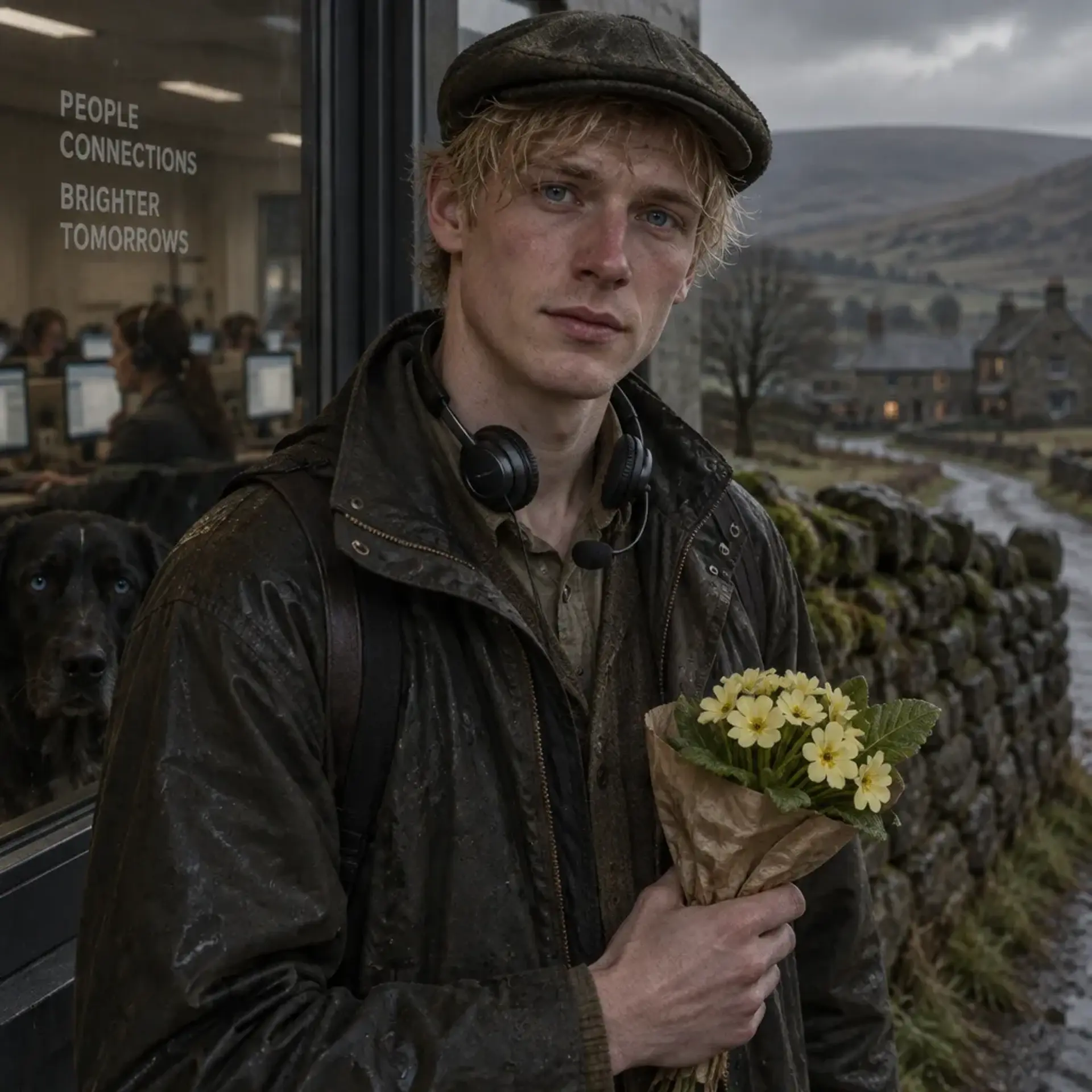
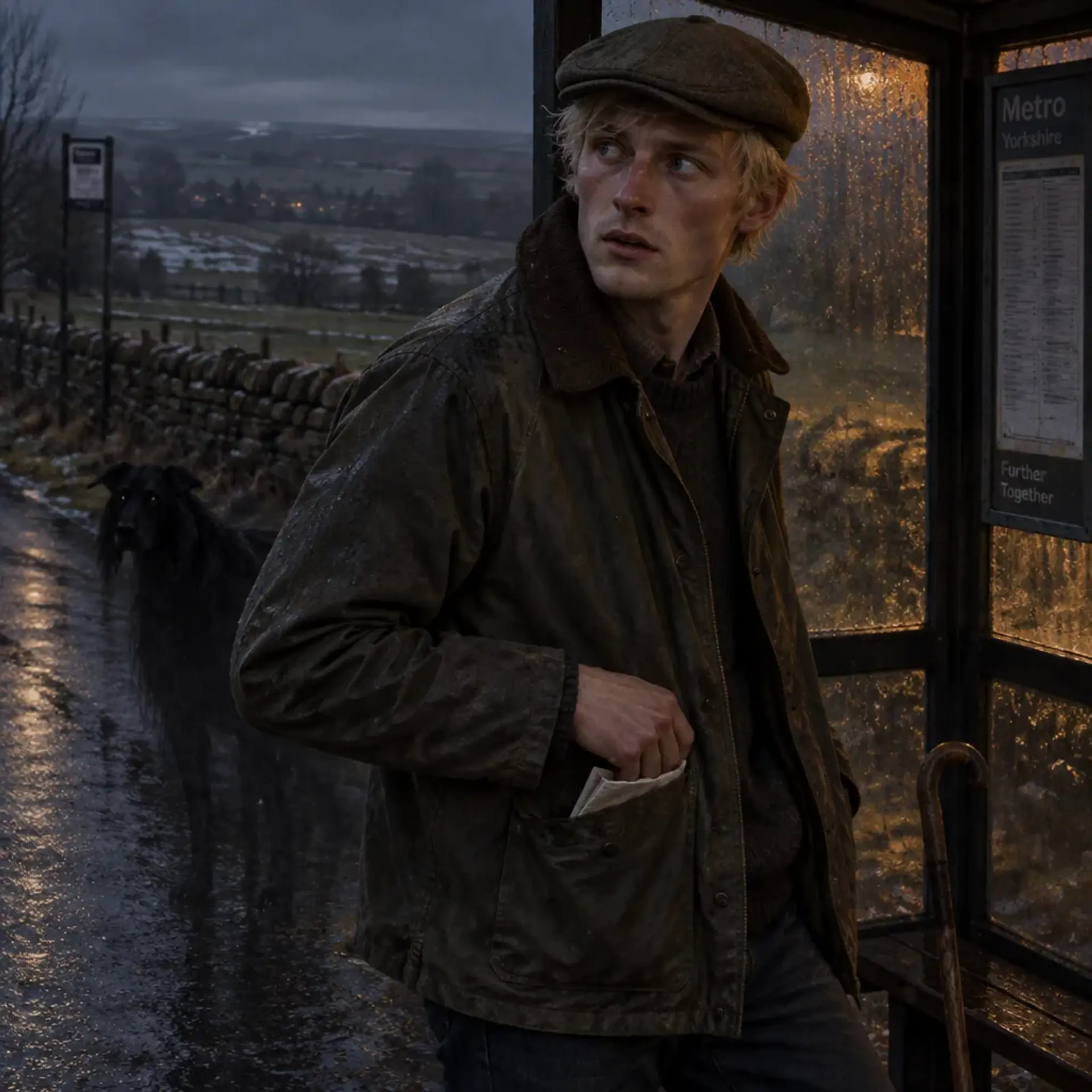
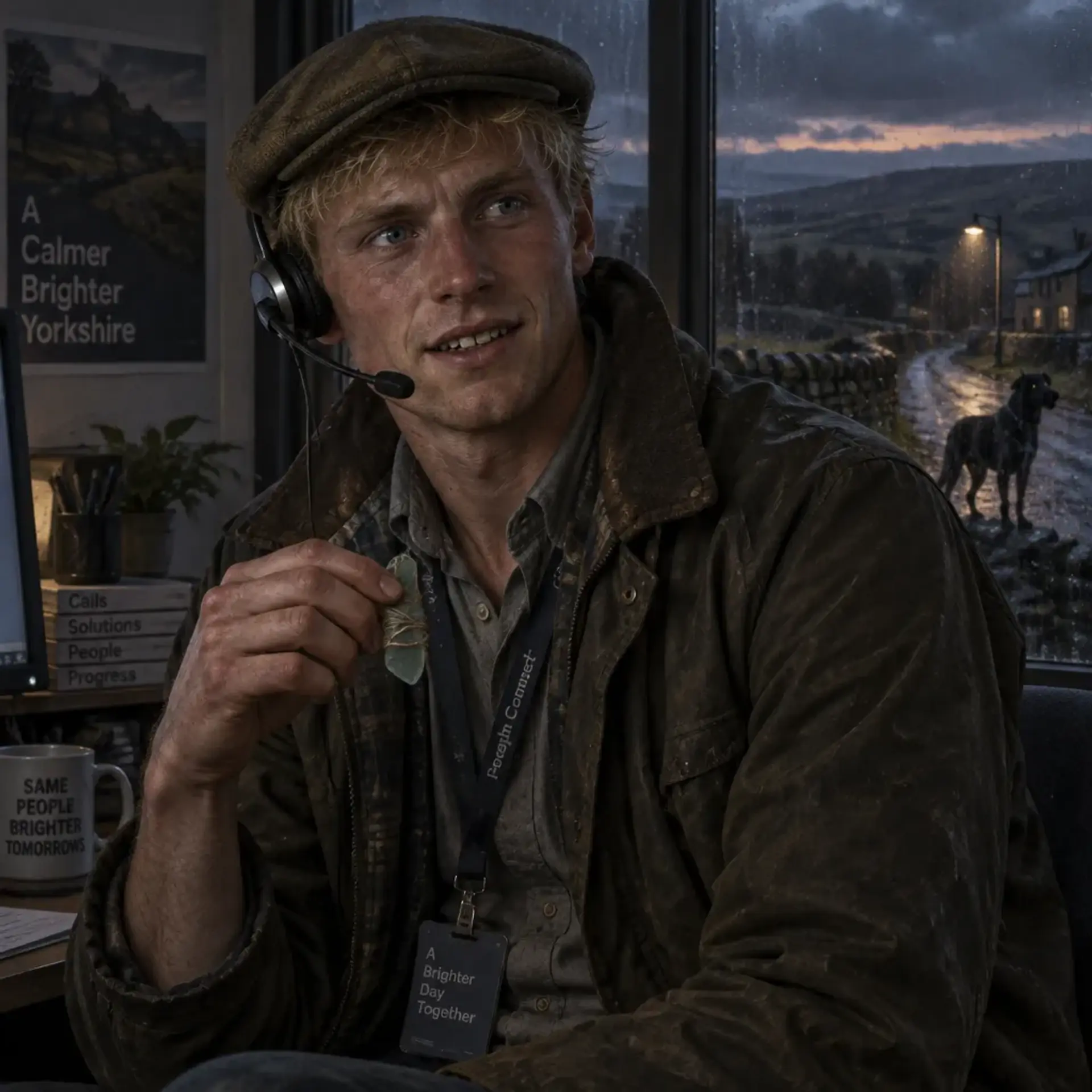
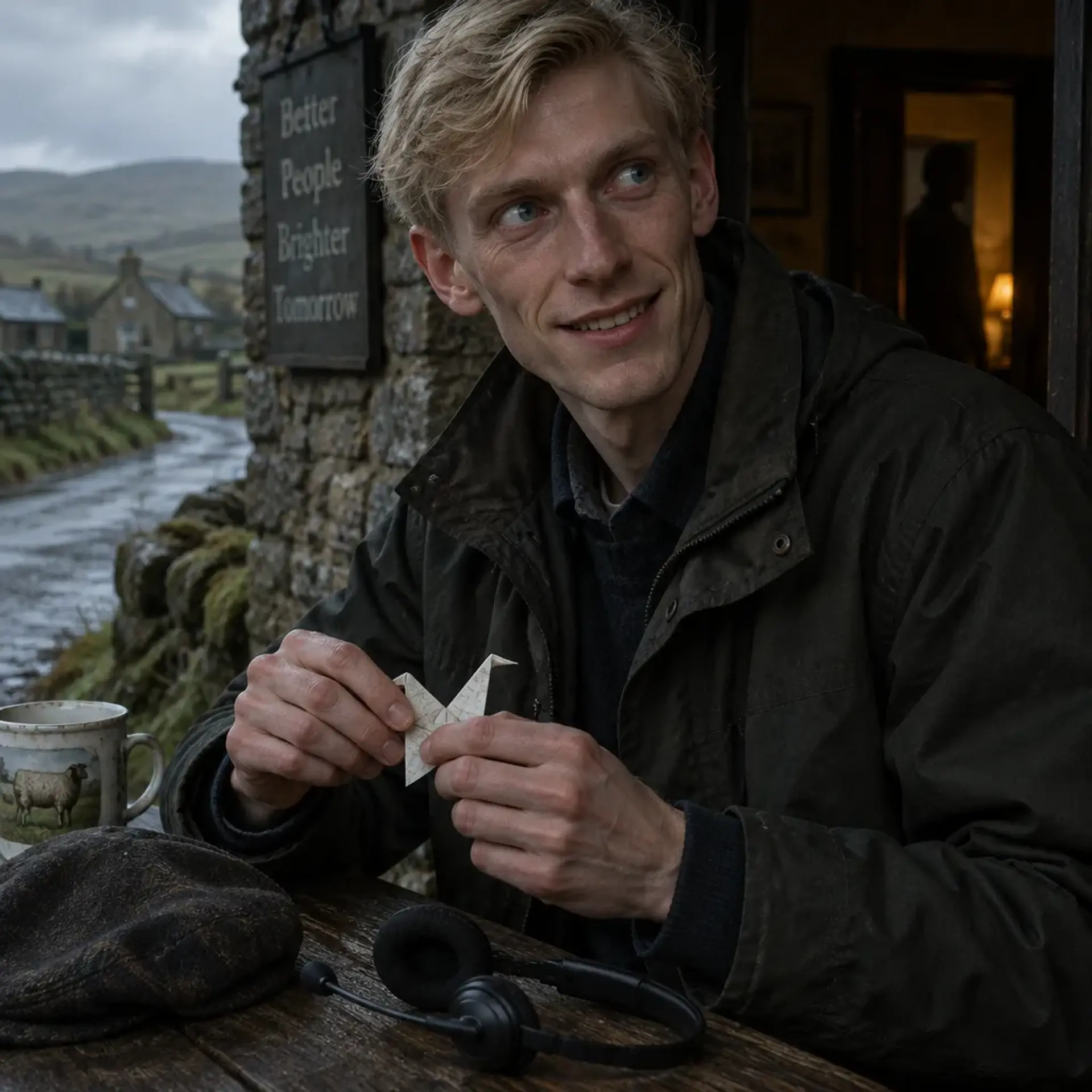
A handsome, conspicuously youthful Yorkshireman, six feet tall, with straight pale-blond hair that falls neatly until damp weather makes it lie in thin, bright ropes. His face is smooth and open at first glance, but his smile shows broad, close-set teeth and a jaw that works side to side when he is thinking. His blue eyes catch lamplight with a startling, almost heated clarity. He moves like someone accustomed to uneven hills: feet placed carefully, shoulders loose, then sudden, dog-fast turns of attention. He adjusts the seam of his left cuff with his thumb whenever he sees a doorway. The unexpected detail is that he keeps a tiny, carefully folded paper bird in his wallet and refolds it when frightened. People remember that he looks young enough to be mistaken for a student, yet seems to know when the road behind them has become unsafe.
Clothing
Contemporary practical clothes suited to 2026: dark jeans, a weatherproof jacket, plain trainers, and a flat cap when he wants to look unremarkable. He keeps his old-fashioned restraint in the neatness of his cuffs and avoids metal accessories.
Body language
He plants his feet carefully as if judging the ground beneath them, turns his head too quickly toward distant sounds, and rubs his left cuff when uneasy. When a fae impulse rises, his smile broadens before his eyes catch up. His jaw shifts when he is suppressing a thought.
- Height
- 6 feet (183 cm).
- Build
- Lean, long-limbed, and hardy, with the economical strength of someone accustomed to hills and farm work.
- Eyes
- Clear, burning blue.
- Hair
- Pale blond, straight, and neatly kept.
- Skin
- Pale, with a weather-reddened cast after time outdoors.
- Age
- Appears 20; true age spans many centuries. He has lived under other names and survived both world wars.
- Gender
- Male
- Size
- Medium
Distinguishing features
Personality
17 traits and drivesOswin is gentle in ways that do not make him harmless. He will give a stranger directions, lend his coat, or patiently explain a phone contract, then turn frighteningly decisive if that stranger threatens a child or crosses a boundary he has sworn to guard. He is shrewd and practical, distrustful of grand promises, and yet there is an old part of him that longs to be swept into wonder. He resents that longing because he knows how easily delight becomes obedience in the fae world. In ordinary company he is warm, dryly funny, and fond of calling people love. At work he performs patience while inwardly despising the scripts and the demand that he sound cheerful on command. In grief he becomes exact and quiet in his choice of words, not because he has grown polite but because he is afraid that careless speech will make a promise. When frightened, he touches his cuff, checks the exits, and tries to turn the conversation toward something practical. The seasons expose the contradiction most sharply. Christmas once brought him close to being human again, especially when he attended church and sat with the Pickles family. He remembers that warmth as a gift he no longer possesses. May is the opposite: the first three days can fill him with such unearned delight that he feels invulnerable and may accept an invitation before considering its cost. On Halloween and All Saints' Eve, he becomes tired, alert, and burdened by the dead, who ask him to carry messages and settle old business. He dislikes their demands, but he does not always refuse. He believes himself to be Yorkshire in a human shape, not merely a man who happens to live there. That conviction makes him protective of the land and resentful of how much the modern world has flattened it into roads, schedules, and call-center scripts. Yet he does not romanticize his past: he remembers hunger, violence, the loss of Mary and William, and the frightening pleasure of the Other Side. His deepest effort is not to become good or normal. It is to keep choosing kindness when his nature offers easier, crueler choices.
- Alignment
- Protective but self-interested; inclined toward keeping bargains, not laws.
Quirks
Habits
Traits · 5
Flaws · 4
Fears · 4
Wants and needs · 4
Combat
HP 38 · 30 feet; 40 feet in Barguest form (custom Generic Fantasy movement values).He avoids open fights and tries to move danger away from bystanders. He uses his hound form to intimidate, pursue, or break through a line, then disengages rather than fighting to the death. Iron is a severe liability. He hesitates when an opponent is one of the night-creatures he once knew.
Oswin Hirst
Actions
Reactions
Services they sell
Rewards they can give
Equipment
- Mobile phone (mundane)A basic contemporary mobile phone used to keep in touch with Durham and to screen unwanted calls.
- Call-center headset (mundane)Work headset, a reminder of his hated telemarketing job; he keeps it clean and coiled.
- Paper bird (personal keepsake)A small folded paper bird made from an old note, repeatedly refolded at moments of fear.
- Everyday jacket (clothing)A weatherproof jacket with ordinary pockets and no ornamental metal fittings.
Possessions
Background
Oswin Hirst was born in the Yorkshire Dales in the age of the Danelaw, after his mother was assaulted by Viking raiders. He learned Old English and Norse as the languages of ordinary survival, then acquired other tongues through long years among the dead and the folk beyond the hills. He does not speak the forbidden languages he learned there. He says their sounds make a door in the mind, and he has no wish to open it again. He was human once. One memory returns with unhelpful clarity: as a young man, before the hound and the years that would not settle on his face, he walked home in rain carrying a loaf beneath his coat. His mother had left a lamp lit. The bread was warm against his ribs, and the small, unimportant kindness of being expected home seemed to him the whole shape of a life. He remembers it because it proves he once wanted nothing supernatural. His other enduring memory is of the Other Side. He followed a pale track through a gap in a familiar dale and found a place where the grass bent beneath no wind and the sky looked like a reflection in dark water. Figures greeted him as if he had been expected. They offered a feast, called him by names he will not repeat, and asked him to dance. He remembers the joy as bodily and complete, and the terror of realizing he no longer cared whether the human world existed. He fled only when he heard a child crying in the distance, a sound that reminded him of home. Long exposure to fae country, the dead, and devils changed him. He became the black hound of local dread, a Barguest that could take other shapes and appear around settlements as a warning or an omen. He learned to keep dangerous night-creatures from the town boundaries. Some are old acquaintances rather than enemies, which makes every confrontation a negotiation with a face he might once have shared a fire with. He can speak with the dead, but calls their requests dribble and avoids them when possible. He settled into a sheep farmer's life and met Mary Pickles, a Yorkshire woman with blond hair and blue eyes. Oswin told her stories of his travels, though never the whole truth. They married, and he tried to become ordinary by tending the farm, keeping a fine house for his station, and spending time with Mary and their son. Mary noticed that Oswin did not seem to age. She also noticed his aversion to iron and the way he watched the seasons. Their son William, called Black William or Blackby by locals, had black hair despite both parents being blond, and burning blue eyes like his father's. He developed more slowly than other children. Mary feared that the Barguest had fathered him, not knowing the truth about Oswin's nature. Oswin loved the boy and tried to reassure Mary with church doctrine and the new sciences, even as he privately feared what their mixed heritage might mean. Mary's family became part of his life and its undoing. Thomas Pickles, Mary's father, was shrewd and suspicious. He guessed Oswin was hiding something and intended to turn that secret to the advantage of himself and his family. He did not confront Oswin openly; he watched, gathered scraps, and made plans. Rose, Mary's mother, treated Oswin with a wary domestic kindness, offering food and asking questions that could be mistaken for casual conversation. Hugh and Edward, Mary's brothers, related to him differently: Hugh preferred practical talk and tested Oswin's usefulness on the farm, while Edward was more willing to share silence and grief. Oswin was left with Edward in a graveyard one morning after the family lost Alice, Mary's older sister, to a winter fever. Thomas had seen a black hound before Alice's death. Oswin could not tell whether he had been an omen, a warning, or merely a witness. He still carries the shame of having been unable to make the family believe that seeing him did not cause the death. Mary kept iron scissors close and an iron thimble near William after his birth. Oswin understood why, and never asked her to put them away. Her pregnancies after William failed, including one child who was born sickly and died soon afterward. The grief narrowed their home. Thomas eventually gained control of the farm and reduced Oswin to the Pickles cottage. Mary later divorced him and married a stableman. William, as he grew older, became dangerously unwell and was confined in an institution. Mary, William, Thomas, Rose, Hugh, and Edward are all long dead. Oswin remembers them as people rather than as a tragedy he can tidy into folklore. At Christmas, once, he sat with the Pickles family by the fire after church. For a few hours the season steadied him; the fae pull loosened, and he felt almost wholly human. He no longer has that table, that household, or anyone who expects him to come home. Oswin lived through the world wars. Their machinery, mass death, and relentless noise dulled his supernatural gifts but did not make him mortal. In the modern era he uses the name Ewan Armitage and presents himself as a twenty-year-old man. He dresses for 2026, works as a telemarketer, and hates the work's forced cheer and endless scripts. His old identity as a Yorkshire spirit has become harder to feel, as if the land's voice were speaking through several closed doors. Yet the Dales still call to him in dreams. He considers himself Yorkshire made briefly human, a changeling who has outlasted the people who could have named him. He calls Durham his closest brother by proxy: Durham is a six-foot-four son of a long-dead noble, adventurous and hardy, while Ewan has forty-seven other siblings by the same strange county kinship. Their father is England, though not by blood. Recently, at work, Ewan reached beneath a customer's desk to retrieve a dropped headset and caught his palm on an exposed iron staple. The pain was small, but the reaction was not. His hand cramped, a smell of wet fur filled the cubicle, and his reflection in the black computer screen showed a dog's muzzle for half a heartbeat. He wrapped the cut, hid the shaking, and spent the rest of the day unable to sense the dead. He has not told Durham. On May Day in the present era, Ewan woke before dawn with an almost unbearable delight in the world. He walked to a park, scattered primroses along a gate without knowing why, and nearly accepted an invitation from a stranger who addressed him in a forbidden tongue. The invitation sounded like a harmless picnic. He understood, in the instant before answering, that he would have followed the stranger out of the world. He called Durham instead and stayed on the phone until the first three days of May had passed. His happiness was real, but so was the danger in it. On Halloween and All Saints' Eve, the dead press close. In the modern city, Ewan heard them in a closed train station after midnight: voices asking him to find lost names, carry messages, and settle old debts. A child in a yellow coat asked him to tell her mother she had not been alone. Ewan took the request, then found the name and delivered it to a living relative. He refused the other requests, though he stayed until sunrise because the dead had begun to crowd the platform edges. That night the black hound's shadow appeared beneath him under fluorescent lights. Ewan's current problem is not simply survival. He is trying to decide whether staying human is a choice he can keep making, and whether he owes anything to the town boundaries he once guarded. His old family is gone, but his supernatural acquaintances remain. He fears that one day the fae part of him will stop treating humanity as precious and start treating it as an amusing, temporary custom.
Role in the story
A modern worker with an ancient supernatural past, useful as a guide to Yorkshire's hidden boundaries and a living warning about the cost of bargains. He can become an uneasy ally, a witness to local history, or a danger if seasonal impulses overwhelm his judgment.
“He does not speak the forbidden languages he learned there.”
- Faction
- No formal faction. He has an old, uneasy relationship with the supernatural inhabitants of Yorkshire's boundaries and a kinship bond with Durham and the other county-children.
Known connections
Media
0 imagesNo images yet.
Turn Oswin Hirst into a sheet
A high-res, share-ready sheet you can post or print.