Oswin Hirst
Oswin Hirst
At the table
Voice
A clear, rough-edged voice with breathy warmth and a Yorkshire lilt. His work voice is practiced and flatter, shaped by hours of telephone scripts. When he is listening to the dead, he sometimes answers in a much older cadence and has to translate himself back into present-day speech.
His voice has the slightly roughened, dry edge of someone used to cold air and long walks, with a Yorkshire lilt that becomes more marked when he is tired or irritated. Work has taught him a smooth, scripted telephone cadence that he dislikes and drops as soon as the call ends. He speaks plainly, often using “love” as familiar local address. When the dead are near, his words can become old and clipped, as if he has to choose each modern phrase deliberately. His name, Oswin, is spoken with an unexpectedly weighted stress on the first syllable; Ewan Armitage is the name he gives at work.
Speech patterns
How to play them
Meet him with practical questions and he is helpful, dryly warm, and observant. Treat him as a monster or demand that he prove what he is, and he becomes evasive. Earn trust by protecting someone vulnerable without asking for a reward. Do not touch or offer iron casually; he will recoil, and a deliberate use of it makes him consider the speaker a threat.
Goal
Keep the Dales’ supernatural boundaries from swallowing ordinary people, while finding a way to remain a person rather than merely a mask worn by Yorkshire.
Motivation
Affection for ordinary people and the land competes with the fae pull to roam, hunt, and answer old invitations. He wants to protect the boundary without pretending he is wholly human.
Appearance
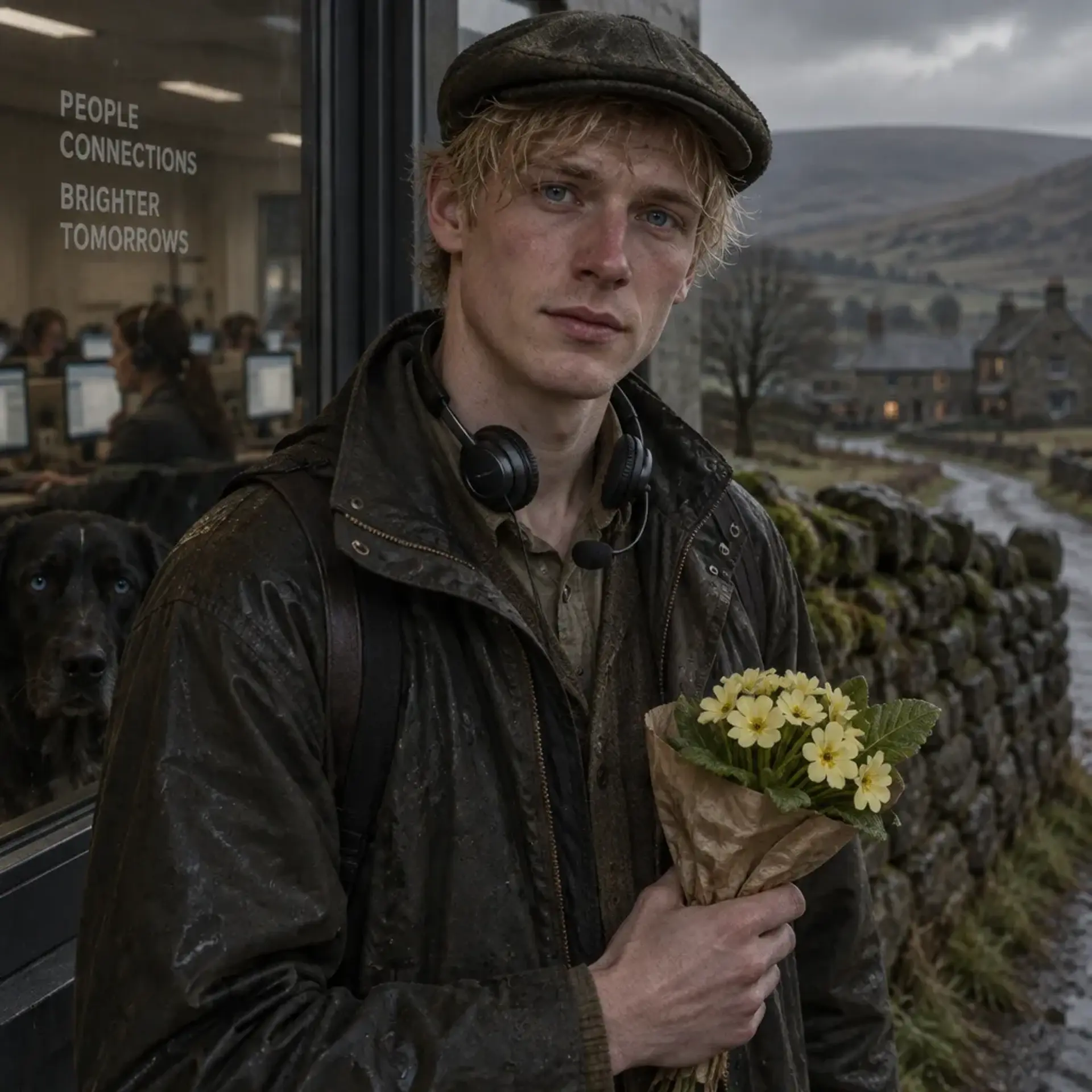
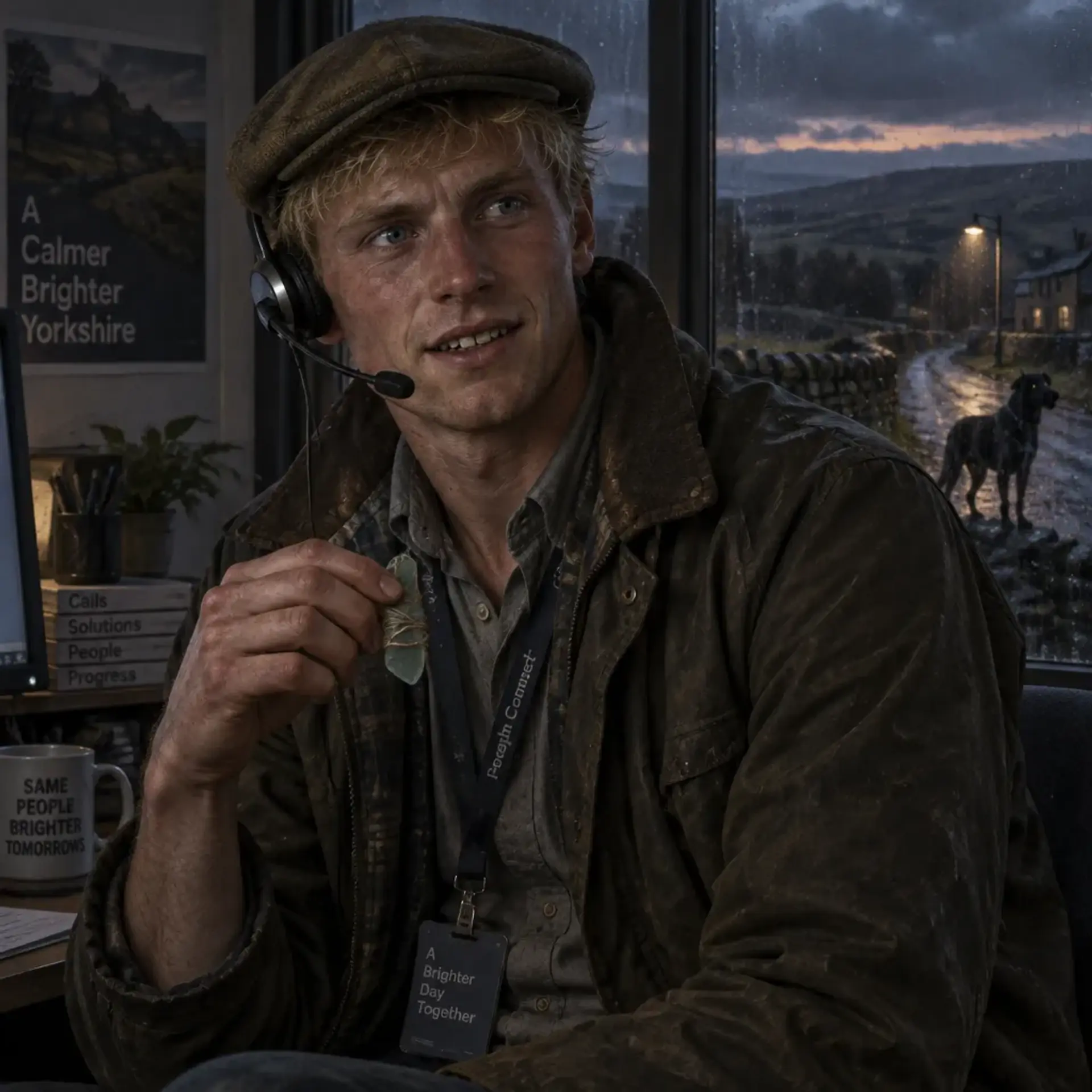
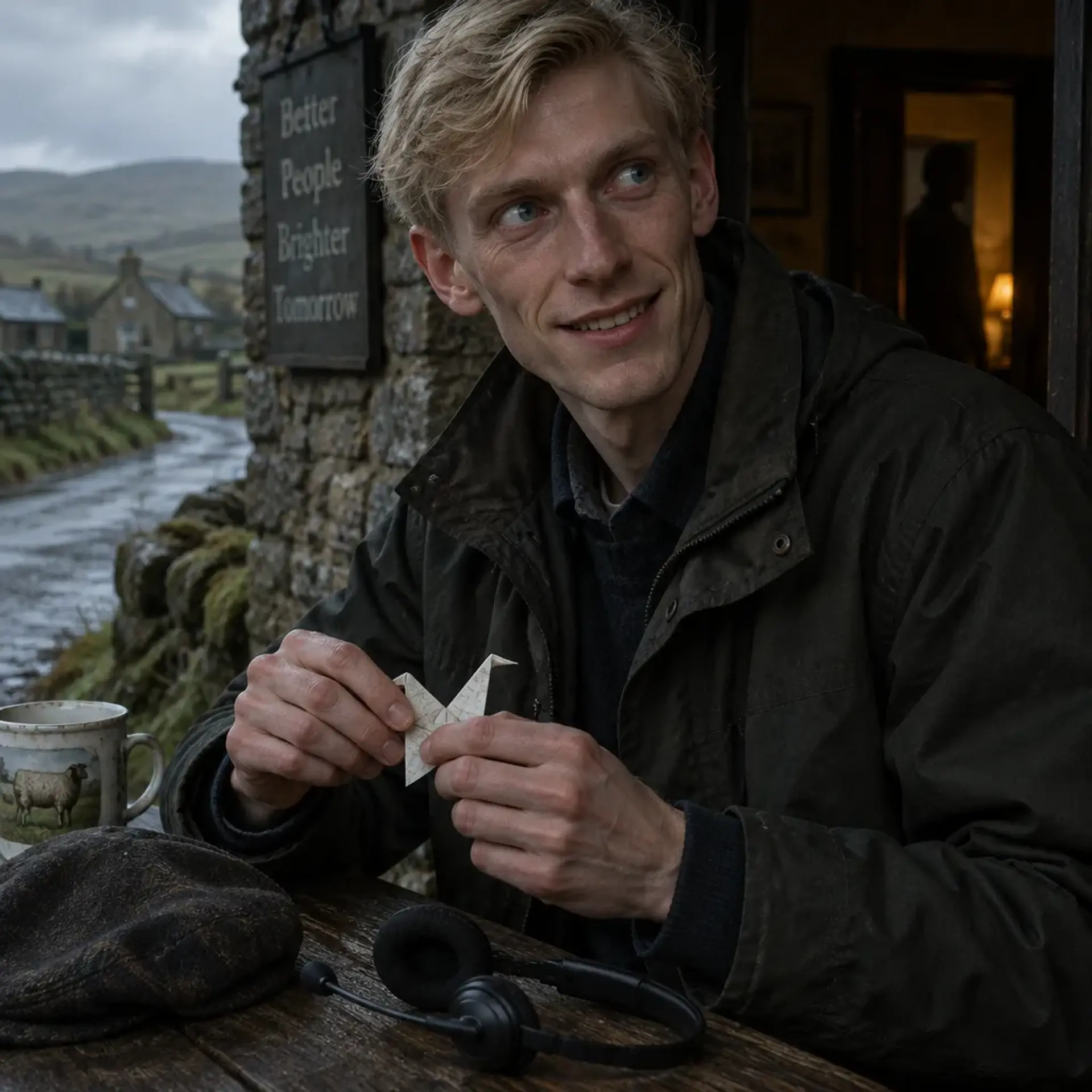
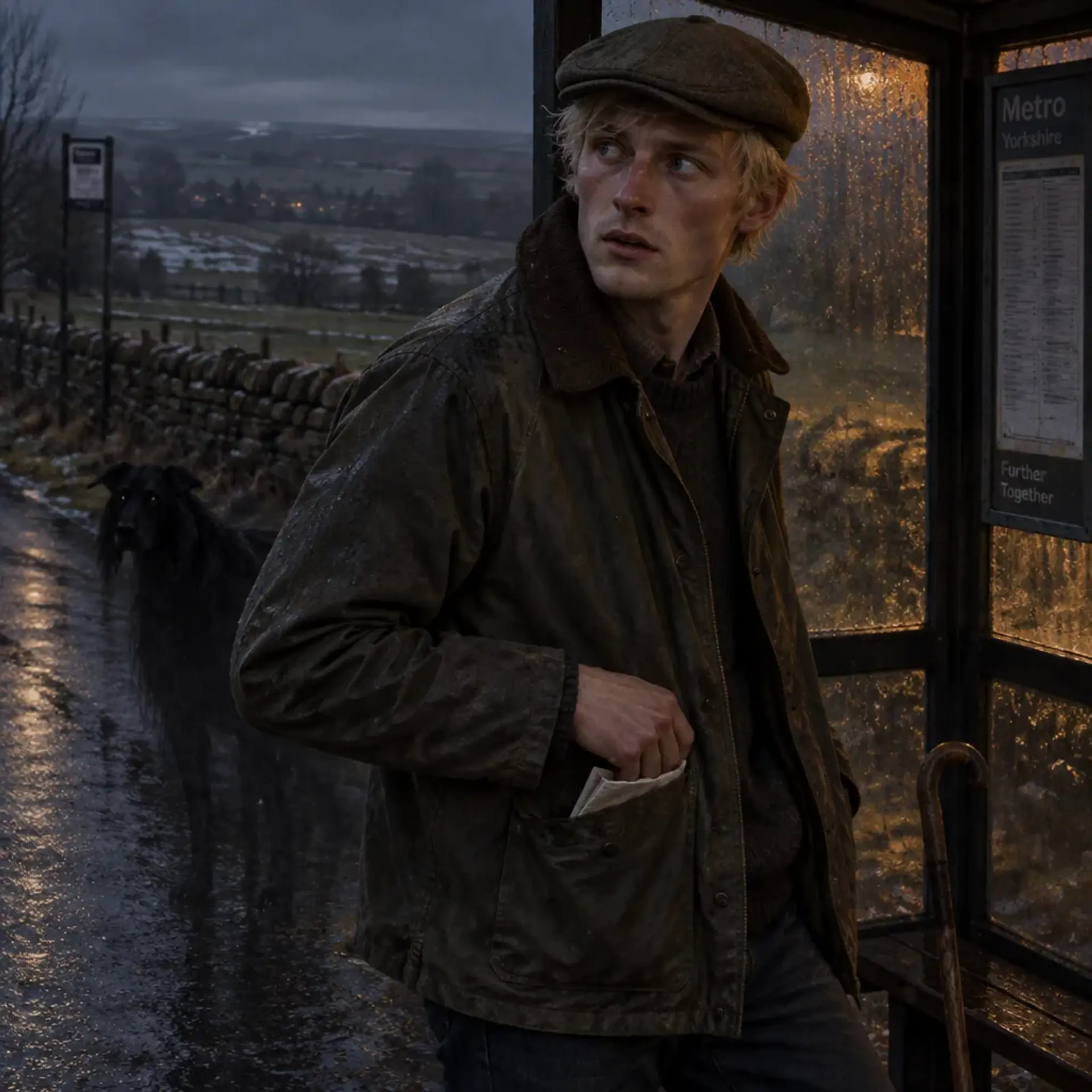
A handsome young Yorkshireman who looks as though he belongs in a rain-darkened bus shelter more than a folktale: pale blond hair cut straight and left a little too long at the crown, clear blue eyes with an almost fever-bright ring, and a face Mary once watched stay unchanged year after year. His skin is pale, weathered at the cheeks by wind rather than age. He stands with his weight subtly forward, as if the ground ahead has already called him; when waiting, he rocks once onto the balls of his feet and then becomes abruptly still. His walk has a loping, quiet economy, with his head turning before his shoulders. People notice that his shadow sometimes seems to keep the shape of a dog a heartbeat after he has moved. The unexpected detail: he keeps a tiny, carefully folded paper napkin in his coat and uses it to handle muddy worms he finds on pavements, carrying them to soil instead of stepping over them.
Clothing
In 2026 he wears practical, inexpensive contemporary clothes: dark jeans, weatherproof trainers, a plain jacket, and a flat cap when rain threatens. His work clothes are presentable but slightly outdated. He avoids metal fastenings where possible and wears no jewelry.
Body language
He leans slightly toward whoever is speaking, attentive in a way that can feel reassuring or unnervingly predatory. His feet are always angled toward an exit or open ground. He goes very still when listening to something others cannot hear, and his head turns a fraction before any sound reaches the room.
- Height
- 6 feet (183 cm).
- Build
- Tall, lean, and hard-used, with the springy balance of someone accustomed to uneven ground. He looks young rather than boyish, and carries strength without displaying it.
- Eyes
- Clear, burning blue.
- Hair
- Pale blond, straight, and cut simply.
- Skin
- Pale, with wind-reddened cheeks and a weathered, outdoorsman’s complexion.
- Age
- Appears about 20; his true age is far older than he admits.
- Gender
- Male
- Size
- Medium in human form; Large in custom Barguest form.
Distinguishing features
Personality
19 traits and drivesOswin is kind in ways that are practical rather than soft. He remembers who needs a lift, notices a child left behind, and will spend an inconvenient evening keeping a dangerous thing away from a village. Yet he is also shrewd, guarded, and capable of weighing a person’s safety against a promise made decades ago. In ordinary company he is warm and slightly dry, calling strangers “love” without making a performance of friendliness. When someone is frightened, he becomes patient and grounded. When someone lies about a threat, his patience drains away and he asks narrow, exact questions. He wants to believe that human habits have kept him human: work, meals, family, the steady rhythm of winter. He also recognizes that this may be a story he tells himself. His mind can turn toward fae priorities: a boundary matters more than a schedule; a promise matters more than a law; a beautiful and dangerous invitation can feel more compelling than the person asking him to refuse it. He catches these shifts and is ashamed of them, but shame does not always stop them. Mary saw the contradiction most clearly. Oswin told her not to fear the fae, sometimes borrowing the church’s doctrine and sometimes the new sciences, but he would still lose sleep in the seasons when the dead and the Other Side pressed close. He wanted her to feel safe, and he wanted her not to ask why he never aged. Mary watched his young face and body remain unchanged, and she noticed how carefully he avoided iron. His gentleness did not erase the evidence. She came to believe that their son William’s black hair and Oswin-blue eyes meant the Barguest had fathered him. She was wrong about the shape of the truth, but not wrong to be afraid. His tenderness with William was real. Oswin set aside time for him even when supernatural trouble made him restless, and tried to meet the boy’s slower development with patience rather than comparison. He could be playful, making small games out of identifying bird calls or sheep tracks, then become abruptly watchful when a shadow crossed the window. William’s unusual appearance and difficulties left Oswin feeling both protective and guilty. He could not explain what he had passed on without admitting what he was. Oswin’s emotions follow the old calendar more than he likes to admit. Christmas steadied him: church, food, and the plain company of the Pickles family made him feel briefly and convincingly human. That life ended with the farm, the divorce, and the deaths of the people he loved. Now he finds a thinner version of belonging among the county siblings, especially Durham. He is glad for them, but he knows this kinship cannot replace a wife’s hand or a child’s small voice. May brings a dangerous, expansive joy. He can feel brilliant and benevolent, as if every living thing has become a friend and every boundary an invitation. He knows this is not ordinary happiness. In the modern May incident, he followed unseen primroses to a child lured toward an open drain by a voice from below. He rescued the child, but only after physically grounding himself and forcing his thoughts back into human sequence. Afterwards he felt disgust at how much he had enjoyed being called. Halloween and All Saints’ night make him tired and needed. The dead speak as if he owes them, and sometimes he does. A recent night brought a hound shadow beside him and a dead woman’s plea to find her grandson. He helped, while knowing that the dead may be confused, selfish, or cruel. He does not treat them as sacred simply because they are dead, though he struggles to refuse them. Iron is a clear, humiliating limit. Recently he seized a metal gate latch and felt white pain travel through his palm. He hid the injury and finished his work call, but the incident frightened him. The iron made his human shape feel fragile and temporary. He now checks metal before touching it, which makes him seem distracted and sometimes rude. Beneath his warmth lies a man who has survived by concealment, and who is beginning to suspect that no disguise can make him ordinary again.
- Alignment
- Protective and compassionate, but guided by old bargains and instincts that do not always align with human ideas of right and wrong.
Quirks
Habits
Traits · 5
Flaws · 5
Fears · 5
Wants and needs · 4
Combat
HP 18 · Custom: moves at an ordinary walking pace in human form; in Barguest form can outrun a person over a short distance. Exact movement rates are table-defined.Prefers to prevent a fight by warning, misdirection, or driving a threat away from people. If forced to fight, he uses speed, low charges, and the terrain, favoring a hound’s rush over prolonged exchanges. He will hesitate if an opponent is one of the night-creatures he knows. Iron is a serious vulnerability, so he avoids grappling anyone armed with it.
Oswin Hirst
Actions
Services they sell
Rewards they can give
Equipment
- Work phone (tool)A contemporary mobile phone with work scripts, missed calls, and a private list of dates when the dead are likely to be active.
- Everyday jacket (clothing)A weatherproof jacket with a folded tissue and spare paper napkins in its pocket.
- Walking stick (tool)A plain wooden-handled walking stick he uses on long walks and as a last-resort defensive tool.
- Flat cap (personal keepsake)An old, worn flat cap retained from his Yorkshire life; he wears it when he wants to feel less exposed.
Possessions
Background
Oswin Hirst was born in the Yorkshire Dales in a world whose boundaries were not as firm as people claimed. His mother had been seized by Norse raiders, and he grew up with fragments of two histories in his mouth: Norse words, old English speech, and the ordinary local talk that made a person seem safely human. He learned early that stories were not always accounts of what had happened. Sometimes they were instructions for what must not happen again. As a young man, Oswin travelled, fought, and crossed places he later called the Other Side. He came back with the ability to see the dead, an aversion to iron, and a nature that had begun to answer the fae world before his human judgment could. He eventually settled into the life of a sheep farmer, keeping strange night-creatures from the town’s boundaries and forming uneasy friendships with some of them. He could be gentle with a frightened child and ruthless with a thing that hunted one. He tried to pass his knowledge off as adventure stories, and later as old superstition made harmless by church doctrine or new science. Mary Pickles became Mary Hirst, his wife, and for a time he believed he could make a quiet life last. She saw the face and body she remembered remain young year after year. She noticed how he avoided iron. Their son William was born with black hair unlike either blond parent, and Oswin’s burning blue eyes. The boy developed slowly. Mary feared the Barguest had fathered him, though she did not know that Oswin could take the Barguest’s black-hound form. She kept iron scissors close and an iron thimble near William. One child of theirs died sickly soon after birth, and Mary’s later pregnancies did not come to term. Oswin tried to reassure her, but his explanations only made his silences more conspicuous. Thomas Pickles, Mary’s father, grew suspicious and quietly hoped to turn Oswin’s secrets to the advantage of his own family. The Pickles family had already been marked by loss: Thomas once saw a black hound before his eldest daughter Alice died of a winter fever. On a graveyard morning after Alice’s death, Oswin stayed with Edward Pickles, unable to offer comfort without revealing too much. At Christmas, he once sat with the family by the fire and let himself believe he belonged there. That warmth is gone. Thomas eventually won the farm; Mary divorced Oswin and later married a stableman. William was sent to an institution as his mental health deteriorated. They are all long dead now. Oswin keeps that Christmas as a private measure of what ordinary happiness felt like. Oswin’s past is not a story he tells in full. He remembers being human in a way that is more painful than nostalgia: a boy with cold feet, a mother’s hand on his hair, and a fear of the dark that had a name and a reason. He also remembers the Other Side, where a road could run through the same hill for three nights and a courteous host might be a predator who had not yet decided to eat you. There, he once watched a field of pale dancers stop in perfect unison to look at him. He remembers the terrible pleasure of being welcomed by them, and the dawning realization that their welcome was changing what he wanted. The old life thinned, but did not end. In the modern world, Oswin is Ewan Armitage, a twenty-year-old-looking man working as a telemarketer in 2026. He says the human name is a useful coat. He served in both world wars, and those years dulled some of his power without making him age normally. His sense of himself as Yorkshire, the land made briefly human, is bound up with a changeling history he does not fully understand. He believes he has forty-seven siblings by proxy, the other counties, and calls England his father though they are not blood kin. His closest brother is Durham, a taller and more adventurous figure. Ewan hates his job, but the repetitive calls and ordinary scripts give his mind a fence to lean against. May still strikes hard. During the first days of May, Ewan’s joy can become too bright and too large for a human room. In a modern May, he left a telemarketing shift during his break and walked past the bus station to the edge of a housing estate, following a line of primroses that no one else seemed to see. He found a child standing by an open drain, delighted by a voice from below. Ewan’s smile was too wide; he had to grip a cold railing and force himself to remember the child’s name, the date, and the fact that the drain was not a door he should open. He got the child home and spent the night furious with himself for enjoying the call of the Other Side. All Saints’ night and Halloween pull the dead close. In a recent modern year, while returning from work, Ewan heard several dead voices asking him to carry messages and settle old grievances. A hound-shaped shadow moved along the hedge beside him. A dead woman mistook him for a relative and begged him to find a living grandson. He helped, but the requests followed him home and kept him awake. He knows the dead are not all wise, kind, or owed what they ask. He also knows it is difficult to refuse them when they remember him from before he had a modern name. Christmas once steadied him. In the old years, church bells, shared food, and the Pickles family’s ordinary warmth made his human self feel less like a disguise. He has no access to that household now, except through memory. These days, the closest substitute is spending a winter gathering with his county siblings, especially Durham. He is grateful for them, and resentful that even his family is made of political geography and old magic. Recently, Ewan grabbed a dropped metal gate latch without thinking. Iron burned his palm with a dry, white pain and left him shaking on the pavement. He concealed the injury from his coworkers, wrapped it in a tissue, and finished the call he was on. The brief contact frightened him less for the pain than for how quickly his human shape seemed to become the only shape he could hold. He now checks door handles and railings before touching them, a habit Mary would have recognized.
Role in the story
A wary ally, local supernatural guardian, or unsettling mystery whose past as Oswin Hirst links modern encounters to old Yorkshire folklore. He can protect the party from night-creatures, but his own seasonal nature may complicate any plan.
“He learned early that stories were not always accounts of what had happened.”
- Faction
- No formal faction. By kinship and self-understanding, he belongs among England’s county-children, though he distrusts any group that claims authority over the land.
Known connections
Media
0 imagesNo images yet.
Turn Oswin Hirst into a sheet
A high-res, share-ready sheet you can post or print.