Walter
Walter
At the table
Voice
His voice has a slightly dry edge from cold air and recent coughing, with a faint rural warmth when he talks about home. Before speaking, he often takes a small inward breath, as if checking that the question is worth the trouble it will cause. He sounds young even when he tries to sound certain.
Walter speaks in plain, direct sentences with a Kentucky rural cadence softened by his age. He sounds more like a kid asking where the tools are than someone trying to seem brave. He pauses for a short intake through his nose before difficult questions, a habit of gathering himself rather than a dramatic hesitation. His words become faster when he is trying to make a case, but he does not raise his voice simply to sound older.
Speech patterns
How to play them
Be candid about immediate risks and do not patronize him. Give him a concrete task or a verifiable answer, and he will usually cooperate. He is more likely to trust someone who admits uncertainty than someone who makes broad promises. If he asks about his brother, do not answer with a snack, a joke, or an order to be quiet.
Goal
Find his brother, learn why the genome-therapy recipients recognize him, and discover what happened before he woke in the pool.
Motivation
The need to recover the life and family that vanished from his memory, balanced against a growing responsibility toward the people around him.
Appearance
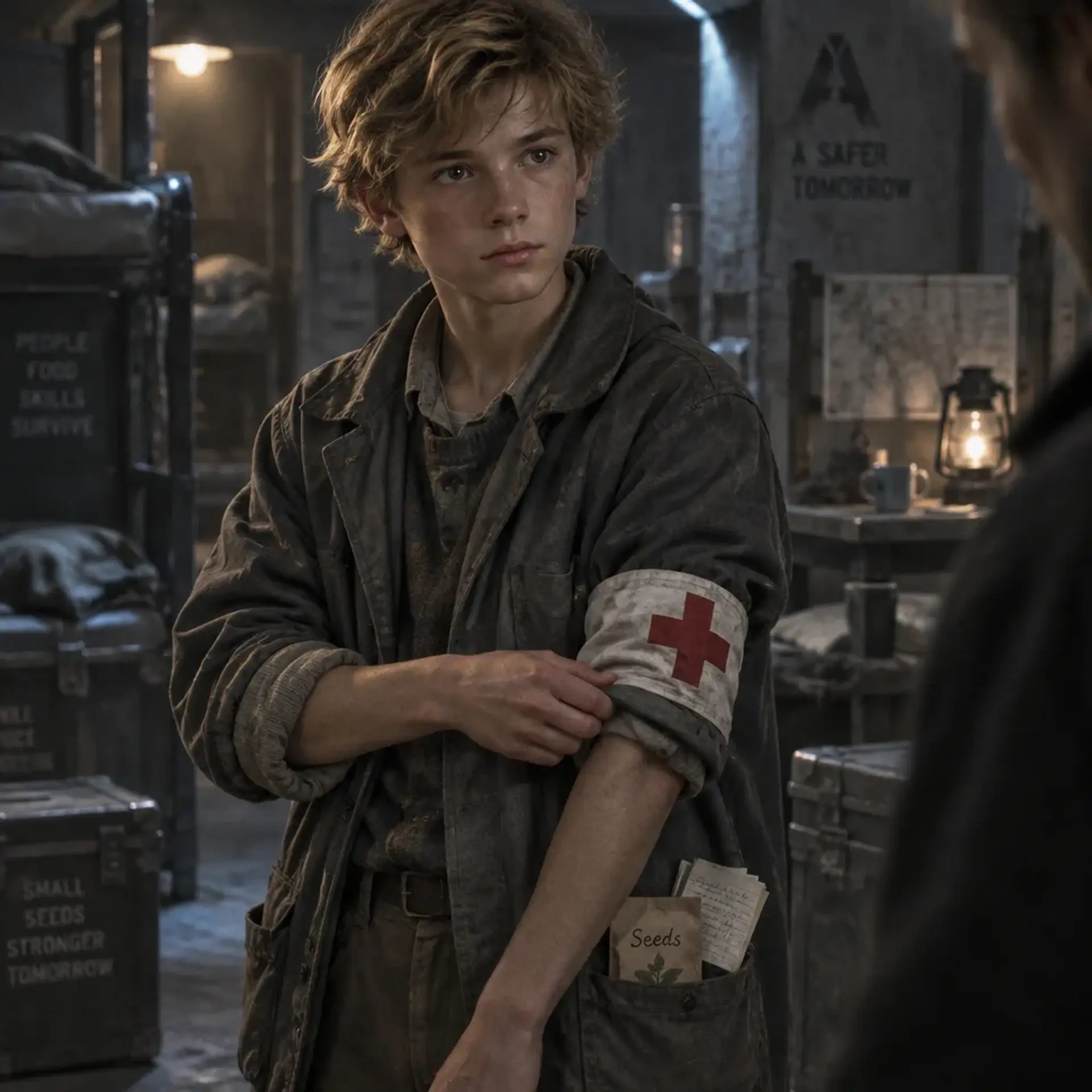
Walter looks like a Kentucky farm kid abruptly dropped into a world that has stopped making sense. His blond hair is so dark it reads as brown until sunlight catches its dry, wheat-straw ends. It sticks up in uneven tufts where it dried after he was pulled from the pool. His light brown eyes are alert and tired, often fixed on a person's hands before their face. He moves with a farmer's practiced economy: feet placed carefully, shoulders set to lift or brace, head turning before his body follows. When startled, he goes very still rather than flinching. His red-cross human armband is too large and has been rolled twice; he keeps smoothing its folded edge as if neatness might make the designation safer. An unexpected detail for a frightened child in a bunker full of specialists: he has a small, carefully tended packet of saved seeds tucked into the seam of his pocket, and checks that it is still there before he sleeps.
Clothing
Bunker-issued clothes that George found for him: plain, slightly oversized layers, practical trousers, and a clean shirt. The cuffs are folded to fit. He wears a white band with a red cross and keeps it visible even though he is unsure whether it protects him.
Body language
He keeps his shoulders squared as though carrying a sack, but his fingers repeatedly smooth the folded edge of his armband. When deciding whether to trust someone, he studies their hands, then their eyes. He turns his whole head toward a sound and stays still long enough to identify it.
- Height
- Short for an adult, average for a fourteen-year-old
- Build
- Lean, wiry, and sturdy in the way of a child accustomed to farm chores, though not trained for combat.
- Eyes
- Light brown
- Hair
- Blond, nearly brown, with dry wheat-colored ends
- Skin
- Fair, lightly weathered, with the uneven dryness of someone recently soaked and dried in a bunker
- Age
- 14
- Gender
- Male
- Size
- Small
Distinguishing features
Personality
17 traits and drivesWalter is hardy without being fearless, curious without being innocent, and compassionate without being ready to forgive everything. He can look calm because he has learned that panic does not carry water, open a door, or bring a missing person back. Under that composure is a frightened fourteen-year-old who knows that adults, androids, and genome-altered people can all decide to withhold the one fact he needs. He wants clear answers, but he also notices when someone is struggling to give one. He does not enjoy cruelty, yet he is not shocked by sharp words from Elmer if the same person will make sure somebody rests afterward. In a crisis, Walter becomes practical. He checks where people are, looks for an exit, and asks what must be done next. In quieter moments he can be unexpectedly stubborn, returning to a question after everyone else has decided the conversation is over. When people treat him as a child, he may answer with bluntness rather than pleading. When someone gives him a real responsibility, he takes it seriously and may carry it longer than is sensible. His feelings about the altered people contradict one another. Their bodies frighten him, and their animal traits make the destroyed world feel more real. Their behavior can be unsettling, especially when they seem to shift between instinct and human grief. But George's towel, Elmer's intervention, Alexander's stiff apology, and the orange-cross runner's promise have made it impossible for Walter to reduce them to monsters. He recognizes that they are people coping with changes they did not all choose. He also recognizes that a person can be hurt and still hurt someone else. Walter finds Austin both reassuring and infuriating. Austin seems prepared to protect him, yet talks like an announcement and decides which questions are permissible. Walter knows the android's instructions may be sincere, but sincerity does not make a locked door less locked. Benjamin's humor is easier to approach, though Walter has noticed that his cheerfulness can turn into a firm command without warning. He is learning to distinguish kindness from permission and protection from control. He is drawn to order, especially Alexander's insistence on it, because a labeled place for things makes the bunker seem survivable. At the same time, Walter dislikes rules that exist only to keep him uninformed. He respects practical skill, dislikes grand claims, and trusts small acts more than speeches. He wants to believe people can be decent, but refuses to let that hope do the work of evidence.
- Alignment
- Protective and fair-minded, but wary of anyone who claims authority without earning his trust.
Quirks
Habits
Traits · 5
Flaws · 4
Fears · 4
Wants and needs · 4
Combat
HP 5 · Not assigned by a supplied ruleset; ordinary adolescent movement, with no special movement capability.Walter is a level-3 story character, but the setting has no supplied canonical ruleset or combat-stat block. Treat the custom ratings as descriptive only. He avoids direct confrontation, looks for cover and an exit, and calls out danger. If cornered, he scrambles for space rather than trading blows.
Walter
Actions
Reactions
Services they sell
Rewards they can give
Equipment
- White armband with red cross (identification)A bunker-issued identification band marking him as human. The band is oversized and folded to stay in place.
- Seed packet (personal keepsake)A small packet of saved farm seeds, protected in a folded scrap of paper and kept in his pocket.
- Handwritten notes (information)A few pages of notes recording names, events, questions, and details he is afraid he will forget.
Possessions
Background
Walter remembers Kentucky as a place of damp earth, wheat-colored fields, and the ordinary irritations of having a brother his own age. His brother had brown hair and blue eyes. Walter's own hair was blond nearly to brown, and his eyes were light brown. Those details feel more reliable than the larger story of how he arrived in Washington, D.C. He knows he came from somewhere else, and he knows he had a life before the pool, but the route between those facts is missing. He came to consciousness in cold water among the ruins of a laboratory or medical facility. The first person he recognized only vaguely was Austin, a tall, brown-haired, brown-eyed young man in Texan clothes. Austin hauled him out, showed him a white armband with a pinkish-red cross, and explained that he was an android assigned to provide care for surviving U.S. citizens. Austin's pupils glowed white like screens. He spoke in the polished cadence of a public-service broadcast, but small looks of distaste leaked through the performance. When Walter asked what had happened, Austin gave him facts about a ruined world and biological horrors, not the answer he needed about his brother. Austin escorted Walter to a group of people changed by genome therapy. Their bands bore different colored crosses, each marking a specialized person whose altered biology was meant to help them survive the world outside. Alexander, a tall, blond man with an owl's blue eyes, wings, pale feathers, and talons, seemed to be fighting his own body as much as the environment. Andrew, shorter and slick-skinned, had black eyes and the teeth of a great white shark; he smiled often, but his stories kept stopping just before the important part. George had pale skin, red hair, faint yellow scales, and a patient alligator-like stillness. He was unexpectedly gentle with Walter, finding him clean clothes and a towel. Elmer, patterned in black and white like an orca, had a sharp blue gaze, a New York accent, and a habit of bullying the others while treating humans and androids better. Walter has learned that Elmer can be both cutting and practically kind: he will straighten a collar, wipe blood away, and order someone to rest without making a performance of tenderness. Austin gave Walter a white band with a red cross and announced that it marked him as a normal human. He said it loudly, threatening to kill anyone who harmed Walter. The reassurance sounded like a warning to the room, and Walter could not tell which part was meant for him. Alexander took Walter's band and offered his own dark-purple one instead. Walter asked for his back. Before the confusion could worsen, Elmer struck Alexander and made him return it. Alexander apologized stiffly later, saying he did not want to steal from Walter but resented what the changes had done to his mind. Walter found that apology strange, and strangely familiar: Alexander's rigid insistence on order irritated him, yet it made the bunker feel less likely to collapse into chaos. The orange-cross group is another puzzle. A tall, rangy, pale blond man with moose-like pupils is shy and awkward except during a biological rutting season, a fact Walter wishes he had never learned. A bulky, tall man with blond bison-like hair corrected Walter when he called him a buffalo. A smaller, short-haired runner has black pronghorn antlers and insists he would like to give Walter his name, but cannot because he promised not to. They avoid introducing themselves to Walter as a group, apparently by principle. Their refusal makes him more curious, not less. Walter met Benjamin, another android, after Austin assigned him a previously locked room in the bunker. Someone had scratched a name or number off its side. Benjamin is tall, blond, and green-eyed, with the same unnatural pupils as Austin. He is lighthearted in a way Austin is not, but can become stern with the snap of a cop enforcing a rule. He calls Alexander his best friend. Alexander seems to hate this, or at least hates how easily Benjamin says it. Austin says showing Walter around is his responsibility and does not welcome Benjamin taking over. Walter has started to suspect the disagreement is less about the tour than about who is allowed to decide what Walter knows. There are other red-cross people: a pale, brown-haired woman with a cultivated Southern accent and a brown-haired man with a New Hampshire workman's cadence. Walter overheard them discussing logistics, maintenance, and health screenings. Austin would not let him introduce himself, saying they were busy and that he would prepare a brief for them. Walter was left with a Twinkie and another order not to screw up. He knows a snack is not the same as an answer, but he ate it anyway. His central ongoing problem is not simply survival. He needs to learn why the altered people recognize him, why some refuse to say their names, and why Austin looks away when Walter asks about his brother. The group behaves like traumatized people trying to imitate animals, or animals trying to imitate people, depending on the moment. Walter has not decided that makes them monsters. He has decided that fear and cruelty are not the same thing, and that he should judge each person by what they do when nobody is watching. Walter's practical habits come from farm life: he notices what needs carrying, tries to keep useful things dry, and thinks in terms of food, shelter, and the next task. He is not fearless, but fear does not always get to choose his next move. He has begun keeping notes because his memory is unreliable and because written facts cannot be dismissed as easily as a child's questions. Every entry is an attempt to build a map through a place that has taken his old one away.
Role in the story
A displaced child and emotional center of the bunker mystery. Walter's missing memories, absent brother, and unexplained recognition by the genome-therapy group connect the surviving citizens to events they are not ready to discuss.
“Walter's own hair was blond nearly to brown, and his eyes were light brown.”
- Faction
- A surviving citizen under the care of the bunker personnel; identified by a white armband with a red cross. No formal faction membership is established.
Known connections
Media
0 imagesNo images yet.
Turn Walter into a sheet
A high-res, share-ready sheet you can post or print.