Mark
Mark
At the table
Voice
A young, bodily voice with a little breathiness after exertion, as though he has hurried up stairs or come in from the cold. When rattled, his breath catches high in his chest and his consonants become clipped; when trying to impress, he places each word with careful, borrowed formality. His voice does not sound like Mary’s to those who knew her.
Mark speaks in careful, plainly English sentences, with a slight effort toward respectable middle-class propriety. He can sound rehearsed when explaining himself to Simon or the doctors, then become suddenly blunt when tired. In relaxed company he talks quickly about sport, daily work, women, and the body, sometimes overconfidently. When rattled, his breath catches before his words; he may restart a sentence rather than lower his voice.
Speech patterns
How to play them
Treat Mark as a person with immediate practical concerns, not as a puzzle to be solved in front of him. Offer privacy, food, and a concrete choice. He is more forthcoming during a walk or while making breakfast than under formal questioning. Avoid casually threatening the Bell children or Trudy. Ask before handling the missing-heart question, and do not assume he can explain the difference between his own thoughts and Kent’s impressions.
Goal
Keep a place to live, understand what happened on 30 May, protect the Bell children where he can, and find out whether Mary remains within him.
Motivation
To be treated as a real person without abandoning the people and memories that belong to Mary.
Appearance
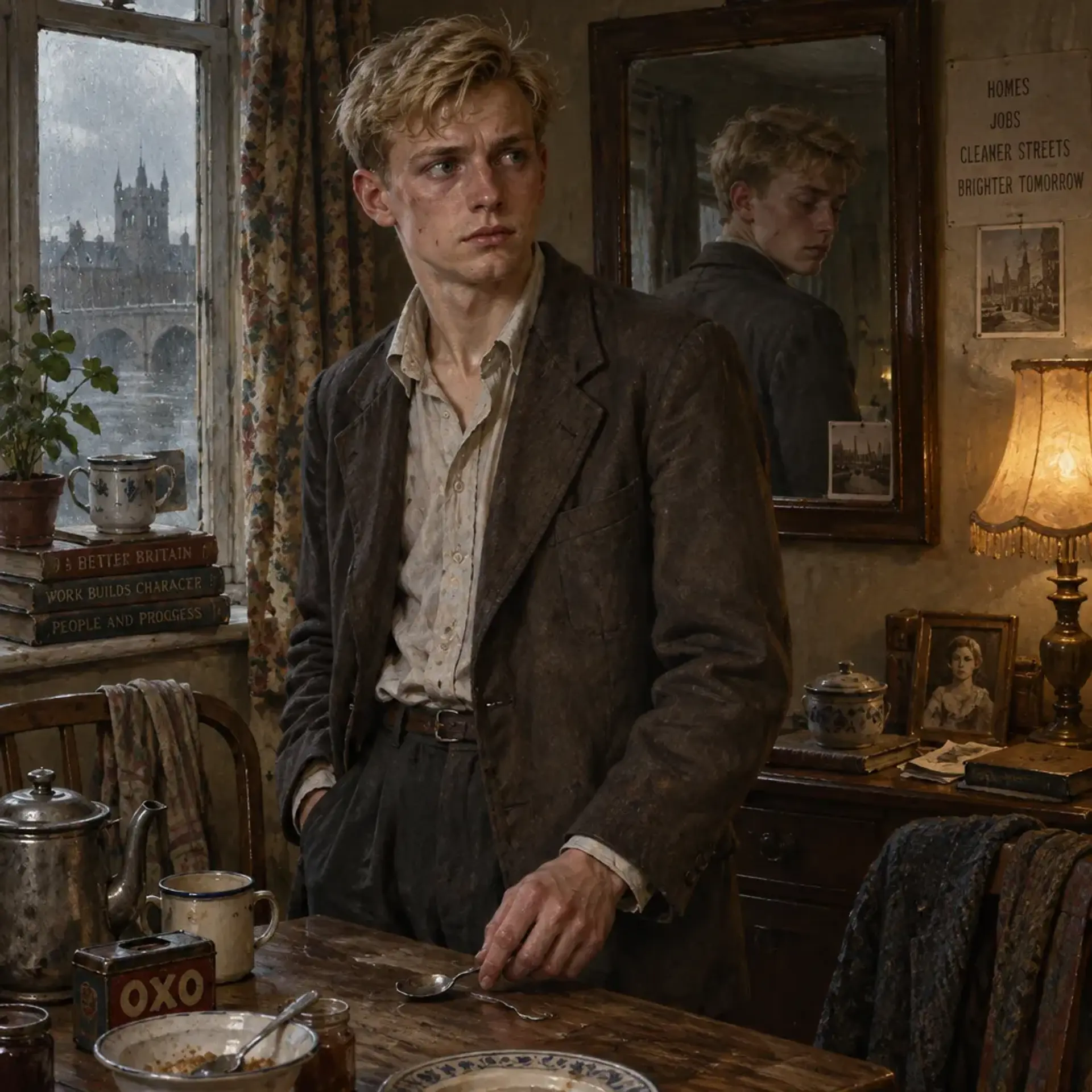
Mark appears to be a young man of eighteen with a face and body plainly unlike Mary’s, though the household’s memories insist he is also the person they knew as Mary. His bright, short blond hair sits in stubborn bristles that refuse a neat part; his malachite-green eyes seem alert even when he is exhausted. His skin has the pallor of someone who has been indoors too long, frequently interrupted by smudges of garden soil, leaf fragments, or a damp streak from the shore. He moves with a forward-tilting eagerness when outdoors, but waits indoors with his weight carefully placed as if testing the floorboards. When unsettled, his breathing catches high in the chest, then resumes in deliberate, almost irritated pulls. People remember the contrast between his proper, watchful bearing and the muddy cuffs, scuffed shoes, and small creature he may be trying to hide in a pocket. The left palm bears a thin scar where he tested cold iron.
Clothing
A mismatched wardrobe assembled from Trudy’s gifts, borrowed household clothes, and whatever fits Mark’s changed body. He prefers clean, presentable clothes and dislikes the donated shoes, though he wears them. When laundry leaves him without a shirt, he may initially fail to appreciate why this bothers Trudy.
Body language
He waits with his weight slightly forward and his hands occupied, often rubbing a thumb across his palm. His posture becomes stiffly erect when he thinks someone is judging his manners. When alarmed, his breath catches and his shoulders lift before he forces them down. In open spaces he loosens quickly and moves with a restless, exploratory stride.
- Height
- Taller than Mary had been; exact height unknown
- Build
- Lean, long-limbed, and stronger in close quarters than his unassuming frame suggests.
- Eyes
- Malachite green
- Hair
- Bright blond, cut short
- Skin
- Pale, with a tendency to look flushed after exertion or cold
- Age
- 18
- Gender
- Male
- Size
- Human-sized
Distinguishing features
Personality
19 traits and drivesMark is earnest without being straightforwardly innocent. He wants to be regarded as a proper, high-class young man, yet the instincts that shape him are local, practical, and stubbornly middle-class. He notices a shabby shoe, an untidy table, or a careless phrase and forms a judgment, then turns around and returns from the garden with mud on his knees and a beetle in his pocket. He is not a hypocrite so much as someone trying to borrow a settled idea of how a man should behave while his own life refuses to settle. He is more of a homebody than Mary’s nighttime excursions might suggest. The first nights outside felt like freedom, but what he wants now is a room, familiar meals, a schedule, and a place where nobody asks him to prove who he is. He likes streets and shorelines when he chooses the route. He dislikes being sent out as if he were a child. Left undisturbed, he can stay under a blanket long after morning; Trudy has learned to coax, tease, and finally haul him into the day. He may then prepare breakfast with fussy care, as if a decent meal can make the rest of the morning comprehensible. His attention to status coexists with a strong interest in ordinary people. At a pub, he watches how everyone speaks and sits, trying to infer who belongs. He wants to be accepted as a gentleman but is fascinated by work, sport, bodies, and the plain talk of men. He may launch into a conversation about women with the unearned certainty of someone trying on a social role. Trudy punctures this performance without cruelty. Mark complains about her rebellious style as though he is offering sensible advice, but he does not actually want her to become someone safer or more conventional. He wants her nearby, and is only beginning to notice that this wish changes his voice and behavior. Mark is protective, but protection comes out unevenly. He cares about the Bell children and is particularly moved by Matilda’s loyalty, yet he does not naturally reproduce Mary’s way of caring for them. He prefers roughhousing, sports, and expeditions to patient supervision. When the youngest children need him, he can be attentive in short, wholehearted bursts, then lose patience with the endless demands of the household. He does not always know which memories are his, which belong to Mary, and which come as Kent’s bodily knowing. This uncertainty makes him defensive: he would rather do something useful than discuss a self he cannot define. In a crisis, he can be startlingly decisive. When Simon argued with him, Mark pinned his father with a skill he had not knowingly learned. That moment frightened the family and Mark himself. He is not eager to use force and would rather leave than win. His strength appears as something his body can do before his conscious mind has chosen it. Afterwards, he feels ashamed, angry at being treated as dangerous, and unsettled that the hold felt so familiar. Mark’s moods are shaped by context. With Trudy, he is talkative, sometimes overconfident, and easily teased into showing his embarrassment. With Simon, he becomes formal and guarded, answering questions as if each one might be used to trap him. With Malinda, he cannot settle on whether to be patient or flee; her drunkenness and history make her attention unpredictable. Around children, he is less self-conscious but also less like the gentle caretaker they remember. With strangers, he reaches for manners and status first. Alone, he becomes restless, paces, and sometimes sleeps badly enough that Trudy has to check he is not ill. He is not simply shy. Mark can hold a room’s attention when he is explaining a matter he thinks important, but he hates being examined as though he were an exhibit. Dr. Bronson’s earnest questions irritate him because the young psychiatrist seems to want a clean account. Dr. Grey’s physical examination is worse: Mark resents having his body treated as proof that he is lying. He wants recognition before explanation, though he knows he cannot provide a convincing explanation himself. The clearest contradiction in him is that he wants to be ordinary and also wants to be acknowledged as extraordinary. He wants a job, rent, decent shoes, a private corner, and the right to make breakfast without a family meeting. At the same time, he knows his body changed in a way no ordinary account covers. He fears that being treated as a phenomenon will erase his claim to a life, but he also fears that everyone will decide the phenomenon is not worth believing. He is proud, dependent, curious, and frightened in shifting proportions. Underneath his borrowed manners, he is trying to learn what kind of person can be built from a life that may already have belonged to someone else.
Quirks
Habits
Traits · 5
Flaws · 5
Fears · 4
Wants and needs · 5
Combat
HP 0Avoids a fair fight. Mark looks for a way out, a door, an obstruction, or a moment to distract an aggressor. If trapped, he may use an unexpectedly effective hold, then immediately try to disengage. These are narrative custom options, not canonical Secret Histories combat rules.
Mark
Actions
Reactions
Services they sell
Rewards they can give
Equipment
- Second-hand shoes (clothing)A worn, ill-fitting pair given by Trudy; Mark wears them despite his misgivings.
- Mixed clothes (clothing)A practical set of borrowed and gifted garments, not always suited to his tastes or the weather.
- The Heart of England (missing object)The heart-shaped chalk object is missing. Henry claims to have sold it.
Possessions
Background
The story begins before Mark had a name. An amateur alchemist called Bartholomew Golden came to the Hush House with a supposed fossilized living heart, wrapped in newspaper and offered as payment for entry. He called it the Heart of England and claimed it could bring forth servants from the shadows of people, born of chalk cliffs and borderlands. The thing looked less like an alchemical marvel than a lump of Dover chalk carved into a human heart, crusted with barnacles and tangled sea grass. Golden was never allowed near Brancrug again. The heart was thrown into the sea. It came back to shore wet with salt and black ooze, and, beneath its stone crust, a red-pink light seemed to have returned. A young Londoner named Abraham Groff picked it up on a journey home to Wiltshire. It beat under his coat on the train. He showed it to neighbors; in company, it went lifeless. Alone, it woke again when he took it to a Hampshire shore and dropped it in water. Abraham came to believe it was special and belonged to him. It was not greed, exactly. He thought it disliked visitors. Strange sounds followed: voices, moving doors, footsteps climbing empty stairs. Eventually he sold it to William Windon, a local boy of seventeen who had once seen the object. William hid it in a log and struck it with a hammer. The beating stopped. Mary Bell, eighteen, lived in an isolated house in Rochester, Kent, with seven siblings and two parents who often seemed more occupied with their grievances than their children. She was the oldest and had learned to treat work as an emergency that never ended. She tried to keep Matilda from becoming her replacement as unpaid caretaker, and tried to make time for the youngest children, especially the little one who followed her with a blanket. She had a part-time job and a friend, Trudy, who noticed how tired she was. Mary was not stupid, but she had little time to sit with a mystery. When her mother, Malinda, gave her the curious heart-shaped rock for her eighteenth birthday, Mary accepted it gratefully, even though the gift was scarcely jewelry and Malinda was often too drunk to notice what Mary did with it. At first the object merely beat in time with Mary’s heart. Then her reflection changed. A handsome young man with bright short blond hair and malachite eyes looked back from mirrors and windows. Mary thought it was a cruel joke, then a frightening nuisance, and then another problem to work around. The face did not resemble hers. It sometimes turned away when she looked directly at it. The change did not feel like a second, neatly separate person speaking inside her head. It arrived as odd reactions, physical certainty, and knowledge that had no obvious source. The name Kent gathered around those impressions, as if the county itself had acquired a human face. Mary’s first full night as Kent followed a bad dream. She woke in an unfamiliar body, terrified by its weight, reach, and voice. The horror did not make her brave; necessity did. She discovered that she could leave the house as Kent and explore while the rest of the family slept. By dawn, she expected to be herself again. Her first adventure was a ramble through the sleeping streets, a climb into a tree, and a visit to a derelict building where she tested the new body against cold bark, wet brick, and the night air. She returned with dirt on her clothes and a collection of sensations she could not explain. She began treating these outings as a convenient escape from a crowded home, not as a second life. A later early-morning change happened at home, with the youngest children awake before the adults. Mary had to improvise clothes while a small child tugged at her sleeve and another demanded breakfast. She tried to keep the children calm, put bread on the table, and pass off her unfamiliar appearance as an explanation nobody should repeat. Mark’s instincts leaned toward rough play and outdoor games rather than Mary’s careful, patient attention. The children noticed that difference before they understood its meaning. Mary learned how dangerous a sudden change could be when there was no empty room, no time, and no privacy. The pub adventure began as a walk meant to end at the shore. Mark followed the pull of the town into a pub, where his unfamiliarity with local expectations showed. He watched the room as if assessing its furniture and rank, then tried to act as though he belonged there. He was drawn to the ordinary talk of work, sport, and women, but remained a little too formal, too interested in whether he was being regarded as a gentleman. A casual remark about his appearance made him stiffen. Rather than start a fight, he tried to answer with stiff courtesy and leave on his own terms. His curiosity about the people and the place was real; so was his wish to be thought better bred than he felt. Trudy became the person best able to see the change without pretending it was simple. She was a short, skinny young woman with dirty-blond hair, hazel eyes, and an alternative style she called rebellion. One evening, she found Mark out late, chilled and badly dressed for the weather. She lent him help without treating him like a helpless child, and later brought him clothes, socks, undergarments, and shoes. They were not to his standards, but his gratitude was sincere. When a man tried to mug him, Mark’s naivety about danger nearly made matters worse. Trudy stepped in, read the situation faster, and got him clear. Afterwards she made him listen to her account of precisely how foolish he had been. Simon, Mary’s father, once returned home earlier than expected and encountered Mary as Kent. The trip back toward home became an anxious exercise in passing, explanation, and avoiding familiar eyes. Simon wanted a rational account and was frightened by how little he could offer one. Malinda’s drunken encounter with Kent was less controlled. She saw a stranger wearing the wrong face in her home, then confronted the impossible familiarity of his manner. Her confusion and drink made her cruel and affectionate by turns. Mark could not decide whether to soothe her, correct her, or get away. Neither parent understood what was happening, and Mary’s old role as the one who smoothed over household trouble made it hard for Mark to stop trying. On 30 May, the familiar skin simply stripped away. What remained was Wilt in body: Mark, as the household now encountered him, no longer plausibly Mary in appearance. The change recalled the terrible idea of a forbidden drink such as Leathy or Skinshuck mead, a bodily shedding rather than an ordinary transformation, but it was not presented as the same substance or process. 'The tongue and the eye, and now we begin! Forget your name, forget your skin.' The words became a fearful refrain in the days that followed. Simon was deeply alarmed. He brought in Dr. Bronson, a young London psychiatrist fresh from college and eager for a case he was not equipped to understand, and Dr. Grey, an older physician from Suffolk who examined Mark for surgery or unusual physical conditions and found himself unsettled. Bronson tried to assess mental health and verify claims without pretending the case fit his training. Grey examined the body and could not provide the reassuring explanation Simon wanted. The family reacted in different, practical ways. Simon wanted the town kept away and insisted on appointments, explanations, and boundaries. He feared that something had happened to Mary and that the evidence was standing in front of him under another name. Malinda responded inconsistently, sometimes treating Mark as a frightening intruder and sometimes reacting to old domestic habits. The children adjusted unevenly. Matilda remained concerned and willing to follow, while Henry’s resentment and cunning sharpened. The younger children accepted pieces of the new routine more readily than the adults, though they still sought comfort from the person who had once been Mary. Mark did not behave as Mary had: he wanted to roughhouse, play sports, and bring small creatures into the house. He returned from the garden muddy, leafy, and pleased with himself, annoying Simon over propriety and Malinda for reasons of her own. Mark’s first major break with Simon came after an argument. Mark pinned his father with startling skill, using a hold that seemed to come from the body rather than from any remembered lesson. He did not strike Simon, but the sight of his father held down made the room go still. Mark left to walk. Henry and Matilda followed at a distance, worried for different reasons: Matilda feared what the argument meant, while Henry was curious about the limits of Mark’s new strength and identity. Mark let them come, though he pretended not to notice. The walk was not a triumphant escape. It was a chance to breathe away from the doctors, questions, and rooms full of people who remembered Mary. The heart later went missing. Henry said he had stolen and sold it, and the family had no proof that this was true. Mark does not know that Henry may be able to use the object to influence him. The old heart may still be close enough to matter. The possibility gives Henry leverage and gives Mark another reason not to trust a brother who can be clever when hurt. The rent situation with Trudy began as temporary shelter and became a difficult shared arrangement. Mark took a job to pay his share and slept on the couch while clearing a small place of his own. Trudy gave him clothes and established practical limits. He often paced at night, slept as if fighting through fits, and left shaving razors where they did not belong. If his clothes were being washed, he might go without a shirt until Trudy told him to stop making the flat uncomfortable. He talked to her as if they were still the same old friends, then veered into long discussions of sport, his body, and women. Trudy teased him, challenged his assumptions, and did not let him get away with treating her independence as a defect. Mark sometimes called her rebellious as though that were a cautionary failing, while she regarded his old-fashioned judgments as excellent material for a joke. He nearly fought one of her brothers after misunderstanding what it meant to share a flat with a single woman. Trudy stopped the escalation and made him explain his assumptions aloud. Mark considers her a good friend and can be too attentive without recognizing why: he stares too long, escorts her at night, or offers his coat when she is cold. When strangers assume they are a couple, Trudy answers for herself, and Mary’s brothers, if present, often correct the assumption. She also has to rouse Mark into the world in the morning; left alone, he becomes a turtle under a blanket. Trudy styles her hair while he prepares breakfast, and their different working-class and middle-class instincts collide in the cramped room. He tries to make the breakfast proper. She gets him out the door. The cold-iron test was Mark’s own mistake. He tried one of his mother’s suspicions against his palm and was left with a scar. Trudy made him swear never to do it again. The scar is now a small, practical reminder that his body is not simply a new costume. Mark has a job, a makeshift home, a complicated attachment to Trudy, and a family that has not agreed what to call him. His life continues in the intervals between impossible changes.
Role in the story
A young man living in the aftermath of an impossible bodily and personal change. Mark can be a companion, a witness to the heart’s influence, or the center of a family mystery involving identity, care, and control.
“He called it the Heart of England and claimed it could bring forth servants from the shadows of people, born of chalk cliffs and borderlands.”
- Faction
- No formal faction. His strongest ties are to the Bell household and Trudy’s rented flat.
Known connections
Media
0 imagesNo images yet.
Turn Mark into a sheet
A high-res, share-ready sheet you can post or print.