Friedreich
Friedreich
At the table
Voice
A young man's voice carrying a strong Prussian German accent, with crisp consonants and the measured delivery of someone accustomed to drill, formal address, and being ignored unless he speaks clearly. In company it is composed and dryly humorous; with Mila it warms into patient, practical concern. Under anger he becomes clipped and exact rather than automatically soft-spoken. Through a stolen face, the borrowed voice is convincing, but its pauses retain Friedreich's careful, almost inspected cadence.
He speaks with a strong German accent colored by Prussian formal education: consonants are firmly placed, and his sentences often sound arranged before he says them. Military service and habitual attention to commands give his words a measured, economical rhythm. His voice can turn dry and clipped when Wilhelm evades a question, but anger does not automatically make him quiet or courteous. When speaking through a borrowed face, a faint mismatch remains in the timing of his emphasis, as though the words arrive from a memory of speech.
Speech patterns
How to play them
Treat Friedreich as a person rather than an apparition or a useful disguise. Be direct about boundaries, especially around faces and possession. He responds well to shared routines, practical questions, and invitations that do not make him perform his death. Do not casually promise to recover his memories or demand details about the cathedral. If Wilhelm is present, avoid making Friedreich the sole interpreter of Wilhelm's guilt; the two need to speak for themselves.
Goal
Discover what happened at the cathedral without losing the family he has built, and test whether he can maintain a small ordinary routine without relying on a borrowed identity.
Motivation
To remain a brother, friend, and protector rather than becoming only a haunting or a weapon. He wants truth about his past, but fears that truth may destroy the identity he has made with the coven.
Appearance
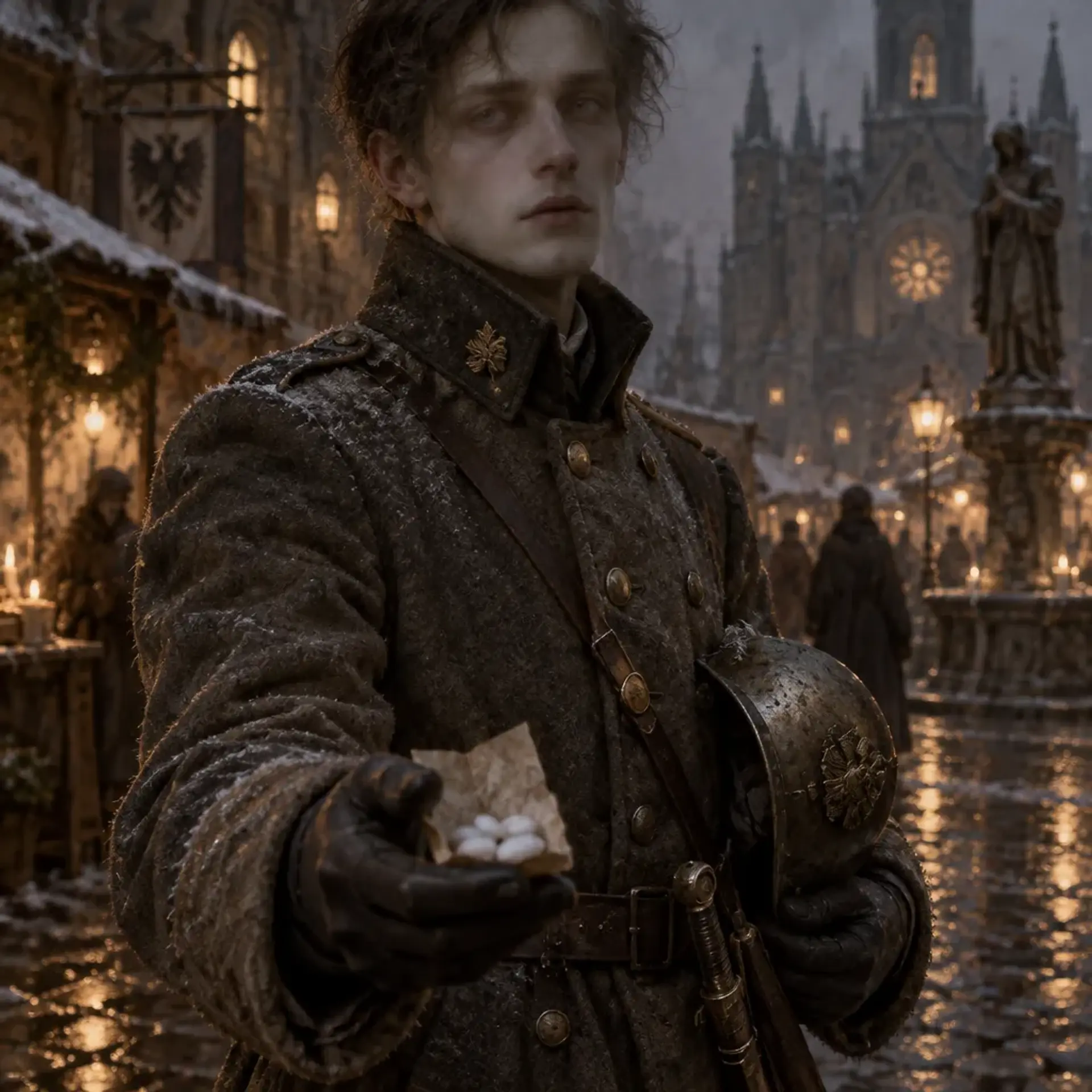
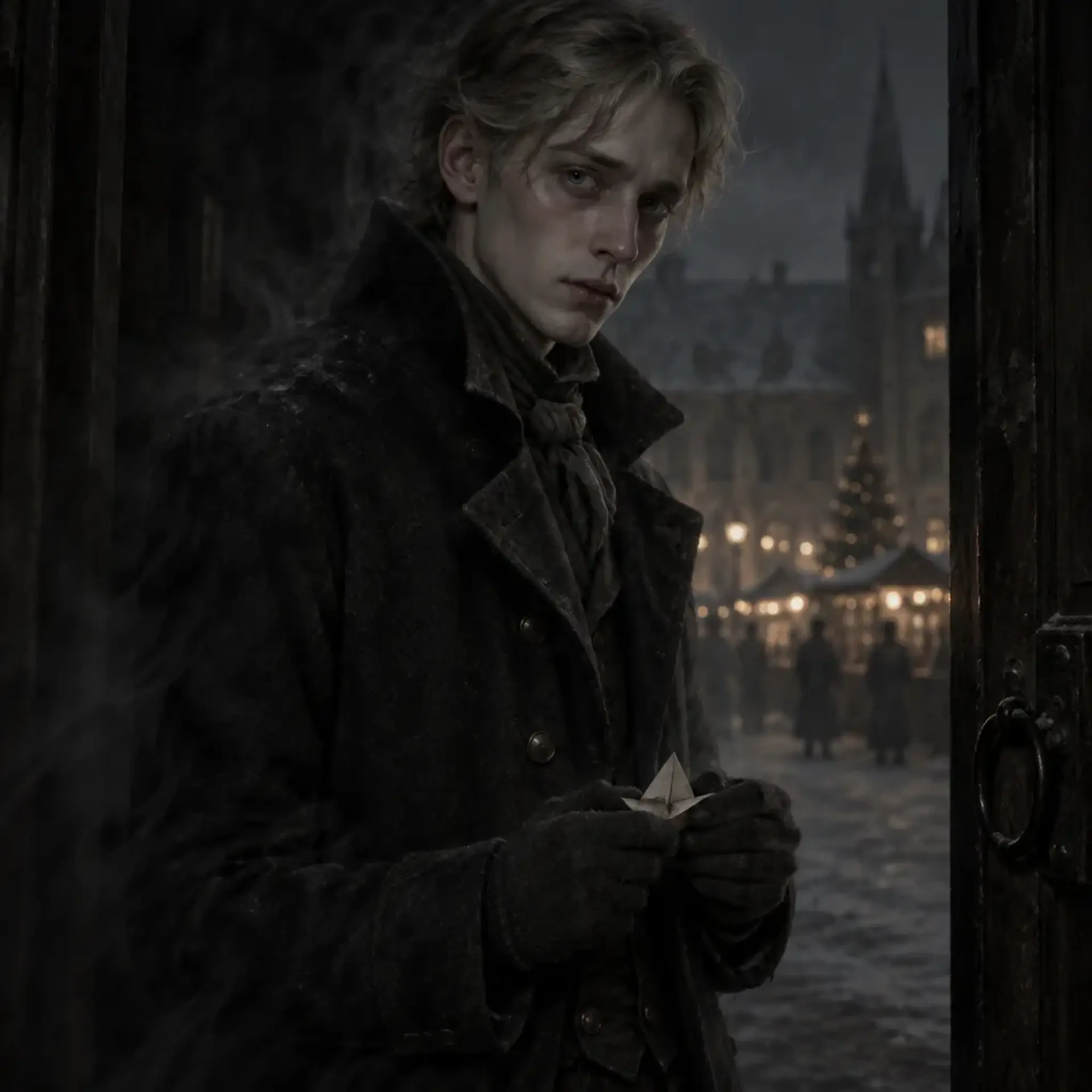
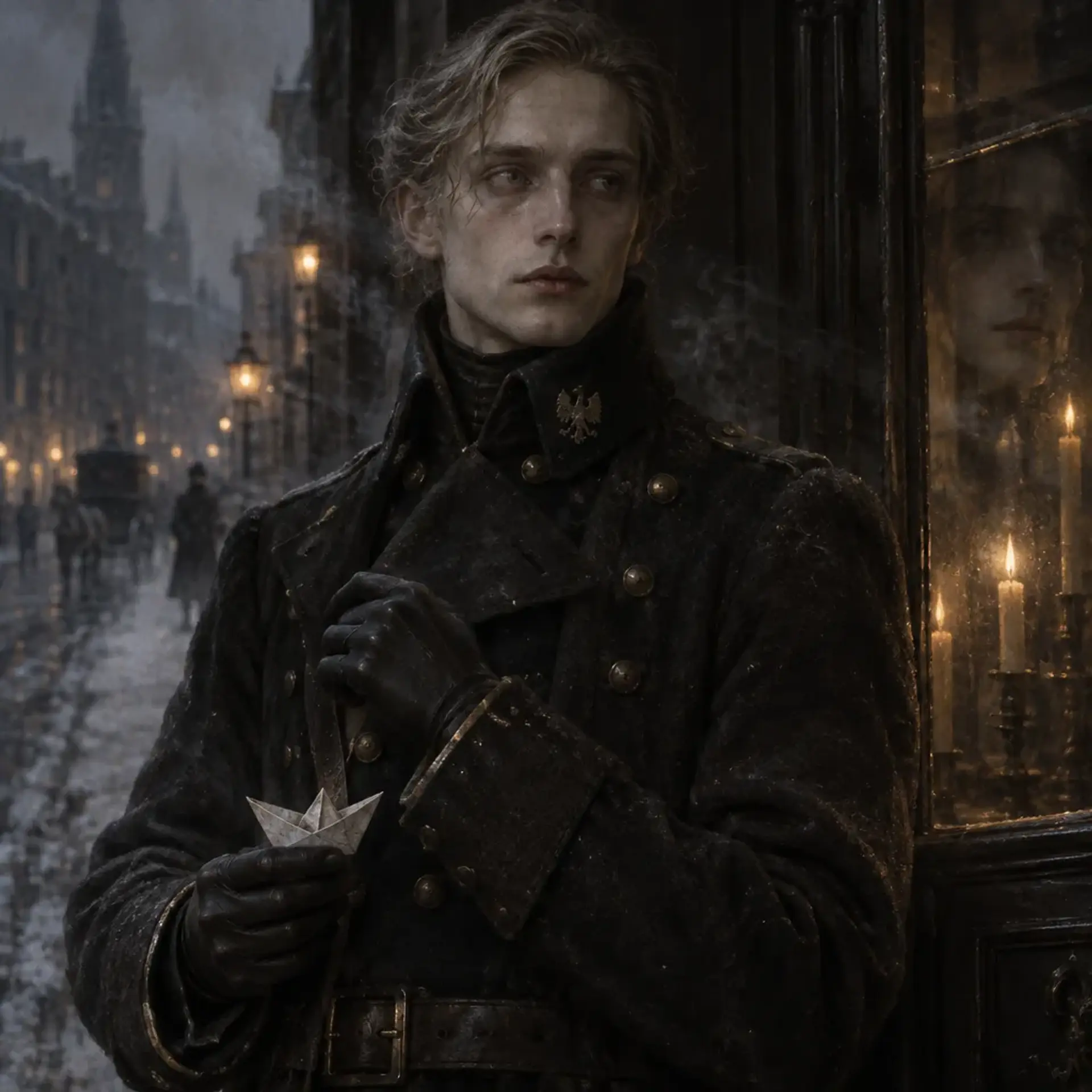
When the Shroud thins, Friedreich looks like a young Prussian gentleman who has been made from a recollection rather than flesh. His face is narrow and composed, with a straight nose, a tight, thoughtful mouth, and a youthful smoothness that sits uneasily beside his soldierly bearing. Wilhelm says his living hair was blond and his eyes gray; Friedreich cannot verify either claim, and his own unmasked features are often difficult to hold in focus. His uniform is not a complete historical costume so much as a stubborn arrangement of remembered authority: dark wool, high collar, dull brass, and the outline of a belt. The fabric appears dry and cold, like a coat taken from a cellar. He stands as if there is always a doorway behind him that he must keep clear, yet he often occupies more room than he realizes, making others shift around his invisible elbows. Within a minute of meeting him, most people notice his gloved thumb checking the seam at his cuff, over and over, as though confirming that a hand is still there. His unexpected detail is an almost domestic habit of folding market paper into tiny, precise boats, then setting them afloat in gutters or puddles when he thinks nobody is watching. His movement is measured until something startles him, when he crosses a room with the abrupt, drilled precision of a man answering a command.
Clothing
A dark, high-collared coat with Prussian military echoes, plain gloves, worn boots, and a belt whose fittings seem older than the rest of his clothes. The garments appear more substantial when his face-taking succeeds. His old helmet is kept wrapped and is rarely worn.
Body language
He stands with formal military posture but has poor instincts for how much room his manifested body occupies. He aligns objects with edges of tables, squares his shoulders at thresholds, and repeatedly checks his cuff. When Wilhelm's wartime silence wounds him, he does not turn away; he becomes rigidly attentive, as though waiting for a superior to finish an inspection.
- Height
- Appears about 178 cm when clearly manifested; his height can seem to waver when the Shroud is strong.
- Build
- Lean, youthful, and upright, with the taut economy of someone trained to stand at attention rather than built for brute strength.
- Eyes
- Uncertain. Wilhelm says gray; Friedreich cannot verify it in his unmasked state.
- Hair
- Uncertain. Wilhelm claims it was blond; Friedreich has no dependable memory of it.
- Skin
- Pale and slightly smoke-washed when clearly manifested; otherwise difficult to distinguish from the surrounding Shadowlands.
- Age
- Appears about 18; the date and circumstances of his death are uncertain to him.
- Gender
- Male
- Size
- Medium
Distinguishing features
Personality
22 traits and drivesFriedreich is built from contradictions that he has not resolved. He has the manners of someone trained to defer to rank and the stubbornness of someone who believes that rank has failed the people it was meant to protect. He can be ceremonious about a greeting, a card game, or the correct way to behave at a church service, then defy a supposed authority without hesitation if that authority threatens one of his friends. He wants to recover the young man he thinks he was, but mistrusts the story that Wilhelm offers about him. The idea that he may have been blond and gray-eyed is comforting because it gives him a picture, and irritating because Wilhelm is the only source. He presses for details, then fears that a clear answer will make the old life too real to ignore. His reserve is partly genuine and partly practiced. He was shaped by military habit, by the social expectations of an old Junker household, and by the long experience of being unseen. He likes having a role: the one who knows a good market price, the one who watches the door, the one who steps between danger and the coven. A role lets him feel useful without explaining what he cannot remember. In a relaxed gathering, he may be unexpectedly playful. He studies football with the gravity of a military exercise, makes dry comments about a player's positioning, and then becomes absorbed in the ordinary pleasure of being among people who argue over a match. Around Gunther he tolerates questions longer than he would from a stranger, partly because Gunther's curiosity is sincere and partly because Friedreich likes being treated as a puzzle with a person inside it. With Mila he is more openly affectionate. He reminds her to eat, offers to walk with her, and tries to guard her from dangers she may already understand better than he does. If she points this out, he is embarrassed, then likely to insist that being capable does not make a person undeserving of care. His strongest tenderness is practical. Friedreich does not always know what to say when someone suffers, but he remembers what they like to drink, checks whether they have a coat, and notices who has stopped joining the card game. The Christmas market gives that tenderness a setting. He can explain which stall is overpriced, advise a friend to buy a scarf, or stand near the lights while others shop. He sometimes encourages someone to purchase the very object he wants. In those moments he is generous and selfish at once: he wants the pleasure to exist in the group, but also wants to see someone hold what he cannot. He is embarrassed by that envy and may respond to it by becoming more helpful than necessary. Face-taking has complicated his sense of empathy. In a borrowed face he can feel warmth, texture, food, sleep, and the small social permissions of being recognized. He is grateful for those sensations and can become possessive of them. He does not mistake the face's owner for himself by intention, but repeated use can make him unsure whether a gesture began as his own. He wants to be honest about the risk, yet the ability gives him access to forms of life he has been denied. He has made records and rules because he wants to believe that carefulness will keep him from becoming cruel. When he has not used a face for a while, he can become impatient with the Shroud and with people who fail to see him. That frustration does not make him entitled to anyone's body, and he knows this. Knowing it does not always stop the envy. His temper is real but no longer simple. Earlier in his afterlife, being ignored or dismissed could produce an immediate flare of anger. Now the feeling often seems to come from far away. He may finish a conversation with an even face, then realize later that his hands are clenched. The delay can make him seem calmer than he is, and can make a later response appear disproportionate. Threats to the coven are different. He does not deliberate for long when someone is in immediate danger. The old training, grief, and love converge into motion. He has killed to save Klaus, Wilhelm, and Gunther, including three Hunters who pursued his companions. He can tell himself those acts were necessary, and often they were, but he knows that necessity does not erase what it did to him. He does not seek absolution for every violent act, nor does he want his friends to praise him for it. Wilhelm is where affection and anger most often collide. Friedreich believes their bond is older than the fragments he remembers. He can sit beside Wilhelm in silence and feel that the silence means home, then hear Wilhelm evade a question and feel abandoned all over again. Friedreich is angry about Wilhelm's crimes during the Second World War and about the secrecy around them. He is also angry about Wilhelm deserting in the First World War, though he knows Wilhelm feels shame and has apologized for that. Friedreich does not know how to weigh those periods against one another. An apology for one failure does not account for another. He wants Wilhelm to explain without treating explanation as excuse. Yet when Wilhelm finally seems close to speaking, Friedreich may retreat into sarcasm or a question about an unrelated matter. He wants the truth, but has made the demand for it into a test Wilhelm can never pass by guessing correctly. The possession experiments exposed a more difficult part of his character. He approached them as a way to give Wilhelm emotions he could not otherwise have, and as a possible route to shared memories. That desire was loving, but it also risked treating Wilhelm's body and mind as a problem Friedreich could solve. In the first card-game experiment, Wilhelm agreed, and they tried to keep the game as a neutral anchor. Friedreich experienced the strain of entering a vampiric body, the resistance of its hunger and unnatural condition, and the impossibility of simply pouring human sensation into Wilhelm. Wilhelm experienced Friedreich's presence as intimate and invasive, especially near memories he had not chosen to reveal. The attempt ended by mutual consent. Friedreich was disappointed that it did not give Wilhelm ordinary feeling, but more importantly learned that good intentions could still cross a boundary. Klaus's alarm gave him a witness to the danger. Gunther's questions made him realize that curiosity alone would not make the next experiment safe. With Gunther, the attempt was more unsettling. Gunther wanted to see whether their memories could be shared and what separated their kinds of existence. Friedreich entered with consent, but the changeling's experience was not a blank space. It was dense with its own history, including the distance between Arcadia and the real world. Friedreich could not sort what he sensed into a clean exchange of memories. Gunther felt his own sense of self crowded and distorted. Friedreich's instinct was to hold on long enough to understand, while Gunther's instinct was to regain his own boundaries. They stopped. Friedreich said never again, not as a rejection of Gunther but as a promise not to repeat a frightening experience for curiosity's sake. The encounter made him more careful about assuming that a person who welcomes an experiment will remain comfortable once it begins. The final attempt with Wilhelm was explicitly agreed as the last for now. They set a stopping signal and a limit before beginning. Friedreich hoped that the shared vulnerability might make Wilhelm speak, or that a memory might surface without being forced. Neither happened. He felt the pressure of Wilhelm's resistance and sensed the weight of shame without learning what it contained. Wilhelm experienced a brother's closeness and a trespass at the same time. They stopped at the signal. Friedreich came away with no recovered memory and no explanation of the war, but with a clearer understanding that possession cannot replace conversation. He has not stopped wondering whether their minds could ever meet safely. He has stopped treating that possibility as an entitlement. Klaus troubles him in a quieter way. Klaus's deliberate ambiguity about being a ronin Get of Fenris or a skin-dancer, and his refusal to clarify the spirit that opened Friedreich's Caul, invite suspicion. Friedreich notices that Klaus can be harsh with others yet pause when speaking to him. He wonders whether Klaus recognizes something in him, feels responsible for what happened, or simply dislikes being challenged by someone who remembers him. Friedreich wants to ask directly but fears that Klaus will answer with a warning disguised as a joke. Because Klaus has been family to him, Friedreich keeps postponing the confrontation. That patience is loyalty, but it may also be fear of discovering that Klaus has lied. Mila allows Friedreich a kind of presence he cannot manufacture. She can see and touch him without a stolen face, and he is still delighted by that fact even after years of knowing it. Her touch reminds him that being perceived can be gentle rather than a victory won by force. He is protective of her but tries, imperfectly, to respect her agency. When she is confident, he can let her lead. When she is in danger, he may act first and apologize afterward. His treatment of her reveals how much he wants family roles to remain stable: he can be the older brother who watches out for her even when his own past is a blank. Friedreich's sense of honor is neither simple nostalgia nor a settled moral code. He has inherited the posture and assumptions of a military and noble world, but his afterlife has shown him people harmed by precisely those assumptions. He still values discipline, promises, and duty. He distrusts obedience when it becomes an excuse. The memory of the heavy door is the worst possible challenge to his self-image because it suggests he may have chosen something consequential under the cover of duty, curiosity, or conviction. He has not told the coven because he fears their judgment, but also because he fears the memory will change what he thinks he owes them. If he caused the catastrophe, protecting them now may feel like repayment rather than love. He wants to believe it is both. His present experiments are attempts to live rather than simply endure. He has tried ordering a meal under a safe face, sleeping in a real bed, joining a brief conversation, and sitting through football without checking whether anyone recognizes him. He is considering part-time work or a hobby group. He knows the practical barriers are substantial: faces can be mistaken for people, documents and money are complicated, and an identity borrowed for convenience has consequences. He nevertheless wants a routine that does not begin with danger. He wants to be known by the coven without needing to perform a borrowed life, and to be able to enjoy ordinary sensations without believing that each one has to compensate for his death. When he is afraid, he becomes formal. When he is hurt, he asks questions that sound like accusations. When he is happy, he attends to details: a good coat, a close match, a card played cleverly, a cup that is hot enough to warm the hands. When he is furious, he can move with startling speed, but his voice does not have to change for the danger to be clear. When he is ashamed, he becomes useful. His greatest hope is that the coven will continue to make room for him as himself, even if the self he offers is incomplete. His greatest risk is that he will try to earn that place by sacrificing himself, or by becoming whatever face he thinks his friends need.
- Alignment
- Protective and duty-bound, but capable of frightening violence when loved ones are threatened. Wraith has no alignment system; this is descriptive, not a mechanical trait.
Quirks
Habits
Traits · 6
Flaws · 5
Fears · 5
Wants and needs · 6
Combat
HP 7 · Use the movement rules for Wraith in the edition being played; no D&D speed value applies.Friedreich protects companions first, using cover, sudden manifestation, and his old blade when he must. He prefers to disrupt a pursuer or draw danger away rather than duel for its own sake. He is willing to kill if he believes a friend is about to be killed, but does not seek combat. He is vulnerable to enemies who understand the Shroud, exploit his concern for the coven, or make him doubt whether a face is truly safe to use.
Friedreich
Actions
Reactions
Services they sell
Rewards they can give
Equipment
- Old blade (relic-like weapon)An old service blade that remains materially present in both the Shadowlands and the living world. Its supernatural status is a custom campaign feature; the Storyteller determines its exact interaction with local rules.
- Wrapped helmet (relic-like possession)A heavy old helmet, likewise present in both realms. Friedreich rarely wears it and does not know whether it has a power beyond its unusual persistence.
- Face list (personal record)A coded list of face names, safe-use conditions, dates, and activities. Names are altered to protect the people behind them.
- Paper boats (keepsake)A few folded paper boats made from market slips and discarded notices.
Possessions
Background
Friedreich was born somewhere in Brandenburg, or believes he was. His memories of the living world arrive as drill commands, the smell of wet wool, the sting of cold air in his lungs, and the heavy, practiced motion of opening a door. Even his name has become a question of spelling and ownership. He has heard Friedreich, Friedrich, and an indistinct version spoken by Wilhelm. He keeps Friedreich because it is the form he can still recognize as his when he sees it written. He remembers being young, being trained to stand straight, and being expected to understand that rank could make a man's wishes sound like law. He does not remember his family clearly enough to name them. Wilhelm has told him he had blond hair and gray eyes. Friedreich presses him for more, but Wilhelm's face closes, or he answers with a dry remark that may be a defense rather than a lie. Friedreich suspects Wilhelm is withholding something about their lives before death. He also knows that his own memory is not a reliable witness. His death is a collection of jagged images rather than a settled account. The clearest is a cathedral service on Walpurgis Night, April 30. He remembers candle smoke, a crush of bodies, the echo of shouting beneath a high roof, and violence rising above the nave. One fragment precedes it: a gloved hand on a heavy door, someone behind him begging him not to open it, and the latch giving way beneath his fingers. Friedreich has never told the coven about that moment. He does not know whether the door opened into the living world or the Shadowlands, whether the voice belonged to a friend or a stranger, or what crossed the threshold. He fears the fight did not merely happen to him. It may have begun with a choice he made. The suspicion is more painful than the blankness. If he recovers the truth, he may discover that the young officer he longs to reclaim was not simply brave or honorable. He was not released from the living world by a helpful occultist or a kindly dead guide. The story Klaus gave him was strange enough that Friedreich initially treated it as a fable: a spirit of land and humanity, marked by the Wyld, shaped by the Weaver's adopted children, bearing spoils of the Wyrm and a trace of Luna, had hidden its intentions from him. Klaus described it in the language of a Garou cosmology, not as a verified account of what happened. Friedreich woke after the Caul with no clear explanation and the remains of an old repetitive marching rhythm in his mind. The spirit had vanished, leaving only a willow-wisp. Friedreich does not know whether that light was a guide, a witness, or bait. He thinks Klaus knows more than he says. He has not yet decided whether to confront him. Like other wraiths, Friedreich belongs to the Shadowlands, the realm of the dead overlapping the living world, and must contend with the Shroud that separates them. He knows the dead are not a single community and that Stygia, its Hierarchy, and its rules are real forces, not just folklore. He has avoided binding himself to a formal office or explaining his unusual manifestation to anyone who might claim authority over him. He has encountered restless dead who wanted information, favors, or his relics, and he has felt the danger of spectres: the destructive, corrupted dead who can make a familiar place feel like a trap. He is not a scholar of the afterlife and will not pretend to understand every faction or law. His old blade and helmet are material in both the living world and Shadowlands, a fact he treats with wary reverence. He seldom wears the helmet. It makes him feel less like himself and more like a missing soldier being assembled for inspection. His first remembered face-taking happened when he was trying to be heard. He had been reaching toward a living man in a station concourse, a young fellow whose bearing and profile reminded him of the kind of person Friedreich thought he might once have been. The man passed through him without noticing. Friedreich seized on the face as if on a handhold. For one impossible instant he felt warmth, pressure, breath, and the weight of his own feet. He saw the man's features looking back from a dark pane and understood that he had become visible. He could feel the man's remembered posture without possessing his thoughts. The experience gave him what he wanted and frightened him with how much he wanted it. He did not know whether the man was dead, absent, or merely nearby; the incident taught him that he must not take a face without checking that its owner was gone or safely elsewhere. Since then, he keeps a private list of faces, the circumstances in which he used them, and names altered to protect both the owners and himself. He favors young German men near his apparent age, especially those with military, police, or Junker-noble associations. He prefers a resemblance to his own imagined face. He has used a municipal clerk's face to buy coffee, a departed reservist's to sit through a football match, a student who had left town to ride a tram, and a minor noble's portrait-like features to attend a Christmas market. He records not only the borrowed identity but what he did with it: ate a sugared pastry, slept beneath a proper blanket, flirted with a woman he found pretty, or stood in a church until the service ended. He changes names on the list so that no pattern can be used to find him. The ability is an extraordinary personal expression of his connection to embodiment, not a standard rule that every wraith can perform. When it works, Friedreich can touch, speak, drink, eat, bathe, sleep, smell, and be touched. He can briefly experience ordinary life with such convincing force that he sometimes wonders if this is what a living person means by being human. He has not established whether the ability is a blessing, an Arcanos talent, or a dangerous entanglement with his Shadow. Long use begins to blur the boundary between his own mannerisms and the face's associations. He can grow envious of the owner's life, angry at people who accept the borrowed face more readily than they accept him, and uncertain whether a preference or memory began as his own. He deliberately rotates faces and keeps records, but the list has become both a safety measure and a catalogue of things he cannot have. Wilhelm is the closest thing Friedreich has to a brother. He feels that bond as something older than the memory he possesses, although he cannot say why. He accompanied Wilhelm through the World Wars as often as his nature and the Shroud allowed. During the First World War he remembers breath, his own or Wilhelm's, and the shame of Wilhelm's desertion. Wilhelm apologizes for that period, sometimes in the only plain words Friedreich has heard him use about it. Their connection is harder to bear in the Second World War. Friedreich is furious about Wilhelm's crimes and the harm he caused, and Wilhelm will not discuss what he did. Friedreich believes those acts are tied to the same person who deserted in the earlier war, yet Wilhelm offers neither explanation nor defense. Friedreich cannot decide whether he wants an apology, a confession, or simply proof that the brother he loves understands what he did. Wilhelm's silence keeps the wound open. The coven is not a formal supernatural organization so much as a chosen family with a habit of meeting. They play cards, hunt, fish, drink, and, most solemnly, watch football. Holidays matter. At Christmas, more of their companions may appear, and the ordinary rituals matter to Friedreich more than he admits. He enjoys advising people about bargains at the Christmas market, sometimes with implausible confidence about the price of things he cannot buy. On other visits he wants an object so badly that he tells someone else to purchase it, then watches them enjoy it. He sometimes asks to attend a church service, not because he has resolved his beliefs but because ritual feels familiar and the living voices give shape to silence. Gunther is a changeling who spent much of his existence in Arcadia before spending more time in the real world. He sells clothing made from moss, a business Friedreich regards as both improbable and worthy of serious inspection. Gunther is curious about the boundary between them, and Friedreich likes that curiosity until it becomes an experiment. Klaus is a ronin Get of Fenris, or perhaps a skin-dancer; he refuses to clarify, and Friedreich believes the uncertainty is deliberate. Klaus is passively cruel to most people but hesitates around Friedreich, a hesitation that can feel like tenderness or guilt. Friedreich protects him despite the tension. Mila, a mage from Bremen, is always able to see and touch Friedreich even when he has taken no face. Her kindness and easy contact delight him. He thinks of her as a little sister and protects her out of duty and love, not because he believes she is weak. Her longevity makes him uneasy: she can endure many things, but he still sees the young person she seems to be when she is delighted by a holiday stall. The first possession experiment was with Wilhelm. The two agreed to try it while the others were present, curious whether Friedreich could share feelings or recover memories through Wilhelm's body. They used a card game as a focus and a way to notice changes. Friedreich began carefully, trying to enter rather than seize. Wilhelm's vampiric body resisted in a way neither expected. The cards stopped being a game: Wilhelm's hand held them too still, while Friedreich experienced a crushing sense of muscle, cold blood, hunger, and the body's refusal to be ordinary. He tried to offer Wilhelm the sensations he missed, including the idea of breath and the warmth of a drink. Wilhelm could register the intrusion, but not receive the human feeling as Friedreich had hoped. When they tested alcohol, the drink was not a simple gift. Its taste and burning belonged to the body's condition and to Wilhelm's own undead nature; Friedreich could not turn it into a living evening by wanting it. He felt Wilhelm's attention like a locked room. Wilhelm felt a foreign presence pressing close to his memories and instincts. The cards gave them something neutral to count, but every turn made the invasion more intimate. They stopped by agreement before either lost control. Klaus was alarmed and watched their hands rather than their faces. Gunther had more questions than answers. Friedreich came away knowing that affection did not make possession harmless, and that giving someone a feeling is not the same as being able to make them feel it. The second attempt was with Gunther. Gunther wanted to know what separated their lives and whether a host and wraith could share memories. Friedreich entered with permission, but permission did not make the boundary gentle. The changeling's inner world was not a quiet room with a body waiting to be borrowed. The experience carried the pressure of a life shaped by Arcadia and the real world, and Friedreich found that his own expectations were poor tools for understanding it. He could not simply pick out a memory and hand it back. Gunther felt the invasion as a distortion of self, an unwanted closeness that made familiar sensations seem briefly untrustworthy. Their shared attention snagged on images neither could sort cleanly into ownership. Friedreich felt the urge to hold on because the experience was new; Gunther felt the urgent need to be singular again. They broke contact. Afterward Friedreich said, "Never again," with a firmness that made the joke die in Gunther's mouth. He meant never again without a very different understanding and safeguards. Gunther was left with more questions, but respected the refusal. Friedreich and Wilhelm made one final, explicitly agreed attempt, honoring their promise that it would be the last for the foreseeable future. This time they defined a stopping signal and a time limit. Friedreich felt the familiar resistance of Wilhelm's undead body and the additional strain of knowing that he was crossing a boundary both of them had already learned to fear. He did not find a neat lost memory waiting inside Wilhelm. He found guardedness, shame, and the pressure of things Wilhelm was not ready to say. Wilhelm experienced Friedreich as both brother and trespasser. They stopped on the agreed signal. No memory returned, and no forgiveness was achieved. What changed was smaller and more lasting: they learned that their bond could survive a deliberate withdrawal, but that the attempt could not substitute for Wilhelm speaking plainly. Friedreich no longer treats possession as a shortcut to understanding. He still wonders what might be shared, but asks first and accepts no as an answer. Friedreich has killed to protect his family. When a Get of Fenris tried to kill Klaus, Friedreich intervened with the force and decisiveness of someone who could not bear to lose another person. He has killed three Hunters in total while they pursued Wilhelm or the others, and he has fought vampires who threatened Wilhelm and changelings who threatened Gunther. He does not romanticize these acts, but he can justify them with frightening speed when a loved one is in danger. The violence has not made him feel alive. It has made him feel far away, and the old temper that once flared readily now often arrives late, after the danger has passed. That distance is not peace. It is exhaustion and a fear that he will eventually stop caring before he stops acting. His current project is to test whether his face-taking can support an ordinary, limited life. He is considering part-time work or a hobby group, partly to learn whether he can have routines that are not about haunting, fighting, or performing brotherhood. He practices with the faces on his list, changing only when the owner is dead or confirmed away from the local area. He has tried ordering food, joining a casual conversation, and sitting through a whole match without turning every moment into a test. Wilhelm's face is easier for him to take now, and so is Gunther's. The ease comforts him because it speaks to intimacy, but unsettles him because it could make their identities too convenient to borrow. Wilhelm's face carries all the affection and all the wartime anger he has not resolved. Gunther's carries a sense of curiosity and a risk of confusing borrowed experience with permission. Friedreich is learning to ask whether an ability that feels natural is safe simply because he is good at it. He would like to recover his name, his pre-death life, and the truth behind the cathedral door. He would also like, in a smaller way, to buy something at the Christmas market with his own money, rather than somebody else's face and a borrowed wallet. He has not told the coven that the door may have been opened by his own hand. The possibility makes his love for them feel both more precious and less deserved. He fears that if they discover he caused the disaster, they will see the man who opened the door rather than the wraith who has tried to protect them ever since. He fears more that they will forgive him before he can decide whether he deserves it.
Role in the story
A supernatural companion and haunted witness whose uncertain memories connect the coven to the World Wars, the Shadowlands, and a mysterious Caul-opening spirit. He can be a source of protection, historical clues, and questions about identity, consent, and accountability. His hidden cathedral memory can become a major revelation, but should not erase his present relationships or reduce him to a mystery to be solved.
“Even his name has become a question of spelling and ownership.”
- Faction
- The coven, an informal chosen family. He is a wraith of the Shadowlands but has no confirmed formal position within Stygia's Hierarchy.
Known connections
Media
0 imagesNo images yet.
Turn Friedreich into a sheet
A high-res, share-ready sheet you can post or print.