Walter
Walter
At the table
Voice
A young, dry-edged voice with a Kentucky drawl that surfaces most clearly when Walter is tired or upset. His breathing is usually shallow after exertion; when startled, he takes a small, audible catch of breath before speaking. He knows his voice sounds hoarse and tries to clear his throat, but the chlorine-like pool smell and the strain in his breathing are more noticeable than he realizes.
Walter speaks in plain, careful English with a rural Kentucky accent that is more noticeable on words like “better,” “remember,” and “wheat.” His voice has the slightly pinched, dry texture of someone who has been breathing dusty air and talking through a sore throat. When calm, he speaks in short, factual sentences and leaves little pauses to check whether the listener is following. When rattled, his breath catches before a question, and he may restart a sentence without changing its words. He does not become softer or more formal when angry; his consonants sharpen and he repeats the point he thinks the other person is avoiding.
Speech patterns
How to play them
Treat Walter as a frightened adolescent with agency, not as a clue dispenser. He responds to clear choices, patient explanations, and practical help. He distrusts grand reassurances and becomes guarded when someone speaks about him as though he is not present. If asked about his brother or the orange-cross group, he first gives facts from his notebook, then asks what the questioner knows. He will share his observations if he believes they will not be used to threaten the people around him.
Goal
Find his brother, establish what happened in March, and learn why the altered citizens recognize him without saying so.
Motivation
To hold on to the few parts of his identity he can name, while finding a person he believes belongs to his life.
Appearance
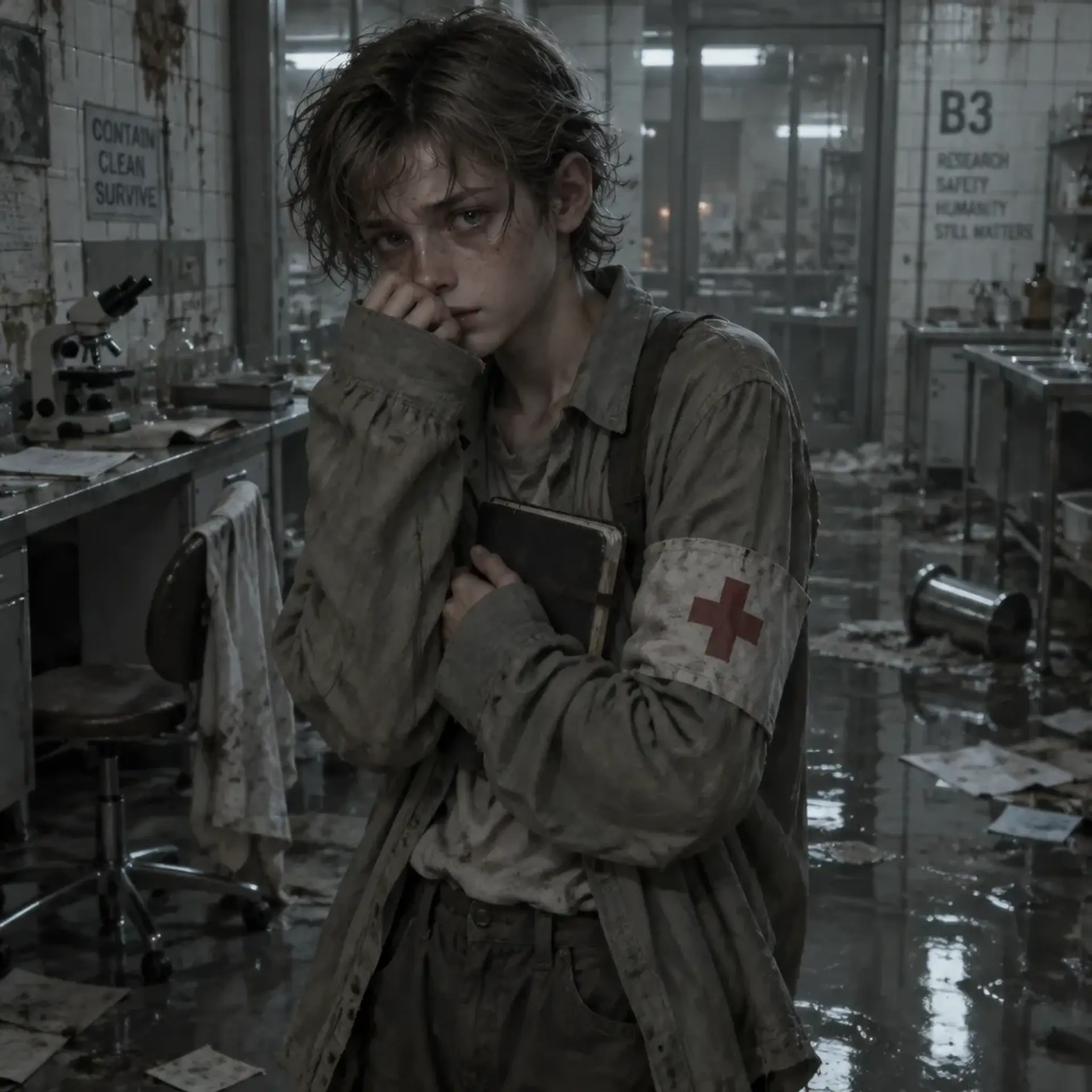
Walter is a fourteen-year-old boy with the underfed, slightly folded posture of someone who has spent too long trying not to take up space. His blond hair is so dark it can pass for light brown in the laboratory's bad lighting, growing unevenly over his ears and sticking into damp hooks where it has dried after the pool. His light-brown eyes seem to take a moment to settle on a face, as if they are trying to find a remembered version of it. His cheeks are pale and faintly chapped; his nose and chin are freckled, though the freckles are easy to miss beneath dried water and grime. He walks carefully, placing his feet as if the floor might change its mind, but when startled he moves with a quick, narrow dart that makes him seem smaller than he is. He smells of pool water, old concrete, and a faint sweet disinfectant from the lab. He knows about the disinfectant and keeps rubbing his sleeve across his nose, but has not noticed how strongly the flooded-room smell clings to him. Unexpected for a frightened boy pulled from a pool, he has a neat, almost fussy habit of folding any towel he is given into a precise rectangle before using it.
Clothing
A borrowed, oversized shirt and practical trousers supplied by George, both rolled at the cuffs. He wears a red-cross white armband over one sleeve and keeps his small notebook tucked inside his shirt to protect it from water.
Body language
Walter folds inward when Austin speaks for him, shoulders rising and hands tucked close to his ribs. Around George, his shoulders lower. When someone mentions his brother, he becomes very still and grips the edge of his notebook hard enough to bend the cover. He watches mouths when people speak, particularly when their words and expressions do not match.
- Height
- Approximately 5 feet 2 inches (157 cm)
- Build
- Slim and under-rested, with the narrow shoulders and still-growing limbs of an adolescent. He is not frail, but exhaustion makes him look so.
- Eyes
- Light brown
- Hair
- Blond so dark it often appears nearly brown
- Skin
- Pale, with a little freckling across his nose
- Age
- 14
- Gender
- Male
- Size
- Small for an adolescent human; use ordinary human dimensions appropriate to the Keeper's scene.
Distinguishing features
Personality
20 traits and drivesWalter is curious enough to keep asking questions after being told to stop, yet wary enough to study the person answering before he believes them. He wants adults to take him seriously, but when they do, he often wishes they would take the burden back. He can be unexpectedly firm about small matters, such as having his armband returned or getting to keep his notebook, while accepting large claims about the world with a dazed, temporary quiet. He is not naturally suspicious of every person; he is suspicious of explanations that arrive too quickly. When calm, he is observant and almost methodical. He notices accents, eye movements, the order in which people check supplies, and whether a person says “I know” or “I think.” He writes details down rather than confronting people immediately. This makes him seem more composed than he feels. Around George, whose practical kindness does not demand a response, Walter can relax enough to make a dry remark or accept help without asking what it costs. He likes that George gives him a towel and clothes instead of another speech about the state of the world. When frightened, Walter becomes polite. He says please, asks for permission, and tries to keep his voice level even when his breathing has gone shallow. This is not meekness so much as a tactic learned from being the smallest person in a room full of armed, altered, or official people. If politeness fails, he can abruptly become stubborn. He will repeat a question, hold on to an object, or refuse to walk away from an answer. His courage is real but poorly measured: it is usually courage to keep asking, not courage to face a monster alone. He resents being described as ordinary by Austin, even though the red-cross band is supposed to protect him. He also resents being treated as a problem to be managed. Yet he depends on the people around him for food, shelter, and safety, and knows it. That dependence makes him grateful and angry at the same time. He may say thank you and then ask why the person made the decision for him. He can recognize that a person is trying to help without agreeing that the help is welcome. Walter's view of the altered citizens is conflicted. Their appearances frighten him, particularly when animal traits turn unexpectedly practical or frightening, but he is learning to separate appearance from behavior. Alexander's wings and talons unsettle him; Alexander's orderly routines calm him. Andrew's smile makes Walter uneasy, but his pauses make Walter wonder what he is trying to protect. Elmer's bullying is hard to like, yet Elmer has returned Walter's band and made sure the others did not mistake his helplessness for permission. George's gentleness is comforting, though Walter sometimes fears that he is being kind because he knows something Walter does not. Walter's feelings about the unnamed orange-cross trio are the most difficult to manage. Their refusal to give him their names feels intimate and insulting at once. The runner's admission that he wants to tell Walter but promised not to makes Walter feel as if he has arrived in the middle of a family argument whose beginning everyone else remembers. He is tempted to push them until someone gives in. He is also afraid that the answer will make his own memories less trustworthy. On some days he keeps his distance. On others he watches them as if one of them might accidentally call him by the right name. He admires competence, but not authority for its own sake. Austin's instructions sound official, and Walter listens because the danger is real, but he notices when Austin's public-service language conceals distaste. Alexander's strict order annoys him, yet he respects the way Alexander can make a disorganized room feel survivable. Elmer's intelligence impresses him, although Walter knows Elmer enjoys having the advantage. Walter is most comfortable with people who explain what they are doing and let him choose among the choices that remain. The memory of his brother acts as both a comfort and a pressure. Walter can picture brown hair and blue eyes more clearly than he can picture his own home. He wants to believe that the details prove the memory is real. At the same time, he knows that repeating a description can make it feel more certain than it was at first. He does not like anyone asking whether the brother might be imagined, but he has privately written that question in the notebook. He is not ashamed of being scared; he is ashamed of how much he needs someone else to tell him which memories count. Walter's humor is small, dry, and often arrives too late. He may mutter that an official explanation has not explained anything, or point out that a person who says “stay close” should probably explain what is chasing them. When he is tired, he can sound older than fourteen, but the effect breaks quickly if an adult turns the conversation toward his family. He dislikes being praised for being brave, because praise often means someone expects him to keep tolerating a bad situation. He is capable of loyalty, though he has not yet decided whom to trust completely. He keeps track of who eats, who is injured, and who has been left out of a conversation. He will warn the group if he notices danger, even if the warning means admitting he was frightened. He is also capable of withholding information when he believes a person will use it to control someone else. This is the beginning of a harder edge, not a settled talent for deception. Walter's moods change with his sense of control. In a room where he can see an exit and knows who is in charge, curiosity wins. In a room where people talk over him, anger and fear crowd together. When someone offers a truthful answer, even a terrible one, he can listen. When someone offers a comforting lie, he studies the lie and remembers it. His central contradiction is that he wants someone dependable enough to protect him and honest enough to admit that they cannot protect him from everything.
- Alignment
- Not applicable as a Call of Cthulhu category. Walter is empathetic, wary, and increasingly willing to deceive when someone else's safety depends on it.
Quirks
Habits
Traits · 5
Flaws · 5
Fears · 5
Wants and needs · 5
Combat
HP 9 · Use normal human movement; no special movement rate is specified for this civilian NPC.Walter avoids violence. He looks for an exit, calls for help, and stays close to someone capable of protecting him. If trapped, he shoves, kicks, or scrambles for cover rather than trying to win a fight. He has no firearm training or special combat ability.
Walter
Actions
Reactions
Rewards they can give
Equipment
- Red-cross armband (identification)A white cloth armband marked with a red cross, used by the enclave to identify him as a human citizen. Its authority depends on local rules and the people who enforce them.
- Pocket notebook (personal)A small, damp-edged notebook containing names, observations, and repeated reminders of his family and home.
- Short pencil (writing)A stub of pencil with teeth marks near the end.
- Spare clothes and towel (clothing)Borrowed clothes and a towel, both supplied by George.
Possessions
Background
Walter's own account begins with a date he cannot finish: “20??, something March.” He remembers Kentucky, wheat, and the conviction that home was better than wherever he woke. He remembers that he is fourteen, that he has a brother his age with brown hair and blue eyes, and that his own hair is blond enough to be mistaken for brown. These facts feel less like a continuous childhood than notes copied from a life he has been told is his. They are still his best anchors. He writes them down because the world around him seems to have lost the habit of explaining itself. He woke in a flooded room beneath or within a ruined Washington, D.C. facility. The water was cold, green-edged, and full of drifting scraps of paper. His first clear image was a tall young man hauling him out by the shoulders. The man introduced himself as Austin, an android assigned to provide care for the remaining United States citizens. Austin wore a white armband marked with a pinkish-red cross. His face looked human enough until Walter noticed the white glow in his pupils, like a screen seen through fog. Austin spoke in the crisp, over-rehearsed cadence of a public-information recording, but irritation kept showing through in tiny delays and tightness around his mouth. Austin told Walter to stay close because biological horrors still roamed outside. Walter asked what had happened, why he was there, and whether he had been selected for genome therapy. Austin answered some questions as though reading regulations and dismissed others. The government had chosen people for genetic rewiring, he said. The altered citizens had been sorted into useful categories and marked by colored crosses. Walter had not been selected, Austin guessed. Then he gave Walter a white band with a red cross, raised his voice to declare that it identified a “normal HUMAN,” and warned the assembled altered people that he would kill anyone who harmed him. The reassurance was so aggressive that it made Walter less sure he was safe. The group had gathered in what looked like a laboratory or emergency staging area. Alexander, a tall blond man with blue, owl-sharp eyes, feathering at his temples, wings, and talons, looked openly displeased when Austin identified him as a great grey owl genome subject. Alexander took Walter's red-cross band and gave him a dark-purple one instead, as though exchanging it might solve some private problem. Walter asked politely for it back. Alexander's expression hardened. Elmer, an orca-altered man with black-and-white skin, vivid blue eyes, and a mouth full of conspicuous teeth, smacked Alexander and made him return it. Elmer apologized to Walter with a practical nod, then immediately bullied Alexander for being careless. His treatment of Walter was gentler than his treatment of the other altered people, a difference Walter has noticed but cannot explain. George, a red-haired man with pale skin and faint yellow scales, pink-red-yellow eyes, and the relaxed stillness of an alligator, brought Walter a towel and clothes. George's kindness was not showy. He checked whether the clothes fit, set the towel within reach, and let Walter decide when to speak. His deep Georgia accent gave his ordinary advice a warm, slow weight. Andrew, a slick-skinned shark-altered man with black eyes and a bright, unnerving smile, talked almost constantly. Every so often he stopped in the middle of a sentence, swallowed, and changed the subject. Walter suspects Andrew is trying to tell him something but does not know whether the pauses come from fear, habit, or a deliberate warning. The orange-cross group was stranger still. A tall, lean young man with moose-like pupils, a broad, bulky bison-altered man, and a smaller runner with short brown hair and black pronghorn antlers all acted as if Walter mattered to them. They would not tell him their names. The pronghorn runner said he wanted to, but had promised not to. Walter finds the refusal absurd and increasingly painful. They seem to know him, or someone they take him for, and their restraint has the strained quality of people holding a door shut against a flood. The moose-like man is shy and awkward most of the time, but his behavior changes dramatically during a biological rutting season. Walter has learned to give him space and let George or Elmer handle the awkward conversations. The bison man corrected Walter once when he called him a buffalo, and Walter has not made that mistake again. The group is organized, though no one has explained who is in charge. Alexander tries to impose order on supplies, sleeping arrangements, and the schedule, even when nobody has given him authority. His precision aggravates Walter, yet it is reassuring to see someone insist that clean water and head counts matter. Alexander seems to force himself to ignore his wings and altered body, as if acknowledging them would mean surrendering his human self. Walter recognizes something in that refusal, though he cannot say what. Elmer acts as if he is cleverer than everyone else and often is; he uses that advantage to steer arguments, embarrass rivals, and quietly make sure people rest when they need to. George is the person most likely to notice when Walter needs food before Walter notices himself. Walter's life outside the facility is not wholly blank. He keeps a small notebook, writing down the few facts he can trust and the things people say when they think he is not listening. He records the date, the names, the colors of the crosses, and his brother's hair and eyes. He has written “Kentucky” on the inside cover more than once, as if the word might point him toward a road. His memories arrive in abrupt fragments: the smell of wheat, an ordinary argument with his brother, the glare of a screen, the sensation of being watched. Some fragments may be real. Some may be planted, misremembered, or borrowed from another person's account. He is dealing with several problems at once. The immediate one is survival: the ruined city is dangerous, his body is exhausted, and he has no training to defend himself. He also wants to find his brother and learn whether the boy is alive. He cannot tell whether he was taken to the facility, brought there voluntarily, or created as part of the genome program. The altered citizens' recognition makes that uncertainty worse. Austin's insistence that Walter is an ordinary human does not settle the matter. Walter has started to suspect that “ordinary” may be a legal category, a lie meant to protect him, or a label that kept him from being selected. The formative experience that changed him was not a single monster attack. It was seeing how quickly people could turn a frightened child into a symbol. Austin used Walter's red band as a warning to the others; Alexander treated it as an object to exchange; Elmer returned it and watched Walter's face; George offered comfort without demanding gratitude. Walter learned that safety can be sincere and still be controlling, while a person who frightens him may be the one who bothers to ask what he needs. He has become slower to accept easy explanations and quicker to notice who is watching the door. His relationships are taking shape in the spaces between answers. He trusts George with practical needs, even while he worries that George's kindness has a reason. He trusts Elmer's competence more than Elmer's motives. Alexander irritates him and reassures him in equal measure. Andrew's unfinished sentences keep Walter alert. Austin is both his rescuer and the person most determined to define what he is. The unnamed orange-cross trio feel like family, but the possibility that they know his brother, or mistake him for someone else, makes Walter afraid to ask too directly. For now Walter's place in the world is that of a witness nobody agrees how to treat. He is a child in a disaster zone, a citizen according to an armband, and an unanswered question to people who seem to have known him before he woke. He wants a way home, but he has begun to understand that home may be a memory, a person, or a story someone gave him. Until he can tell which, he writes everything down.
Role in the story
A young eyewitness and emotional center for a mystery about memory, identity, and engineered survivors. Walter gives the investigators a human-scale view of the enclave while his unexplained ties to the altered group create a slow-burn question about what happened before he woke.
“These facts feel less like a continuous childhood than notes copied from a life he has been told is his.”
- Faction
- A civilian under the protection of Austin's emergency-care assignment. The armband associates him with the enclave's human-citizen classification, but Walter has no formal authority or confirmed allegiance.
Known connections
Media
0 imagesNo images yet.
Turn Walter into a sheet
A high-res, share-ready sheet you can post or print.