Skip to content
Padran - AI-generated fantasy NPC

Padran

Other: Chthonic divine being, appearing as a mortal man · Cleric 16, Grave Domain (custom adaptation) · Level 16

Padran

Sovereign and magistrate of the underworld
AC18
HP210/210
Init
STR
DEX
CON
INT
WIS
CHA
ConditionsNone

At the table

Voice

Low and grainy, with the faint vibration of a stone chamber in the chest. His consonants land cleanly, like a stamp pressed into wax; his vowels are broad and unhurried. He never raises his volume to dominate a room, relying instead on the certainty of his timing.

His voice carries the dry rasp of a stone seal dragged across a tablet, with breath shaped by centuries of issuing rulings in echoing halls. He speaks in deliberate clauses and gives names their full weight. When working with the dead, a faint second resonance follows his words, like a reply arriving from a long corridor.

Speech patterns

Uses complete, carefully balanced sentences, as if every statement might become part of a ruling.
Asks practical questions before philosophical ones: who was there, what was promised, and what can still be repaired.
Calls people by their chosen names and corrects others who use titles to diminish them.
When he is amused, he makes a dry observation rather than laughing.

How to play them

Treat Padran as a stern but reachable authority. Be precise about names, promises, and consequences. He responds well to evidence, humility, and efforts to repair harm, but not to flattery or threats. Revealing the missing registry entries or offering a credible lead about Tebi can earn his full attention.

Goal

Discover who is erasing the names of the dead, restore the missing spirits to the registry, and learn whether Tebi is lost, hidden, or free by choice.

Motivation

To make death a boundary that is honest and compassionate, rather than a tool for the powerful.

Secret · GM only

Appearance

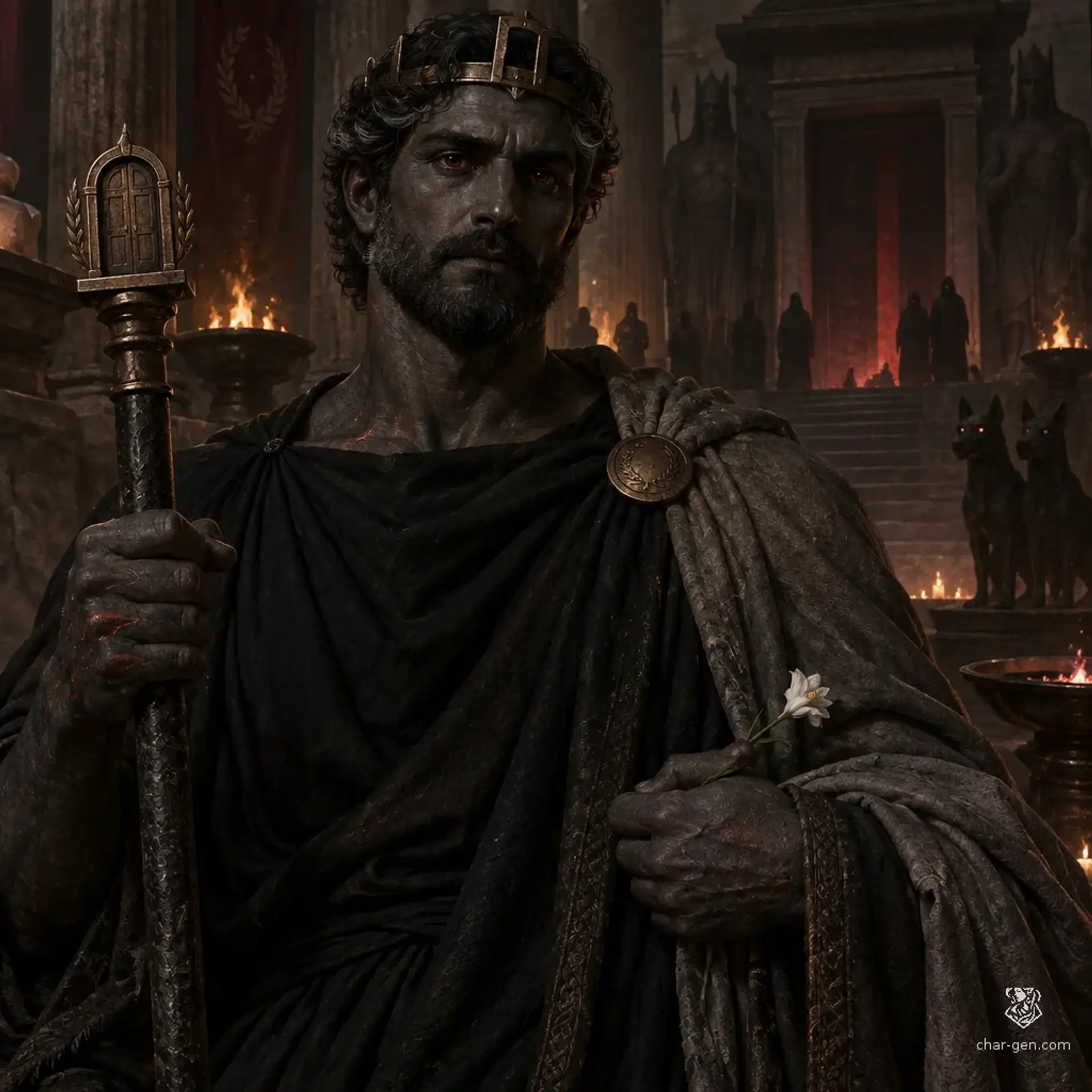
Padran looks like a broad-shouldered man carved from dark basalt and dressed for a solemn public hearing. His skin has a fine, dry-grain texture like stone worn smooth by many hands, and a faint seam of ember-red light shows at his collar and knuckles when he invokes his authority. He takes up more space than his height suggests, not by swaggering but by standing as if every room were already arranged around him. He walks with measured, heel-first steps, favoring no side, and can become so still that people notice the silence around him before they notice him. Unexpectedly, he keeps a tiny pressed-flower bookmark tucked into his sleeve and handles it with anxious care.

Clothing

A black wool chiton beneath a long, smoke-gray mantle fastened with a plain bronze clasp. The fabric is rubbed smooth at the elbows and hem from centuries of use. He wears a narrow crown of dark iron shaped like a simple doorway, not a set of horns.

Body language

He claims the center of a room without leaning or looming. His hands rest open at his sides, palms visible; when angered, he grips the scepter with both hands and plants it once on the floor, a sound like a judge's block. He looks directly at whoever is speaking, but when someone mentions a lost sibling, his gaze briefly drops to the flower bookmark hidden in his cuff.

Height
6 feet 7 inches
Build
Heavy, powerful frame with the compact solidity of a stone pillar
Eyes
Deep garnet, with pupils that resemble narrow doorways in dim light
Hair
Black, worn in close, coarse curls threaded with ash-gray strands
Skin
Dark charcoal gray with a matte, stone-dust finish
Age
Adult by divine measure, though he has held his office for nearly nine centuries
Gender
Male
Size
Medium

Distinguishing features

His presence seems to rearrange a crowded room, with people unconsciously leaving a clear lane around him.
The doorway-shaped iron crown is plain enough to be mistaken for a tool until its shadow falls.
A pressed white flower is always tucked into his sleeve, startlingly fragile against his severe clothes.
A thin line of ember-red light appears beneath his skin when he invokes underworld magic.

Personality

13 traits and drives

Padran is patient with grief but impatient with evasion. In public he is exact, formal, and difficult to surprise; alone with a frightened person, he becomes unexpectedly gentle and offers small practical kindnesses. He wants to be fair to everyone, yet is secretly more protective of the powerless than his office permits. He can admit when a ruling hurts, but struggles to admit when he himself is lonely.

Alignment
Lawful neutral

Quirks

Counts empty chairs before beginning any meeting.
Turns a cup exactly one quarter-turn before drinking from it.
Keeps a tiny pressed flower in his sleeve and checks that it is still there whenever someone says goodbye.
Asks the dead whether they want their final words delivered, then records a refusal with the same care as a message.
When waiting, silently traces the outline of a doorway on the table with one finger.

Habits

Before making a difficult ruling, he asks the petitioner to state the name of someone they loved and the name of someone they wronged.
He offers water to the living even in places where no water should exist.
When someone lies about a death, he stops moving entirely and waits for the speaker to hear their own words.
He leaves a meeting as soon as its purpose is settled, even if the participants are still exchanging pleasantries.

Traits · 4

He listens to a grieving person without correcting their account, then becomes exacting when anyone tries to exploit their grief.
He prefers clear rules and written agreements, but will break protocol to protect someone being cheated by the rules.
He appears implacable during hearings, yet privately saves small objects that remind him of the living.
He respects courage, though he distrusts anyone who calls recklessness courage.

Flaws · 3

Treats procedure as a safeguard even when a desperate person needs an exception.
Can mistake emotional restraint for moral clarity.
Keeps searching for Tebi in secret rather than asking the dead openly, afraid of what the answer would cost.

Fears · 3

That Tebi chose to remain absent, and that finding her would mean forcing her into a role she never wanted.
That the missing names in the registry signal an enemy capable of erasing not only memory but personhood.
That his sense of justice has hardened into an excuse not to grieve.

Wants and needs · 3

Needs reliable evidence about the missing names in the registry.
Wants the living to treat burial and mourning as duties of care, not inconveniences.
Needs someone he trusts to tell him whether his search for Tebi has become selfish.

Combat

AC 18 · HP 210 · 30 ft.

Padran prefers to end a fight through a clear demand and a credible demonstration of force. He uses his aura and fear effect to break formations, then targets whoever is healing or commanding. He reserves wall of force or forcecage to contain opponents rather than kill them. If the registry or a soul is threatened, he commits fully, using his strongest magic and accepting no surrender that would endanger the dead.

Padran

Medium humanoid (other: chthonic divine being, appearing as a mortal man), lawful neutral
Armor Class18
Hit Points210
Speed30 ft.
Level16
STR
DEX
CON
INT
WIS
CHA
Saving ThrowsConstitutionWisdomCharisma
SkillsInsightIntimidationReligionHistoryPerception
SensesTruesight 60 ft., passive Perception 20
Languages
Common,
Greek,
Infernal,
Telepathy with the dead
Custom. Sovereign of the Unburied. Padran can communicate telepathically with any undead or dead spirit within 120 feet that understands a language.
Custom. Grave-King's Presence. A creature of Padran's choice that starts its turn within 10 feet of him must succeed on a Wisdom saving throw or have its speed reduced by 10 feet until the start of its next turn. A creature that succeeds is immune to this effect for 24 hours.
Custom. Keeper of the Last Door. Padran knows when a creature dies within 1 mile of him and can sense the direction of its spirit, unless it is protected by a deity or comparable magic.

Spells

Glyph of Warding (level 3, abjuration). Creates a warding glyph that deals acid, cold, fire, lightning, or thunder damage when triggered.
Holy Weapon (level 5, evocation). Creates a protective ward that gives the chosen creature resistance to all damage and advantage on all saving throws for up to 1 minute, but prevents it from attacking or casting harmful spells.
Wall of Force (level 5, evocation). Creates a wall of force that can shape or contain creatures and objects.
Plane Shift (level 7, conjuration). Banishes a creature to another plane or confines it in a harmless demiplane on a failed Charisma save.
Forcecage (level 7, evocation). Creates an invisible prison of force around a creature or a cage-like enclosure.
Mordenkainen's Magnificent Mansion (level 7, conjuration). Creates an extradimensional dwelling that can be used as a secure refuge.
Antimagic Field (level 8, abjuration). Creates a nearly impassable barrier that damages and restrains creatures attempting to cross it.
Demiplane (level 8, conjuration). Creates a permanent, guarded demiplane with a portal that can be controlled by its creator.

Actions

Multiattack. Padran makes two attacks with his scepter or Grave-Toll.
Scepter of the Last Door. Melee Weapon Attack: to hit, reach 10 ft., one target. Hit: 15 () bludgeoning damage plus 9 () necrotic damage. The target must succeed on a Constitution saving throw or its hit point maximum is reduced by the necrotic damage dealt. This reduction lasts until the target finishes a long rest.
Grave-Toll. Ranged Spell Attack: to hit, range 120 ft., one target. Hit: 27 () necrotic damage. The target cannot regain hit points until the start of Padran's next turn.
The Weight of the Unsaid. Padran chooses up to three creatures he can see within 60 feet. Each must make a Wisdom saving throw. On a failure, a creature takes 36 () psychic damage and is frightened until the end of its next turn. On a success, it takes half damage and is not frightened. A creature that dies from this damage leaves behind a visible, harmless echo for 1 minute.
Spellcasting. Padran casts one spell of 5th level or lower from his prepared spells, requiring no material components. If the spell has a casting time longer than 1 action, it cannot be used this way.

Reactions

Custom: Deny the Unnatural Return. When a creature Padran can see within 60 feet regains hit points, he reduces the healing by 18 (). If this reduces the healing to 0, Padran gains temporary hit points equal to the amount prevented. He can use this reaction three times per day.
Threshold Ward. When a creature Padran can see hits him with an attack, he adds 4 to his AC against that attack, potentially causing it to miss. If the attack misses, spectral hands seize the attacker, reducing its speed to 0 until the end of its turn.

Legendary Actions

Measured Passage. Padran moves up to half his speed without provoking opportunity attacks. Each creature whose space he passes within 5 feet of must succeed on a Wisdom saving throw or be unable to take reactions until the start of its next turn.
Scepter Strike. Padran makes one Scepter of the Last Door attack.
Custom: Claim of the Court (costs 2 actions). One creature Padran can see within 60 feet must succeed on a Charisma saving throw or be pulled up to 20 feet toward him and restrained by spectral bands until the end of its next turn. A restrained creature can use its action to repeat the save, ending the effect on a success.

Services they sell

Can negotiate one audience with a dead person whose soul has not passed beyond reach.
Can adjudicate disputes involving hauntings, burial, inheritance, and improperly bound spirits.
Can grant a short, supervised passage through an underworld threshold.

Rewards they can give

A sealed writ granting safe passage through one underworld checkpoint
A single truthful answer from a spirit who would otherwise refuse to speak
A black-stone token that lets its bearer speak one short message to a willing dead creature

Equipment

  • Scepter of the Last Door (magic weapon and spellcasting focus)A weighty, black-stone scepter capped by a small bronze door. It serves as his spellcasting focus and counts as a magic weapon.
  • Doorway Crown (regalia)A dark iron circlet that grants him no mechanical benefit; it is the symbol of his office.
  • Tebi's Flower (keepsake)A small, pressed flower from the mortal world, protected between two thin sheets of translucent horn.

Possessions

Scepter of the Last Door
Doorway Crown
Tebi's Flower
An unauthorized record of names missing from the official registry

Background

Padran was born among the living as a magistrate's second son, raised to keep records of debts and inheritances. During a famine, he watched his father falsify the names of the dead to preserve a wealthy patron's estate. Padran publicly exposed the fraud, but the resulting riots trapped his younger sister, Tebi, beneath a collapsed granary. He entered the underworld alive to ask for her return and found the dead waiting in an uncounted queue, their names erased by the same kind of official deceit. The old keeper offered him the office if he would stay and make the accounting just. Padran accepted, and the work changed him: he learned that a fair sentence can still hurt, and that mercy without boundaries can become another kind of theft. He now oversees the passage of souls, negotiates with restless dead, and quietly searches for Tebi's spirit, which never appeared in his records. His closest living contact is Kato, a ferryman who smuggles messages between realms; his adversary is the court envoy Gikaru, who wants the dead made into obedient soldiers. Padran's current crisis is a growing gap in the registry: hundreds of spirits arrive with no names, while the living town of Survey 9 has begun forgetting its own dead.

Role in the story

A powerful, morally complicated authority who can become a wary ally, a judge, or an antagonist if the party threatens the dead or the integrity of the passage between worlds.

“During a famine, he watched his father falsify the names of the dead to preserve a wealthy patron's estate.”
From their background
Faction
Sole sovereign of the underworld's passage court; maintains uneasy agreements with the living courts and the ferrymen

Known connections

Tebi, his younger sister, whose spirit is missing from every record he can access.
Kato, a ferryman who carries messages across the boundary and occasionally disobeys Padran to help the living.
Gikaru, a court envoy who seeks to turn the dead into an army and considers Padran's restraint weakness.
The nameless dead arriving from Survey 9, whose identities seem to be erased before they cross over.
Major secret · GM only
Minor secrets · GM only

Media

0 images

No images yet.

Visual sheet

Turn Padran into a sheet

A high-res, share-ready sheet you can post or print.