Skip to content

Narek Tegu

Other: Underworld deity, formerly mortal human · Custom 16th-level divine ruler, with features inspired by the cleric and paladin classes · Level 16

Narek Tegu

God and sovereign of the underworld; guardian of the dead and mediator of funeral rites
“That matter has not been laid to rest.”
AC19
HP225/225
Init
STR
DEX
CON
INT
WIS
CHA
ConditionsNone

At the table

Voice

His voice begins in the chest, with a dry, breath-worn rasp from years of speaking over funeral pyres and river noise. The consonants land cleanly, as though each word has been set in place by hand. When amused, a brief roughness at the back of his throat makes the warmth in his voice unexpectedly human.

He speaks in complete, carefully measured sentences shaped by years of reciting names at funerals and settling disputes among the dead. His vocabulary is plain until a bargain is being made, when every condition becomes exact. He often uses a person's name at the end of a sentence, making reassurance feel intimate and a warning feel final.

Speech patterns

Uses names rather than titles whenever he knows them.
Frames bargains in exact terms, then asks whether the other party understands the cost.
Uses practical funeral language as metaphor: 'That matter has not been laid to rest.'
Answers boasts with a calm question about what the speaker intends to do when the boast fails.

How to play them

Offer Narek a name, a truth, or a promise kept, and he will listen longer than expected. He responds poorly to flattery used as leverage and immediately notices anyone treating the dead as objects. He can be bargained with, but insists that terms be specific and that the vulnerable are not used as collateral.

Goal

End the unlawful binding of the dead in Tarka without breaking the compact that keeps the living and underworld from open war.

Motivation

To preserve dignity for the dead while preventing the living from turning grief into a weapon.

Secret · GM only

Appearance

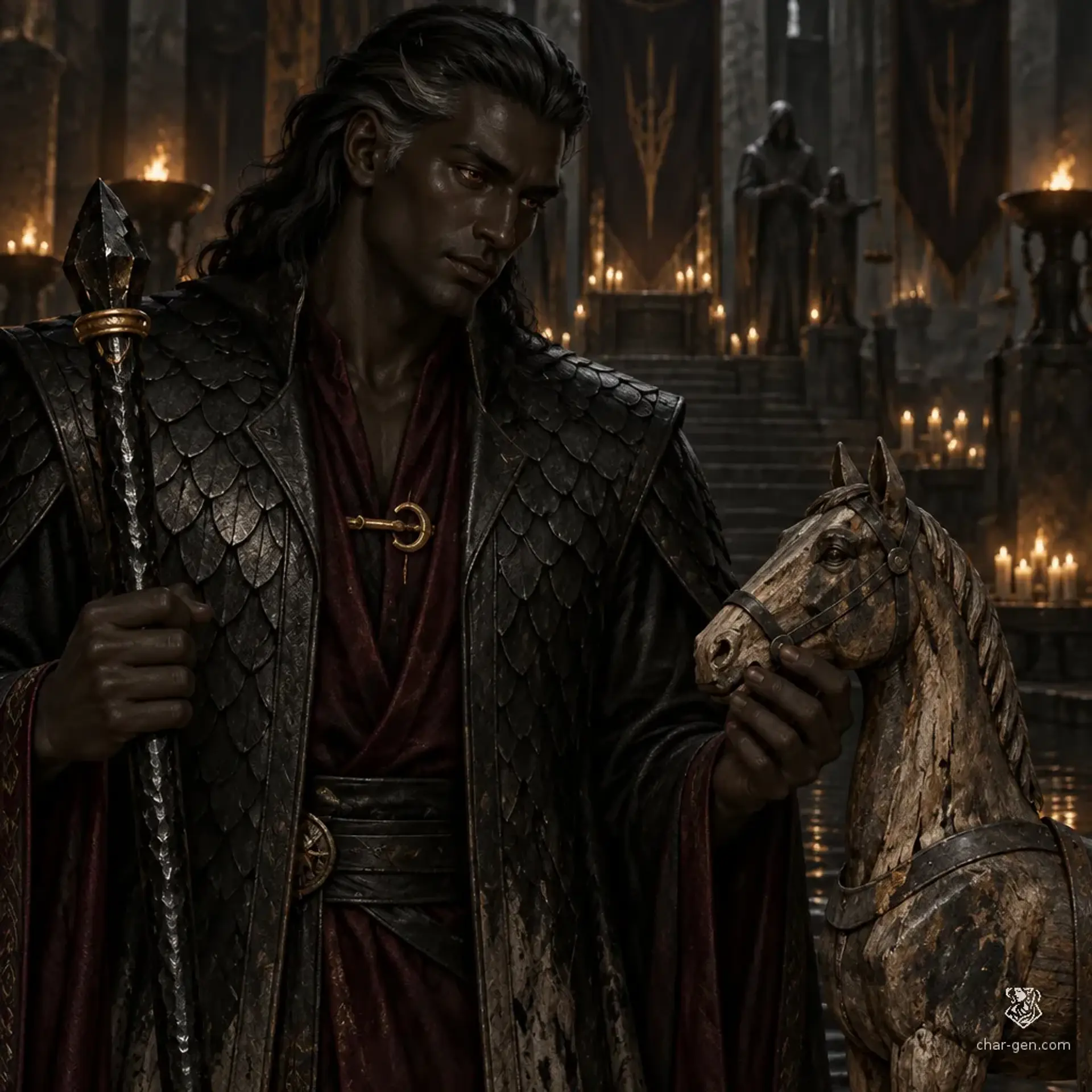
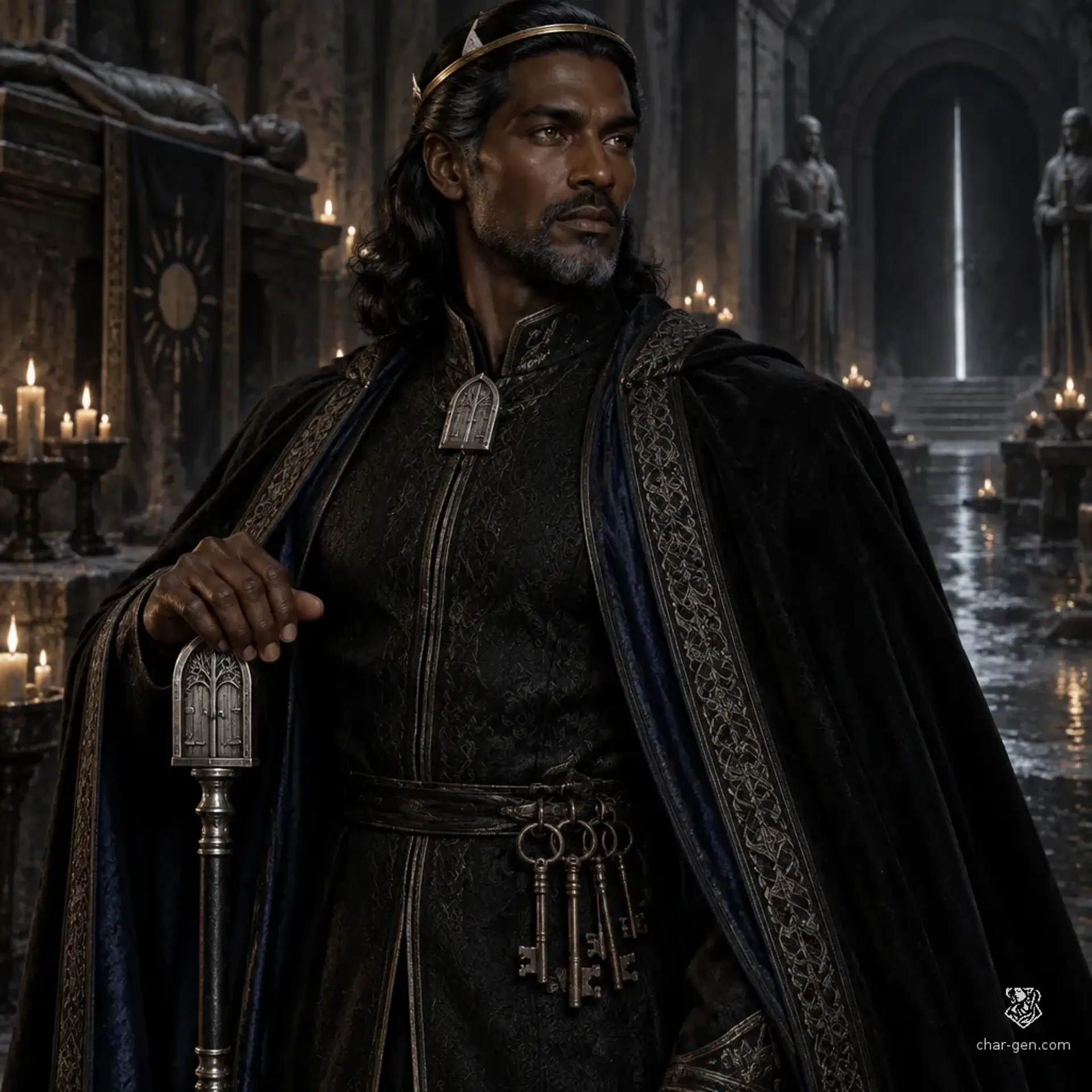
Narek is striking in the way a locked tomb is striking: immaculate, intimate, and difficult to look away from. His pale skin has the cool, faintly translucent cast of candle wax, with blue-gray shadows at the temples and a fine sheen like polished marble. He stands with his weight balanced on the balls of his feet, perfectly still until he moves, then crosses a room with the unhurried certainty of a door closing. His long, work-roughened hands are stained at the cuticles with black funerary resin; he uses them with surprising tenderness when laying a body to rest. His beauty feels deliberate rather than soft, sharpened by a straight nose, a precise mouth, and the patient attention he gives whoever is speaking.

Clothing

A fitted charcoal coat of soft, heavy cloth, lined in dark plum silk; a high collar fastened with a plain bronze clasp; black gloves tucked into his belt, rarely worn; and a narrow sash embroidered with tiny names in a script only the dead can read

Body language

He waits with his weight slightly forward, hands folded loosely at his belt as if ready to lift something. In conversation, he holds eye contact without challenge and tilts his head when listening. When displeased, his thumb presses once against the first joint of each finger, a small inventory-taking gesture.

Height
6 feet 4 inches
Build
Tall and broad-shouldered, with a lean, controlled strength that suggests long practice rather than display
Eyes
Dark amber, with a reflective gleam like lamplight on deep water
Hair
Black, worn to the collar and combed back; a few silver strands catch the light like wire
Skin
Pale ivory with a cool waxen sheen
Age
Looks about 40; has existed for thousands of mortal years
Gender
Male
Size
Medium

Distinguishing features

Pale, wax-sheened skin with cool blue-gray shadows at his temples.
Long hands with black funerary resin worked into the cuticles, a visible trace of his old trade.
A still, forward-balanced posture that makes him seem already in motion.
A small bronze clasp shaped like a closed door, worn at his throat.

Personality

14 traits and drives

Narek combines an intimate gentleness with an uncompromising sense of duty. In private, he is dryly funny and unexpectedly attentive to ordinary comforts; in court, he is formal and exacting. He can show real warmth to mourners, yet becomes frighteningly direct when someone exploits the vulnerable. He likes beauty and company, but distrusts anyone who mistakes desire for entitlement.

Alignment
Lawful neutral

Quirks

Counts the chairs in a room before sitting, then leaves one empty for anyone absent.
Turns a cup so its handle points toward the person who is speaking.
Taps the bronze door clasp twice before entering a room, even when the door is already open.
Keeps scraps of funeral ribbon and knots them into tiny, tidy bundles while listening.
When introduced to someone, asks what name they want remembered under.

Habits

At the start of a meeting, he asks who has died recently, even if the conversation is about something else.
When someone speaks honestly about grief, he gives them his full attention and does not interrupt.
He grows brisk and cold when a powerful person treats the dead as property.
After a difficult decision, he washes his hands in a bowl of clean water, even if they are not visibly dirty.

Traits · 4

Remembers small personal details about mourners, but refuses to indulge powerful people who demand special treatment.
Enjoys dry jokes and beautiful clothing, yet considers vanity a poor substitute for character.
Offers comfort freely, but expects promises and bargains to be honored exactly.
Can be patient through a long grief and suddenly decisive when someone crosses a moral line.

Flaws · 3

Treats obligations to the dead as absolute, even when the living face urgent danger.
Has difficulty accepting help because he believes the burden of his office must be carried alone.
Can become controlling when he thinks someone is being exploited, mistaking protection for permission.

Fears · 3

That the dead will become a resource controlled by the powerful rather than people owed dignity.
That his compassion will eventually make him break the compact and unleash a war between realms.
That Kantu or Tika will be harmed because of their connection to him.

Wants and needs · 4

Needs evidence of who is binding the dead in Tarka.
Wants the names of the unlawfully detained dead returned to their families.
Needs allies who can act in the living world without making him break the compact.
Wants one honest conversation about his mortal life, without anyone asking him to perform divinity.

Combat

AC 19 · HP 225 · 30 ft.

Narek opens by dividing enemies with darkness or fear, then uses his reach and necrotic glaive to punish anyone who closes on his allies. He prioritizes necromancers, captors, and anyone attempting to flee with a soul or corpse. He avoids lethal force against those who can be disarmed or persuaded to yield. If his realm or protected dead are threatened, he uses legendary actions aggressively and fights until the danger is ended.

Narek Tegu

Medium humanoid (other: underworld deity, formerly mortal human), lawful neutral
Armor Class19
Hit Points225
Speed30 ft.
Level16
STR
DEX
CON
INT
WIS
CHA
Saving ThrowsConstitutionWisdomCharisma
SkillsInsightPersuasionIntimidationReligionPerceptionHistory
SensesTruesight 60 ft., passive Perception 20
Languages
Common,
Undercommon,
Celestial,
A custom funerary language spoken by the dead of his realm
Custom feature. Lord of the Last Door. Narek can sense when a creature within 1 mile dies, unless its death is concealed by a deity or equivalent magic.
Custom feature. Undying Sovereign. Narek has advantage on saving throws against spells and other magical effects. If reduced to 0 hit points outside his realm, he instead drops to 1 hit point and vanishes to the underworld, where he reforms after days.
Custom feature. Grave Sovereignty. Undead within 60 feet of Narek have disadvantage on attack rolls against him and his chosen allies.
Magic Resistance. Narek has advantage on saving throws against spells and other magical effects.
Legendary Resistance (3/Day). If Narek fails a saving throw, he can choose to succeed instead.

Spells

Heal (level 6, evocation). A visible creature regains 70 hit points. This spell has no effect on undead or constructs.
Power Word Kill (level 9, enchantment). Narek speaks a word of power to a creature he can see within 60 feet. If it has 100 hit points or fewer, it dies. Otherwise it takes psychic damage. A creature killed by this spell cannot be revived except by true resurrection or wish.
True Resurrection (level 9, necromancy). Narek touches a creature that has been dead for no more than a century and restores it to life, provided its soul is willing and free.
Darkness (level 2, evocation). Narek creates a 20-foot-radius sphere of magical darkness that only he can see through. The darkness lasts up to 10 minutes with concentration.
Cure Wounds (level 1, evocation). Narek touches a creature and restores hit points equal to plus his spellcasting ability modifier.
Death Ward (level 4, abjuration). Narek touches a creature and lays a hand upon its life force. The next time it dies before the spell ends, the spell returns it to life with 1 hit point.
Forbiddance (level 6, abjuration). Narek creates a warded space that prevents creatures from entering by teleportation or planar travel and bars certain creature types he chooses.
Speak with Dead (level 3, necromancy). Narek touches a dead creature and learns its final thoughts, if any, and the emotional state it had at the moment of death.
Maddening Darkness (level 8, evocation). Narek creates a 20-foot-radius sphere of blackness and bitter cold. Creatures in the area must make a Constitution saving throw, taking cold damage on a failure, or half on a success.

Actions

Multiattack. Narek makes three attacks with his sepulchral glaive, or two attacks and casts one spell with a casting time of 1 action.
Sepulchral Glaive. Melee Weapon Attack: to hit, reach 10 ft., one target. Hit: 16 () slashing damage plus 9 () necrotic damage. The target cannot regain hit points until the start of Narek's next turn.
Declare the End. Narek names a creature he can see within 60 feet. The target must make a Wisdom saving throw or take 27 () psychic damage and become frightened until the end of Narek's next turn. On a success, it takes half damage and is not frightened. A creature that succeeds is immune to this feature for 24 hours.
Black Procession (Recharge 5-6). Narek opens a 20-foot-radius pocket of underworld dusk centered on a point he can see within 120 feet. It lasts until the start of his next turn. Enemies in the area when it appears must make a Constitution saving throw, taking 36 () necrotic damage on a failure, or half as much on a success. The area is lightly obscured to Narek's enemies.

Reactions

Not Yet. When a creature Narek can see within 60 feet targets an ally with an attack, Narek imposes disadvantage on the attack roll by naming the ally as one who has not yet been claimed. If the attack still hits, the ally has resistance to its damage. Narek can use this reaction three times per day.
Gather the Fallen. When a creature Narek can see within 60 feet dies, he can move up to his speed toward it without provoking opportunity attacks. He can then preserve its soul from capture or possession until the end of his next turn.

Legendary Actions

Measured Passage. Narek moves up to half his speed without provoking opportunity attacks.
Glaive. Narek makes one Sepulchral Glaive attack.
Call to the Threshold (costs 2 actions). One creature Narek can see within 60 feet must succeed on a Wisdom saving throw or be unable to take reactions until the end of its next turn. Undead and creatures that cannot hear him are unaffected.

Services they sell

Arrange a lawful audience with a dead soul.
Provide safe passage through a section of the underworld.
Identify whether a soul has been captured, bound, or redirected.
Negotiate a formal rite for the burial of someone denied proper funeral customs.

Rewards they can give

A safe passage through one route of the underworld.
The return of a soul held unlawfully, if the party can provide proof and accept the terms of the compact.
A blessing that lets one character speak with a deceased loved one for one minute.
The names of powerful dead who witnessed a hidden crime.

Equipment

  • Sepulchral Glaive (weapon)A dark hafted polearm with a crescent blade etched in the names of the first dead he personally buried.
  • Closed-Door Clasp (wondrous item)A plain bronze clasp that marks his office and opens ordinary doors in the underworld.
  • Rite Bowl (tool)A small bowl of black stone used for washing hands after rites and difficult judgments.
  • Namesash (wondrous item)A narrow, name-filled sash that lets him recognize any dead soul whose name is embroidered upon it.

Possessions

Sepulchral Glaive
Closed-Door Clasp
Namesash
Black-stone rite bowl
Unsent letters to the living
A chipped wooden toy from his mortal childhood

Background

Narek was born mortal in a high valley where families carried their dead down a black-stone road to a river shrine. As a young undertaker, he learned every relative's name and kept a private record of those whose families could not afford proper rites. During a winter famine, a magistrate ordered the unclaimed dead thrown into a ravine. Narek defied him, carrying the bodies one by one to the river. That night, the river opened into the underworld and its old keeper offered Narek a choice: take the office and keep the dead from being treated as refuse, or leave the threshold unmanned. Narek accepted, and the keeper's crown passed to him with the burden of every unfinished farewell. He has since made a realm where the dead are received, not judged for wealth or rank. His long-running conflict is with the living city of Tarka, whose rulers have begun binding the newly dead into a labor force. He still exchanges letters with Kantu, a mortal funeral clerk who sends him names of the unlawfully detained, and he quietly protects Kantu's daughter, Tika, from the magistrates' attention. Narek is not free to simply invade the living world: the ancient compact that grants him dominion over the dead also forbids him from claiming the living by force.

Role in the story

A formidable patron, judge, or adversary whose power is matched by a genuine concern for the dead. The party may need his help to recover a soul, expose Tarka's abuses, or negotiate a passage between worlds. He is not automatically benevolent: he will oppose anyone who steals or binds the dead, even if they believe their cause is noble.

“As a young undertaker, he learned every relative's name and kept a private record of those whose families could not afford proper rites.”
From their background
Faction
Sovereign of the underworld and keeper of the old compact between the living and the dead

Known connections

Kantu, a mortal funeral clerk in Tarka, risks his position to send Narek names of the unlawfully detained dead.
Tika, Kantu's daughter, is a novice physician whom Narek secretly protects and hopes will never need his services.
The former underworld keeper, whose crown Narek inherited, may still exist beyond the last river and considers Narek's reforms a dangerous softness.
Major secret · GM only
Minor secrets · GM only

Media

0 images

No images yet.

Visual sheet

Turn Narek Tegu into a sheet

A high-res, share-ready sheet you can post or print.