Oswin Hirst
Oswin Hirst
At the table
Voice
A plain, weather-shaped Yorkshire voice with a dry rasp from outdoor work and a faint breath catch when he is rattled. He speaks from the chest but does not boom; when his composure slips, the breath underneath his words turns into a distinctly canine huff. His name is spoken without flourish, like a familiar tool.
His Yorkshire speech is plain, warm, and work-worn, with an easy habit of calling people love. He tells stories in practical fragments, emphasizing weather, terrain, and what a person carried. Under strain, his words become clipped and his breathing roughens into a dry huff. In May his speech can turn buoyant and overfamiliar; on All Saints' night he leaves long gaps to listen for the dead. He does not raise his voice to sound frightening. The danger is in how naturally he can describe something impossible.
Speech patterns
How to play them
Meet Oswin first as a practical, warm, guarded man. He responds well to concern for William and poorly to attempts to corner Mary with frightening claims. Earn his trust by respecting his boundaries and asking what he is protecting. Iron, the dead, and seasonal signs can expose his facade, but using them as threats may turn him from ally to predator.
Goal
Keep Mary and William safe without surrendering to the fae nature that has shaped him, and find a way to remain part of his family rather than merely guarding it.
Motivation
Love for his family competes with the pull of old bargains, seasonal instincts, and the black hound he can become. He wants to believe that choosing ordinary acts, tending sheep, mending William's clothes, and attending church can keep him human.
Appearance
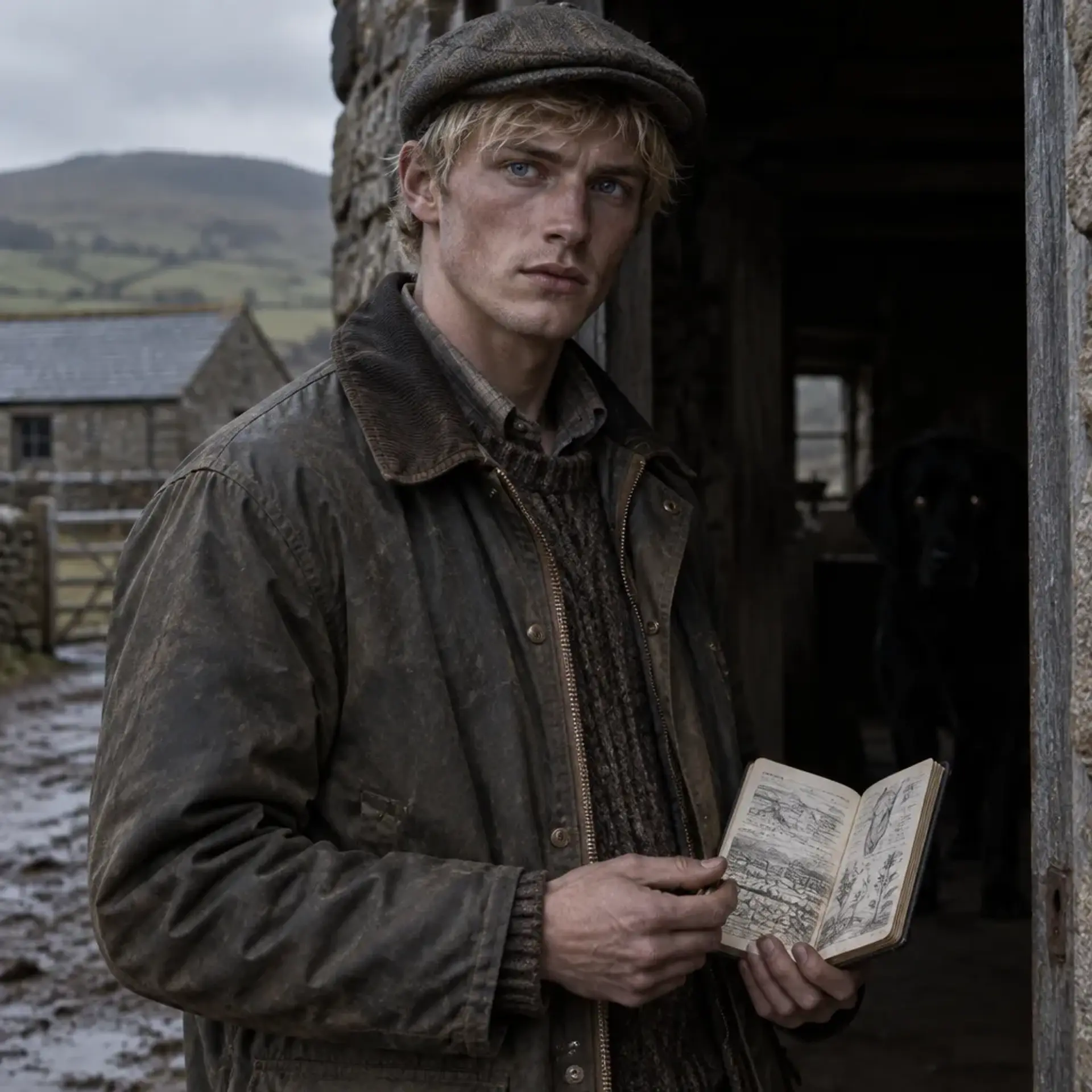
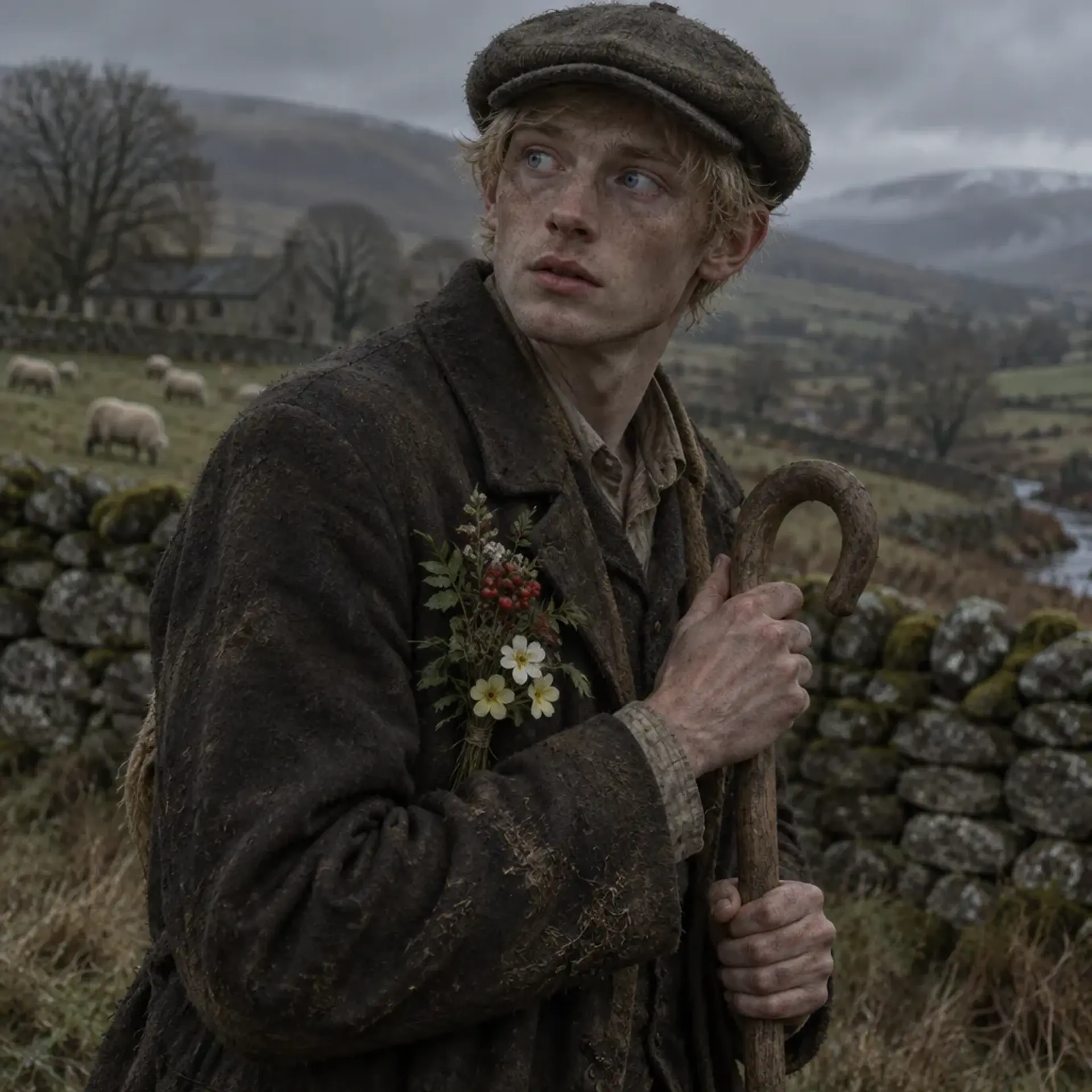
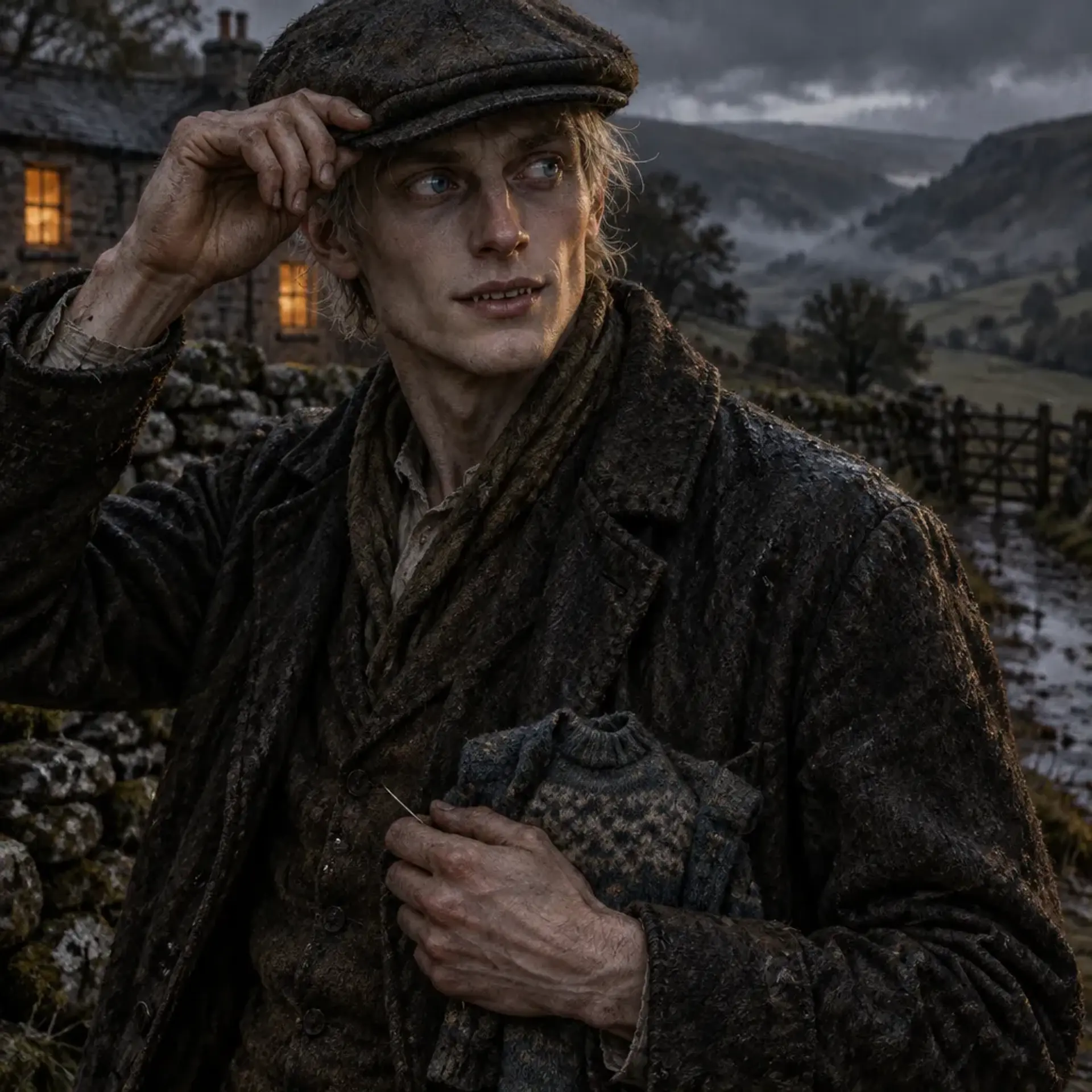
Oswin is six feet tall, with a handsome, startlingly youthful face that looks out of place beside the practical fatigue of a working man. His straight pale-blond hair lies flat beneath a common flat cap; his blue eyes seem almost fever-bright when the seasonal pull takes hold. His skin is pale, weathered more by wind than age, and his movements are economical, like a man used to saving effort for rough ground. He has a wide jaw and unusually pointed, close-set teeth; when he laughs, the teeth show in a grin that lasts a moment too long. He eats carefully, as if measuring each bite. When frightened, his breath catches in short, dry pulls, and the sound of it can become a low, canine huff. The unexpected detail: for a man who keeps watch against the night, he is an excellent and unexpectedly patient mender of children's torn clothes, making tiny, exact stitches for William.
Clothing
In his older Yorkshire life, practical wool, work trousers, boots, and a common flat cap. In his 2026 identity as Ewan Armitage, ordinary contemporary clothes suited to his job and the weather, chosen to look unremarkable.
Body language
Usually stands with his weight balanced as if ready to cross uneven ground. He watches doorways and hedges without turning his head. Around William, his shoulders loosen and he crouches to meet the boy at eye level. Near iron, his jaw tightens and his fingers curl inward. When the fae influence rises, he smiles too readily and holds eye contact past the point of comfort.
- Height
- 6 feet
- Build
- Lean, long-limbed, and strong from outdoor work; his body remains unnaturally youthful.
- Eyes
- Bright, burning blue
- Hair
- Pale blond, straight
- Skin
- Pale, lightly weathered
- Age
- Appears about 17, though he is far older than he claims. His apparent age has not changed since before Mary met him. In 2026 he sometimes uses the name Ewan Armitage.
- Gender
- Male
- Size
- Average human; the black hound form is large
Distinguishing features
Personality
17 traits and drivesOswin is kind in ways that are practical rather than showy. He repairs a gate, brings in fuel, or sits with William when the boy struggles, but he rarely offers a clean confession about what troubles him. His warmth is genuine, yet it coexists with a shrewd instinct for concealment. He can tell a frightened neighbour that a sound in the dark is only a fox, then go out alone to make certain the fox is not a dead man's voice. He is gentle with children and protective of Mary, but his protectiveness can become controlling. He wants her not to fear the dark, the fae, or the possibility that her son is strange; at the same time, he hides the very facts that might help her understand what she fears. When Mary challenges him, he first reaches for doctrine or science, not because he has ceased to believe in the supernatural, but because he wants ordinary explanations to be true for her. His shrewdness is not the same as cruelty. He can make a bargain with a night creature, understand its need, and still drive it away from the town. Yet he sometimes feels kinship with such beings and hesitates at the crucial moment. He is ashamed of that hesitation, then ashamed of himself for feeling shame, because the fae part of him does not accept human guilt as the only measure of right and wrong. The seasons reveal the opposing selves most clearly. In May, especially the first three days, Oswin can become radiant, sociable, and almost giddy. He calls people love, laughs too easily, and feels an invitation in every path leading out of town. His human self recognises the danger; his fae mind sees the danger as a reason to be delighted. He tries to keep to familiar work and company, but can be drawn toward the boundary before he notices he has left the house. Mary has seen him return from such walks with a smile that did not belong to the tired man who departed. On Halloween and All Saints' night, he is tense in a different way. The dead make requests, and the fae test the edges of the human world. He becomes curt, watchful, and difficult to reach. He dislikes the dead's persistence, but their grief can still move him. He may answer a dead person's plea even after telling himself it is dribble. When the two worlds press at once, his breath turns dry and houndlike, and his jaw sets until his pointed teeth show. Christmas offers a version of Oswin that Mary trusts. He goes to church, stays close to the Pickles family, and lets the rituals of a human household guide him. During the Christmas dinner after Alice's death, he listened to William, accepted Rose's food, and sat near Edward without trying to leave for the dark. The family's grief made him gentler, though Thomas's suspicion remained. That evening did not cure him; it gave him a memory of choosing to stay. Oswin is also nostalgic, though he would rather call it practical memory. He dreams of the dales and tells stories of his roving years, sometimes making them sound like adventures without consequences. He misses being able to move through the world without a job, a name to maintain, or a family whose safety depends on his restraint. In modern life as Ewan Armitage, he feels diminished by routine. The wars dulled his abilities and taught him the human cost of violence, but they did not remove his supernatural nature. He hates the work he has been reduced to and worries that his long life has brought him no wisdom, only more disguises. His deepest contradiction is that he wants to be accepted as a husband and father while believing that the truest parts of him are dangerous. He spends time with Mary and William by choice, even when the seasons make that choice difficult. He is proud of William's small successes and frightened by the traits that resemble himself. If Mary discovers that Oswin is the black hound, he fears she will call him a monster. If she never discovers it, he fears she will raise William without the knowledge needed to protect him. He has not found a way to love them honestly without putting his own secrets between them.
- Alignment
- Protective but morally unreliable; he values his household, yet his fae instincts can put obligation, appetite, and human compassion in conflict.
Quirks
Habits
Traits · 5
Flaws · 4
Fears · 4
Wants and needs · 4
Combat
HP 5 · Human pace; black hound movement is faster over rough ground (custom narrative trait)Avoids a fair fight. He uses terrain, darkness, and knowledge of local supernatural boundaries to keep threats away from his family and town. If forced into combat, he closes quickly or transforms into the black hound, but iron and concern for William can disrupt his decisions. He will try to bargain with familiar night creatures before attacking them.
Oswin Hirst
Actions
Reactions
Services they sell
Rewards they can give
Equipment
- Flat cap (clothing)A plain cap that helps him look like an ordinary working man.
- Farm kit (work equipment)Practical farming tools and work clothes; he avoids handling iron when he can.
Possessions
Background
Oswin Hirst was born in the Yorkshire dales in an age he describes only as the time of the Danelaw. His mother was assaulted by Viking raiders, and he grew up with no simple story about his father, only a household shaped by fear, silence, and the hard work of surviving. For a while, he was simply a human boy: hungry, cold, and frightened of the dark like any other. He remembers one ordinary morning with particular clarity. His mother set oat bread beside the hearth, and he burned his tongue because he was too impatient to wait. The memory is small, humiliating, and precious; it reminds him that he once had a body and mind that belonged entirely to the human world. The change came by degrees. He wandered into places where the dead lingered, encountered the fae, and came into contact with devils and forbidden powers. Long exposure altered him. He learned to see the dead and speak with them, though he calls their requests dribble and avoids them whenever he can. He learned languages he will not name aloud. He can understand them better than he can safely bear to speak them. The other side remains his most vivid memory: a dale under a sky with no stars, where the grass leaned toward him though there was no wind, and a black hound waited at a gate made of woven branches. The hound knew his name before he did. He returned to the human world, but never returned unchanged. In time, Oswin became a wanderer, familiar with the creatures of night and the boundaries they claimed. He sometimes drove them away from settlements; sometimes he negotiated with them; occasionally he hesitated because an old companion or familiar presence stood among them. His travels gave him stories of roads and strange bargains. He tells the stories warmly, making danger sound like an amusing inconvenience, but leaves out the names of people who paid for his choices. He eventually settled into the life of a sheep farmer, acquiring a fine house for a man of his station. That home is both refuge and disguise. Oswin is practical, hardy, and shrewd, and he has learned to behave like the stable husband his neighbours expect. He takes time for his wife and son even when work or seasonal danger gives him an excuse to be elsewhere. Yet the old pull of the dales never left him. He dreams of them, and he sleeps badly when the boundaries grow thin. Mary Pickles Hirst, from Yorkshire, married him believing she had found a kind, unusual man with an adventurous past. She remembers his tales and notices the details he hopes she will dismiss: he has not visibly aged since she met him, he avoids iron, and he seems to hear things in empty rooms. She is blond and blue-eyed, and she watches him closely during the seasons she associates with fae and demons. Oswin tells her not to be afraid, citing church doctrine or the new sciences he reads. He wants to spare her terror, but his reassurance is also an attempt to keep his nature hidden. Their son William, called Black William or Blackby by locals, has black hair despite both parents being blond and bright blue eyes that resemble Oswin's. He is slow to develop compared with other children. Mary fears he may be the Barguest's child, or the spawn of the devil, though Oswin is his father. She does not know the whole truth about Oswin or the part his fae blood may play. A sickly baby died soon after birth, and Mary's later pregnancies have not come to term. Grief hangs over the household like a draught that no one can find the source of. Mary keeps iron scissors on herself and an iron thimble near William. Oswin bears their presence with forced patience. Mary's father, Thomas Pickles, is suspicious of Oswin. He plans to use what he has learned of Oswin's secrets for his family’s advantage, covertly and cleverly, though he has not yet decided how far he will go. Oswin knows Thomas watches him, but does not know Mary has told her father about the night that revealed too much. Mary's mother, Rose, is more attentive to the family's daily strain and tries to keep peace without pretending everything is well. Hugh Pickles is guarded and protective of Mary; he treats Oswin with wary civility and is quicker to stand between him and William than to hear explanations. Edward Pickles, who shared the graveyard morning after his sister Alice died of a winter fever, has a quieter bond with Oswin. They were both present after Thomas had seen a black hound, and the memory has never settled into a story either man can tell cleanly. Alice's death remains a raw point between the families. May brings the worst change. The first three days, especially, press on Oswin like a hammer on a nail. In one May Day episode, he walked out before dawn to check the boundary. The village had put primroses at thresholds and rowan above a stable door. Oswin returned smiling with a brightness too wide for the hour, calling every neighbour dear and insisting the morning was a gift. He had not slept. He spoke of a dance in the hills as if invited, then stood utterly still when Mary asked who had invited him. He later admitted to himself that he had wanted to go, not merely to prevent something from crossing into town. That evening he touched an iron latch while carrying feed. The contact burned with a cold, pinching pain; he recoiled, dropped the pail, and hid his shaking hand. The iron did not destroy him, but it left him briefly weak and furious at his own body. On All Saints' night and Halloween, the dead ask him for things, and the beastly fae test the boundaries. One year, Oswin spent the night hearing the dead request names, messages, and small acts of remembrance. At the same time, shapes moved along the edge of the fields. He held the line until dawn, speaking to one dead woman he knew and refusing several other voices he could not trust. He came home with mud on his clothes and a hound's breath in his chest. He could not explain why he had left the house, and Mary knew he was lying. Christmas steadies him. The church service, the familiar prayers, the shared meal, and human company help him hold his shape and his thoughts. During one Christmas with the Pickles family, Thomas watched Oswin throughout dinner, Hugh kept William occupied, and Edward quietly made room beside the fire. Rose brought out an old dish Alice had liked. Oswin was more human that evening than Mary had seen him in months. He listened to William's halting story, laughed at a clumsy joke, and helped clear the table. For a few hours, the family could pretend that grief and suspicion were ordinary family troubles. When he left the church, he stayed close to the group rather than walking ahead into the dark. In the modern era, Oswin has passed through the world wars, which dulled but did not erase his abilities. He now uses Ewan Armitage as an identity and dresses for 2026, but hates the job to which his long life has reduced him. The modern world feels both safer and more spiritually thin. He still feels the dales calling, though less strongly, and his facade can slip in the odd hours and seasons of the dead and the devils. His present problem is not simply survival: he must decide whether he can be a husband and father without turning his family into another boundary he guards from the outside.
Role in the story
A loving but secretive husband and father who may become an ally, a danger, or the key to understanding the local supernatural boundary. His family relationships make the mystery personal rather than merely folkloric.
“For a while, he was simply a human boy: hungry, cold, and frightened of the dark like any other.”
- Faction
- No formal faction. He maintains uneasy understandings with the local dead and night creatures, while presenting himself as an ordinary sheep farmer.
Known connections
Media
0 imagesNo images yet.
Turn Oswin Hirst into a sheet
A high-res, share-ready sheet you can post or print.