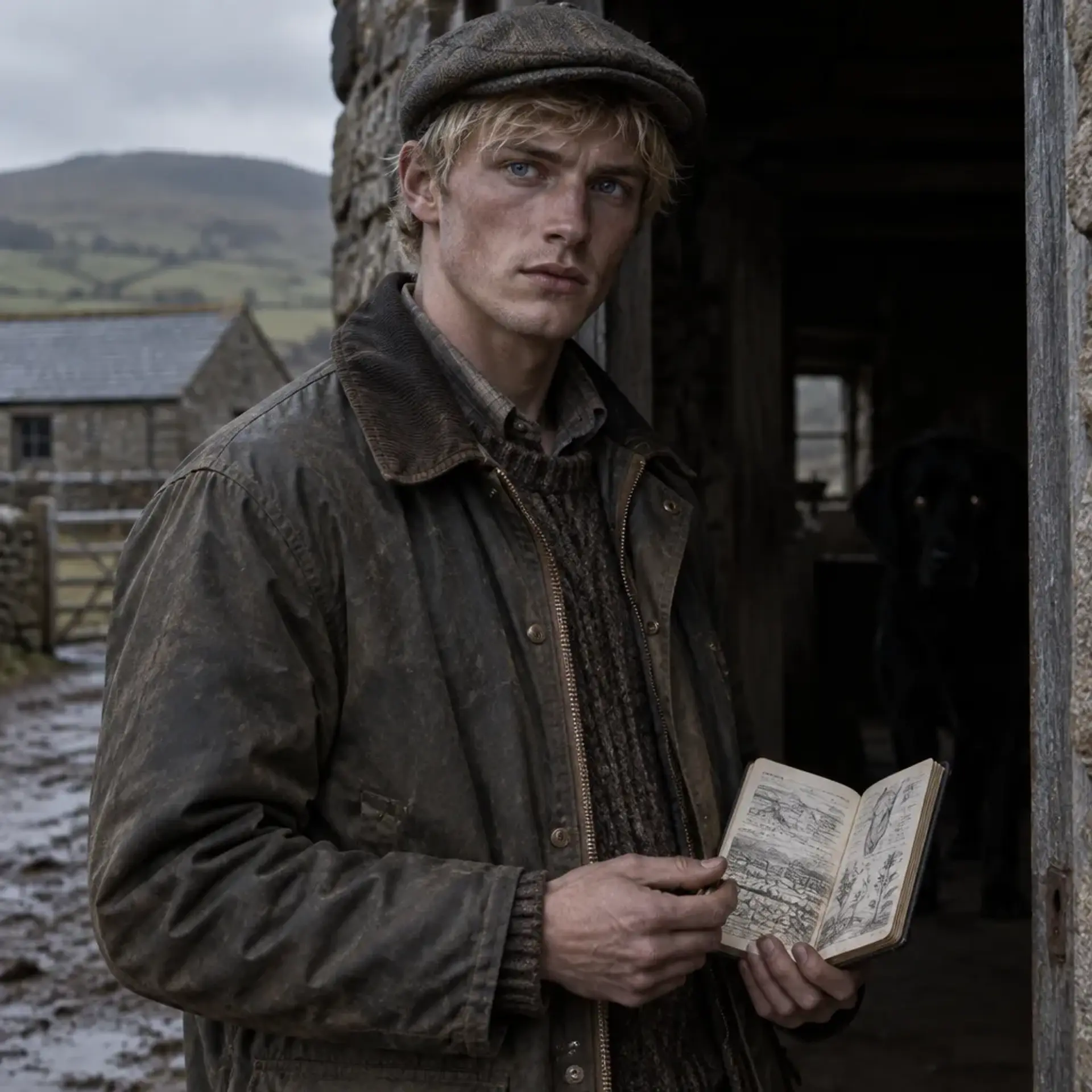
Oswin Hirst
Oswin Hirst
At the table
Voice
His voice has the dry, steady texture of someone used to talking over wind and livestock, with a Yorkshire warmth that makes even a warning sound neighborly. When exhausted, a faint rasp comes from his throat, as if he has spent the night breathing cold air. On the rare occasions his fae instincts dominate, his words become clipped and exact, with an old rhythm that does not fit his modern clothes.
A plain Yorkshire manner warmed by habitual "love," with practical farm vocabulary and a careful way of making a warning sound like common sense. His speech is contemporary when living as Ewan Armitage, but old words slip out around the dead, in dreams, and under seasonal pressure. He chooses each forbidden-language word not to say, sometimes visibly biting it back.
Speech patterns
How to play them
Treat him as a grounded, helpful neighbor first. He responds to practical questions and genuine concern better than accusations. Do not assume his evasions mean indifference. Mentioning William may open him up or make him guarded, depending on the approach. Iron can expose his vulnerability but using it as a threat will make him desperate. His mechanics are custom scenario guidance because no Secret Histories rule text was supplied.
Goal
Protect Mary and William from supernatural danger while preserving their ordinary family life, and learn whether William's heritage can be understood without making him a target.
Motivation
Love for his family, a stubborn remnant of his human past, and the need to keep his own fae nature from making choices on his behalf.
Appearance
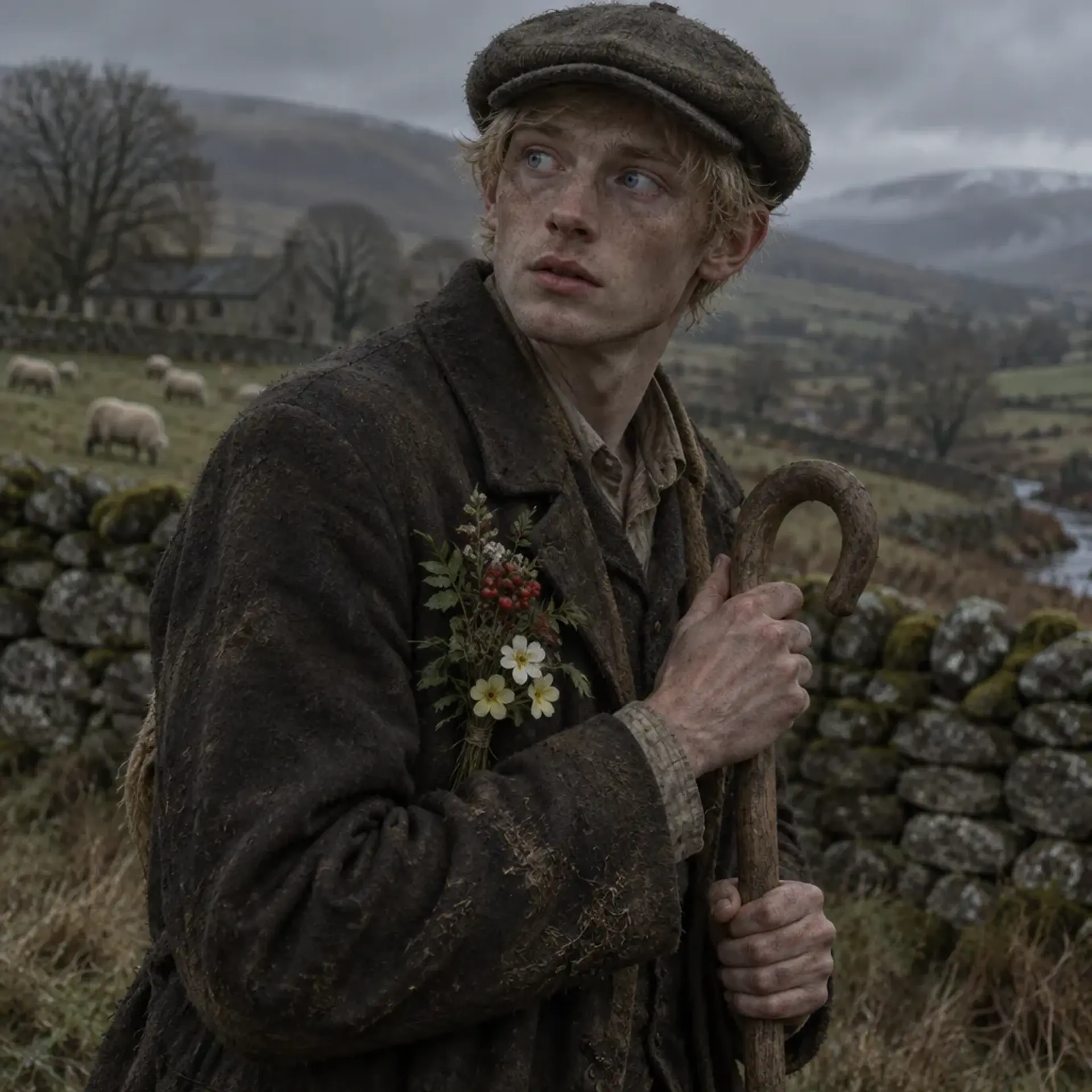
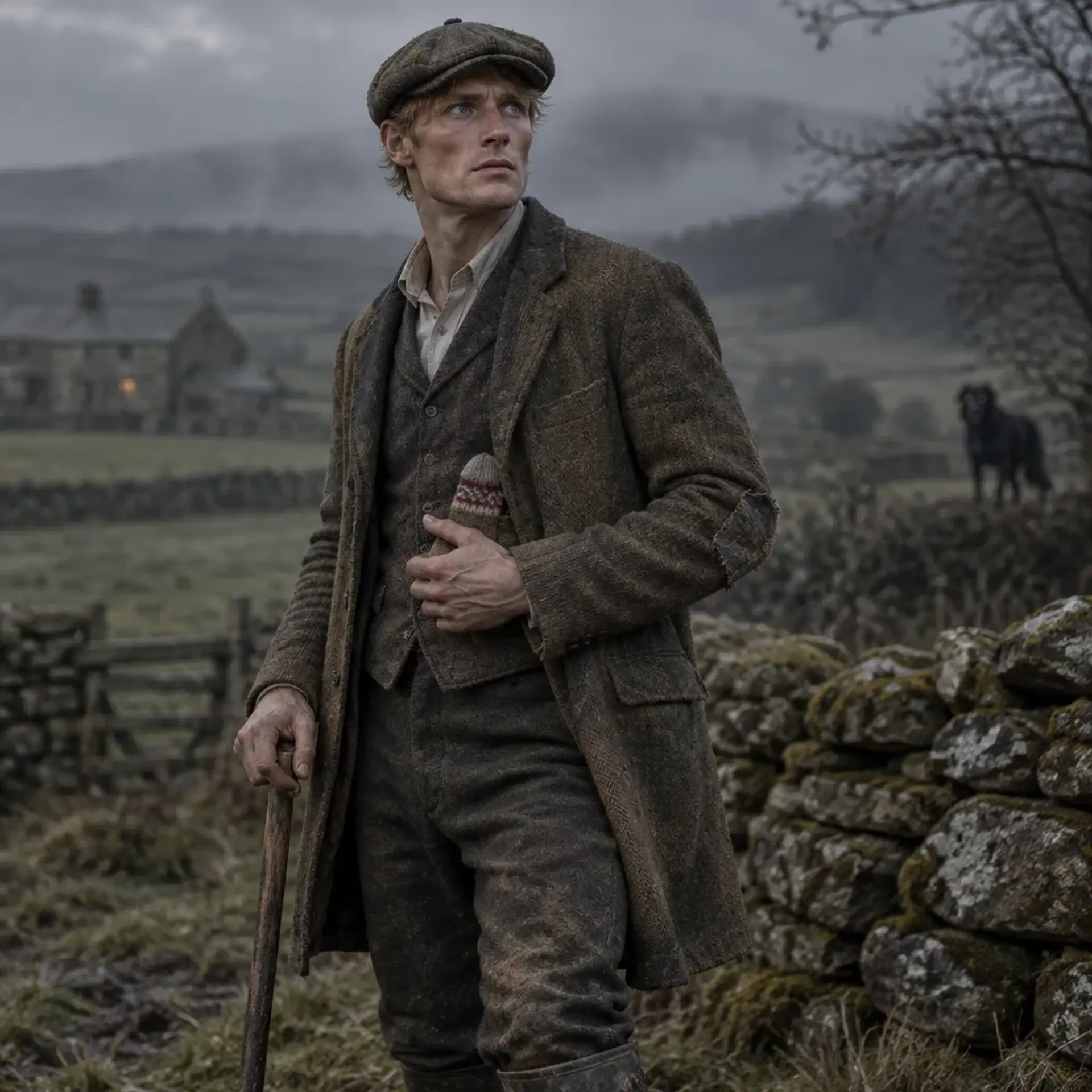
A handsome, plainly dressed young man whose apparent age is fixed in a way that first seems like good fortune and later becomes unsettling. He stands six feet tall, long through the legs, with the wiry, weather-hardened strength of someone accustomed to sheep, steep fields, and carrying awkward loads. His pale skin is browned and roughened across the bridge of his nose and the backs of his hands by wind and farm work; the rest of him seems strangely untouched by the years. His straight blond hair is usually flattened by a cap, then springs loose in clean, bright strands. His blue eyes are vivid and burn with a cold, glassy brightness when his glamour slips. In a room, he watches thresholds, windows, and the space behind people rather than their faces. He moves economically, placing each foot as if the ground might be listening; in the hound's shape that restraint becomes a silent, heavy certainty. He leaves the impression of an amiable young farmer who has learned to stand as if he has already seen how a room ends. Unexpected detail: he keeps a modern, carefully tended pocket notebook full of tiny, precise drawings of sheep's teeth, old door latches, and the shapes of clouds.
Clothing
In his current life, functional twenty-first-century clothes suited to farm work: weatherproof jacket, work trousers, sturdy boots, and a plain flat cap he wears out of habit. In older periods he dressed to fit the era and station, never conspicuously. He avoids metal fastenings when he can do so without attracting notice.
Body language
He keeps his shoulders loose and his hands occupied, but his gaze repeatedly measures exits, thresholds, and the dark space just beyond a window. When unsettled, he presses his thumb against the side of his forefinger as if checking for an old tool's handle. When William is close, his posture turns subtly protective; when a fae presence is near, he becomes still in the way a hunting dog does.
- Height
- 6 feet (183 cm)
- Build
- Tall, lean, and hardy, with the practical strength of a farmer and the unchanged proportions of a young man.
- Eyes
- Bright blue, with an unnerving burning intensity when his nature shows.
- Hair
- Pale blond, straight, and usually flattened under a cap.
- Skin
- Pale, weather-browned and roughened across the nose and hands; the rest of his face retains an improbably youthful smoothness.
- Age
- Appears about 21; claims to be a young adult. His true age reaches back to the Danelaw. His present-day identity, Ewan Armitage, is an assumed name and life.
- Gender
- Male
- Size
- Medium
Distinguishing features
Personality
20 traits and drivesOswin is gentle without being soft and shrewd without enjoying cruelty. He has the habits of a man who measures weather, feed, and risk before speaking, but the memories of a wanderer who once crossed into places most people cannot imagine. With Mary he is attentive and often affectionate, yet his protection becomes a form of control when he hides facts she has a right to know. With William he is patient, willing to repeat a game or explanation as many times as it takes, and he finds an ordinary pleasure in being needed. With Thomas he is courteous and guarded, each man trying to discover what the other knows. With Hugh he accepts blunt tests until his patience runs out; with Edward he is more careful, because Edward has shared the graveyard and may have seen the hound. Rose draws out his domestic manners, though she also unsettles him by noticing what he is trying not to show. His moods alter with the calendar. In the first days of May, joy floods him in disproportionate waves. The world seems freshly made and full of invitations. He laughs too easily, dances when no one has asked him, and can mistake a dangerous lure for a beautiful opportunity. The same heightened state makes him more attentive to birds, dew, and the smell of turned earth, which is why he is reluctant to call it wholly a curse. He knows the first three days are particularly perilous in local belief and tries to observe protective customs, but part of him resents anything that limits the season. Near Halloween and All Saints' night, he is burdened rather than joyful. The dead approach with errands, accusations, requests for remembrance, and ordinary questions that have waited too long. He grows impatient with their chatter but is ashamed of that impatience. He may seem absent at supper because he is listening to a voice no one else can hear. He fears that repeated contact has taught him to treat the dead as a nuisance instead of people. The night in the graveyard with Edward after Alice died left him with a lasting conflict: he protected Edward from the things moving through the mist, but he cannot tell whether he did so out of love for the family or because the hound considered Edward its own. Christmas has the opposite effect. Church words, shared food, and the human custom of making a place for everyone steady his judgment. During the Pickles family Christmas he could sit among them, help Rose with the wood, and make William laugh without searching each sound for a second meaning. He remembered his human mother's hands mending a sleeve and cried. The memory embarrassed him, but it also reassured him. He still has a human past; it has not simply been erased by age or magic. He is not consistently solemn. He jokes with local people, calls them love, and has a farmer's appreciation for small absurdities. He can be dryly funny about modern inconveniences and genuinely curious about new machines, though he dislikes the way his job has reduced his days to something he cannot care about. When relaxed, he tells adventurous stories from his roving years, leaving out the details that would reveal their true scale. When frightened, he becomes practical and decisive rather than loud. When angry, he may speak with an unnerving, old-fashioned precision and say exactly what he means. He does not become quieter or more polite; he becomes less willing to pretend that the listener has misunderstood him. The conflict inside him is not a simple struggle between good and evil. He wants a home, but the roads still call to him. He wants to be a loving husband, but he treats secrecy as protection. He wants to remain human, yet the fae part of him feels exhilaration where a human might feel fear and sees a promise as binding even when it was made under deception. He can see the dead and offer them help, but he has no patience for their endless claims on him. He is capable of compassion that crosses centuries and of a cold calculation that shocks the people who love him. His most human habit is not kindness alone; it is the knowledge that kindness must sometimes be chosen against what comes naturally. Mary's attention is changing him. She notices his face and body have not aged since their meeting, notices that he avoids iron, and watches him during the seasons she fears. He knows she worries about the dark and tries to reassure her, citing church doctrine or the new sciences. He tells himself he is sparing her terror. He can see that she is not reassured. Her iron scissors and the thimble near William make him feel both watched and oddly relieved: some part of him recognizes that she is trying to protect their child, even if she has guessed the wrong story about the Barguest. Oswin will not speak forbidden languages, even when doing so could make a negotiation easier. He calls them forbidden partly because of what they do to the speaker and partly because he fears how readily they come to his tongue. He does not like being asked to prove what he is. He would rather fix a gate, move a flock, or walk a frightened person home. He is most persuasive when he can offer a real service, and most dangerous when someone tries to make him choose between his family and a supernatural obligation. He rarely threatens first. If he does, his manner becomes direct and the animal stillness beneath it is hard to miss.
- Alignment
- Protective and compassionate by choice, though his increasingly fae instincts are indifferent to human ideas of fairness.
Quirks
Habits
Traits · 5
Flaws · 5
Fears · 5
Wants and needs · 5
Combat
HP 0Avoids a fair fight. He uses terrain, warning, intimidation, and knowledge of local creatures to keep danger away from the household. If forced to fight, he uses a tool at hand or changes into the black hound to drive a threat off. Iron, concern for William, and the presence of familiar fae can make him hesitate. All mechanics here are custom Secret Histories table guidance, not official rules.
Oswin Hirst
Actions
Services they sell
Rewards they can give
Equipment
- Pocket notebook (personal)A practical notebook kept in the modern era, filled with private observations and sketches of animals, thresholds, and weather.
- Farm tool (tool)An ordinary farm tool he carries or finds nearby; he prefers not to rely on it as a weapon.
- Flat cap (clothing)A flat cap associated with his everyday Yorkshire appearance and his habit of blending into local life.
Possessions
Background
Oswin Hirst was born in the Yorkshire Dales under the Danelaw, in an age when the boundaries between a settlement, a burial place, and the wild were spoken of as practical facts. His mother had been taken by Viking raiders; the circumstances of his birth were a wound in the family history that people remembered differently depending on who was asking. He grew up human, among hard weather, animals, and stories whose speakers did not always distinguish between warning and entertainment. One of his clearest human memories is small rather than grand: he is a boy at a winter hearth, his mother turning a torn sleeve inside out so she can mend it without wasting good cloth. He remembers the heat on his cheek, the rasp of thread, and the certainty that someone would notice if he came home late. That memory has survived centuries more vividly than kings or battles. As a young man he travelled beyond the Dales. He learned languages, crossed roads and borders, and fell in among places where the dead were not silent and the fae were not merely a fireside tale. He did not become something other than human in a single dramatic bargain. Exposure accumulated: a night spent following lights that did not cast shadows; a passage across a boundary he could not later find; a season in which his own laughter seemed to answer from the mouths of strangers. He learned that he could see the dead and speak with them. He also learned that some things could speak through him, if he gave them a voice. He calls their languages forbidden and will not utter them, even when he understands every word. His memory of the Other Side is not a dream of jeweled courts. It is a track through wet grass that went on after the hillside had ended, a pale sky with no sun, and a procession of people wearing the faces of those he had failed to save. They welcomed him as if he had returned from an errand. At the edge of their gathering stood a black hound, patient and watchful, with his own eyes. He ran back toward the human world. When he reached it, he could still remember being frightened, but the fear felt like something a previous person had owned. That estrangement troubled him more than the hound itself. Oswin later discovered the hound was not merely an omen following him. He could become it. His first transformation came in the Dales after he followed a dead voice toward a farmhouse boundary. The change left him exhausted, muddy, and certain that a group of villagers had seen a monster where he had felt an uncomfortable kind of homecoming. Thereafter, he kept watch on the dangerous creatures of the district. Some became enemies; others became uneasy acquaintances. He learned which paths they used and which promises kept them outside the town. He is not their master. He is the neighbor who knows their habits and can sometimes ask them to turn aside. Centuries passed unevenly. Oswin roved, worked, fought, and hid. He served in both World Wars under names that no longer matter, and each war dulled something in him. He learned to pass for an ordinary man by adapting his clothes, speech, and papers to the time. The violence did not make him brave; it made him tired of the dead asking him to carry their unfinished business. In the twenty-first century he goes by Ewan Armitage. He has a job he hates, a phone he barely likes, and the peculiar sadness of watching the modern world replace old fears with new forms of neglect. The Dales still call to him, but the pull is weaker than it used to be. He met Mary Pickles in Yorkshire and became Oswin Hirst, her husband. He told her stories of his travels, softened the truth with humor, and offered her the warmth he still remembers from his childhood hearth. Mary is 32, five feet five, blond and blue-eyed. She notices what he tries to pass off as luck: his handsome, youthful face and body have not aged since they met. She notices the way he avoids iron, though he explains it as a matter of preference. He wants her not to fear the dark, and will cite church doctrine or new scientific explanations to steer her away from the fae. He knows that both arguments are often evasions. Their son William, called Black William or Blackby by local children, has black hair despite both parents being blond and Oswin's burning blue eyes. William is slow to meet some milestones. Oswin loves him with a steady, practical devotion, setting aside time for him even when seasonal danger has kept him awake all night. Yet Oswin does not know the full extent of Mary's fear: she believes William may have been fathered by the Barguest, the black hound of Yorkshire dread. She watches husband and son most closely during the seasons associated with fae and demons. She carries iron scissors and keeps an iron thimble near William. Her suspicions are not baseless. Oswin's blood and the hound are in the boy's inheritance, though Oswin does not know how that came to be, or whether the Barguest is a name for himself, a separate being, or both. Mary has suffered pregnancies that failed, including one child who was born sickly and died soon afterward. Grief has made the household tender and watchful. Her father, Thomas Pickles, lives at a cottage a good distance away. He suspects Oswin is not what he claims and intends to use those secrets for his family's advantage, covertly and cleverly. Oswin does not know Mary has told Thomas about the night that changed her understanding of him. Thomas's wife, Rose, is warmer but observant; she notices who is missing from Christmas prayers and never mistakes quietness for innocence. Mary's brothers Hugh and Edward are not alike. Hugh tests Oswin with blunt questions and resents the way he seems to get away with being young. Edward is more careful; he once stood with Oswin in a graveyard the morning after their family lost Alice to a winter fever. Edward saw a black hound there, and Oswin has never learned exactly what he thinks he saw. Alice's death followed a night when Thomas had seen the hound. That coincidence has turned into a family story, and into a sore point no one can discuss without hurting someone. A recent event has made the iron question harder to avoid. While repairing a gate, Oswin grabbed a rusted iron staple barehanded before it could fall into the grass where William was playing. The contact burned with a dry, inward pain. His fingers cramped; the world lost its edges, and for several breaths he could not remember the human name he was using. Mary saw him drop the staple and heard him make a sound like a dog trying not to whine. He claimed the rust had caught him. She saw no wound, only his hand trembling. Since then she has kept the iron scissors closer. May Day is the season he fears most because it also feels most wonderful. In one recent May, he woke on the first morning of the month smiling at the light as if it had personally welcomed him. His pleasure was too great for the small things around him: the lambing shed, Mary's tea, the bright grass. He became reckless, teasing the village children into a dance and persuading a neighbor to follow him toward a hill path. A familiar fae creature waited there. Oswin nearly took its invitation, not because it threatened him but because going seemed beautifully obvious. Mary called him back with William's name. He turned, laughing, then went pale at the sight of her fear. He spent the first three days of May sleeping in short, guarded stretches, with primroses at the door and no water drawn after sunset. He knows the customs, but they do not make him safe. On All Saints' night and Halloween, the dead become active and ask him both for help and to do things for them. He tries to avoid the dead's chatter, calling it dribble, but finds refusal difficult when a voice belongs to someone he once loved. One Halloween, he went to the churchyard before dawn with Edward after remembering Alice. The dead pressed around him with small demands: carry a message, find a lost name, tell a living person they were forgiven. At the boundary, beastly fae moved through the mist. Oswin held them off until the bells began, then went home without telling Mary where he had been. Edward saw enough to know that Oswin had been protecting him. He also saw Oswin pause as if the hound's instincts wanted to chase the fae into the dark. Christmas steadies Oswin, though it does not erase him. One Christmas with the Pickles family, he attended the church service with Mary, William, Thomas, Rose, Hugh, and Edward. The familiar words and ordinary company softened the fae pressure. He helped Rose bring in wood, kept William amused by folding paper, and sat with Thomas at the table without answering every suspicious glance. For a few hours he was almost simply a husband and father. Later, when the family sang, he remembered his human mother's mending hands and cried without understanding why until Mary took his hand. Thomas noticed the moment and filed it away as either proof of humanity or a useful weakness. Oswin's present problem is not only keeping the supernatural away from the family. He must decide whether to tell Mary the truth before Thomas makes use of it, whether to risk drawing attention to William, and whether his fading human instincts can still be trusted when May comes round again. He wants a quiet life and misses the road. He wants to believe those desires are compatible. The hound knows otherwise.
Role in the story
A loving but evasive husband and father, an unaging boundary-keeper, and a potential guide to the local supernatural world. His family suspicions and Thomas's schemes can draw the player characters into a conflict where protecting Oswin may mean confronting the harm caused by his secrecy.
“He grew up human, among hard weather, animals, and stories whose speakers did not always distinguish between warning and entertainment.”
- Faction
- No formal faction. He maintains uneasy local ties with the dead and boundary creatures and acts as a self-appointed keeper of the town's edges.
Known connections
Media
0 imagesNo images yet.
Turn Oswin Hirst into a sheet
A high-res, share-ready sheet you can post or print.