Oswin Hirst
Oswin Hirst
At the table
Voice
His voice carries a slight rasp from cold air, smoke, and years of outdoor work. Before answering, he often takes a measured breath through his nose, as if testing the weather in the room. His Yorkshire vowels are familiar and grounded; older words surface when he is tired, frightened, or speaking to the dead. In hound form, his voice becomes a low, rough sound that seems to arrive from farther away than it should.
He speaks plainly, with Yorkshire warmth and an old-fashioned precision that sometimes slips through his modern manner. He calls people 'love' without making it a performance. His stories are full of paths, weather, and practical details, and he avoids naming supernatural things when he can. When he is angry, he becomes direct rather than soft-spoken.
Speech patterns
How to play them
Approach him with practical questions and patience. He responds best to people who protect the vulnerable without demanding that he explain every old grief. Iron, threats to children, and attempts to bargain with the dead can make him abruptly guarded. The 0 hitPoints field is a storage placeholder, not a Vaesen rule; use the game's normal NPC and conflict procedures.
Goal
Keep the boundary between the human world and the Other Side from swallowing another family, while deciding whether he is still capable of belonging to either.
Motivation
To preserve the part of himself that could love a family, even after the people he loved are gone.
Appearance
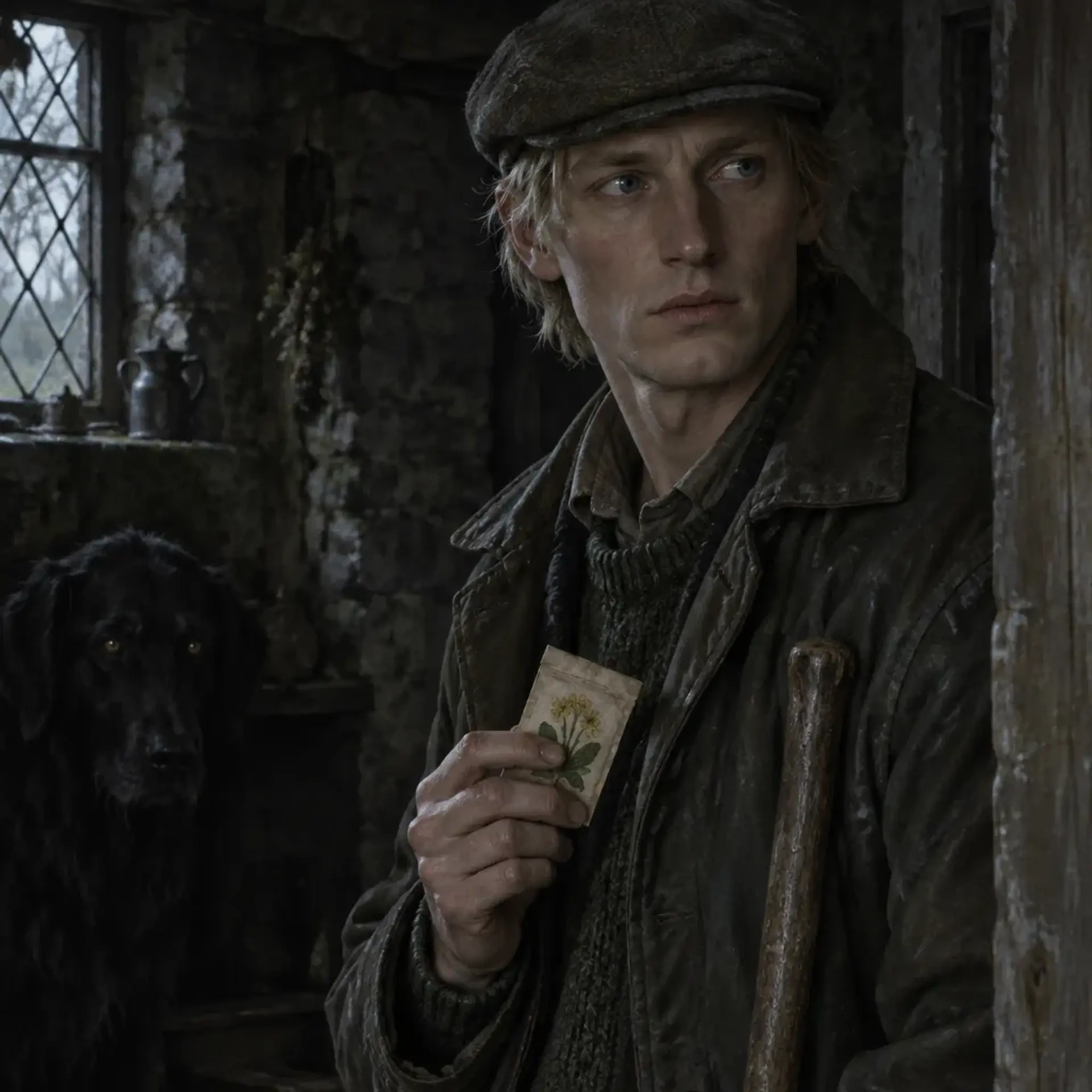
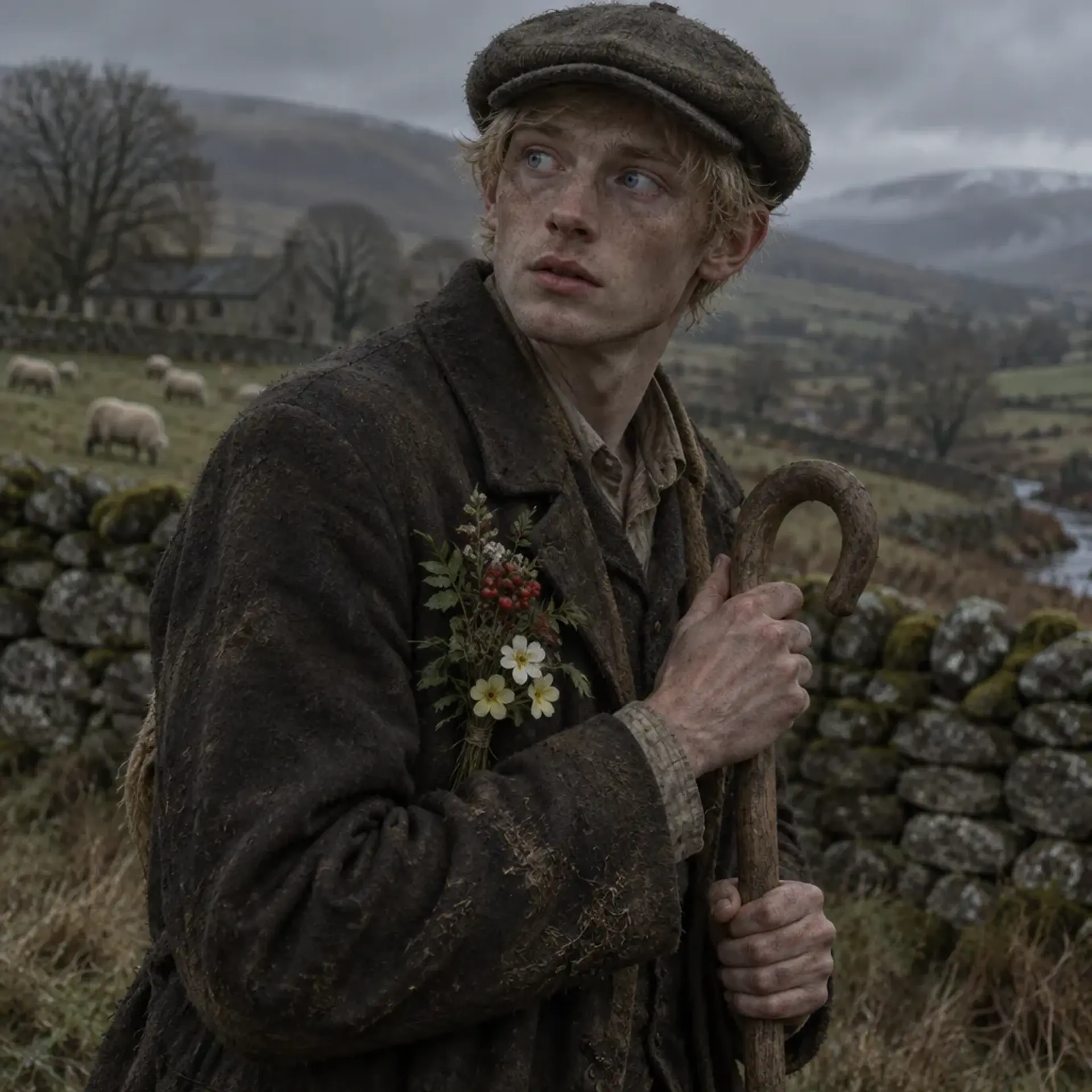
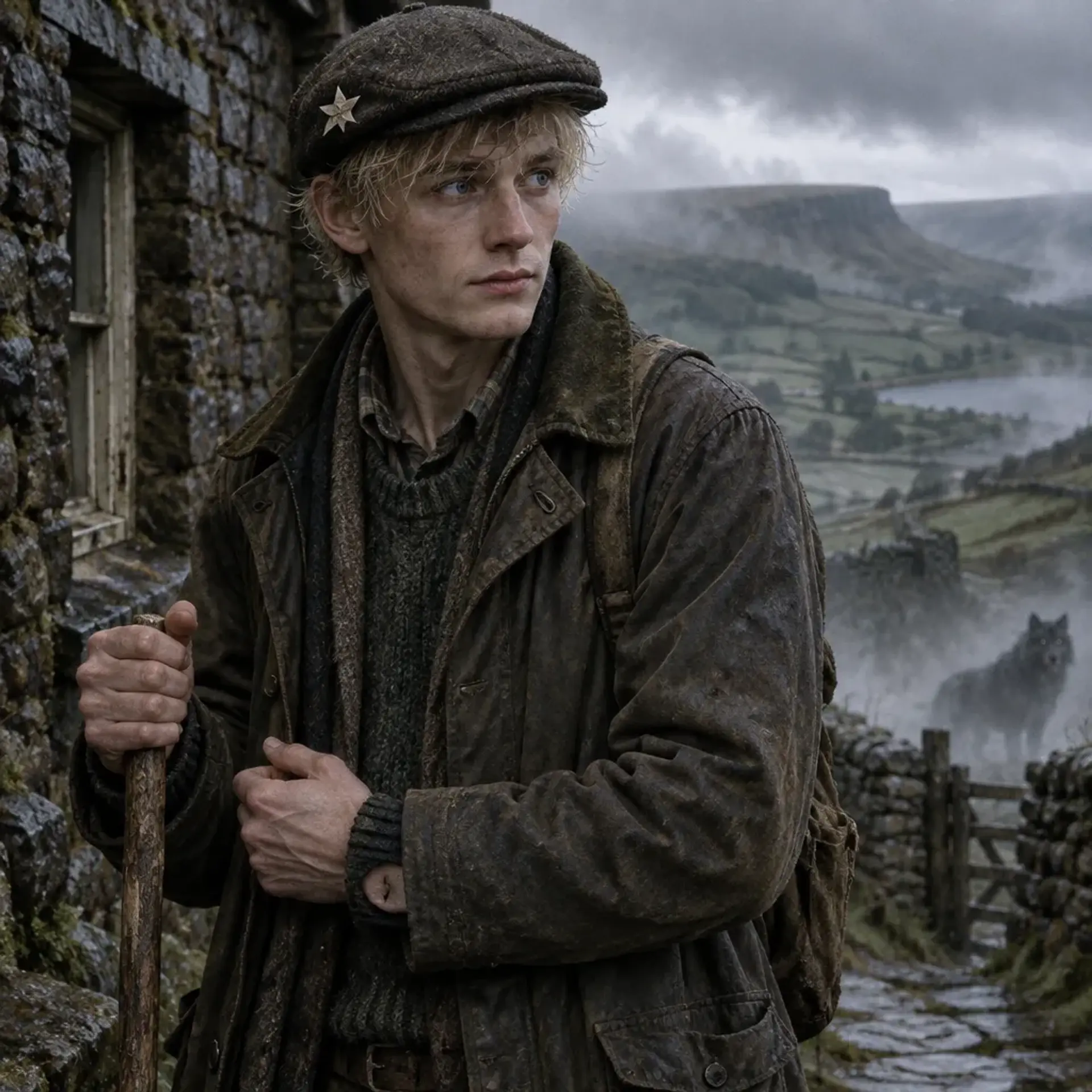
A handsome, tall young man with the composed face and unlined skin of someone barely seventeen. His pale blond hair falls straight beneath a common flat cap, and his clear blue eyes can look warm and attentive until an old, distant brightness catches in them. He moves with the economical balance of a shepherd used to wet hillsides, but sometimes stops mid-step as if listening to a footfall no one else can hear. His coat and trousers suit his present day, though he wears them with the settled practicality of a man who expects weather, work, and trouble. Within a minute of meeting him, people notice that he checks the edge of his cuff with his thumb before answering a difficult question. Unexpectedly, he keeps a tiny, carefully folded paper star tucked into his capband, a remnant of a child's Christmas craft.
Clothing
In 2026, practical modern layers, work boots, and a familiar flat cap. He dresses to pass unnoticed and avoids clothing fastenings made of iron where he can.
Body language
He checks his cuff with his thumb before difficult answers, holds himself still when listening for the dead, and turns his shoulders toward whoever seems most vulnerable in a room. Near iron he draws his hand back sharply. In May his posture opens and his steps grow springy, as if every path is an invitation.
- Height
- 6 feet
- Build
- Tall and lean, with a shepherd's hardiness and a youthful, unweathered face.
- Eyes
- Clear, burning blue
- Hair
- Pale blond, straight
- Skin
- Pale, with the weather-worn texture of someone who has spent years outdoors
- Age
- Appears about 17, though he is far older than any ordinary human. He has not visibly aged since meeting Mary Hirst. In 2026 he uses the name Ewan Armitage and presents himself as a young adult.
- Gender
- Male
- Size
- Average human; large black hound in custom supernatural form
Distinguishing features
Personality
17 traits and drivesOswin is kind in the practical, unshowy way of someone who will mend a gate before discussing why it broke. He is also shrewd, private, and capable of letting another person believe a comforting lie if he thinks the truth would hurt them. With children and frightened people he is patient; with a threat to a boundary he becomes decisive and watchful. He misses the days of wandering, yet remembers the cost of being alone in the Other Side. He wants Mary and William to have been ordinary, and that desire made him deny what he could see. In May his pleasure can become bright and reckless, as though the world were made for dancing and every warning were an insult. At Christmas, particularly in church, he can settle into human habits and feel gratitude without suspicion. He does not grow quieter or more polite when angry: he gets blunt, names the practical danger, and moves to put himself between it and someone vulnerable. The dead irritate him when they treat him as a servant, but he still listens when their need concerns the living.
- Alignment
- Protective by intention, dangerous by nature; not neatly governed by human morality.
Quirks
Habits
Traits · 5
Flaws · 4
Fears · 4
Wants and needs · 4
Combat
HP 0 · Ordinary human movement; faster pursuit in custom black hound form, resolved narratively with the Vaesen rules in useAvoids open fights and protects escape routes. He prefers to warn, misdirect, or drive a threat away from the boundary. If forced, he may take hound shape to pursue or intimidate. He is reluctant to harm a human and can hesitate if a familiar supernatural creature is nearby.
Oswin Hirst
Actions
Reactions
Services they sell
Rewards they can give
Equipment
- Flat cap (clothing)A plain modern flat cap, worn habitually and used to conceal the folded paper star.
- Paper star (keepsake)A small paper star made with a child's uneven folds. Oswin will not explain why he keeps it.
- Walking stick (tool)A weathered walking stick useful on hills and ordinary paths, not a special weapon.
Possessions
Background
Oswin Hirst was born in the Yorkshire Dales during the age of the Danelaw, the child of a human woman violated by Viking raiders. For a long time he knew himself only as a boy of the hills: cold streams, sheep paths, rough bread, and a mother's guarded silences. One of his clearest memories of being human is small rather than heroic. His mother warmed his hands around a chipped bowl after he had fallen in a beck, then scolded him for pretending not to be frightened. He remembers the smell of peat smoke in her hair and the certainty that a living person could make a dark room safe. That certainty did not survive his roving years. Oswin traveled, fought, and wandered through places where the dead and the fae pressed close to the human world. Long exposure changed him. He learned that he could see the dead and understand their speech; he also discovered that he could understand certain forbidden tongues too well. He refuses to speak them. He says that the sounds make a listener's thoughts feel borrowed. At some point he learned he could take the shape of the black hound feared in Yorkshire tales. He does not claim to be the Barguest, but he knows why people might believe it. He once remembered the Other Side as a place, not merely a story. In that memory, he followed a path beneath a sky without stars, across grass that shone like wet glass. A host of beautiful, courteous figures welcomed him as if he had been expected. Their feast tasted of apple skin and ash. When he asked to leave, they asked him to name what he loved most. He escaped by naming the hills, not a person, and heard laughter following him back into the world. He has never trusted beautiful invitations since. In time Oswin tried to settle into a shepherd's life. He built a respectable home and married Mary Hirst, a Yorkshire woman with bright blond hair and blue eyes. He was gentle with her and tried to share his old adventures as if they were simply stories. He wanted her to feel safe, so he quoted church teaching and the newer sciences she had heard discussed, insisting that fear of fae and demons belonged to an older, less informed world. Yet he did not age. Mary noticed that his face and body remained the same handsome young ones she first knew. She noticed, too, how he avoided iron. Their son William was born with black hair, though both parents were blond, and burning blue eyes much like Oswin's. The villagers called him Black William, or Blackby. William developed more slowly than other children, and Mary feared that he was the child of the Barguest, or worse, the Devil. Oswin loved his son and made time for him even when the seasons made sleep difficult. He did not tell Mary what he suspected: that William carried a mingling of human and fae blood. Mary kept iron scissors close and an iron thimble near the child's bed. Oswin could not bring himself to explain why the precautions hurt him. Mary's pregnancies after William did not go well. One child was born sickly and died soon afterward; other pregnancies failed before they could come to term. Oswin could offer no comfort that did not sound like evasion. He knew that his nature might be involved, but could not prove it and feared what Mary would do if he said so. The grief made them careful around one another. They remained affectionate, but each learned to hide a different terror. Mary's father, Thomas Pickles, grew suspicious. He meant to use Oswin's secrets to improve his own family's fortunes, not by confronting him but by collecting small proofs and letting other people draw the dangerous conclusions. Mary told her father about the night that convinced her Oswin was not ordinary. She has not told Oswin she did. Thomas's wife Rose was kinder than her husband and more perceptive. She tried to protect Mary without openly taking sides. Mary's brothers Hugh and Edward each responded differently: Hugh watched Oswin with practical distrust, while Edward was more inclined to pity him and was drawn into the family's grief after their sister Alice died of a winter fever. Thomas once saw a black hound, and the Pickles family never fully recovered from the fear that followed. Later, on a cold morning in a graveyard, Oswin stood with Edward after Alice's death. The dead were close enough that Oswin could hear them, but he did not call them forward. Edward was grieving and needed a brother-in-law beside him, not a story about spirits. Oswin stayed, shivering in the dawn, and let the silence be ordinary. That was one of the rare moments when he chose human company over supernatural knowledge. May is dangerous for him. The first three days press fae joy upon him with the force of a command. On one May Day, after a night of restless walking, Oswin found himself laughing among the hills, radiant with a joy that had no human cause. He led a small ring of wandering fae away from the town boundary, but the work became play in his mind. He nearly followed them into the hills. A shepherd's dog barking at him brought him back to himself. He returned home shaken, and Mary saw his unguarded delight as something more frightening than anger. All Saints' night and Halloween are different: the dead become active, asking him for things and demanding that he do things for them, while beastly fae test the boundaries. One such night Oswin heard the dead calling from a lane and went out to keep them from following a child home. A hound's body made the task easier, but he returned with mud in his fur and a voice full of names no living person had spoken. Mary found him by the hearth and watched him avoid her iron scissors. He told her he had been checking the sheep. Christmas steadies him. One Christmas with the Pickles family, he went to church and stayed through the service, then sat with Rose, Thomas, Hugh, Edward, and Mary over a modest meal. William was small enough to fall asleep against him. For a few hours, the fae pull slackened and Oswin could answer to the ordinary name of husband and father. He remembers that warmth more clearly than many of his adventures. The old family life is long gone. Mary eventually divorced him; William was later confined to a madhouse, and the Pickles family died. Oswin has survived them all. He served in both world wars, and the scale of human violence dulled his supernatural abilities without making him human again. In 2026 he lives as Ewan Armitage, wearing clothes for his time and working a job he hates. He misses Mary and William in silence. The pull of the Dales remains, though it has weakened. At odd hours and in the seasons of the devils and the dead, his human facade slips. He keeps watch over the boundaries, sometimes alongside creatures he ought to drive away, and still tries to spare ordinary people the cost of what he knows.
Role in the story
A guarded witness to the supernatural who may serve as an ally, a warning, or a tragic example of what happens when a person survives longer than their human life.
“For a long time he knew himself only as a boy of the hills: cold streams, sheep paths, rough bread, and a mother's guarded silences.”
- Faction
- No formal faction. He keeps an uneasy, personal understanding with some local dead and fae, while guarding the edges of human settlements.
Known connections
Media
0 imagesNo images yet.
Turn Oswin Hirst into a sheet
A high-res, share-ready sheet you can post or print.