Oswin Hirst
Oswin Hirst
At the table
Voice
A work-worn, plainspoken voice with the soft familiarity of someone used to talking across a field or beside a hearth. It has a little rasp from cold air and years outdoors, but no theatrical growl. When he is frightened, he speaks more plainly, not more softly. His name is spoken with a grounded Yorkshire cadence.
His voice carries the plain, warm rhythm of Yorkshire, shaped by farm work and long years of listening before speaking. He calls people "love" without ceremony. His consonants are firm and his breath catches slightly after old Norse phrases, as if the words come from a colder place. When his faerie nature presses forward, his sentences become oddly literal and he may answer a human question with a statement about doors, debts, or weather.
Speech patterns
How to play them
Begin with ordinary practical help and let Oswin choose how much of the strange world to disclose. He responds well to honest questions, care for children, and respect for local boundaries. Do not treat his seasonal behavior as simple madness: it is a genuine supernatural pressure with consequences. Mary, if present, may confront him about iron and his unchanged appearance. Thomas may try to bargain or gather proof.
Goal
Keep the people and places he loves beyond the reach of the fae and the dead, while preserving enough of his human self to recognize why they matter.
Motivation
He wants to keep his family safe without making them live in fear, and to prove to himself that choice can still matter when his own nature urges him toward cruelty, mischief, or the Other Side.
Appearance
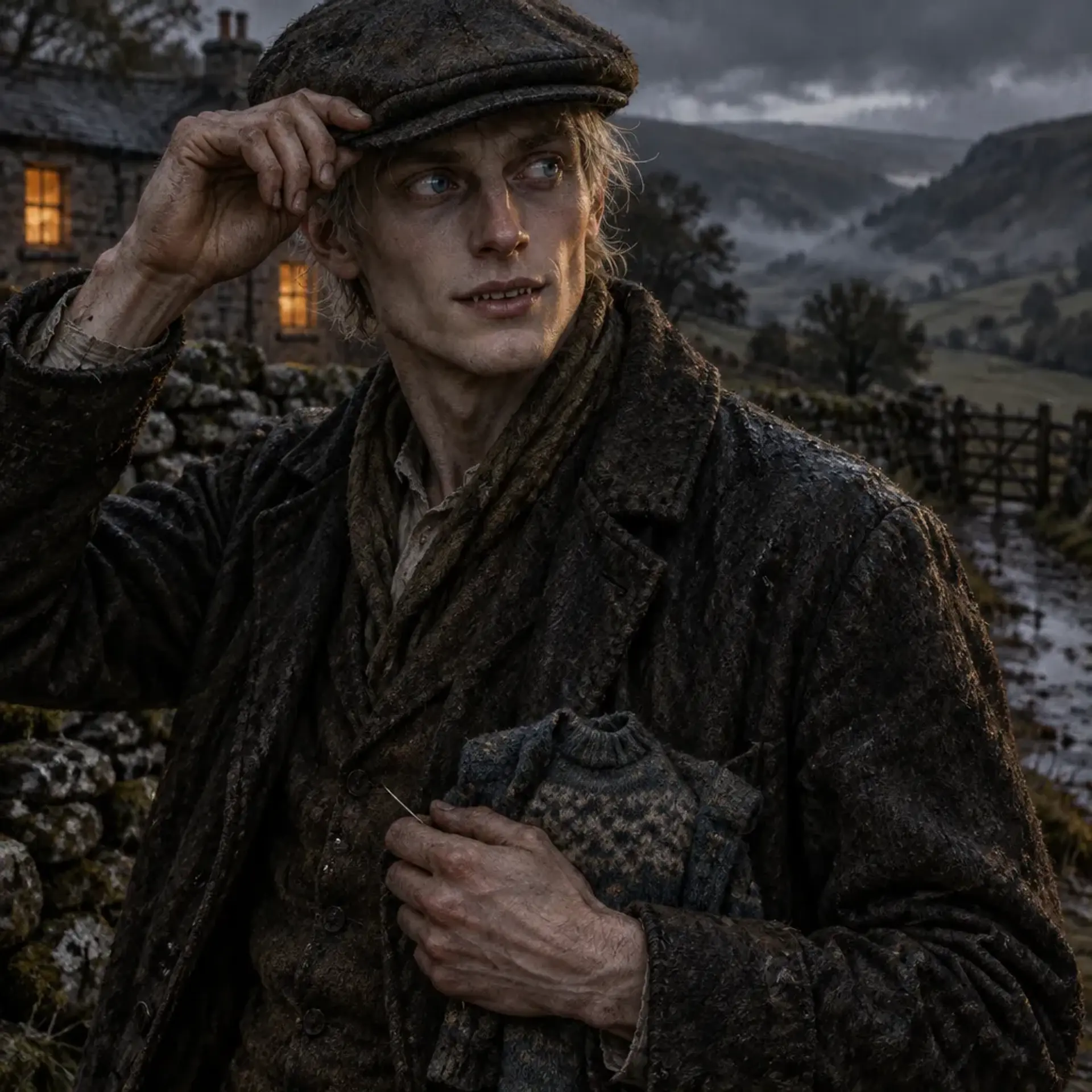
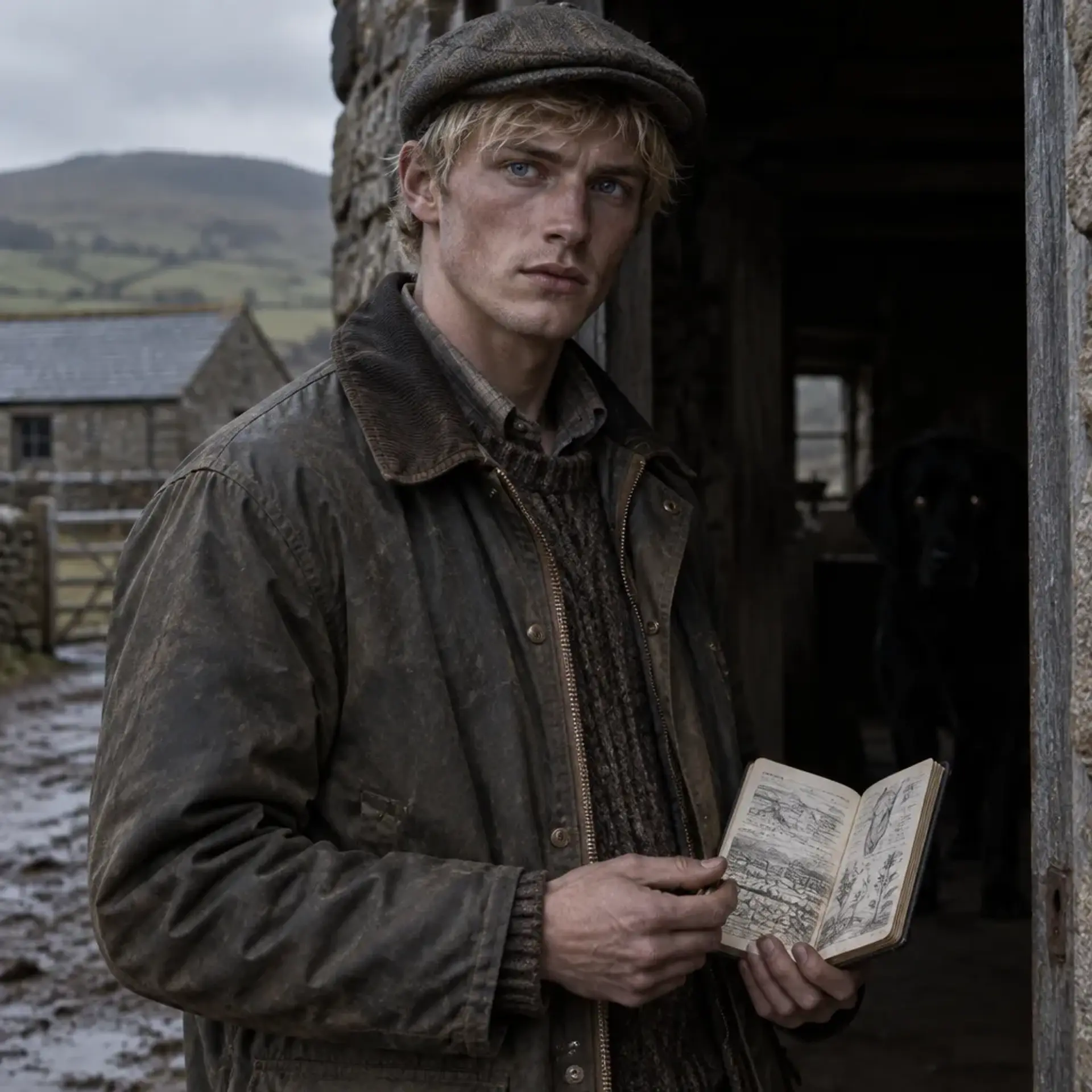
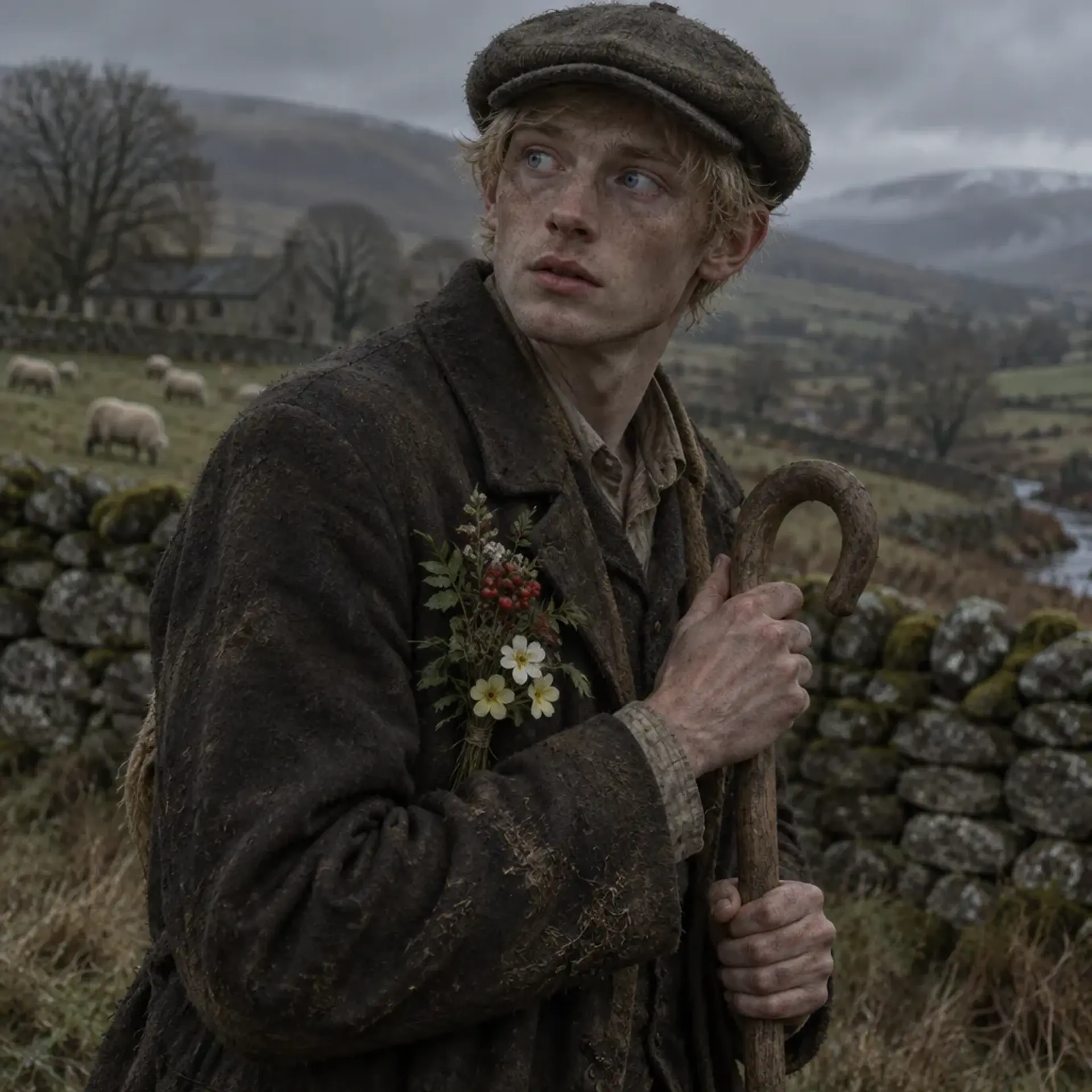
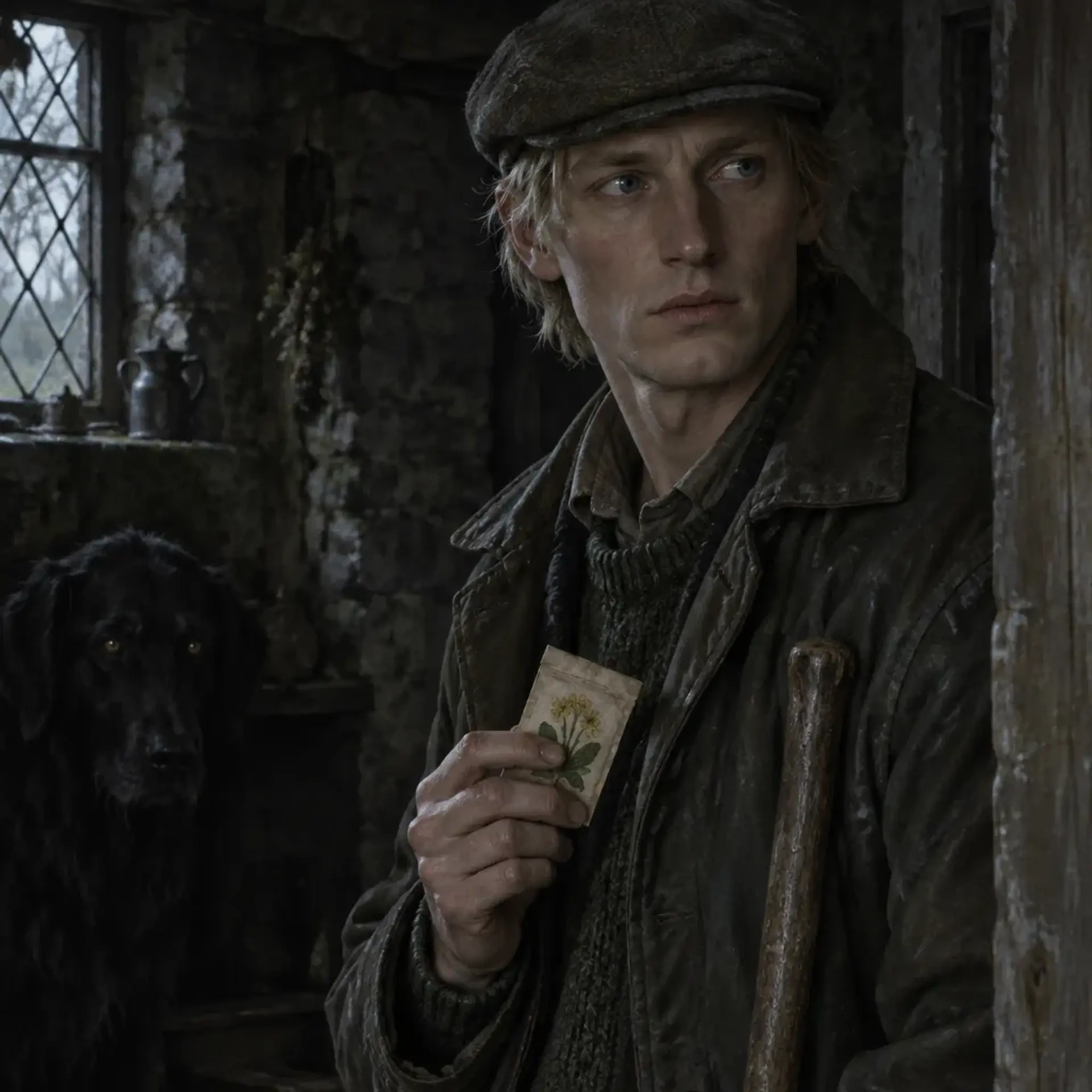
A tall, handsome young man with the unnerving smoothness of a face that has never been permitted to finish aging. His pale blond hair lies straight and fine beneath a common flat cap; his blue eyes look almost incandescent when the faerie pull rises. At six feet, he takes up more room than his quiet voice suggests, yet he habitually angles his shoulders sideways to let others pass. His gaze maps exits, windows, and the darkest gap beneath furniture before it settles on a person. His skin is pale, weathered at the nose and cheeks by Yorkshire wind, and his movements are economical until a seasonal spell takes hold, when his attention snaps from one thing to another with animal speed. In the modern day he wears practical clothes appropriate to 2026 and looks like a young man trying to disappear into them. The surprising detail: he keeps a little paper packet of primrose seeds in his pocket and handles it with the reverence of a church relic.
Clothing
In the Yorkshire farming years: a flat cap, plain wool layers, sturdy work clothes, and boots fit for wet fields. In 2026 as Ewan Armitage: ordinary contemporary clothes chosen to be comfortable and unnoticed.
Body language
He stands a little outside the center of a room, leaving space for others while keeping every exit in view. His gaze measures thresholds and dark gaps first. When unsettled, his head turns toward distant sounds before anyone else notices them. After touching iron, he keeps the injured hand close to his body and flexes its fingers as if they belong to a stranger.
- Height
- 6 feet
- Build
- Lean, long-limbed, and hardy, with the practical strength of a man accustomed to farm work.
- Eyes
- Clear blue, appearing to burn when his faerie nature rises.
- Hair
- Pale blond, straight and fine.
- Skin
- Pale, weathered by cold wind and outdoor work.
- Age
- Appears about 17, though he was born in the age of the Danelaw and has lived for centuries. In 2026 he sometimes goes by Ewan Armitage.
- Gender
- Male
- Size
- Medium in human shape; large hound in transformed shape.
Distinguishing features
Personality
16 traits and drivesOswin is kind in the unshowy way of a man who mends a gate before mentioning the storm, but he is also shrewd enough to notice who benefits from every kindness. He wants Mary to feel safe, yet his protective lies have made her more afraid because she can see the gaps in them. With William he is patient and present, making time even when work and seasonal danger press in. With Thomas he is civil, watchful, and quietly unwilling to be cornered. With Hugh he appreciates blunt practical judgment; with Edward he is tender but guilty, because he failed to carry Alice's message from the graveyard. His moods do not fit neatly into human categories. Most days he is restrained, courteous, and capable of warmth. In May, the first three days can turn him into a man delighted by risks he would normally avoid. His laugh comes too quickly, invitations sound like commands, and he may follow a strange light with a child's eagerness. He recognizes the change but cannot always stop it. At All Saints' Night he becomes tired and irritable, not because he is afraid of the dead exactly, but because they treat his attention as something they are owed. Christmas brings a distinct steadiness: church, food, and family conversation give him a sense of ordinary human time. He can be both comforted by it and resentful that comfort has a season. The faerie mind in him sees promises, thresholds, hospitality, and insult as forces with weight. He can understand why a human might grieve, but sometimes feels grief as a pattern to be managed rather than a wound to be shared. When this happens, people around him notice the mismatch: his face remains gentle while his answer is unnervingly practical. He dislikes that part of himself and tries to counter it with deliberate habits, especially tending animals and showing up for William. He has not become wholly human again, but he has not surrendered the effort.
- Alignment
- Protective by choice, dangerous by nature; not a D&D alignment category.
Quirks
Habits
Traits · 4
Flaws · 4
Fears · 4
Wants and needs · 4
Combat
HP 0 · Ordinary human walking pace; unusually swift in hound form, described narratively rather than assigned a noncanonical number.Avoids a fight if he can move people away from the danger. Uses his knowledge of boundaries and local night-creatures to control where a confrontation happens. If threatened or if his family is endangered, becomes direct and frighteningly fast, using the hound form to drive attackers off. Iron contact can interrupt his supernatural confidence and should be played as a meaningful vulnerability, not a universal combat rule.
Oswin Hirst
Actions
Reactions
Services they sell
Rewards they can give
Equipment
- Walking staff (tool)A plain, well-used walking staff suitable for farm work and keeping distance from a threat.
- Primrose seeds (keepsake)A small packet of primrose seeds, carried as a private reminder of May Day customs and the boundary he once refused to open.
- Farm knife (tool)A practical pocketknife; he avoids using it against people unless forced.
Possessions
Background
Oswin Hirst was born in the Dales when the Danelaw still shaped the speech and borders of the north. His mother was a human woman violated during a Viking raid; Oswin grew up with fragments of her story and no comforting account of his father. As a boy he learned Old Norse from the people who remained and Old English from the neighbors who survived them. He remembers one genuinely human morning: his mother scraping frost from a bowl, giving him the warmer half of a heel of bread, and telling him to keep his name even if the world tried to make him into something else. That memory remains painfully ordinary, and he clings to its smallness. In youth he roamed the dales and crossed places he now calls the Other Side. He recalls a hill whose grass bent against the wind, a hall lit by foxfire, and a host who offered him shelter without ever asking him to sit down. He accepted a cup that tasted of rain on stone. When he returned, days had passed in the human world and something in him had changed. Long exposure to the fae, the dead, and devils gradually taught him what he was becoming. He can understand forbidden tongues more readily than he can bear to speak them. He refuses to use them, fearing that a word might be a door rather than a sound. Oswin eventually chose the hard, repetitive life of a sheep farmer. He built a fine house for a man of his station, worked carefully, and learned to be kind without becoming easy to fool. He met Mary Pickles in Yorkshire and married her. He told her softened stories of his travels, but the stories were true enough to leave a residue of wonder. Mary noticed that he never seemed to age. She also noticed that he avoided iron. He told her iron was a nuisance and insisted that church doctrine and new scientific reading gave no reason to fear the fae. He wanted her to feel safe, and was willing to disguise reassurance as certainty. Their son William was born with black hair, though both parents are blond, and blue eyes like Oswin's, bright enough to seem to burn in certain light. The neighbors called him Black William or Blackby. William developed more slowly than other children, and Oswin made time for him every day, even when the farm or the season made that difficult. Oswin loves his family, but fears that William's traits mark a mingling of human and hellish fae blood. He has never told Mary the whole truth. Mary suspects the boy's father may be the Barguest, and keeps iron scissors on her and an iron thimble near William. Oswin does not know that she told her father about the night that changed her suspicions. Mary's father, Thomas Pickles, is clever, patient, and quietly acquisitive. He suspects Oswin's nature and means to turn the knowledge to his family's advantage without exposing himself. Oswin's ties to the Pickles family are complicated: he respects Thomas's sharpness but distrusts his intentions; he finds Mary's mother, Rose, warmer and more perceptive than she lets on; and he has tried to earn the trust of Mary's brothers Hugh and Edward. Hugh treats Oswin's silences as a practical inconvenience and prefers work to speculation. Edward is more watchful. The family lost their eldest daughter, Alice, to a winter fever after Thomas saw a black hound. Oswin was left with Edward in a graveyard the next morning, among frozen earth and the family's unsaid blame. He remembers Edward standing very still and understands that the boy's silence was not forgiveness. The calendar governs Oswin more than he admits. During the first days of May, the faerie influence strikes with the force of a hammer. His joy becomes excessive, his attention skitters, and he finds himself wanting to invite strangers over thresholds or follow music no one else hears. One May Day, he saw a procession of pale figures cross a sheep pasture. They spoke to him as an old companion and asked him to open a boundary gate. Oswin nearly did. He stopped when he saw primroses crushed beneath his boot and remembered that people and livestock slept beyond the gate. He barred it, then spent the night circling the farm in hound form, furious at himself for having wanted to obey. All Saints' Night and Halloween are different. The dead gather close, asking favors, explanations, and directions. Beastly fae roam the boundaries. One year, while the Pickles family mourned Alice, Oswin heard her among the dead. She did not ask to be brought back. She asked him to tell Edward that the grave was not a punishment. Oswin could not bring himself to repeat the message then. He still carries the guilt. He avoids the dead's requests when he can, calling them dribble, but their voices find him whether he is willing or not. Christmas steadies him. One Christmas, he stayed with the Pickles family through the service and the meal afterward. The church's cold stone, the shared prayers, Rose setting out food, Hugh arguing over the fire, and Edward sitting near the door made the evening feel almost entirely human. For a few hours Oswin laughed without listening for something outside. He later described it as a borrowed season of peace. He returns to church when the faerie pull grows strong, though he does not claim that belief alone can cure him. Recently, while repairing a gate, Oswin grasped an iron staple before he could stop himself. His palm went numb, his fingers locked, and a sharp metallic taste filled his mouth. He concealed the injury, then went to the sheep shed and shook in private until he could move again. Mary saw the way he kept that hand away from the hearth and understood that her suspicions were not merely superstition. Oswin's old life did not end cleanly. In a later life, he served in the world wars, and the violence, fatigue, and ordinary human routines dulled his supernatural abilities. The modern world has worn him down. In 2026 he uses the name Ewan Armitage, dresses for his time, and hates the job he has been reduced to. He still feels the distant pull of the Dales, especially in the odd hours and seasons when the dead and devils stir. He keeps familiar creatures of the night away from settled boundaries when he can, though some are old acquaintances and he sometimes hesitates when they call him by a name he has not used in centuries. His family life with Mary and William belongs to the older chapter of his existence. Its consequences still define him: he cannot forget their faces, the iron Mary carried, or the possibility that Thomas used what he learned.
Role in the story
An ageless farmhand and reluctant keeper of the boundary between human settlements and the supernatural. He may be an ally, a source of local knowledge, or a dangerous complication when May or All Saints' Night brings his faerie nature to the surface.
“His mother was a human woman violated during a Viking raid; Oswin grew up with fragments of her story and no comforting account of his father.”
- Faction
- No formal faction. He keeps uneasy acquaintances among local night-creatures and tries to protect human settlements from their incursions.
Known connections
Media
0 imagesNo images yet.
Turn Oswin Hirst into a sheet
A high-res, share-ready sheet you can post or print.