Mark
Mark
At the table
Voice
A young man's voice with a slightly dry, breath-held texture, as if he is used to speaking carefully in rooms where adults might interrupt. His words carry the habits of a household where one learned to be heard without making a scene, but Kent's formal preferences add an old-fashioned correctness. He does not sing or drop to a theatrical whisper. When tired, his consonants blur; when angry, they become sharp and direct.
His voice belongs to a young man with a careful, educated-sounding manner he cannot entirely sustain. He over-enunciates when nervous, as if good diction might keep a conversation orderly. His throat catches slightly after a bad night's sleep. In anger he loses the polish and speaks quickly, with a bluntness that surprises people who assumed he was timid.
Speech patterns
How to play them
Treat him as a person, not as a puzzle or a replacement. Give him concrete choices and time to answer. He responds well to practical kindness, honest boundaries, and being included in ordinary work. He becomes defensive if someone insists that he is simply Mary, or demands that he prove what he is. The 3-point hit track is a custom tabletop convenience only, not a claimed Secret Histories rule.
Goal
Find a stable way to live as Mark, learn what happened to Mary, and discover whether the missing heart can influence or control him.
Motivation
To make a home and a respectable life without being reduced to an experiment, while finding out whether the heart has made him and whether Mary can still be reached.
Appearance
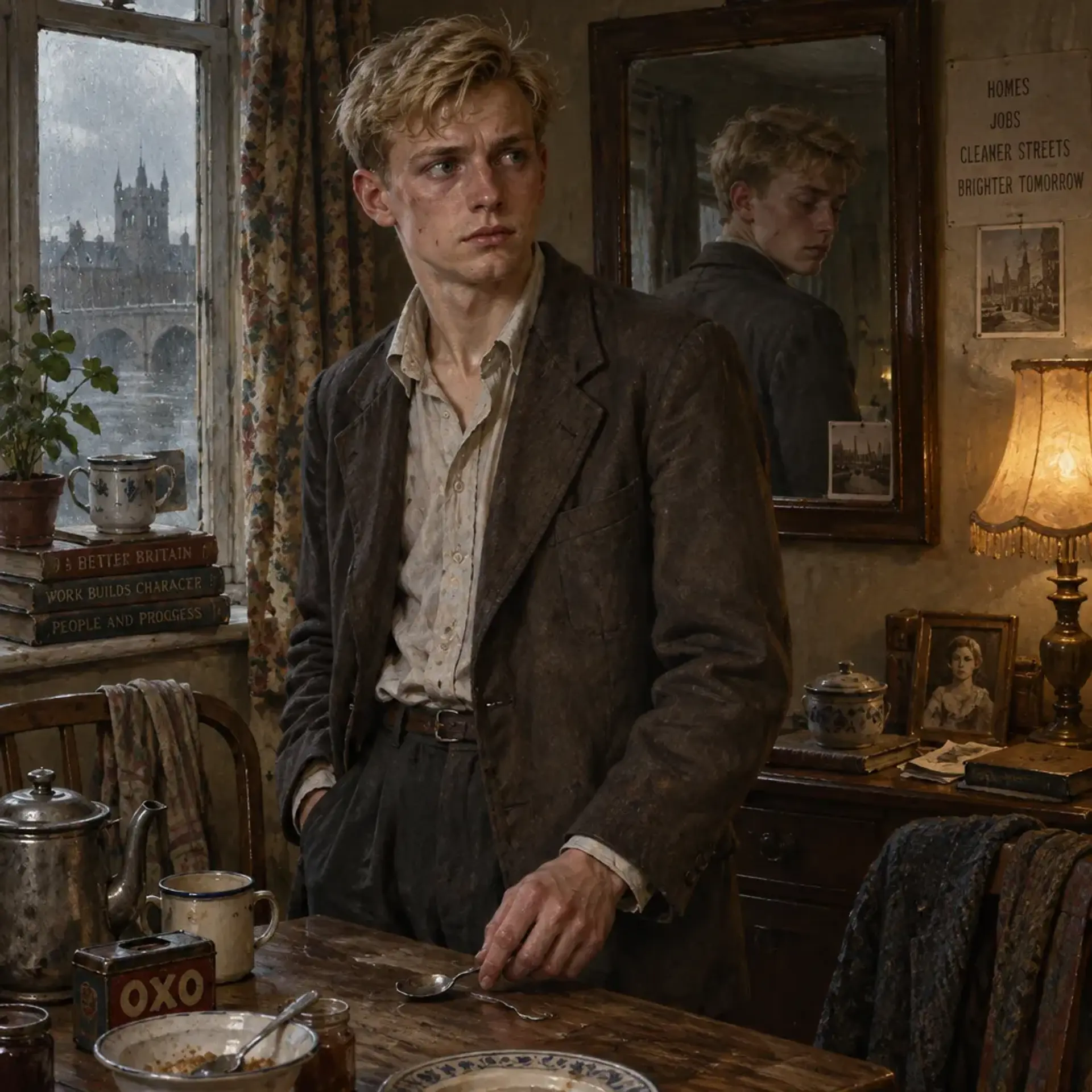
Mark looks like a young man who has stepped out of a railway photograph from a slightly different life: handsome, tall, and clean-featured, with short bright-blond hair that never quite lies flat and deep malachite-green eyes that seem unusually vivid in dim rooms. His face is not Mary's face, and his body is not hers. His skin has a new, healthy-looking pallor, but at the hairline, wrists, and collar the change can seem too seamless, as if a costume has been removed rather than a person transformed. He moves with a careful, guarded propriety until he is comfortable, then becomes unexpectedly physical, bounding into a game with the younger children or taking stairs two at a time. His hands are broad and unaccustomed to Mary's chores; he keeps flexing them as if checking that they belong to him. He tries to dress like a respectable young gentleman, but often wears clothes borrowed or bought in haste, with sleeves and shoulders sitting imperfectly. The unexpected detail: he is fussy about table manners and the polish of his shoes while cheerfully climbing a tree or scrambling through a ruined building.
Clothing
He wants neat, respectable clothes, but his wardrobe is assembled from borrowed items, inexpensive purchases, and Trudy's gifts. His trousers and jackets rarely fit perfectly. He takes extra care of one clean shirt and polishes shoes that are not quite his size. At home he sometimes leaves his shirt off while laundry is drying, to Trudy's exasperation.
Body language
At first meeting he holds himself upright and keeps his hands close to his sides, as if afraid of taking up too much space. When anxious, he rubs his left palm with his thumb, especially near the cold-iron scar. In familiar company his posture loosens, and he leans forward with an eager, almost boyish intensity. He looks away from mirrors when they seem too attentive.
- Height
- Tall, noticeably taller than Mary was
- Build
- Tall and lean, with long limbs that make his attempts at restraint look slightly awkward. He is stronger and more athletic than Mary's old habits suggest, but not trained for a fight.
- Eyes
- Malachite green
- Hair
- Bright blond
- Skin
- Pale, with a healthy-looking flush that makes the change seem disturbingly complete.
- Age
- 18
- Gender
- Male
- Size
- Human-sized
Distinguishing features
Personality
20 traits and drivesMark is a young man made from incompatible inheritances, and neither side cancels the other. Mary's naivety and devotion remain in him as a willingness to help, an instinct to protect children, and a sincere belief that people usually mean what they say. Kent's feelings and desires pull him toward privacy, respectable appearances, and a small, orderly home. He wants to be thought of as a gentleman, but this is not mere vanity: courtesy gives him a structure when his identity feels shapeless. He can object to Trudy's clothes as improper and then quietly offer her his coat in the rain. He likes a tidy breakfast table but will wrestle with a child on the floor. He is modest about his own needs until they are ignored, then unexpectedly stubborn. With strangers Mark is watchful and stiffly polite. He asks careful questions, studies the room, and waits to learn what kind of behavior is expected. This reserve is easily mistaken for snobbery. In truth, he is afraid of making the wrong social move and revealing that he does not know how to inhabit his life. In familiar company he grows more physical and expressive. He can become a loud, competitive playmate with the younger Bell children, especially when a ball or a race gives him a simple role. He does not automatically take up Mary's old work of caring for everyone, and his siblings may see that as callousness. Mark does care; he simply does not know how to reproduce Mary's habits, and sometimes resents being expected to. His relationship with Trudy brings out his contradictions. He regards her as a good friend and feels protective of her, though he does not recognize the fondness as a possible crush. He may stare at her while she styles her hair, escort her home, or offer his coat, then look genuinely puzzled when she teases him about behaving like a suitor. He can be prudish about her rebelliousness, calling an outfit improper or criticizing her plans, while relying on her courage and practical help. Trudy does not let him turn concern into authority. She answers him playfully, makes him do his share of the housework, and reminds him that a friend is not a guardian. He grumbles, but respects her more for it. Mark is both a homebody and a restless escapee. He wants a quiet room, reliable meals, and a place where nobody stares at him. Yet when the flat feels too small or a conversation turns toward doctors and examinations, he paces or disappears for a walk. His early nights as Kent offered the freedom of being outside without the burden of being known. That freedom still tempts him, though he is now less interested in adventure for its own sake. He would rather walk beside Trudy, look at the sea, or sit in a pub and observe people than pursue danger. His curiosity is real, but it is cautious and often arrives after the danger has begun. When frightened, he reaches for rules. He polishes shoes, corrects his posture, asks what time something starts, and tries to speak in measured sentences. When angry, those rules fall away. He can be blunt, argumentative, and physically impulsive. His fight with Simon showed that he can pin a person when panic and resentment overwhelm his restraint. He is disturbed by that strength and dislikes being told that it proves he is dangerous. If a child is threatened, or Trudy is in immediate danger, he may act before thinking. He is not a natural fighter and has no appetite for cruelty, but he can be reckless in defense of someone he loves. Mark is proud, but not secure. He wants others to see him as a respectable young man, not a freak, a fraud, or a medical specimen. Simon's concern can feel like a cage even when Simon is trying to help. Dr. Bronson's questions make him impatient; Dr. Grey's examinations make him feel as if his body is evidence that belongs to somebody else. He can cooperate when treated honestly, but refuses to perform certainty for the doctors. He does not know whether the truth is that Mary died, that Kent took over, or that the word Mark names a new mixture. What he does know is that he is the one who wakes in the body and has to decide what to do next. He can be unexpectedly tender. He remembers what the children like, tries to make breakfast, and will lend a coat before considering whether he will be cold. His tenderness is awkward rather than smooth. He may try to help by fixing a problem nobody asked him to fix, then feel wounded when told to stop. He is especially careful with Matilda because he senses how much she misses Mary and does not want to replace her by force. He has less patience for Henry, whose claims about the heart sound like a threat, but even there anger is mixed with fear that Henry might be the only person who knows what happened. His shame comes out as etiquette. If he has made a mistake, he apologizes too formally. If he has been frightened, he becomes fussy. If someone sees him in a vulnerable moment, he may insist that he was only tired. He rarely asks directly for comfort, but will remain in the same room as a trusted person, making tea or pretending to read. At night, he paces and sometimes sleeps as if fighting something. He does not tell Trudy the full extent of it because he fears becoming another burden she has to manage. The cold-iron scar is a lesson he has not fully absorbed. He had wanted to test a rumor and treated the experiment as an intellectual question. The pain and scar proved that curiosity can injure him in ways he cannot explain. Trudy's demand that he promise never to repeat it embarrassed him, but he made the promise. He still wonders what else might affect him, and that curiosity could draw him into danger again. Mark's deepest conflict is between wanting an ordinary life and needing an answer. A job, rent, shared meals, and teasing arguments with Trudy make him feel real. But the heart's absence leaves a hole in the story. Henry says he sold it. The heart may be hidden, destroyed, or in someone's possession. Mark fears that finding it could give someone power over him, but fears more that never finding it means he will never understand what he is. He is capable of warmth, humor, and loyalty, but these do not make the mystery harmless. They make the stakes personal.
- Alignment
- Protective and well-intentioned, but increasingly self-interested when his identity or independence feels threatened.
Quirks
Habits
Traits · 5
Flaws · 5
Fears · 5
Wants and needs · 5
Combat
HP 3Avoids violence and tries to leave. If cornered, he uses a shove, a grapple, or an improvised object to create an opening and escape. He is not a trained fighter. Threats to Trudy or the children can make him reckless. Heart-related effects are custom and uncertain, not established system rules.
Mark
Actions
Reactions
Services they sell
Rewards they can give
Equipment
- Ill-fitting everyday clothes (clothing)Borrowed or second-hand clothes, carefully kept despite their poor fit.
- Trudy's shoes (clothing)A pair of shoes Trudy gave him. They are serviceable, but Mark considers them uncomfortable and distinctly below his standards.
- Heart-shaped chalk stone (mystery object)A keepsake from the earlier life, if Mark has managed to keep it. Its current possession and condition are uncertain.
Possessions
Background
Mark's life began as Mary's, an eighteen-year-old in a crowded, strained household in Rochester, Kent. Before the change, she was the eldest of eight children and the one most often expected to notice what needed doing. Her parents, Malinda and Simon Bell, could be neglectful of one another and of the work of raising a large family. Simon was frequently away for employment, while Malinda drank too much and could be unreliable. Mary learned to keep younger children fed, occupied, and out of the path of adult quarrels. She was devoted to Matilda, twelve, and tried to protect her from being made a replacement parent. She also loved the little ones, including Abigail, Oswald, and Jonas, though there was rarely enough time to give them all the attention they wanted. Henry, fourteen, had begun to resent the household and to test how much trouble he could make. Chrissy, Olympia, and Belladonna had their own shifting alliances and worries. Mary was not a saintly household angel: she was tired, naive about some dangers, and increasingly desperate for a life that belonged to her. The stone entered this life by a peculiar chain of accidents. An amateur alchemist, Bartholomew Golden, had once offered a supposed fossilized living heart as payment for entry to the Hush House. He called it the Heart of England and claimed it could bring servants out of man's shadow, born from chalk cliffs and borderlands. The Hush House rejected the gift and Bartholomew was not permitted near Brancrug again. The object looked like a human heart carved from Dover chalk, barnacled and tangled with sea grass. After it was thrown into the sea, it returned to shore washed with salt water and black ooze, its stone showing a strange red-pink light beneath the surface. Abraham Groff found it and took it home. It beat beneath his coat on the train. At first he showed it to neighbours, but it seemed to go dead in company and wake again near water. He came to believe it disliked visitors, and guarded it less from greed than from a conviction that it wanted privacy. Strange sounds, footsteps, and moving doors followed. At last Abraham sold it to William Windon, a local lad who had once seen it. William struck it with a hammer and hid it in a log. The heart stopped beating. Malinda later found the odd stone in that log and gave it to Mary for her eighteenth birthday. The gift was small and awkward, but Mary appreciated that her mother had remembered her fondness for curious stones. Mary kept it. When it began to beat in time with her own heart, she thought it disturbing but had no spare energy to investigate. Her reflection began to change. In the glass she saw a young man with bright blond hair and malachite eyes, taller and handsome, not resembling her. The image moved of its own accord and sometimes looked away when she stared directly at it. Mary's first night as Kent came after a bad dream. She woke in a body that was not hers, frightened and confused, then discovered that she could leave the house without being recognized as Mary. The freedom was the first thing she understood. She went out into the night, awkwardly borrowing clothes and learning the changed body's stride, then explored the streets, the shore, trees, and abandoned places. She returned before dawn, expecting that the episode would pass. It did, then happened again without warning, sometimes even in daylight. She called the young man Kent without understanding what the name meant. Kent felt less like a separate voice in her head than a set of instincts, reactions, and knowledge that rose alongside her own. He was shy, wanted to be regarded as respectable, and possessed an English middle-class propriety that sat strangely beside Mary's urgent desire to escape the house. He was also more of a homebody than she was. One of their early excursions ended with Simon returning unexpectedly. Mary, as Kent, had to get home while Simon was there, terrified that he would recognize her or that she would have no credible explanation. She slipped in through a side entrance and tried to pass herself off as a visitor or acquaintance, relying on borrowed clothes and a strained composure. Simon's attention stayed on the strange young man in his house, not on Mary. He questioned him about his name, why he was there, and whether he had seen Mary. Kent's answers were stiff and too formal. The moment taught Mary that the borrowed identity could get her out of the house, but getting back in was another danger entirely. Another time Malinda, drunk and upset, confronted Kent in the house. Her first response was not recognition but suspicion: a young man had appeared where Mary should have been. Kent stood rigidly, trying to behave as a gentleman, while Malinda demanded to know where her daughter was. Mary, present within the confused experience, had to keep the encounter from becoming a greater crisis. Malinda's slurred questions and sudden shifts between anger and tenderness made the scene more frightening than a simple discovery. The next morning she remembered little, which was both a relief and another wound. Kent's first pub adventure began when he followed the ordinary freedom of being outside too far. He entered a local pub with more confidence in his clothes than in the room, ordered as though he had been there before, and tried to sit as a respectable young man. He watched the bar, the door, and the other patrons with a reserved curiosity. A joke about his polished manners drew a stiff response, then a surprisingly boyish laugh when someone mentioned a football match. He was not looking for a fight or romance; he wanted to see how ordinary men spent an evening. He drank little, asked too many careful questions, and left feeling both pleased that he had managed it and offended by the room's disorder. The excursion hinted at Kent's personality: curious but easily embarrassed, proud of decorum but not immune to pleasure. Trudy became Mary's friend outside the home. Short, thin, and dirty-blond, she called herself a rebel and dressed in conspicuously alternative clothes for the period. She noticed how exhausted Mary was and helped with the children when she could. She also saw Kent appear. Rather than treating him as a novelty, she dealt with the practical problem in front of her: he needed somewhere to sleep, clothes that fitted, and someone to tell him when his manners were becoming ridiculous. After the change of 30 May, when Mary shed her old skin and Mark remained, Trudy was the person most willing to make room for him without pretending that nothing had happened. The morning of 30 May began at home, among small domestic demands. The very young children were awake early, and Mark was trying to help while the household moved around him. Then Mary's skin simply stripped away, like the grotesque aftermath of a forbidden drink, leaving the young man who had been Kent. The experience had an awful resemblance to the stories of Leathy and Skinshuck mead: a body shedding its familiar covering and revealing something else beneath. No drink caused it, and nobody present understood the mechanism. The old face, body, and identity were gone from view; Mark had Mary's naivety and devotion, and Kent's appearance, desires, and feelings. He called himself Mark. Kent had become dominant, and Mary was no longer a person he could simply consult at will. The household reacted in different ways. Simon was deeply alarmed, but he wanted a rational explanation and feared what it would mean if something had happened to Mary that he could not explain. He kept the matter from the town and brought in two doctors. Dr. Bronson, a young London psychiatrist fresh out of college, wanted a case he could understand and gradually learned how little his training could tell him about this one. Dr. Grey, an older physician from Suffolk, examined Mark's body for surgery or unusual medical conditions and was unsettled by what he found, or failed to find. Neither man had a simple answer. Mark grew frustrated with the examinations and with Simon's insistence on treating him as a problem to be solved. The children reacted less uniformly than the adults. Matilda, who had been Mary's closest ally among the siblings, was frightened by the loss but also recognized habits of care in Mark. He did not mother the children as Mary had. He preferred roughhousing, football, and noisy games, and the change felt like a new person in the middle of the family. The youngest children followed him with a mixture of curiosity and alarm. Henry was especially difficult: he watched, tested boundaries, and eventually claimed he had stolen and sold the heart. Mark and the family do not know whether he truly sold it, hid it, or has learned how to use it. Simon's fear and Henry's claims made it harder for Mark to stay home. He fought with Simon, pinned him in the struggle, then left for a walk with Henry and Matilda following behind. He was not trying to abandon them, but he could no longer tolerate being examined and contained in the same rooms where Mary had been expected to serve everyone. Mark now stays with Trudy in a rented flat. The arrangement is affectionate, awkward, and precarious. Trudy made room for him on the couch while he slowly clears a small space of his own. She brought him clothes, socks, undergarments, and a pair of shoes. The fit is poor and the shoes offend his standards, but he is grateful and knows better than to pretend otherwise. He has found a modest job to contribute to the rent and household expenses, though the precise work changes with opportunity and his ability to pass as an ordinary young man. At night he paces when sleep will not come, and sometimes sleeps as if caught in fits. When his clothes are washing he will walk about without a shirt, a habit Trudy treats as a practical nuisance rather than a scandal. He leaves shaving razors out. Trudy makes him pick them up. Their flat has become a negotiated household. Mark often makes breakfast, and Trudy styles her hair in the morning with the blunt confidence of someone who expects the room to make way for her. She has to rouse him into the real world when he retreats into himself like a turtle. He sometimes criticizes her rebellious clothes or habits as though he were her disapproving guardian; she answers with teasing, practical corrections and never lets him get away with it. He can be overly formal about sharing a flat with a single woman and once nearly fought one of her brothers because he misunderstood the situation. He means well, but his assumptions can be naive. He is fond of Trudy, sometimes stares too long, escorts her at night, and offers her his coat. He does not understand that this can look like a crush. She occasionally lets him be gallant, then makes him carry the shopping. A more dangerous experiment came when Mark tested whether the family's talk about cold iron had any truth. He touched it deliberately and suffered a supernatural reaction that left a scar on the palm of his left hand. Trudy made him swear never to try it again. She was angry because he had endangered himself, and because he treated the risk as an interesting question instead of a warning. The scar is now a private reminder that the body has rules neither of them understands. Mark and Trudy have been mistaken for a couple more than once. Mark usually stays beside her when they go out, partly from loyalty and partly because he is reluctant to face unfamiliar streets alone. Mary's brothers dislike the assumption and correct people when they are present. Mark is grateful for their intervention but embarrassed by it. He is trying to build a life that belongs to him while remaining tied to a family that remembers Mary. He does not know whether Mary is absent, buried inside him, or transformed into something he cannot reach. The missing heart, Henry's possible control over it, and the question of whether Mark can remain safely at home are unresolved problems, not finished chapters.
Role in the story
A transformed young man trying to build an ordinary life while the people around him debate what happened to Mary. Mark is an emotional center, a source of clues about the heart, and a person whose future choices can pull the story toward family reconciliation, escape, or supernatural investigation.
“Before the change, she was the eldest of eight children and the one most often expected to notice what needed doing.”
- Faction
- No formal faction. Ties are to Trudy's household and the Bell family. The Hush House and its history are relevant to the heart, but Mark has no known membership or standing there.
Known connections
Media
0 imagesNo images yet.
Turn Mark into a sheet
A high-res, share-ready sheet you can post or print.