Where every pass has a price and every valley keeps its own counsel.
NHNimba Highlands
Overview
The Nimba Highlands are a wide, rugged region of folded mountains, sheltered valleys, and open upland pastures. Its communities are linked by old footpaths and seasonal markets, yet each valley keeps its own customs and practical laws. Travelers find generous hospitality near settled roads and difficult conditions beyond them. Water rights, grazing land, and control of the passes give the region its steady rhythm of cooperation and rivalry, while hidden caves and abandoned workings promise trouble or opportunity.
Cultures
Highland herding communities shaped by seasonal movement between upland pastures.
Valley farming communities known for cooperative irrigation and communal harvests.
Roadside trading communities blending customs from neighboring lowlands.
Places
4 settlements
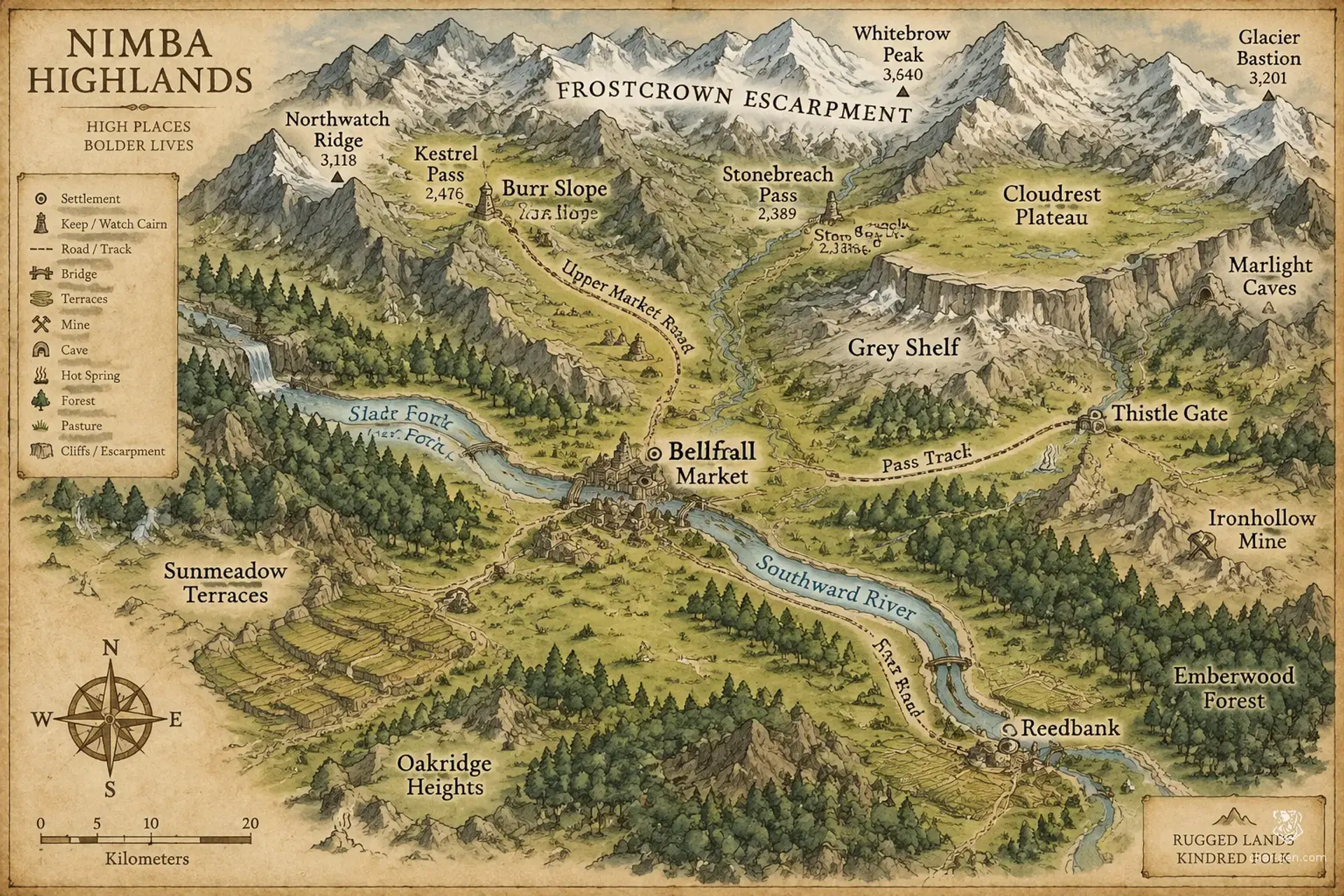
Small · VillageBurr SlopePasture and wool centerA herding village where burr plants cling to wool and travelers' clothing.
Medium · Market townThe Bellfall MarketSeasonal trade hubLocals say a warning bell fell here during a slide, though the old records describe no bell at all.
Medium · VillageReedbankFarming and canal centerCanal crews maintain irrigated plots along the water's edge and settle disputes in a shared hall.
Small · WaystationThistle GateWaystation and toll postA pass-side stop where stubborn thistles grow through the road's stonework.
How they spread
PatternSettlements cluster on sunny valley slopes and beside dependable water, while high plateaus support seasonal camps. The steepest ridges remain sparsely inhabited.
The Pass Track carries caravans westward through high saddles.
The River Road follows the Southward River toward the southern foothills.
Dangers and hooks
3 threats
Most dangerous · HighThe Whiteout FrontsWeatherSudden snow squalls sweep exposed ridges during the cold season.
The Deep-Ravine StalkersHighWildlife
Predators follow livestock routes near wooded ravines and abandoned mines.
Ridgefall BandsModerateHumanoid banditry
Small groups of outlaws watch isolated trails and strike overloaded caravans.
Hazards of the land
Sudden rockslides can bury narrow trails.
Late snowstorms strand travelers on high passes.
Flash floods sweep through steep ravines after heavy rain.
Plot hooks
1
The Vanishing WaterInvestigationA canal has run dry despite a full reservoir, and rival villages accuse one another of secretly diverting its flow.Starts: The players arrive at a crowded irrigation meeting in the Upper Market.Reward: A locally honored travel pass and a share of recovered canal tolls.
2
Tracks Under StoneRescueA caravan carrying iron tools failed to reach the pass exchange, and its tracks end beside fresh rockfall.Starts: A worried factor hires help at a roadside waystation.Reward: Useful equipment, a modest payment, and the factor's future patronage.
3
The Knocking CaveExplorationA cave used for seasonal shelter now echoes with strange knocks, driving herders from valuable pasture.Starts: A herding family asks the party to inspect the cave before the next migration.Reward: Rare mountain herbs and a claim to safe grazing for the season.
4
The Shifted StoneDiplomacyA boundary marker has been moved, threatening to restart an old feud between miners and herders.Starts: A village council requests neutral witnesses before either side gathers supporters.Reward: A negotiated favor from both communities and access to a small mineral claim.
The land
Climate and ground
ClimateCool, wet summers and cold winters, with heavy snow on the highest ridges and sharp local shifts in weather.
TerrainA broad highland region of folded ridges, deep valleys, steep passes, and scattered plateaus.
Biomes
Alpine meadows, Montane forests, Highland scrub, Fertile valley grasslands
Waters and borders
Waterways
The Slate Run, The Alder Fork, The Southward River
Borders
The northern escarpment descends toward colder uplands.
The eastern ridges divide the highlands from a dry basin.
The southern foothills open onto broad farming country.
The western passes lead toward forested lowlands.
On the road
Pass roads can close without warning during snow or rockfall.
Pack animals are more reliable than carts on steep tracks.
Travelers should arrange guides before crossing exposed ridgelines.
Landmarks
Terraces cling to sunny valley walls.
Old watch cairns mark forgotten footpaths.
Hot springs gather beneath a wind-scoured ridge.
A chain of caves shelters seasonal herders.
Landforms
Folded mountain ridges
Broad glacial valleys
Limestone shelves
High grassland plateaus
Resources
Copper ore
Building stone
Medicinal herbs
Wool and grazing land
Power
Rule
GovernmentA loose compact of valley councils and upland communities, coordinated by delegates at seasonal gatherings.
SeatA rotating council meets at the largest seasonal market, with no permanent regional seat.
StabilityGenerally steady, though disputes over water, tolls, and pasture can flare into local feuds.
Laws
Water rights are recorded locally and canal tampering is punished.
Travelers must pay posted bridge and pass tolls.
Grazing boundaries are marked by stones and enforced by village councils.
Factions
Reed-BindersFarmers' league
Influence: Strong among valley farmers and canal wardens.The Reed-Binders are named for persistent reeds clogging their irrigation channels; they seek shared water rights and reliable canal repairs.
Lost Bell CouncilRoadwardens' assembly
Influence: Moderate among guides, toll keepers, and caravan masters.The Lost Bell Council takes its name from an old warning bell mistakenly believed to have vanished in a landslide; it wants control of the safest pass roads.
Burdock CompanyMerchants' consortium
Influence: Growing among herders and traders.The Burdock Company is named for burrs that cling to every pack in the high pastures; it seeks new grazing leases and profitable wool contracts.
Faiths
The Way of the Springs
Influence: Widespread in rural communities and among travelers.Seasonal offerings at springs and high ridges, with prayers for safe passage and rainfall.
The Keepers of Measure
Influence: Strong in market towns and among council delegates.Study, record keeping, and preservation of agreements made between communities.
The Hearth Vow
Influence: Deeply rooted among herding families and valley households.Veneration of ancestors through household rites and shared meals.
People and trade
Who lives here
How manyModerate in sheltered valleys and sparse across high ridges, with many small settlements spread over a broad area.
Main peoples
Upland herders, Valley farmers, Caravan traders
Other peoples
Monastic scholars, Seasonal miners
Languages
Nimban, spoken widely in upland villages.
Lowland Trade Speech, common at markets and caravan stops.
A liturgical language preserved in old shrines.
Trade
WealthUneven but generally modest, with prosperous market valleys and isolated communities reliant on barter.
Work
Terraced farming and orchard keeping
Sheep and goat herding
Copper and stone extraction
Exports
Wool and felt
Dried fruit and mountain herbs
Copper ore and carved stone
Imports
Iron tools and worked metal, Salt and preserved fish, Fine cloth and medicines
Markets
The Upper Market, The Pass Exchange
History and secrets
The highlands grew through scattered valley settlements and seasonal herding routes rather than a single founding kingdom. Cooperation over water and pass maintenance became essential, and local councils gradually formed a loose regional compact. Old road closures, mining disputes, and shifting trade routes still shape rivalries. Many communities preserve distinct customs while relying on shared markets and agreements to survive the harsh seasons.
Key events
Early settlement era
The Canal CompactA succession of valley councils established shared rules for irrigation after several dry seasons.
Old road era
The Bell That Was Not LostA major slide blocked the northern pass, and later storytellers wrongly claimed a warning bell disappeared beneath it.
Recent generations
The Ridge MarkingMiners and herders agreed to common boundary markers after a series of costly grazing conflicts.
Secret 1 · GM only
The oldest boundary stones were placed to conceal an unusually rich copper seam.Found by: Compare old mine ledgers with the current boundaries marked on the ridge.If found: A hidden copper vein lies beneath disputed pasture, and exposing it could upset several local agreements.
Secret 2 · GM only
The cave chain opens onto an underground stream that runs beneath the central ridge.Found by: Listen for the spring's rhythm at the cave after the evening wind dies down.If found: A natural tunnel connects several valleys and could become a secret route for trade or escape.
Media
0 images
No images yet.
Visual sheet
Turn Nimba Highlands into a sheet
A high-res, share-ready sheet you can post or print.