Where every road leads to power, and every alley hides its price.
ICImperial Capital
Overview
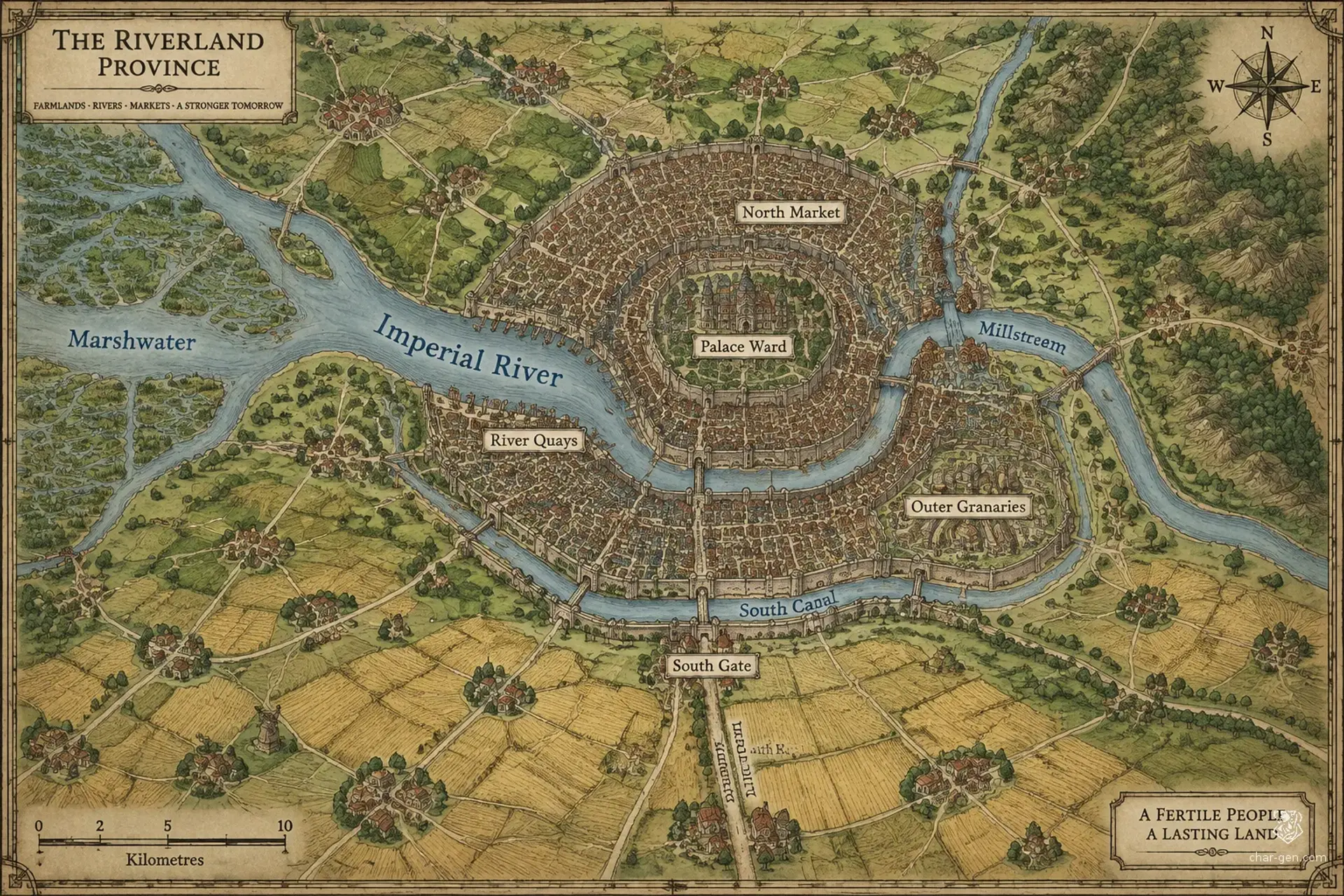
The Imperial Capital is a province-sized heartland of plains, roads, farms, and an urban sprawl so immense that distant wards feel like separate towns. The palace anchors a dense core of offices and wealthy streets, while millions of laborers, traders, and migrants crowd the surrounding districts. Low magic leaves most people dependent on guild craft, organized labor, and practical medicine. Every avenue carries imperial authority, but the alleys reveal how unevenly that authority is enforced.
Cultures
Courtly Imperial customs shape ceremonies, law, and public display.
Guild traditions prize apprenticeship, mutual aid, and guarded trade secrets.
Newcomer neighborhoods preserve provincial foods, dress, and local festivals.
Places
5 settlements
Vast · Urban districtPalace WardAdministrative and ceremonial centerThe district is heavily watched, expensive, and crowded with officials, servants, and petitioners.
Vast · Market districtNorth MarketCommercial exchangeIts crowded stalls sell food, tools, secondhand goods, and rumors from every province.
Large · Port districtRiver QuaysRiver trade and transportWarehouses, taverns, customs offices, and boat crews jostle along the busy banks.
Large · Industrial wardOuter GranariesFood storage and processingA belt of storage yards, mills, and laborers serves the city and nearby farms.
Medium · Gate townSouth GateRoad access and customsCaravans queue for inspection beside inns, stables, and makeshift camps.
How they spread
PatternThe city dominates the center and spreads outward along roads, canals, and riverbanks. Market towns and villages cluster where farms meet transport routes, with dense settlements filling the spaces between.
Common kinds
Walled city districts, Market towns, Riverside villages, Roadside inns and depots
Trade routes
The Imperial River connects quays to distant provinces.
The South Road carries grain and recruits across the plains.
The Canal Road links workshops, mills, and outer markets.
Dangers and hooks
3 threats
Most dangerous · SevereThe Understreet BroodsMonstrous infestationVermin and worse creatures haunt drains, cellars, and forgotten foundations.
False WatchmenHighCriminal predation
Impostors extort travelers in poorly lit outer wards and along deserted roads.
Riot CrowdsModerateCivil unrest
Food shortages, rumors, and harsh arrests can trigger sudden street violence.
Hazards of the land
Crowd crushes can turn a busy street into a death trap.
Open drains and contaminated wells spread disease.
Seasonal floods swamp low wards and outer roads.
Fires can race through tightly packed timber housing.
Plot hooks
1
The Vanished HarvestInvestigationA convoy of grain disappears between the outer granaries and the river quays, and rival merchants accuse one another of theft.Starts: A warehouse clerk offers the party a map of the missing cargo's last route.Reward: A guild payment, legal favor, and a share of recovered grain.
2
Below the Old WallUrban horrorA sealed drain beneath an old ward has opened, releasing strange vermin and a foul smell that makes residents violently ill.Starts: A local healer asks for help after several patients describe the same underground passage.Reward: Medicine, a modest purse, and the gratitude of the ward.
3
A Tool Out of PlaceSocial investigationA guild apprentice is accused of stealing a masterwork tool, but the evidence points toward a planned sabotage of an important commission.Starts: The apprentice's family approaches the party in a crowded market court.Reward: A useful craft item, guild contacts, and possible legal protection.
4
The Missing DispatchIntrigueAn urgent palace summons is intercepted, and several factions race to learn whether its message concerns arrests or a change in imperial policy.Starts: A frightened courier seeks protection at a roadside inn beyond the city gates.Reward: Political leverage, official patronage, or a dangerous favor owed.
The land
Climate and ground
ClimateTemperate, with wet springs, warm summers, and cold winters that bring fog and occasional hard frost.
TerrainMostly level plains crossed by rivers, roads, canals, and a vast, nearly continuous cityscape.
Biomes
Temperate grassland, Cultivated floodplain, Managed woodland, Marshy river margin
Waters and borders
Waterways
The Imperial River, The South Canal, The Millstream, The Marshwater
Borders
Farm country to the north
Low wooded ridges to the east
Open grain plains to the south
Broad riverlands to the west
On the road
Crossing the urban sprawl can take days because gates, tolls, and crowds slow travel.
Main roads are patrolled, but side lanes and canal paths are difficult to police.
Floods and seasonal mud can close the outer roads without warning.
Landmarks
The palace precinct dominates the central skyline.
Old walls divide districts built in different eras.
The river quays handle an endless tide of cargo.
Outer granaries stand amid fields and crowded market villages.
Landforms
Broad river floodplain
Low earthen terraces
Canal-cut meadows
Gentle outer ridges
Resources
Fertile grain soil
River fish
Clay for bricks and pottery
Reeds and pasture fodder
Power
Rule
GovernmentAn imperial bureaucracy governs through palace offices, appointed magistrates, ward councils, and chartered guilds.
SeatThe Imperial Palace stands at the symbolic and administrative center of the city.
StabilityThe regime is entrenched, but succession anxieties, factional rivalries, and periodic unrest keep the streets tense.
Laws
Weapons must be peace-bound inside palace precincts.
Market stalls require guild or ward licenses.
Curfew applies during declared emergencies.
Unlicensed spellcasting is treated as a serious public danger.
Factions
Crown and CouncilImperial administration
Influence: High in the central districts and among officials.Protect imperial authority and suppress threats to public order.
Guilds and ArtisansCraft coalition
Influence: High in workshops and markets.Secure privileges, control apprenticeships, and limit outside competition.
RatsStreet network
Influence: Growing in crowded wards.Win better wages, safer housing, and relief from arbitrary arrests.
Faiths
Cult of Verena
Influence: Prominent among officials, judges, and households seeking order.Justice, civic duty, and the authority of law.
Cult of Shallya
Influence: Strong among workers, the poor, and those facing illness.Endurance, labor, and hope through hardship.
Cult of Sigmar
Influence: Visible in workshops and guild ceremonies.Craft, invention, and the duties of skilled work.
People and trade
Who lives here
How manyExtreme in the urban core and dense outer wards, thinning into tightly settled market towns and cultivated plains; official counts cannot keep pace with migration.
Main peoples
Native Imperial cityfolk
Provincial migrants from across the Empire
Guild apprentices and laborers
Other peoples
Foreign merchants and envoys, Dwarfen craftsfolk, Halfling families
Languages
Reikspiel, Kislevite, Tilean, Classical
Trade
WealthVast wealth circulates through the palace and guilds, while most residents live close to hunger and debt.
Work
Government and administration
Craft manufacture and guild trades
Food processing and distribution
Exports
Cloth and uniforms
Printed books and legal documents
Tools, arms, and household wares
Imports
Timber and stone, Fine wines and spices, Iron and coal
Markets
Central Market, River Quays, Outer Granaries
History and secrets
The Imperial Capital grew from a guarded seat of power into a sprawling heartland whose streets seem to have swallowed the surrounding province. Each generation added walls, markets, and crowded wards, drawing migrants in search of work or favor. The palace remains the center of law and ambition, but its reach weakens in distant alleys, where guilds, ward bosses, and watch patrols compete to impose order.
Key events
Early Empire
The Court Takes RootThe court established permanent offices beside an old river crossing and drew the first major roads toward it.
Middle Empire
The Ringing of the WallsSuccessive walls enclosed new districts, while older suburbs were absorbed into the expanding city.
Recent centuries
The Hungry WinterA grain shortage sparked riots, reforms, and the creation of public granaries beyond the central wards.
Secret 1 · GM only
An abandoned network of foundations predates the current palace and conceals a route used by an earlier court.Found by: A bricklayer notices that old foundations continue beneath a sealed palace service yard.If found: The hidden passage could expose a buried political crime or provide access to a heavily guarded precinct.
Secret 2 · GM only
A quiet cartel manipulates grain shipments to profit from shortages and weaken rival wards.Found by: A missing ledger page appears in a pawnbroker's inventory, marked with the same cipher as several grain contracts.If found: The evidence could implicate powerful officials in deliberate shortages and provoke unrest across the city.
Media
0 images
No images yet.
Visual sheet
Turn Imperial Capital into a sheet
A high-res, share-ready sheet you can post or print.