Every tide hides a path, and every reed may remember it.
SMSalt Reed Marsh
Overview
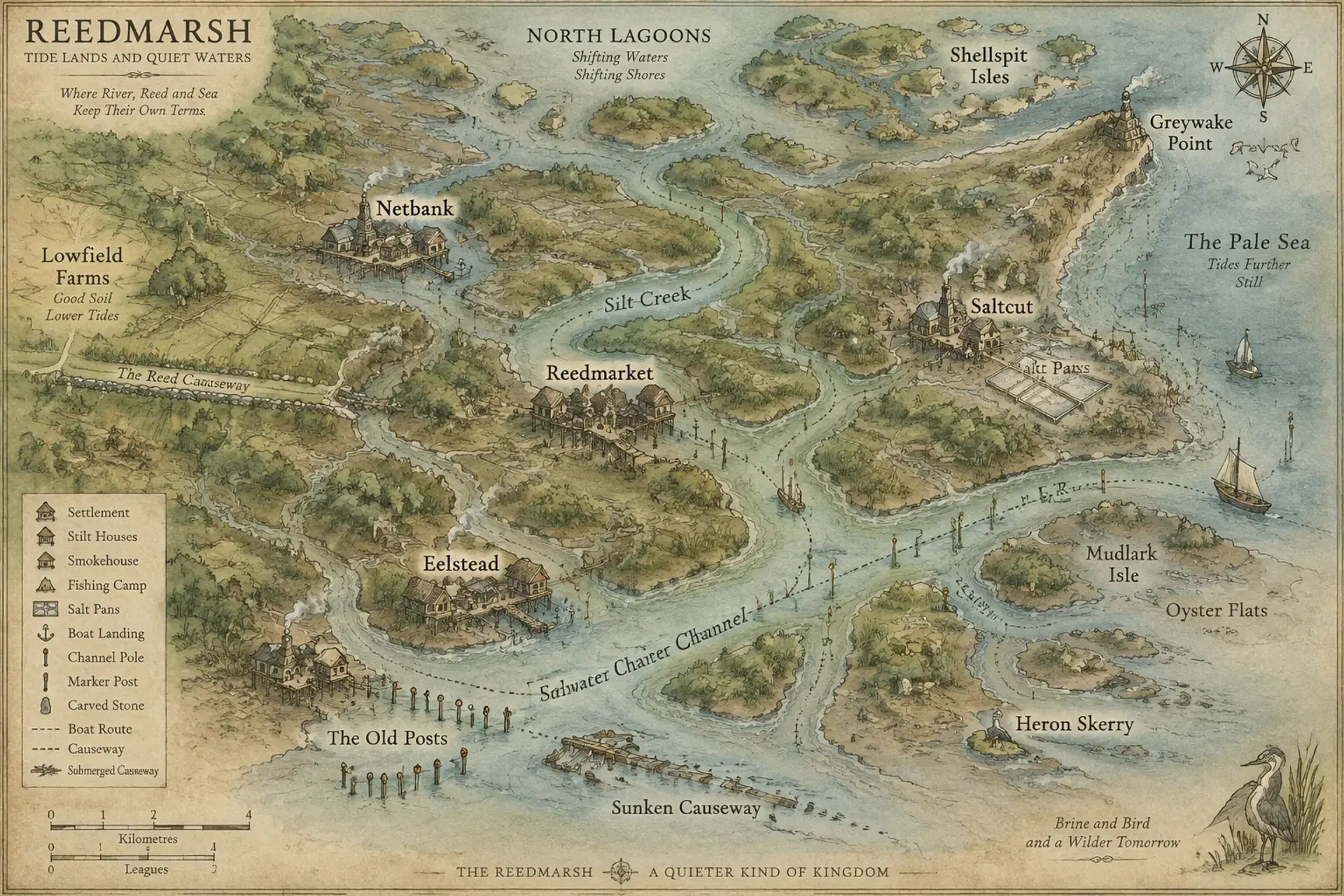
Salt Reed Marsh is a broad coastal wetland of tidal creeks, reed beds, and scattered raised-bank communities within Reefcut. Its waters feed generations of fishers, while its shifting channels form a natural barrier between the coast and inland farms. Boats, tide knowledge, and small practical charms matter more than roads. Beneath the salt reeds lie root-bound traces of a vanished route, drawing merchants, local councils, and fortune seekers into a landscape that resists easy passage.
Cultures
Tideward communities coordinate work by flood calendars and share catches through kin and boat crews.
Raised-bank fishers prize practical charms, communal smokehouses, and quiet bargaining.
Outer-creek traders blend marsh customs with habits brought by passing coastal vessels.
Places
4 settlements
Large village · Raised-bank villageNetbankFishing and council gathering placeA dense cluster of stilt houses surrounds a shared smokehouse and seasonal council ground.
Small town · Tidal market landingReedmarketTrade and supply stopIts landing is busiest when reed bundles, salt, and cured fish move toward inland buyers.
Small village · Fishing hamletEelsteadEel fishing and marsh provisioningFamilies maintain traps along a quiet creek and share a raised storehouse against floods.
Seasonal settlement · Work campSaltcutSalt production and boat repairWorkers gather salt in shallow pans and repair boats between harvest tides.
How they spread
PatternSettlements cluster on shell ridges, natural levees, and creek junctions, with long gaps between reliable high ground. Small seasonal camps follow fish runs and reed harvests.
Markers at Low TideExplorationA section of the old route has surfaced after a storm, and several crews claim the same newly exposed marker.Starts: The fish-smoking ground at NetbankReward: A share of recovered cargo and a pilot's favor
2
The Empty NetsInvestigationA run of dead fish and missing eel traps suggests that something is poisoning or diverting a shared creek.Starts: The landing at ReedmarketReward: Payment in salt, safe passage, and local goodwill
3
A Passage Against the TideMoral dilemmaA merchant crew offers rich pay to guide them through a channel that local tide priests have declared unsafe.Starts: A boat shelter on Salt RunReward: Coin, trade goods, or a useful enchanted boat charm
4
False SignalsSabotageSomeone has been moving the storm markers, leaving boats stranded on exposed mud during the ebb.Starts: The council gathering at a raised-bank landingReward: A community debt owed by several marsh settlements
TerrainA shifting maze of reed marshes, tidal creeks, mudflats, and low banks that flood on the rising tide.
Biomes
Salt reed marsh, Brackish tidal flats, Willow thickets, Mud-island shallows
Waters and borders
Waterways
Silt Creek, Salt Run, Eelwater Channel
Borders
The open Reefcut coast to the east
Low inland farms to the west
A chain of tidal lagoons to the north
The deeper estuary channels to the south
On the road
Boats are the surest means of travel, but local pilots are essential in unfamiliar channels.
Raised causeways vanish under spring tides, while marked poles may be moved by storms or deliberate sabotage.
Tide priests use practical rites and charms to read currents and ward boats.
Landmarks
A line of old marker posts that appears only at the lowest tides
A broad field of salt reeds whose roots expose fragments of worked stone
A sunken timber causeway visible beneath clear slack water
A communal fish-smoking ground on a shell ridge
Landforms
Broad reed beds
Low mud islands
Raised shell banks
Tidal creeks and pools
Resources
Salt
Fish and eel
Reeds for weaving and thatch
Medicinal marsh herbs
Power
Rule
GovernmentA loose compact of settlement councils, boat guilds, and tide priests settles shared matters through seasonal gatherings.
SeatNo single seat governs the marsh; councils meet at whichever raised-bank trade landing can host them safely.
StabilityGenerally cooperative within local communities, but disputes over fishing rights and the vanished route strain regional agreements.
Laws
Marked communal fishing grounds may not be enclosed without agreement from neighboring crews.
Reed cutting is restricted during nesting season.
A boat that ignores a recognized storm signal forfeits claims on any rescue salvage.
Factions
The Netters' CompactFishing guild
Influence: Strong among local boat crews and smokehouse owners.Keep fishing access shared while preventing outsiders from exhausting the creeks.
Tideward CircleTide-priest order
Influence: Respected at creek crossings and consulted before difficult voyages.Protect sacred channels and sell safe passage only under agreed rites.
The Salt LedgerTrade consortium
Influence: Growing, funded by distant merchants and local opportunists.Recover the vanished route and claim any valuable cargo or knowledge it reveals.
Faiths
The Current Path
Influence: High among pilots and boat crews, especially before dangerous crossings.Tide rites, safe passage, and respectful bargains with sea spirits.
Reed Ancestors
Influence: Widespread in family life and seasonal gatherings.Household offerings for fertility, healing, and protection from marsh fevers.
The Lamp and Knot
Influence: Moderate, with charm-workers often hired by guilds and settlements.Study of practical charms, weather signs, and the careful use of common magic.
People and trade
Who lives here
How manySparse overall, with dense clusters on raised banks and navigable creek junctions.
Main peoples
Marsh-born human fishing families
Mixed coastal boat crews
Reed-cutter and salt-gatherer communities
Other peoples
Seasonal eelers from inland farms
Tide priests and itinerant charm-workers
Languages
Reefcut Common, Marsh Cant, Tide Signs
Trade
WealthModest, with prosperous seasons offset by storms, spoilage, and shifting channels.
Work
Fishing and eel trapping
Reed cutting and basketry
Salt gathering and fish curing
Exports
Smoked fish, Salt, Reed mats and baskets
Imports
Grain, Iron tools, Lamp oil
Markets
Netbank, Reedmarket
History and secrets
Salt Reed Marsh grew from scattered fishing camps into a web of raised-bank settlements linked by boats and seasonal paths. For generations, a navigable route crossed the reeds and connected distant waters, but its markers vanished and the channels changed. The marsh now supports a modest trade in fish, salt, and reedwork. Common practical magic helps residents read tides, protect boats, and negotiate with sea spirits.
Key events
Old Tides
The First BanksEarly fishers established raised platforms and learned to follow seasonal channels through the reeds.
Three Generations Past
The Route LostA marked passage through the marsh enabled trade across the coast until its signs and keepers disappeared.
Recent Past
The Netters' CompactCommunities agreed to shared fishing rules after a season of depleted waters and retaliatory raids.
Secret 1 · GM only
The reed roots conceal a deliberate chain of route markers leading to a buried passage beneath the marsh.Found by: At the lowest spring tides, roots part around carved stones bearing the same marks as the old channel posts.If found: The vanished route can be traced, but it crosses a sealed chamber that may hold dangerous cargo or old claims.
Secret 2 · GM only
An ancient tide-working device beneath the marsh still alters currents in a limited area.Found by: Compare old catch records with tide-priest readings and look for repeated current changes around a seemingly ordinary mud island.If found: The marsh's channel shifts are being guided by a hidden structure, and changing it could flood settlements or reopen the old route.
Media
0 images
No images yet.
Visual sheet
Turn Salt Reed Marsh into a sheet
A high-res, share-ready sheet you can post or print.