Where a palace's shadow falls across a city without end.
ICImperial Capital
Overview
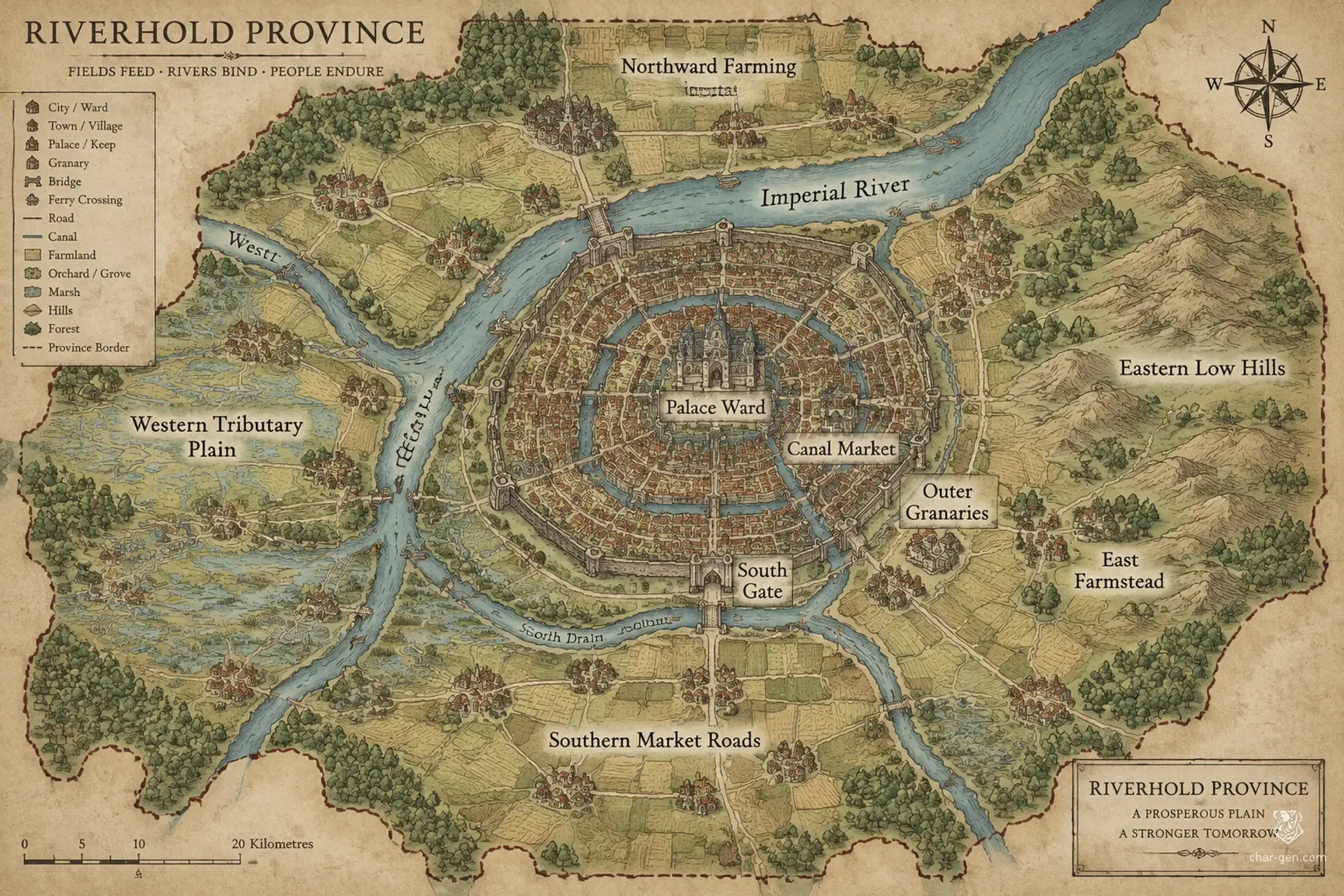
The Imperial Capital is a provincial heartland dominated by a metropolis of staggering scale, where the palace rises above a maze of wards, canals, markets, and crowded housing. Hundreds of millions make their lives within its sprawling urban reach, supported by farms, depots, and river traffic across the surrounding plains. The region feels both orderly and overwhelming: clerks keep careful records, yet the sheer volume of people makes every journey, shortage, and rumor difficult to control.
Cultures
Courtly imperial customs shape ceremony, law, and public architecture.
Canal and market communities value practical cooperation and neighborhood ties.
Provincial newcomers preserve regional foods, crafts, and seasonal festivals.
Places
5 settlements
Metropolitan core · Urban districtPalace WardCourt and government centerAdministrative compounds and ceremonial avenues ring the imperial palace.
Large urban district · Market districtCanal MarketCommercial exchangeCovered quays, counting houses, and crowded stalls handle river and canal trade.
Large service settlement · Granary complexOuter GranariesFood storage and provisioningStorehouses and inspection yards receive food shipments before distribution.
Large town · Road townSouth GateTransport and customsRoadside lodging, cart repair, and cargo checks serve travelers entering the province.
Small settlement · Farming villageEast FarmsteadAgricultural and craft supplyTenant fields, brick kilns, and a weekly market supply the capital's outer wards.
How they spread
PatternThe metropolis fills much of the provincial center, thinning into service towns, estates, and farmland toward the edges. Settlements cluster near waterways, road gates, and storehouses.
The Imperial River links upstream grain estates to central markets.
The Palace Canal carries freight between warehouses and inner districts.
The southern provisioning road connects farms to the granaries.
The eastern ridge road carries stone and timber toward the city.
Dangers and hooks
3 threats
Most dangerous · HighThe Flooded UnderwaysEnvironmental hazardRising water and unstable tunnels threaten low wards after heavy rain.
The Press of the CrowdHighCivil unrest
Rumors, shortages, and mass gatherings can turn streets into lethal bottlenecks.
The Paper KnivesModeratePolitical conspiracy
Agents and hired toughs manipulate records and intimidate witnesses around the registries.
Hazards of the land
Flooding can overwhelm low wards and canal banks.
Crowd crushes occur during festivals and public announcements.
Fire spreads rapidly through tightly packed wooden districts.
Plot hooks
1
The Missing ConvoyInvestigationA grain convoy has vanished between the Outer Granaries and the inner markets, and several wards face shortages.Starts: The party is hired at the Outer Granaries by a provisioning clerk.Reward: Payment, a city pass, and favor with a ward council.
2
Below the WaterlineExplorationA sealed service tunnel beneath an old canal has opened after a flood, revealing fresh footprints and an unfamiliar imperial seal.Starts: A canal worker asks for discreet help at the Canal Market.Reward: Recovered valuables and access to restricted waterways.
3
A Name Struck from the RollSocial intrigueCompeting factions blame one another for forged records that could dispossess an entire neighborhood.Starts: A neighborhood advocate approaches the party outside a district registry.Reward: Legal documents, civic allies, and a modest purse.
4
The Dry PumpRescue and investigationA fire in a packed housing ward reveals that someone has been sabotaging water pumps.Starts: The party arrives as residents form a bucket line beside the damaged pump house.Reward: A safehouse, local gratitude, and evidence against the saboteurs.
The land
Climate and ground
ClimateTemperate, with wet springs, warm summers, and winters cold enough for occasional frost.
TerrainBroad, nearly level plains rise gently toward low eastern hills, while rivers and canals divide the urban heartland.
Biomes
Temperate grassland
Cultivated floodplain
Urban parkland and managed groves
Marshy river margins
Waters and borders
Waterways
The Imperial River, The West Fork, The Palace Canal, The South Drain
Borders
Northward farming estates
The western tributary plain
Southern market roads and villages
Eastern low hills
On the road
Crossing the metropolis can take a full day even when streets are clear.
Canal ferries are efficient but slow during market congestion.
Roadside checkpoints inspect carts entering the inner wards.
Landmarks
The imperial palace dominates the central skyline.
Layered walls mark successive expansions of the city.
Vast granaries stand near the southern road approaches.
Landforms
A broad river plain
Low eastern ridges
Raised canal embankments
Old flood terraces
Resources
Fertile silt and grain
Clay for brick and pottery
River fish and reeds
Power
Rule
GovernmentA centralized imperial court delegates daily administration to ministries, district officers, and ward councils.
SeatThe imperial palace at the city's center houses the court and principal ministries.
StabilityThe government is durable, though shortages, factional disputes, and succession anxieties can unsettle the wards.
Laws
Unlicensed gatherings near palace walls are forbidden.
Merchants must register cargo at ward gates.
Canal traffic yields to marked grain barges.
Factions
The Central RegistryImperial bureaucracy
Influence: Very high near the palace and strong throughout the civil service.The palace administration seeks reliable taxes, orderly succession, and uninterrupted provisioning.
The Ward AssembliesCivic coalition
Influence: Strong in residential districts and modest in court politics.The ward councils defend local services and resist levies they consider unfair.
The Canal GuildsTrade association
Influence: High along the waterways and at major markets.The canal guilds aim to protect shipping privileges and control access to warehouses.
Faiths
The Hearth-and-Record Tradition
Influence: Widespread among families, clerks, and neighborhood associations.The preservation of civic order, household duties, and ancestral memory.
The River Observances
Influence: Strong among boat crews, canal workers, and floodplain farmers.The river's life-giving force and the obligation to maintain its banks and channels.
The Radiant Mandate
Influence: Prominent at court ceremonies and official occasions.Imperial legitimacy expressed through solemn public rites and service to the realm.
People and trade
Who lives here
How manyExtreme within the metropolis, with dense wards extending for many miles and increasingly open farmland toward the provincial edges.
Main peoples
Long-established city residents
Provincial migrants and their descendants
Imperial clerks, soldiers, and household retainers
Other peoples
Foreign merchants and visiting delegations
Rural laborers lodging seasonally in the outer wards
Languages
Imperial Common, Provincial Trade Speech, River Cant
Trade
WealthVast wealth and conspicuous luxury coexist with overcrowded districts and precarious labor.
Work
Government administration and legal services
Food processing and large-scale provisioning
Construction, crafts, and transport
Exports
Grain and preserved foods
Ceramics, metalwork, and printed records
Imperial-made tools and household goods
Imports
Timber and building stone
Spices, fine cloth, and luxury goods
Markets
Canal Market, North Exchange, Outer Granaries
History and secrets
The capital began as a court and crossroads on fertile plains, then expanded as imperial offices, markets, and workers crowded around the palace. Successive rulers widened canals and roads to feed and govern the growing city. Its enormous population depends on a constant flow of grain, water, labor, and records, while the surrounding province supplies farms, depots, and resting places for travelers.
Key events
Founding era
The First CourtA royal road junction became a permanent seat for imperial courts and record keepers.
Consolidation
The Great DredgingCanals and raised embankments turned seasonal floodplains into dependable market and residential districts.
Recent generations
The Ledger DisputeA succession crisis divided officials and merchants, leaving ward councils with lasting influence.
Secret 1 · GM only
An abandoned flood-control channel still runs beneath the central city.Found by: Compare old flood maps with the sealed foundations beneath the palace district.If found: A hidden channel could redirect floodwater away from the center, but its opening would inundate poorer wards.
Secret 2 · GM only
Officials quietly altered historic district boundaries to conceal an old transfer of public land.Found by: Find matching alterations in the registry ledgers and the stone markers of the first expansion wall.If found: Proof of deliberate boundary changes could invalidate powerful land claims and trigger ward unrest.
Media
0 images
No images yet.
Visual sheet
Turn Imperial Capital into a sheet
A high-res, share-ready sheet you can post or print.