Where every hammer blow answers the mountain's rumble.
CRCinder Rise
Overview
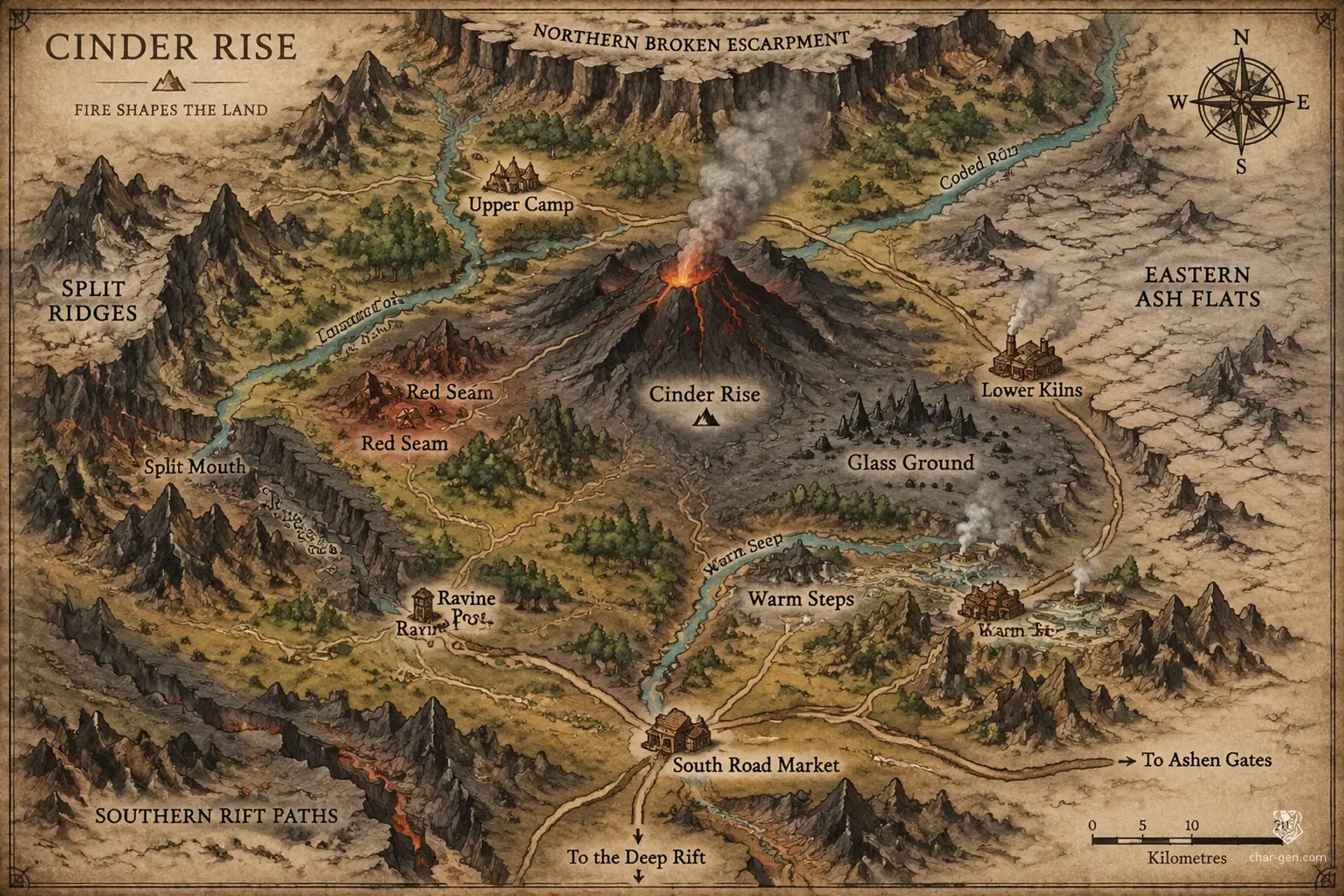
Cinder Rise is a broad volcanic upland of black slopes, scattered work camps, market yards, and mine roads that thread between ravines. Its rich ore has drawn generations of miners and smiths, while ordinary practical magic helps with first aid, weather reading, and furnace craft. Settlements cluster on stable benches and near dependable water, never far from the danger of the smoking peak. Recent tremors have made every loaded cart and underground shift a wager.
Cultures
Slope communities value shared labor, careful toolkeeping, and debts repaid in useful work.
Caravan families bring customs from the broken lowlands and favor portable homes and flexible alliances.
Forge households mark important life events with practical gifts of repaired metal.
Places
5 settlements
Small · Mine campUpper CampMining outpostA shifting cluster of work shelters near several productive but increasingly unstable tunnels.
Large · Industrial townLower KilnsSmelting and trade centerIts smoke-stained yards host furnaces, repair shops, and the region's largest ore market.
Medium · Market settlementSouth Road MarketCaravan hubCaravans exchange food, tools, and news beneath broad ash-cloth awnings.
Small · Terrace villageWarm StepsCraft and farming communityTerraced homes and workshops draw heat from shallow vents, but the ground is closely watched.
Small · WaystationRavine PostRoute watch and provisionsA guarded waystation supplies travelers and marks a safer crossing over the western drainage.
How they spread
PatternSettlements cluster on stable benches near water, workable ore, or established roads. Exposed ridges hold only seasonal camps and signal posts.
The South Road links the lower markets to the outer rift valleys.
The Bench Track carries ore between slope camps and furnace hamlets.
The Ash Road skirts exposed flats toward the eastern lowlands.
Dangers and hooks
3 threats
Most dangerous · SevereThe Cracking TunnelsGeological hazardFresh fractures are spreading through old workings beneath active claims.
Ash SquallsHighEnvironmental hazard
Sudden black gusts sweep across exposed roads and high camps.
Claim CuttersModerateHuman threat
Armed trespassers sabotage markers and threaten isolated prospectors.
Hazards of the land
Unstable tunnels and sudden ground collapses
Ash gusts that reduce visibility and foul water
Sulfurous vents and pockets of hot gas
Fast-moving debris flows after rare heavy rains
Plot hooks
1
Voices BelowRescue and explorationA familiar mine road ends at a fresh fissure, and trapped workers report hearing tools from a sealed gallery.Starts: The foreman at a slope-side work camp asks for a rescue crew.Reward: A share of recovered ore and a forged set of climbing gear.
2
Short WeightsInvestigationOre shipments arrive lighter than their manifests, and rival crews accuse one another of stealing the missing metal.Starts: The dispute begins at the Lower Kilns weigh yard.Reward: A dependable trade contact and a modest purse.
3
The Changed SpringMystery and hazardA new vent has warmed a spring used by several settlements, but its water now carries a strange metallic taste.Starts: A local healer seeks help at a communal water basin.Reward: Rare mineral salts and the gratitude of several households.
4
Marker LostExpedition and negotiationA missing survey marker could prove that a disputed tunnel crosses under a rival claim.Starts: Third Survey offers a contract at the South Road Market.Reward: A formal claim token and access to a mapped safe passage.
The land
Climate and ground
ClimateDry, windy uplands with sharp temperature changes, frequent ash haze, and localized heat near vents.
TerrainSteep black slopes, fractured benches, clinker fields, and narrow ravines surround a smoking volcanic peak.
Biomes
Black volcanic slopes, Ash scrub, High grass benches, Warm ravine thickets
Waters and borders
Waterways
The Cooled Run winds through the western ravines.
The Sootwater Fork drains the southern slopes.
The Warm Seep feeds scattered basins below the peak.
Borders
A broken escarpment marks the northern edge.
The western border follows a chain of split ridges.
Marked work roads are safer than short cuts across loose clinker.
Tremors can shift trail markers and expose sudden crevasses.
Wind carries ash unpredictably, so travelers should shelter eyes and water.
Landmarks
The Red Seam is a band of iron-rich stone visible across a high ridge.
The Warm Steps are terraces heated by shallow volcanic vents.
The Split Mouth is a collapsed mine entrance now used as a warning landmark.
The Glass Ground is a wind-polished field of dark volcanic shards.
Landforms
A smoking central peak
Steep clinker slopes
Fractured high benches
Narrow ash-cut ravines
Resources
Iron ore
Copper ore
Volcanic glass
Sulfur and mineral salts
Power
Rule
GovernmentA loose compact of settlement councils, mine stewards, and trade delegates governs shared roads and resources.
SeatThe rotating work council meets at whichever market yard can safely host it.
StabilityFunctional but strained by tremors, disputed claims, and arguments over who pays for tunnel repairs.
Laws
Mine crews must report fresh cracks before a shift continues.
Ore claims require a public mark and a recorded boundary.
Anyone may draw water at marked communal springs.
Caravan guards may not carry drawn weapons inside market yards.
Factions
The Deep HandsMiners' cooperative
Influence: Strong in work camps and increasingly vocal in market settlements.Keep the mines producing while pressing for safer supports and fair hazard pay.
The Kiln BoardTrade association
Influence: High among smiths and merchants, but dependent on local labor.Control ore grades, furnace schedules, and access to scarce fuel.
Third SurveyCivic survey office
Influence: Respected on the slopes, though often ignored when ore prices rise.Map fresh cracks and close tunnels that risk opening into unstable ground.
Faiths
The Spring Keepers
Influence: Common among miners, travelers, and households near ravines.Offerings of clean water and safe passage through dangerous ground.
The Measured Flame
Influence: Strong in smithies and trade yards.Craft, honest measures, and respect for the risks borne by workers.
The Last Tools
Influence: Quiet but widespread among established families.Remembering the dead through useful objects rather than grand monuments.
People and trade
Who lives here
How manyModerate in sheltered valleys and along work roads, sparse on exposed slopes.
Main peoples
Forge workers and their households
Ore miners from the upper slopes
Caravan traders and itinerant craftspeople
Other peoples
Rift-edge herders, Surveyors and tunnel wardens
Languages
Hifenleaf Trade Speech, Slope Cant, Lowland Common
Trade
WealthUneven; mine owners and skilled smiths prosper while most laborers depend on steady contracts.
Work
Underground ore mining, Iron and copper smelting, Toolmaking and repair, Caravan provisioning
Exports
Iron bars and fittings, Copper wire and sheets, Volcanic glass tools
Imports
Grain and preserved food, Timber and lamp oil
Markets
The Lower Kilns, South Road Market
History and secrets
Cinder Rise grew around rich seams exposed by old eruptions and the practical skills needed to work them. Its scattered camps gradually became market settlements connected by rough roads and shared water points. A compact of miners, traders, and local councils keeps disputes manageable, but its authority is tested whenever the peak rumbles. Recent tremors have opened new cracks in old workings, threatening both livelihoods and the region's fragile cooperation.
Key events
Early settlement
The First CutProspectors followed red-stained runoff and opened the first extensive ore workings.
Old records
Ashfall WinterA sudden eruption buried several camps and forced survivors to rebuild on safer benches.
Compact era
The Road ArticlesMine crews and caravan traders formed a common compact to maintain roads and settle claim disputes.
Recent years
The Cracking SeasonA sequence of tremors split old tunnels and brought neglected safety rules back into dispute.
Secret 1 · GM only
The newest fractures trace a pattern that suggests pressure is building beneath the old mine network.Found by: Compare old survey marks with the newest tremor cracks around the Split Mouth.If found: A hidden seam may extend beneath several occupied workings, putting many settlements at risk.
Secret 2 · GM only
A small group has been diverting high-grade copper through legitimate repair orders.Found by: Look for an unrecorded maker's mark inside a batch of supposedly ordinary furnace fittings.If found: Proof of concealed shipments could destabilize the Kiln Board and expose a wider smuggling route.
Secret 3 · GM only
A deep spring changes color shortly before nearby ground tremors, though no one has connected the signs.Found by: Test the warm seep after sunset, when its mineral film briefly reveals a faint glow.If found: The source could provide useful warning signs of further volcanic movement if studied carefully.
Media
0 images
No images yet.
Visual sheet
Turn Cinder Rise into a sheet
A high-res, share-ready sheet you can post or print.