Highgarden Crossing
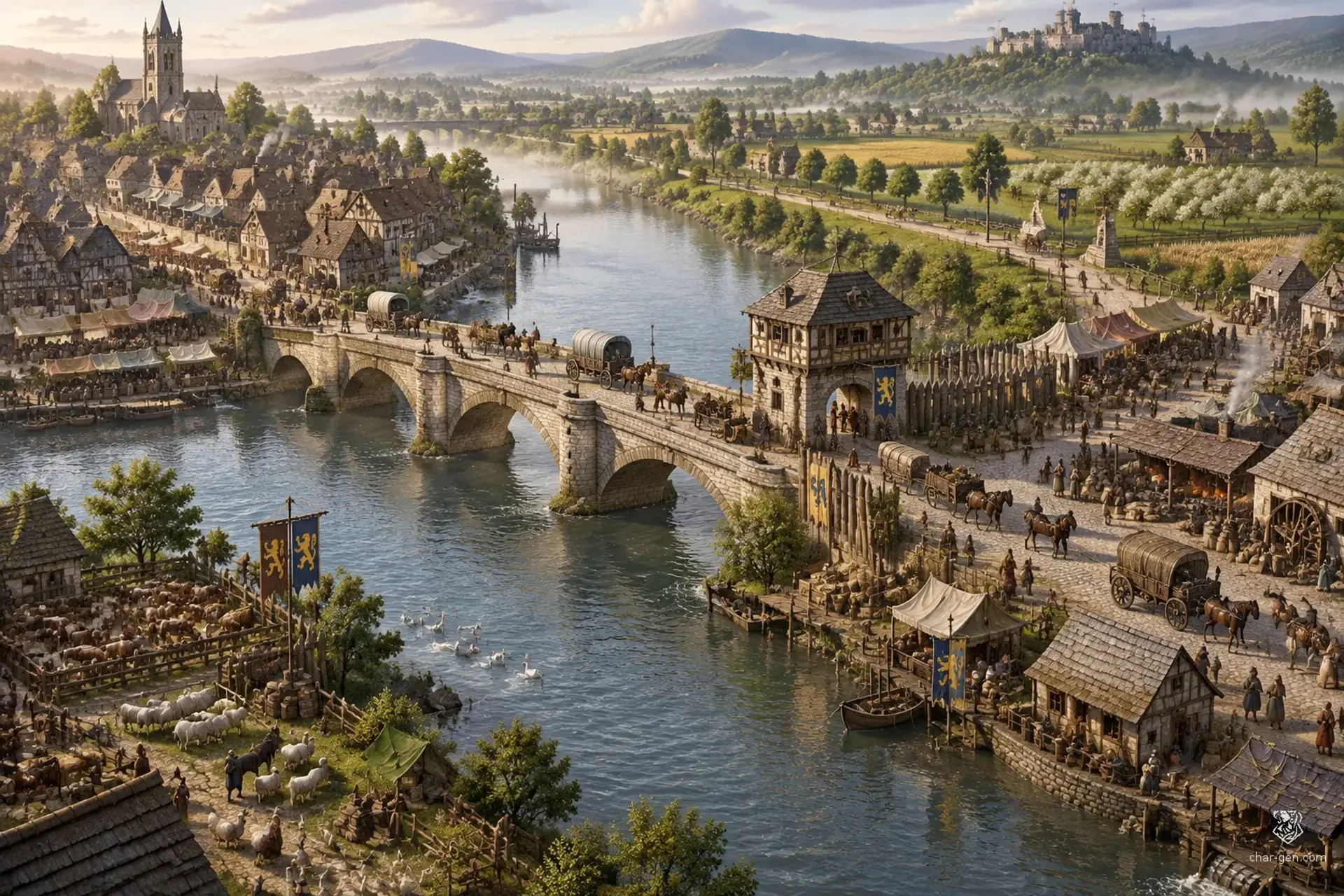
Highgarden Crossing grew around an old stone bridge where four farm roads meet the river route. Stalls crowd both banks, and the approach lanes are lined with livestock pens, wagon yards, and workshops. Its bridge toll pays for repairs and the town watch, but a founding compact ties civic votes to names on a maintenance roll. The roll contains dead households, and the town's prosperity rests on pretending that is ordinary.
Highgarden Crossing
- Population
- 1,700
- Rule
- Reeve Mira Dast
- Wealth
- Comfortable and uneven
- Defence
- Crossing Watch
Overview
Highgarden Crossing grew around an old stone bridge where four farm roads meet the river route. Stalls crowd both banks, and the approach lanes are lined with livestock pens, wagon yards, and workshops. Its bridge toll pays for repairs and the town watch, but a founding compact ties civic votes to names on a maintenance roll. The roll contains dead households, and the town's prosperity rests on pretending that is ordinary.
Atmosphere
Highgarden Crossing is loud from first light: cart wheels knock over the bridge joints, geese object from wicker pens, and bargaining carries across the clear river. The town looks prosperous because every road converges here, but nobody forgets that a toll collector can stop a whole harvest from moving. A founding compact gives voting rights to households listed as bridge maintainers, and the tollhouse still decides whose name counts.
Culture
- The River Mother, honored by farmers and ferrymen
- The Hearth Keeper, whose household shrines are common
Humans, Halflings, Dwarves
Economy
- Market trade and toll collection
- Milling and grain storage
- Blacksmithing, wheelwrighting, and livestock dealing
Grain and flour, Wool and livestock, Carts and harness fittings
Salt, Iron bars and finished tools, Wine, spices, and fine cloth
Geography
Ways in and out
Places to see
- Old Stone BridgeThe old stone bridge narrows at its center, where worn grooves show centuries of cart wheels. The river is clear in ordinary weather, but the high-water marks on the supports rise above a mounted guard's head.
- West Bank MarketThe busiest part of the market lies on the western bank, where livestock pens, produce stalls, and wagon queues overlap. Buyers can find nearly anything at harvest, though every cart must pass through a toll lane watched from the bridge.
- River StairsA set of broad stone steps descends to the river where drovers water animals and children gather after market. Old flood marks are scratched into the lower wall, including one that appears newer than the official record claims.
Power
3 factionsGovernment
Laws
Trouble
- Dead names may decide who controls the bridge.The spring maintenance roll contains dead households whose votes remain legally valid. The council must approve a repair levy before the next flood season, but changing the roll could overturn the Compact's majority and ignite a market shutdown.Involves
Mira Dast, Nara, Jorren
- A missing reserve threatens winter stores and public order.The grain reserve is short by a wagonload, and each faction blames the other for the missing stores. The winter price of flour is already rising. Mira Dast has ordered a second weighing, but the tollhouse ledger records the missing grain as delivered to households that no longer have living members.Involves
Mira Dast, Nara, Hesh
Factions
- Bridge CompactCivic household coalitionThe Bridge Compact is made up of families whose names appear on the maintenance roll. They pay for stonework and claim the right to approve toll schedules and council appointments. Some genuinely keep the bridge sound; others benefit from voting rights inherited through dead or absent households.GoalsPreserve the maintenance roll and its voting privileges, even if that means accepting the tollhouse's questionable entries.Allies
Mira Dast, Jorren
RivalsOpen Road League
- Open Road LeagueMarket reform associationThe Open Road League represents smaller farmers, carriers, and merchants who want predictable tolls and an auditable grain reserve. They have no inherited seats on the council, so they organize market stoppages and public weighing demonstrations to force hearings.GoalsReplace the closed maintenance roll with a public register that gives every resident household a vote, directly opposing the Compact's inherited privilege.Allies
Nara
RivalsBridge Compact
- Crossing WatchTown guardThe Crossing Watch is a professional guard force, but its pay comes from toll receipts and the council can delay disbursement. The guards want stable wages and authority to keep the bridge open during disputes. Their captain knows that closing the crossing may make the town's political arguments into a physical crisis.GoalsSecure fixed wages from toll revenue and prevent either civic faction from using the watch to seize the tollhouse.Allies
Mira Dast
RivalsOpen Road League
Defences
- The old stone bridge has narrow points where guards can halt carts.
- A timber palisade protects the tollhouse and grain store.
- Two raised river chains can block small boats during an alarm.
Law and order
People and places
10 entriesReeveMira Dast Human Female
Mira is a human reeve who listens with both hands folded over her belt. She wants the bridge repaired before the next flood and fears a decision will turn the market crowd against her. Her habit of asking one more question has helped settle old feuds, but now gives every faction time to organize.
Farmer and market organizerNara Halfling Female
A halfling grain farmer who arrives at meetings with dirt still beneath her nails. She wants every household to have a vote and fears that the council will brand her a troublemaker before the next harvest. She folds market notices into tiny squares while listening, then unfolds them in exact order when she speaks.
WheelwrightTovin Human Male
A human wheelwright who can identify a cart by the sound of its axle. He wants a contract to repair the bridge's approach road and fears that a bad repair will cause a wagon crash under his name. He carries a short length of measuring cord and checks every wheel before he trusts it.
Guard captainSethra Dwarf Female
A dwarf guard captain who knows the market crowd by its walking pace. She wants fixed wages and a clear order for emergency closures, and fears a faction will make her guards choose sides. She keeps a small brass tally in her pocket and turns it over whenever she is weighing a decision.
Leather goods and harnessSaddle and Strap Kept by BoranA narrow timber-fronted shop beside the wagon yard, filled with harness, buckles, patched saddles, and leather straps hung from the rafters. Carriers come here for repairs before crossing, often while their animals wait in the pens.
BlacksmithEastbank Forge Kept by UlanA stone-fronted smithy set back from the busiest stalls to keep sparks away from hay and livestock. Its open doors make the hammering part of the market's ordinary noise. Drovers bring broken shoes, while cart owners ask for fittings before long journeys.
TavernThe Southern Measure Kept by PeshA low-beamed common room near the eastern approach, with benches scarred by years of boot knives and a broad hearth that dries wet cloaks. The keeper posts a slate of bridge delays by the door, so travelers often learn the day's politics before they order supper.
TavernThe Four Roads Table Kept by QasimA small tavern in a converted stone house on the south bank. Its back room is rented for private suppers, though people know that the walls carry voices into the kitchen. The regulars prefer plain food and careful conversation, making it a useful place to hear a rumor twice before believing it.
Civic officeTollhouse Run by JorrenA squat stone office built against the bridge's eastern abutment. Its narrow windows let collectors watch the approaches while a side room holds ledgers, weights, and the maintenance roll. On market days, the line outside often becomes an unofficial public forum.
StorehouseCommon Granary Run by HeshA long, low stone building behind the market sheds. Its lockable doors and dry floor make it the safest place to hold the town reserve, though the present shortage has made every delivery a public argument.
Events
Lately
- The annual maintenance roll was posted with several deceased households still listed.The Open Road League has demanded a hearing, while the Bridge Compact insists the roll must stand until repairs are funded.
- A public count found the Common Granary short by a wagonload of grain.Flour prices have climbed, and Hesh's records are now being examined by both factions.
- A support crack was noticed near the eastern bridge abutment.Tovin's warning has reached the guards but not the council, and heavy wagons continue to cross.
Calendar
- First market day after spring plantingThe Green MeasureFarmers bring seed grain, lambs, and tools for a crowded market. The tollhouse posts the year's bridge-maintenance levy, and every household checks whether its name remains on the maintenance roll.The twist · GM only
- MidsummerBridge DayDrovers parade their best cattle over the bridge before trading begins. Children leave flower wreaths at the river stairs, while guards keep livestock from blocking the toll lane.The twist · GM only
- Last market before first frostThe WeighingMerchants bargain for winter stores and the town weighs its grain reserve in public. The council traditionally forgives one small toll debt, a custom that has become a test of political loyalty.The twist · GM only
History
Highgarden Crossing began as a market beside a viable river crossing. The bridge brought trade and a dependable toll, but the compact governing its upkeep narrowed civic power to listed households. The official memory of the great flood celebrates communal rescue; records hint that the council used the emergency to establish a system that still rewards the families who already held influence.
- FoundingThe First CrossingFamilies from a distant southern homeland built the first market here and gave the place a name that locals still use, though its meaning has shifted. The bridge made their road useful to surrounding farms, and tolls paid for a permanent watch.
- Three generations agoThe High WaterAn unusually high flood destroyed the old ferry and swept away several homes. The council's official account says the bridge compact rescued the survivors. A surviving stone tally, however, shows that some families were charged for repairs before they had any safe shelter.
- Two generations agoThe Roll CompactThe council replaced an open household meeting with the maintenance roll, arguing that only families paying for the bridge should decide its use. Since then, names have sometimes remained after families disappeared, because removing them would change who held power.
Secrets
3 secrets · 4 rumours- Secret 1 · GM only
- Secret 2 · GM only
- Secret 3 · GM only
Rumours
Plot hooks
3- 1The Roll in the OpenMira Dast asks the characters to escort Jorren while he carries the original maintenance roll to a public hearing. The obvious threat is theft, but the deeper danger is that the roll contains a living household's erased entry as well as dead names. Restoring it could change the council majority and put the hearing's witnesses at risk.
Political escort · Starts with Mira Dast · Reward: A fair payment, waived passage tolls for a season, and access to the council hearing.
- 2A Wagon After DarkHesh hires the characters to trace the missing grain wagon before panic raises prices. Its trail leads to a farm whose residents were listed as dead after the flood. They took the grain to survive, but the wagon also carried a sealed council account book that could prove who authorized the reserve's removal.
Investigation and negotiation · Starts with Hesh · Reward: A share of recovered grain, a public favor from the reeve, and the account book's evidence.
- 3When the Market StopsNara asks the characters to prevent a planned market stoppage from turning violent. She expects the Compact to send hired men, but the first disruption is actually arranged by a merchant who profits when carts are forced to wait and pay storage fees. Exposing that scheme may weaken the reformers' leverage as well as the Compact's.
Crowd control and investigation · Starts with Nara · Reward: A modest fee, support from local farmers, and a claim on the merchant's seized storage fees.
Media
0 imagesNo images yet.
Turn Highgarden Crossing into a sheet
A high-res, share-ready sheet you can post or print.
