
DnD AI explained: what AI Dungeon Masters and art tools can’t do yet
DnD AI explained for Dungeon Masters: which session prep tasks AI handles well and where an AI game master still falls short at a real gaming table in 2026.
Dungeon Masters spend considerable time creating a variety of resources for a game. This comprises names for non-player characters, maps (even for battles that may never occur) and other content. Apps are available to both ease and fully automate this process. However, despite being good at content creation, DnD AI can still struggle with aspects of social interaction.
DnD AI for Dungeon Masters and players in 2026: key insights
-
AI is effective at easing session prep. It can create non-player characters (NPCs) with a portrait, alongside a character’s background.
-
Some D&D tools use SRD 5.1 or 5.2 for rules. Both are available under the irrevocable CC BY 4.0 licence, which requires attribution.
-
The ENNIE Awards do not accept entries that use AI from the 2025-2026 cycle; UK Games Expo excludes products made entirely or substantially with AI, with limited exceptions.
Prep tasks that generators already handle for Dungeon Masters and players
Tasks with a clear input work well with AI. For example, if the instruction is for a ‘nervous dwarven smuggler, level 5, in debt’, the model can quickly produce a name, reason for being, secret and statistics for this character.
| Task | What the generator drafts | What still needs a human |
|---|---|---|
| NPCs | Personality, goals, secrets, hooks, stats | The voice and the link to the campaign |
| Player characters | Backstory, ability spread, starting gear, portrait | Choices that give a player ownership |
| Battle maps | Top-down art sized for a virtual tabletop | Cover, sightlines, elevation and balance |
| Worldbuilding | Taverns, factions, pantheons, rumours | Continuity with earlier sessions |
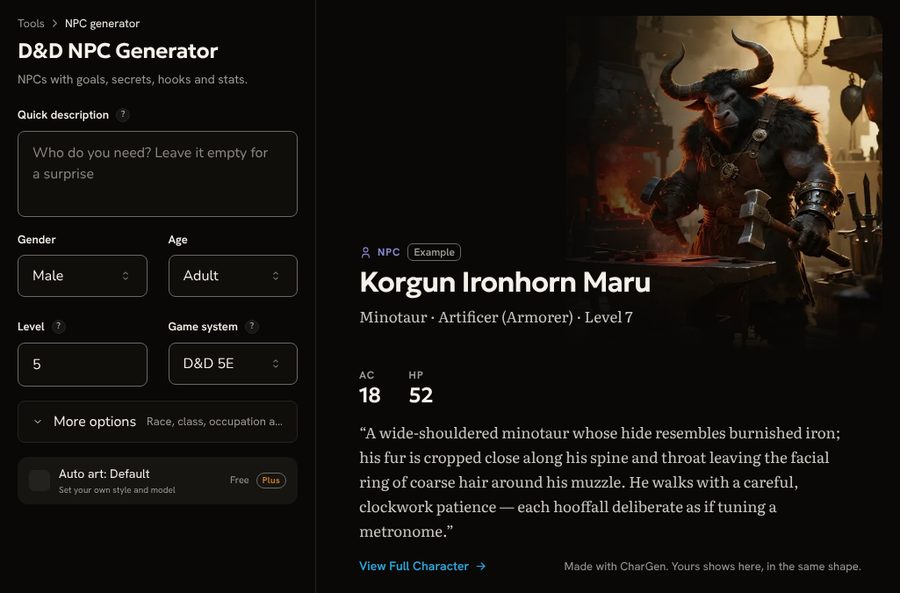
In addition to basic character information, CharGen’s NPC generator also creates a character portrait. It provides suggestions for statistics for DnD 5E, Pathfinder 2E, OSR and system-agnostic games. An AI DnD character creation tool is especially beneficial if someone wants to introduce a new player to a game and needs a hero character ready by next week.
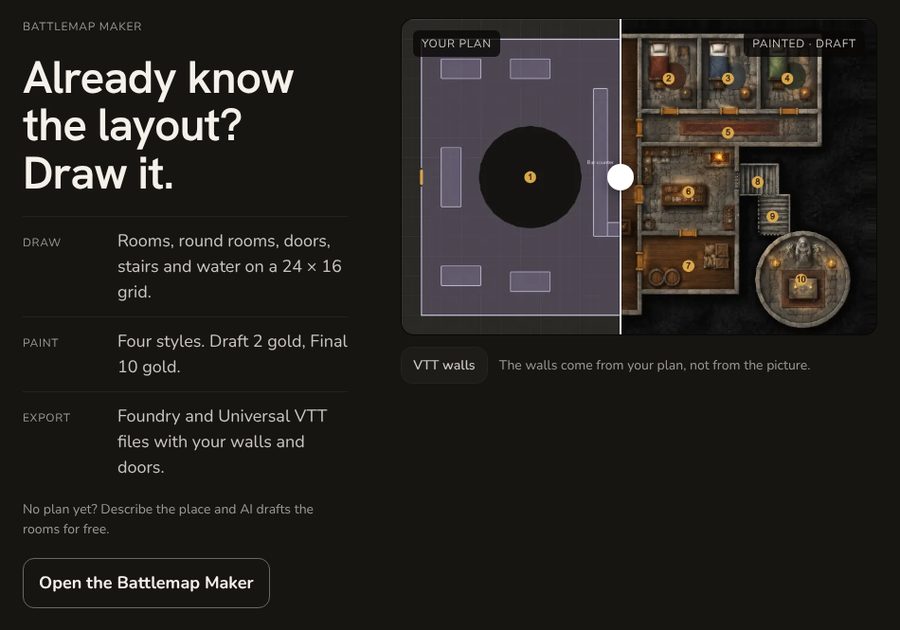
Regarding maps, although AI artwork can be produced, the generated map does not include details about walls. Consequently, a virtual tabletop is unable to recognise and apply occlusion. However, the Battlemap Maker works from a grid-based map the DM sketched. It then exports wall and door information for a virtual tabletop (as a Foundry scene or a Universal VTT file).
What a DnD AI DM can run at the table, and where it falls short
An automated game master can describe settings, request skill tests and monitor a player’s hit points. It can also run basic dungeon exploration for a small group. Nevertheless, it lacks the ability to effectively analyse people’s emotions and to control the flow of a long-running game so that it culminates in an engaging manner.
Memory and consistency: why automated game masters forget goblins
A 2025 study at Aalborg University assessed an automated game master, named ChatRPG, and involved twelve participants. The first version sometimes changed details such as the number of objects and enemies as play continued. Subsequently, two agents were introduced. The Narrator managed the storytelling function, and the Archivist stored factual information. Although testers felt the narrative was notably better structured, there was no significant improvement in freedom of choice or narrative flexibility.
How tabletop role-playing DnD AI tools are created and updated
Some DnD AI programs combine a language or image-generation model with rules and memory functions. Whilst one part of the AI controls the narrative, another assesses whether new objects or injuries should be added to the memory bank.
System Reference Document(s) form the foundation for rules. Wizards of the Coast published SRD 5.1 under the CC BY 4.0 licence in January 2023. SRD 5.2, which is based on core rulebooks from 2024, was subsequently published in April 2025. As with SRD 5.1, this licence is irrevocable. Both versions can be referenced as required, provided that due acknowledgement is given. Developers utilise this, along with publicly accessible wiki sites and online forums, to update and retrain AI. Because collating this information takes time, some development teams use ISP proxies offering fixed IP addresses to ensure a steady data flow.
AI art for tabletop role-playing: community debates and house rules
Artwork is the aspect of AI gaming that most frequently attracts debate. Indeed, in 2023 there was a negative reaction to AI-enhanced artwork in Bigby Presents: Glory of the Giants. Consequently, Wizards of the Coast updated its artist guidelines so that artists it commissions must not use AI art generation when creating DnD art. Since then, various events have independently established their own guidelines regarding AI. See, for instance, GamesRadar+ and EN World for further details.
| Venue or award | Policy (as of November 2026) |
|---|---|
| ENNIE Awards | No products containing generative AI, from the 2025-2026 cycle |
| UK Games Expo | Wholly or substantially AI-made products banned (announced September 2026) |
| Gen Con | AI-generated imagery prohibited in the 2026 art show |
| Origins | Generated products banned on the trade floor |
Within the design profession there is no consensus. A 2026 Tabletop Game Designers Association survey of 171 designers found that 30% accepted AI-generated placeholder art. Nonetheless, around 80% were strongly against AI art in final products, and only two respondents used AI art they planned to keep. Personal artwork for domestic gaming is not restricted by guidelines. However, if artwork is to be sold or submitted for an award, then it must comply with the relevant event’s guidelines.
Integrating AI resources into physical or virtual tabletop gaming
Groups that benefit most from AI resources generally use them before and, to some extent, during a game. They should:
-
Establish in advance how AI content will be utilised.
-
Generate NPCs, shops and maps, then adapt them to the DM’s style.
-
Have reference materials to hand for rules. Allow the DM to make judgement calls, however.
-
Note significant information from each game in a central location. This ensures that subsequent sessions benefit from good contextual information.
-
Enable the human DM to dictate narrative flow, ensure equitable player attention and use safety tools such as the X-card.
Optimal integration: AI as an aid to (not a replacement for) a Dungeon Master
For most groups, DnD AI is most effective in preparation for and, to a limited extent, during a game. For a group game, a human DM can guide the story and respond to the players. Once an automated DM has been tested in low-stakes one-shots, it can suit individuals or groups where no volunteer DM is available. Prior to initial image generation, those intending to sell their work should review the guidelines of the relevant event.
Common questions relating to tabletop role-playing AI resources
Brief responses to commonly raised issues.
Can a DnD AI character generator produce a legal 5E character from SRD rules?
Yes, to an extent. The SRD only provides one subclass per class. Furthermore, although SRD 5.2 introduced goliaths and orcs, it omitted aasimar. An AI trained on internet-wide information may propose features contained in commercially available books. As such, it is necessary to verify that these are permissible under the source books that a group possesses. Manual recalculation of hit points is also recommended.
Is a DnD AI DM appropriate for both solo and multiplayer gaming?
Yes. Text-based games can be played singly or in groups using, for example, Friends & Fables and platforms such as Discord. However, multi-person gaming is more complex for AI, as it must simultaneously monitor the locations and motivations of multiple characters and establish the sequence in which they act. Compared to a one-to-one game, a full party is likely to encounter more errors.
Who holds the copyright for AI-generated characters and maps?
This depends on the service used and the copyright laws that apply. Check the service terms for permission to use the output. Nonetheless, in January 2025, the U.S. Copyright Office emphasised that simply devising prompts does not constitute authorship. Consequently, in the U.S., wholly AI-generated images are not eligible for copyright protection. This is pertinent for those seeking to commercially distribute adventure content.
Can DnD AI resources analyse the emotions of in-person gamers?
To a limited extent. Text-based AI GM tools can process verbal communication, but cannot assess non-verbal cues they do not receive. Although recording devices that summarise games can be beneficial for ensuring smooth transitions between sessions, assessment of whether a joke has lasted too long or that someone has been overlooked remains a human responsibility.