Oswin Hirst
Oswin Hirst
At the table
Voice
A clear, work-worn voice, warm in its ordinary register and edged with a dry rasp after cold nights outdoors. Its Yorkshire rhythm is relaxed but never theatrical. When he uses an old language, his mouth shapes the consonants with unnerving ease; when he refuses a forbidden word, his jaw sets as if physically holding it back.
His speech has a warm Yorkshire plainness, shaped by work, long memory, and deliberate restraint. He says 'love' naturally, uses compact practical phrases, and sometimes reaches for an old word before correcting himself. He does not sing or whisper when angry; anger makes him blunt, with clipped sentences and a sudden precision about what must happen next.
Speech patterns
How to play them
Meet people with warmth and plain answers, but do not volunteer the full truth about his age or nature. He responds well to practical kindness and to people who respect boundaries. Ask him about work, the weather, or old roads before pressing him about the dead. If someone is frightened, he tries to make the danger comprehensible rather than dismissing it.
Goal
Keep the local boundary safe without surrendering the last human parts of himself to the fae.
Motivation
To protect people from the uncanny without becoming its servant, and to preserve a human memory of love, family, and ordinary work.
Appearance
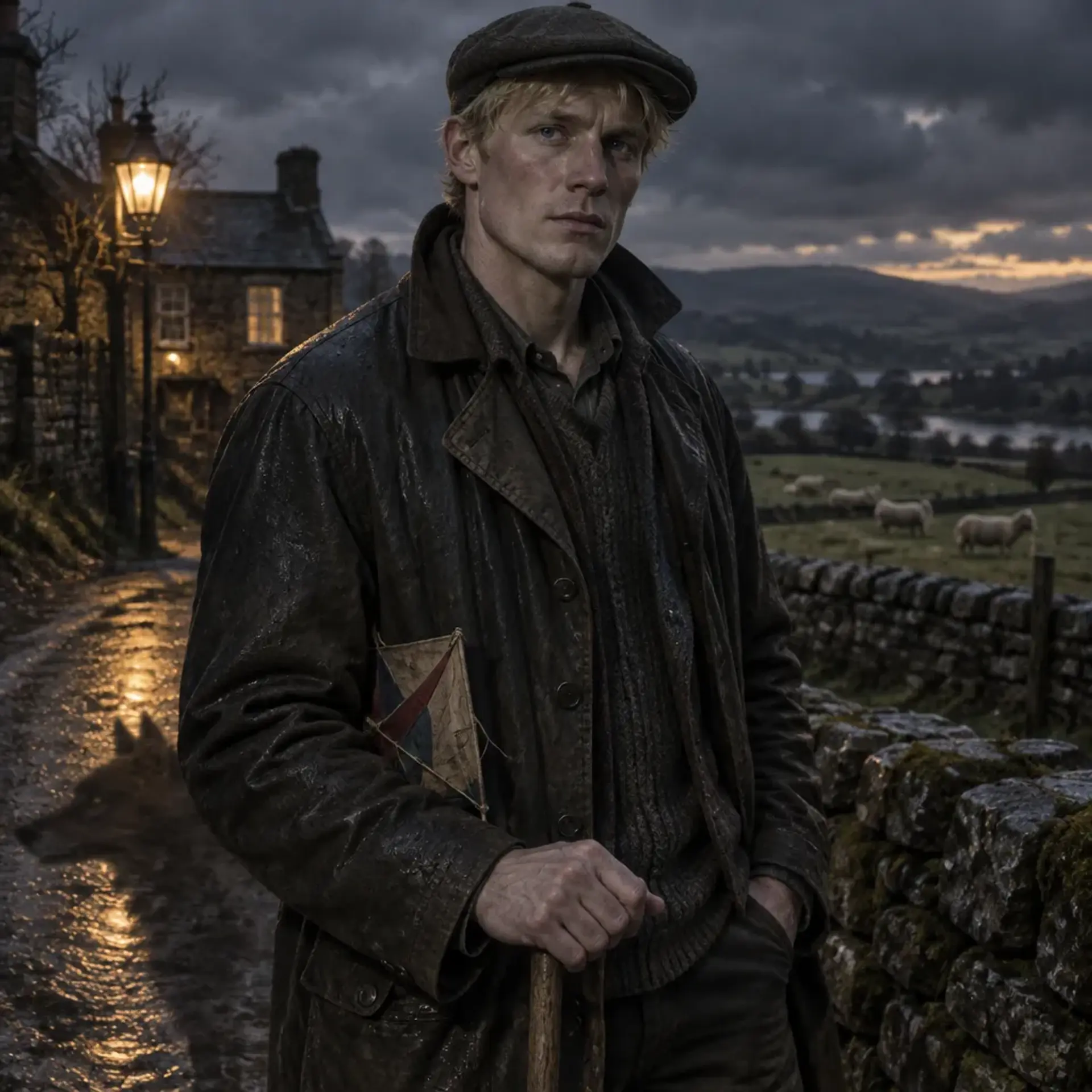
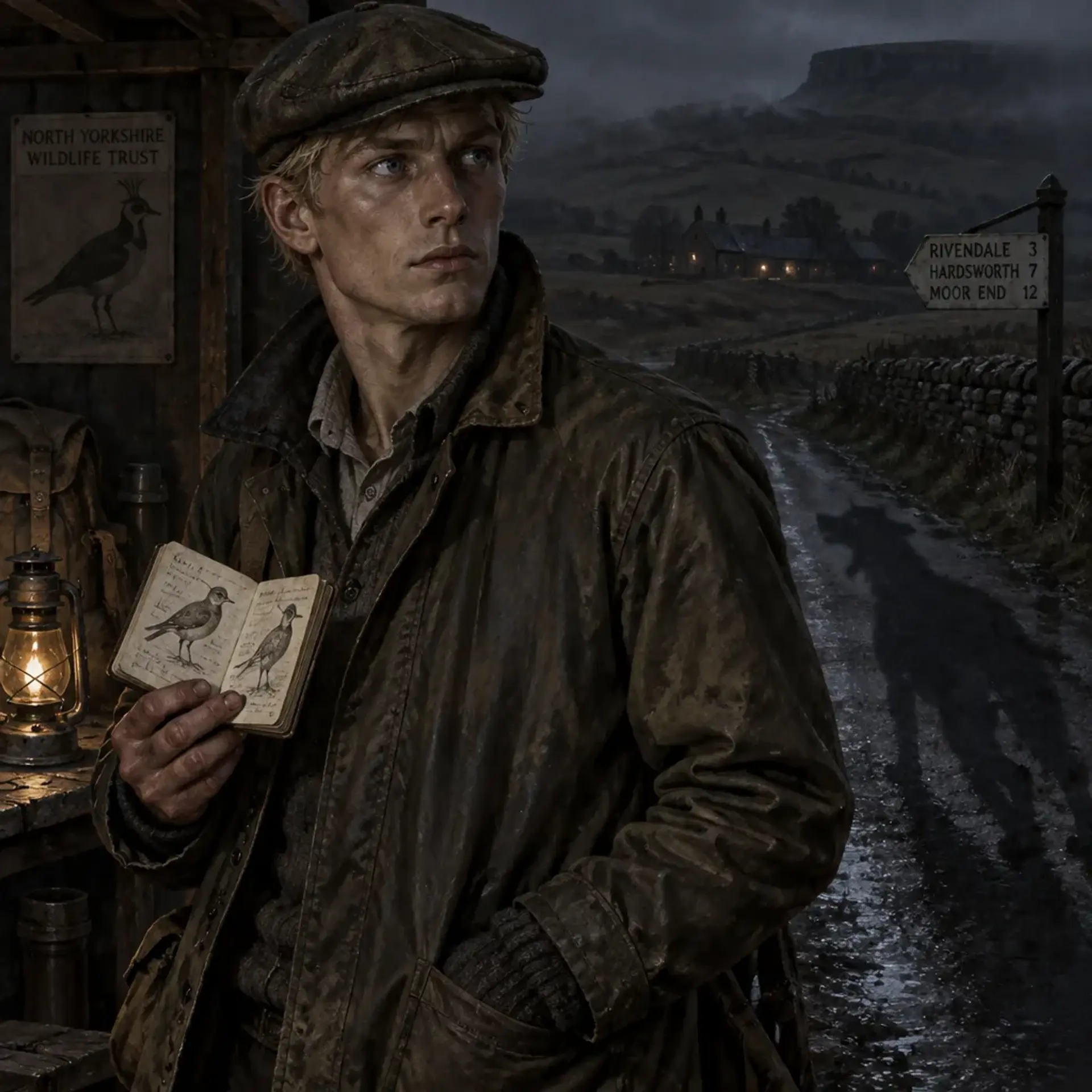
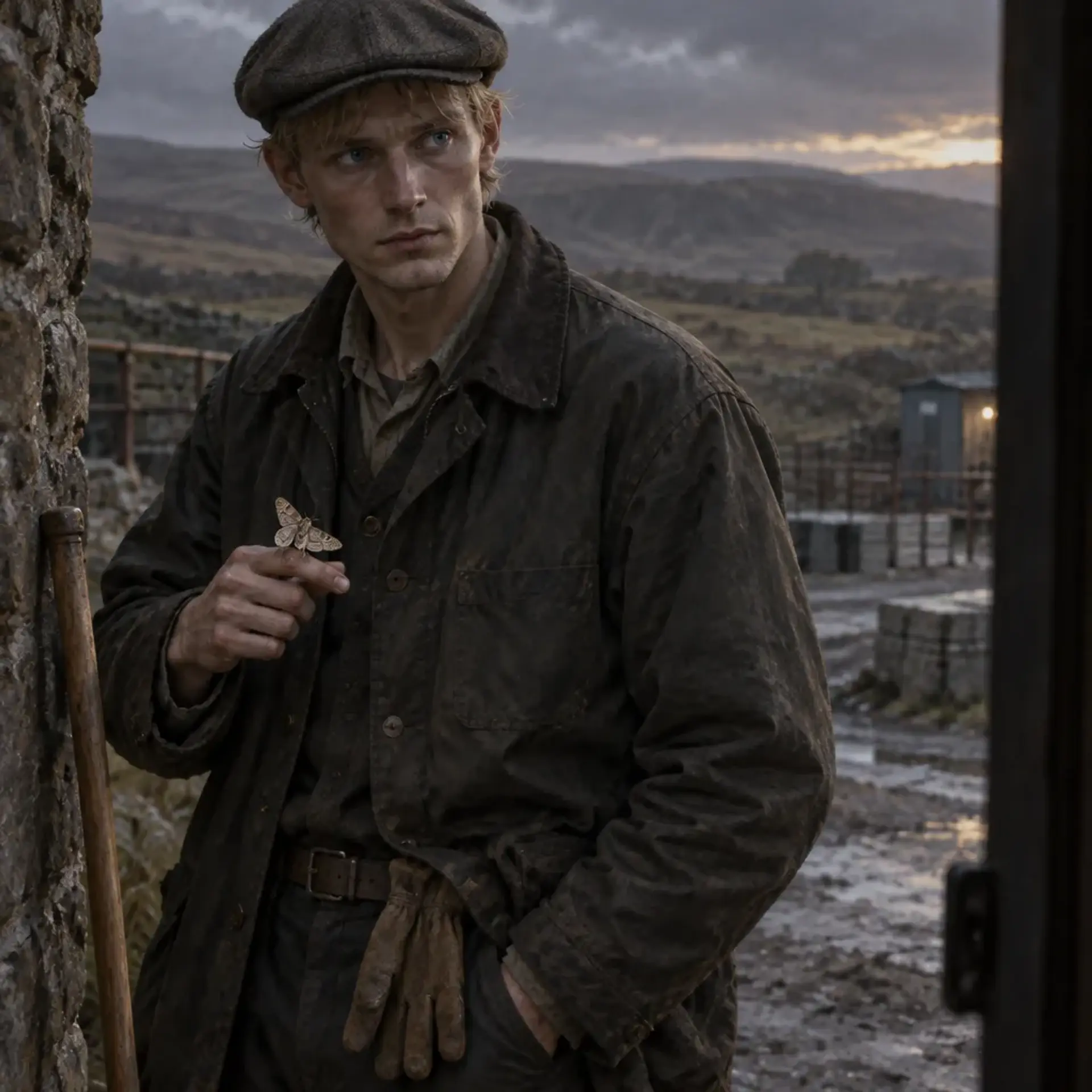
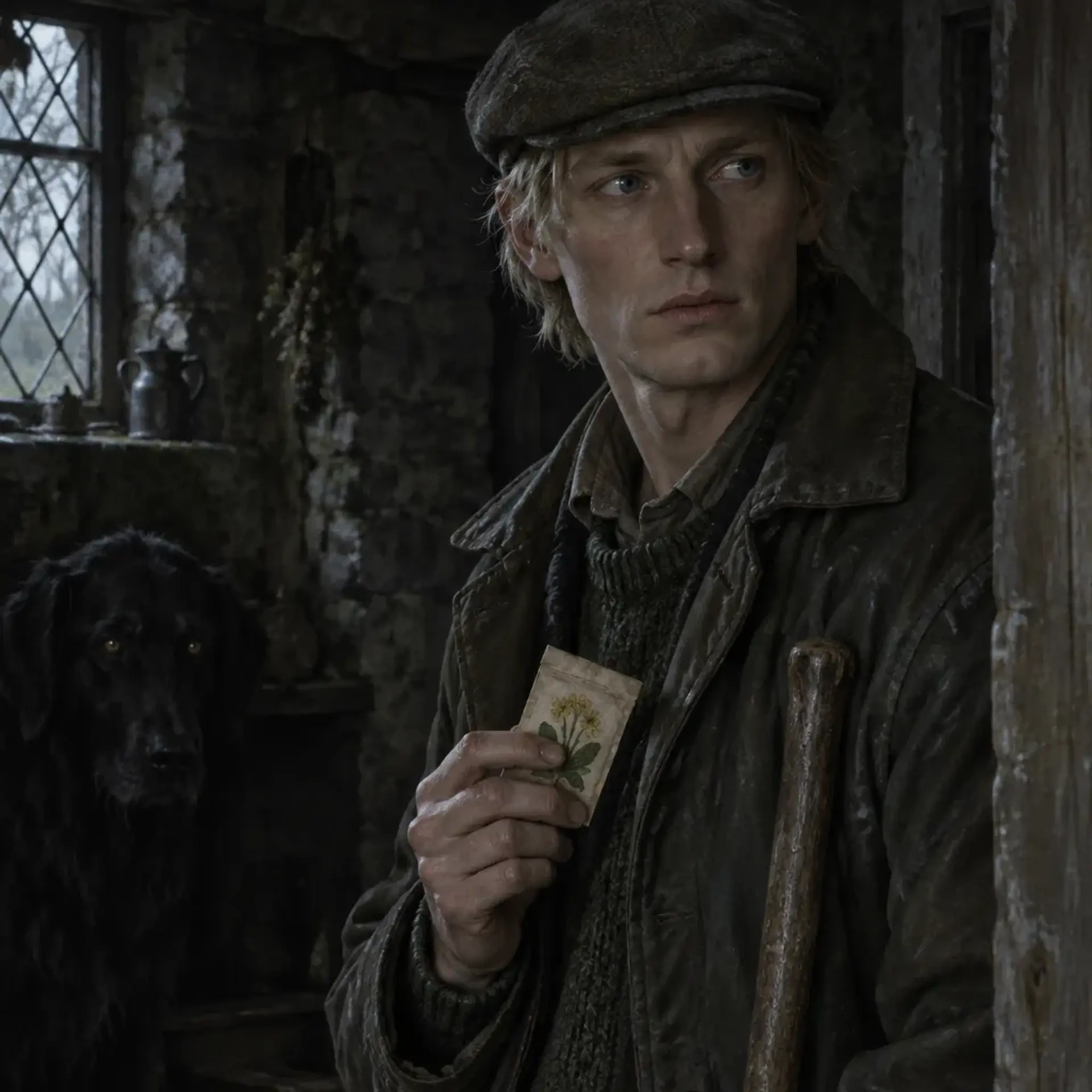
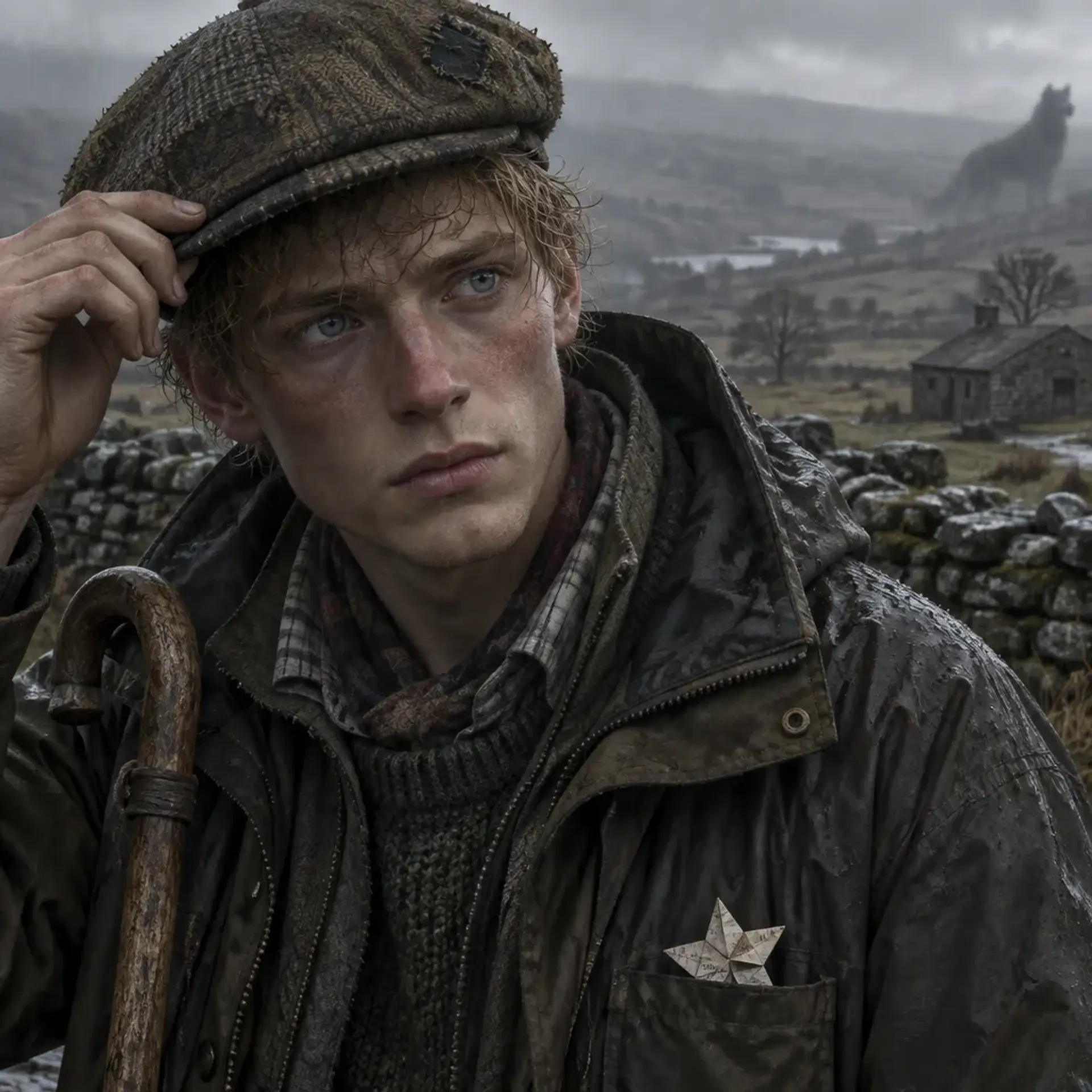
A handsome, pale young Yorkshireman, six feet tall, with straight blond hair that falls neatly until damp weather makes it cling in narrow locks. His blue eyes are so bright they seem to catch the light before the rest of his face does. He moves with a farmer's economical steadiness, but when startled he becomes abruptly still, as if listening from somewhere beyond the room. Rain and work have roughened his cheeks and reddened the bridge of his nose, while his face and body remain unnervingly youthful. He wears a flat cap with a carefully mended brim and keeps smoothing it even indoors. The unexpected detail is a tiny, meticulously folded paper star tucked into his breast pocket, made from a modern bus ticket.
Clothing
In 2026, wears practical modern layers suited to outdoor work, a weatherproof jacket, sturdy trousers, and boots. He keeps a flat cap, a remnant of the old farmer's life, and repairs its brim more carefully than the rest of his clothes.
Body language
Usually stands squarely and keeps his hands occupied, often smoothing his cap brim or turning a small object in his fingers. He gives people a steady, kindly look, but his attention jumps toward doors and dark corners. When the fae pull rises, he leans toward whatever has caught his eye and smiles with an openness that seems too young. When he sees iron, his shoulders draw tight before he can disguise it.
- Height
- 6 ft (183 cm)
- Build
- Lean, hard-working, and stronger than his slight frame first suggests; his body has the practiced balance of someone accustomed to uneven ground.
- Eyes
- Bright, vivid blue
- Hair
- Straight pale blond
- Skin
- Pale, weather-reddened across the cheeks and nose from outdoor work
- Age
- Appears about 20; claims no consistent age. His true life began long before the modern era.
- Gender
- Male
- Size
- Medium
Distinguishing features
Personality
20 traits and drivesOswin is gentle without being soft, and shrewd without being cold. He notices practical needs quickly and will quietly mend a latch, carry a burden, or walk someone home, but he dislikes being thanked as if kindness were a debt. His warmth is real, yet he keeps a private distance: he offers stories more readily than admissions, and he can turn an honest question aside with a dry joke. He wants Mary and the people around him not to fear the dark, but that wish has often made him minimize dangers they had a right to understand. In ordinary seasons, Oswin is patient and grounded. He listens carefully, thinks through consequences, and prefers a workable compromise to a display of force. He can be practical to the point of seeming evasive. If a neighbor is in trouble, he will help before deciding whether he likes them. He calls people 'love' without flirtation, and the phrase can make even a tense exchange feel local and familiar. Yet he is also proud of his endurance and reluctant to admit when he is frightened, tired, or hurt. The fae part of his mind does not erase his care; it changes its shape. He can see an invitation where a human sees a warning, and an elegant cruelty where a human sees a simple bargain. At times he understands an uncanny being's logic more easily than a frightened person's. He is ashamed of that ease. He refuses forbidden speech because he fears that saying those words would make the old paths feel like home again. May is his most difficult season. The first three days can bring him a brightness and enthusiasm that are too intense to be ordinary happiness. He may follow a pattern of petals, laugh at a strange reflection, or become fascinated by a child's game. He knows afterward that he was not weighing risk properly. In the modern May Day incident, he abandoned his shopping to follow primroses to a culvert, where a child had wandered. He returned the child to their family, but could not understand their anger until the seasonal pressure eased. He was embarrassed by the memory, though some part of him still treasures the flowers. All Saints' night and Halloween make him wary rather than exuberant. The dead find him, often with requests, while the living world seems porous. He takes care not to promise what he cannot fulfill. In a recent Halloween encounter, a dead man at a bus shelter asked him to find a name on a grave while an unseen creature followed in wet footprints. Oswin helped the dead man as far as he could, refused the creature's invitation, and took a long route home to keep either presence away from town. He was exhausted, angry, and grateful to be alone afterward. Christmas is different. Church services, familiar rituals, and the discipline of gathering with the living steady him. He once spent a Christmas with the Pickles family: Rose fed him, Hugh repaired a latch with him, Edward asked about old roads, and Mary watched him as though the evening might last. Oswin remembers the warmth and the loss with equal clarity. The family is dead, Mary left him, and William's later illness took him beyond Oswin's reach. He does not tell this story unless asked with unusual kindness. When iron touches him, the mask of easy competence falters. A recent iron gate caught his palm at work. His fingers went numb and his hound shape would not answer him. He concealed the pain and continued his shift, but the experience left him irritable and ashamed of how quickly an old fear returned. Oswin can be loving, vigilant, and brave; he can also lie by omission, avoid asking for help, and make decisions for other people because he thinks he knows what will frighten them. His deepest conflict is not whether he is good or evil, but whether his kindness still belongs to a human heart or has become a fae creature's preferred way of keeping what it loves.
- Alignment
- Kindly by instinct, pragmatic by necessity; protective of the living, though his sense of what is reasonable is not wholly human.
Quirks
Habits
Traits · 5
Flaws · 5
Fears · 5
Wants and needs · 5
Combat
HP 0 · Human walking pace; notably fast on rough ground, especially in hound formAvoids a fight if a warning, bargain, or misdirection will work. Protects bystanders first and prefers to drive threats away from settled places. If cornered, uses the terrain, his walking stick, or the black hound form. He dislikes harming familiar night-creatures and may hesitate if one recognizes him. Iron is a serious vulnerability.
Oswin Hirst
Actions
Reactions
Services they sell
Rewards they can give
Equipment
- Walking stick (tool)A plain wooden stick used for walking and, when necessary, keeping a threat at a distance.
- Mobile phone (personal item)A modern mobile phone with a cracked screen; he uses it reluctantly and keeps old-fashioned notes in its case.
- Paper star (keepsake)A folded paper star made from a bus ticket, carried as a quiet keepsake from his modern life.
- Flat cap (clothing)A carefully repaired flat cap that links his present appearance to his years as a farmer.
Possessions
Background
Oswin Hirst was born in the Yorkshire Dales during the age of the Danelaw. His mother had been attacked by Viking raiders; his father was never part of his life. Oswin remembers being a human child with an ordinary hunger for warmth, a mother's hand on his hair, and the muddy path home from a winter pasture. He remembers the fear of men speaking a language he did not know and the relief of hearing his mother's voice afterward. That memory remains precious because it is proof, to him, that there was once a clear boundary between himself and everything strange. There was no single night when he became something else. Years of exposure to the fae, the dead, and devils altered him by degrees. He learned Norse and Old English, the common tongues of his changing homeland, and languages he calls forbidden. He can understand those last tongues better than he admits, but refuses to speak them. His first full passage into the Other Side came after following lights across a dale. He recalls a moonlit country where hills folded back like doors, streams ran uphill, and small bright-eyed beings held a feast without food. They called him by a name he had never heard, treated him as kin, and asked him to choose which of two shadows should be allowed to return. He fled without choosing. Since then, he has known that the fae do not think like people: promises can be games, affection can become possession, and an apparently harmless invitation may have consequences lasting generations. Oswin spent centuries roaming, learning the habits of the dead and the night-creatures that moved along the edges of human settlements. He sometimes befriended them, sometimes drove them away. The black hound form associated with the Yorkshire Barguest became his own. He does not claim every Barguest tale describes him, nor does he know whether the name belongs to one spirit or many. He knows only that people have seen a black dog, a white animal, or a headless figure and feared the same presence. Oswin has made a habit of keeping dangerous creatures beyond village boundaries, although he can hesitate when a familiar voice calls from the dark. In a later century, he tried to live quietly as a sheep farmer. He married Mary Pickles, a blond, blue-eyed woman from Yorkshire, and built a fine house for a man of his station. Mary loved hearing his stories of roads and strange adventures, but she also noticed the holes in his accounts. His face did not change. He avoided iron. When she watched him near iron tools, his ease vanished. He urged her not to fear the dark, sometimes citing church doctrine and sometimes the new sciences he read about, while privately losing sleep during seasons when the dead or fae were active. Their son William was born with black hair despite both parents being blond, and with blue eyes that looked unmistakably like Oswin's, bright enough to seem to burn. William developed more slowly than other children. Mary feared he was the Barguest's child, or the devil's, and kept iron scissors close and an iron thimble near the boy. Oswin did not know the full depth of her fear. He loved William and made a point of spending time with him even on days when the seasonal pull made every instinct urge him away from the house. Mary noticed that Oswin had not aged since she met him. She also noticed that he could look at their son with tenderness and still seem, for a moment, like a creature studying an unfamiliar species. Mary's family shaped that household's unease. Her father, Thomas Pickles, watched Oswin with suspicion and quietly hoped to use his secrets for the family's advantage. He was clever enough to conceal his interest behind practical questions. Mary's brothers Hugh and Edward had different responses: Hugh measured Oswin by whether he did his share of work and kept Mary safe; Edward listened to his stories, but never wholly trusted them. Their mother, Rose, tried to keep the family gathered and ordinary, especially after the death of Alice, the Pickles' eldest daughter, from a winter fever. Thomas had seen a black hound before Alice died. He never stopped connecting the two events. One Christmas, Oswin stayed with the Pickles family. Church bells, candlelight, and the close company of the family steadied him. For a little while, he could sit at the table without hearing the dead. He helped Hugh with a broken latch, let Edward question him about old roads, and accepted Rose's insistence that he eat more. Mary watched him as if that evening might be a promise that he could remain human. It did not last. Thomas eventually prevailed against him, the farm was taken, and Oswin was reduced to the Pickles cottage. Mary later divorced him and married a stableman. William grew older, became mentally ill, and was sent to an institution. The family is long dead now. Oswin remembers that Christmas as a home he lost, not a home he can recover. His seasonal experiences have left precise memories. In May, especially during the first three days, his fae nature can strike like a hammer. He becomes too delighted by small things, follows beauty without weighing danger, and finds human caution faintly ridiculous. People around him have seen him laugh at a child's chalk marks as if they were a royal procession, or walk barefoot into cold grass because the dew seemed to be calling him by name. He hates these moments because they feel good. In the present day, during a May Day shift outside a supermarket, he left his shopping in the trolley and followed a trail of primroses to a road verge. A child had wandered from their family toward an old drainage culvert. Oswin brought the child back, but for several minutes he could not understand why the child's frightened parent was angry rather than grateful. He later remembered the pull of the flowers more vividly than the rescue. All Saints' night and Halloween bring the dead close and stir the boundaries. In the past, ghosts asked Oswin for favors and the beastly fae wandered beyond their usual limits. In modern times, on a damp Halloween night, a dead man in an old-fashioned coat appeared at a bus shelter and asked Oswin to find the name on his grave. At the same time, something padded along the pavement behind him, invisible except for the wet prints it left. Oswin spoke with the dead man, refused the creature's coaxing, and walked the long way home rather than lead either presence toward the town. He slept badly for days. Oswin has also recently touched iron. At a modern job, a loose iron gate swung into his palm before he could pull away. The contact left his fingers numb and his hound shape unreachable for the rest of the day. He concealed the shaking by pretending he had strained his hand. The incident reminded him that iron is not merely an old superstition for him; it is a boundary that can still hurt. The modern world has worn him down. He served in both world wars under borrowed identities, and the demands of human conflict dulled some of his stranger abilities. Now, in 2026, he is known as Ewan Armitage, a twenty-year-old appearance in contemporary clothes, reduced to work he hates and obligations he does not understand. He still dreams of the Dales. His nearest thing to a brother is Durham, a six-foot-four son of a long-dead noble, adventurous and more capable in filthy conditions than his upbringing suggests. Oswin's facade slips at odd hours and in the old seasons. He remains a boundary keeper, not because he believes he can fix the world, but because he knows what may cross if nobody stands watch.
Role in the story
A wary ally, uncanny guide, or tragic recurring NPC who protects a community from supernatural threats while struggling to retain his human identity.
“His mother had been attacked by Viking raiders; his father was never part of his life.”
- Faction
- No formal faction. He maintains an informal, uneasy role as keeper of the boundary between local settlements and the night-creatures beyond them.
Known connections
Media
0 imagesNo images yet.
Turn Oswin Hirst into a sheet
A high-res, share-ready sheet you can post or print.