Ewan Armitage
Ewan Armitage
At the table
Voice
A dry, weathered voice shaped by Yorkshire wind, farm labor, and military service. It carries easily without shouting and has an unstudied local warmth. When the hound nature presses close, his consonants become sharper and his breath sounds rougher, like a growl caught behind ordinary speech.
His voice has a dry rasp from cold air, hard work, and years of speaking over wind and machinery. The Yorkshire sound is plain and grounded, with a familiar warmth in his habit of calling people love. He speaks carefully when discussing the supernatural, avoiding the forbidden languages even when others might find them useful. When tired, old forms of English and Norse words sometimes edge into his speech. His anger is direct rather than hushed: he clips his words, sets his jaw, and makes himself plainly understood.
Speech patterns
How to play them
Meet Ewan as a helpful but guarded local. Earn trust through practical work, respect his aversion to iron, and do not force him to explain his past in public. If the characters are in danger, he will tell them enough to act safely. If they ask about Mary or William with genuine care, he may eventually speak plainly. On May Day, help him anchor himself rather than mocking or restraining him without cause.
Goal
Keep the town's boundaries safe without becoming the thing people fear, and find a way to live with the memories of Mary and William rather than using endless work to avoid them.
Motivation
He wants to preserve a small, ordinary measure of human kindness in himself. He is tired of being useful only as a guide, a guard, or a frightening story, but still cannot ignore someone in danger.
Appearance
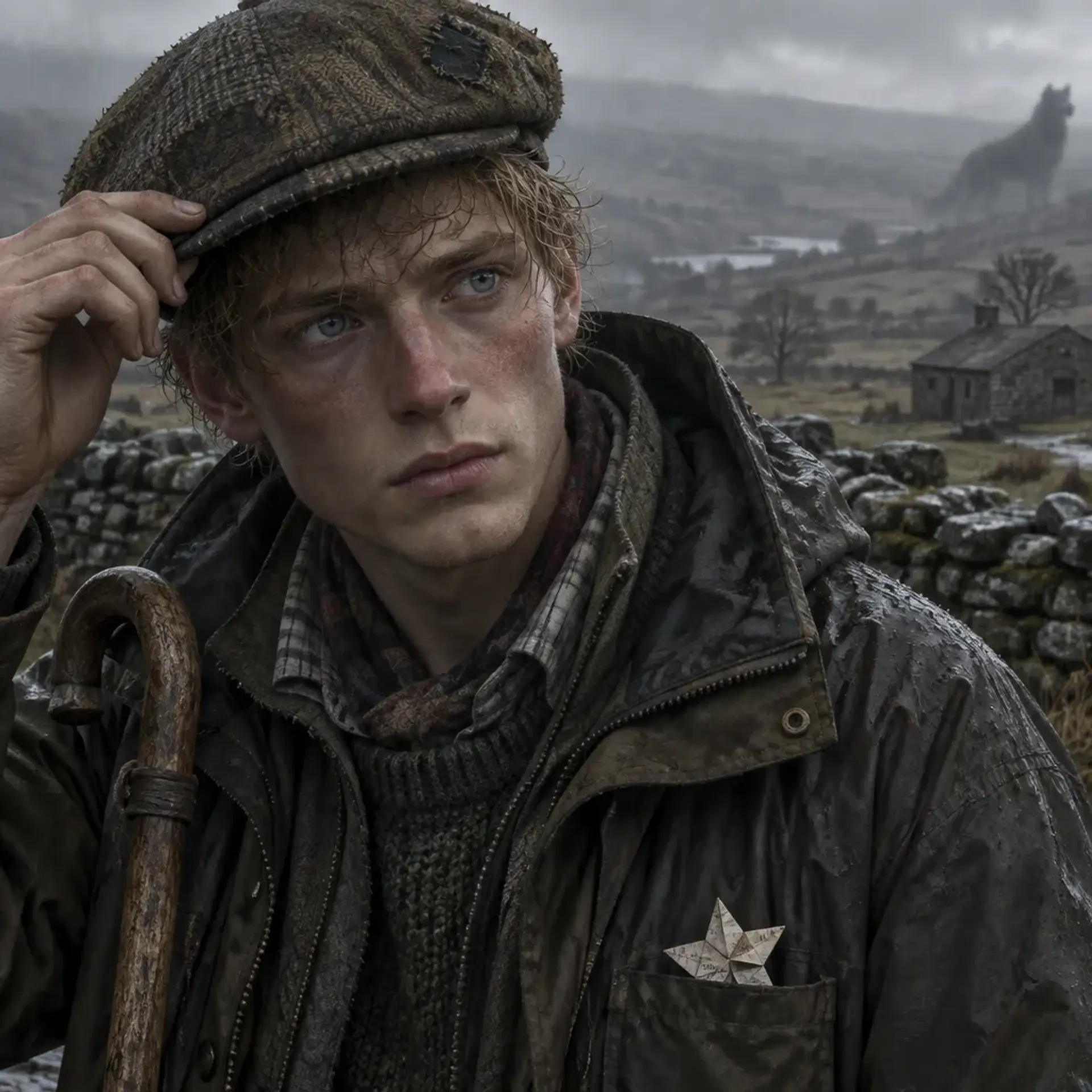
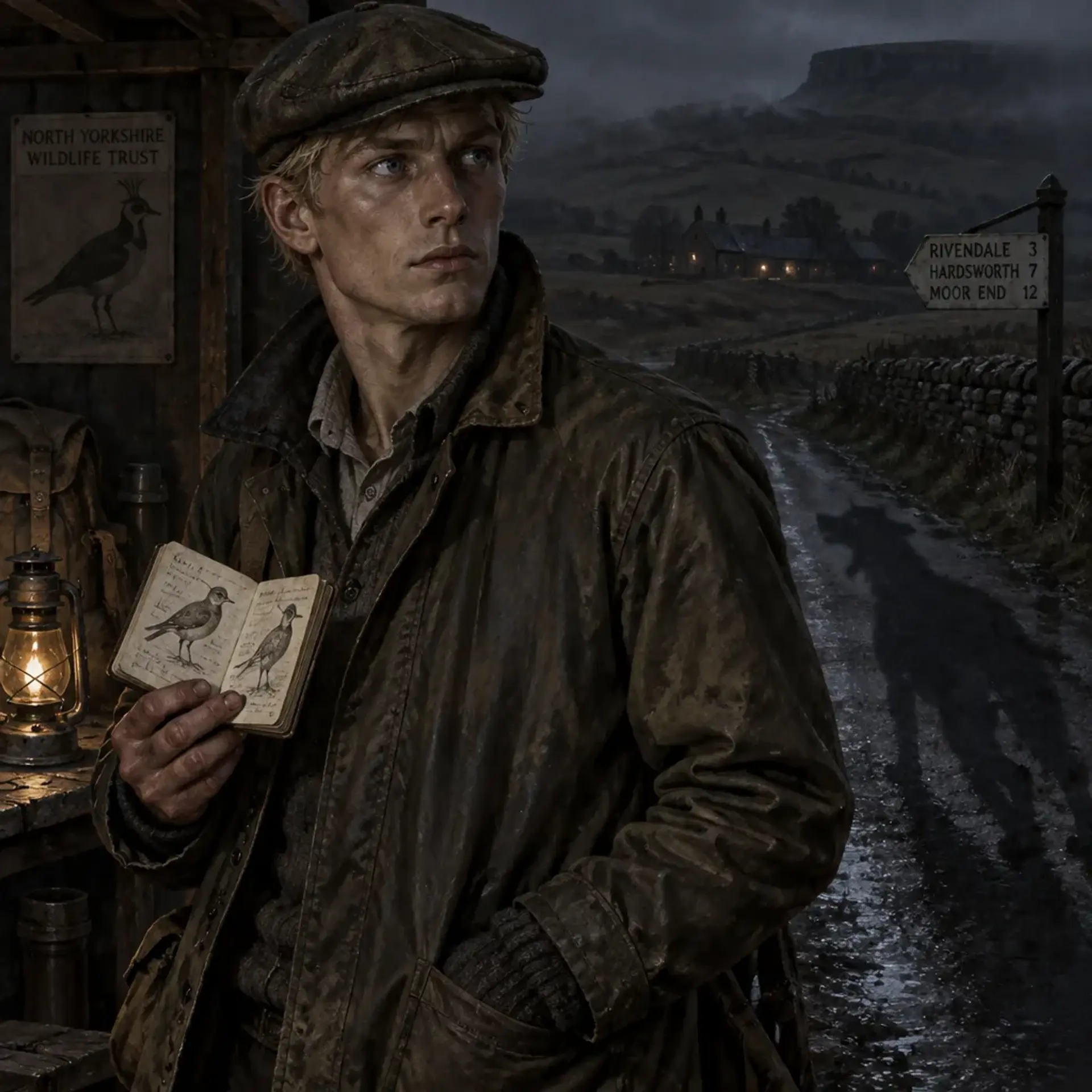
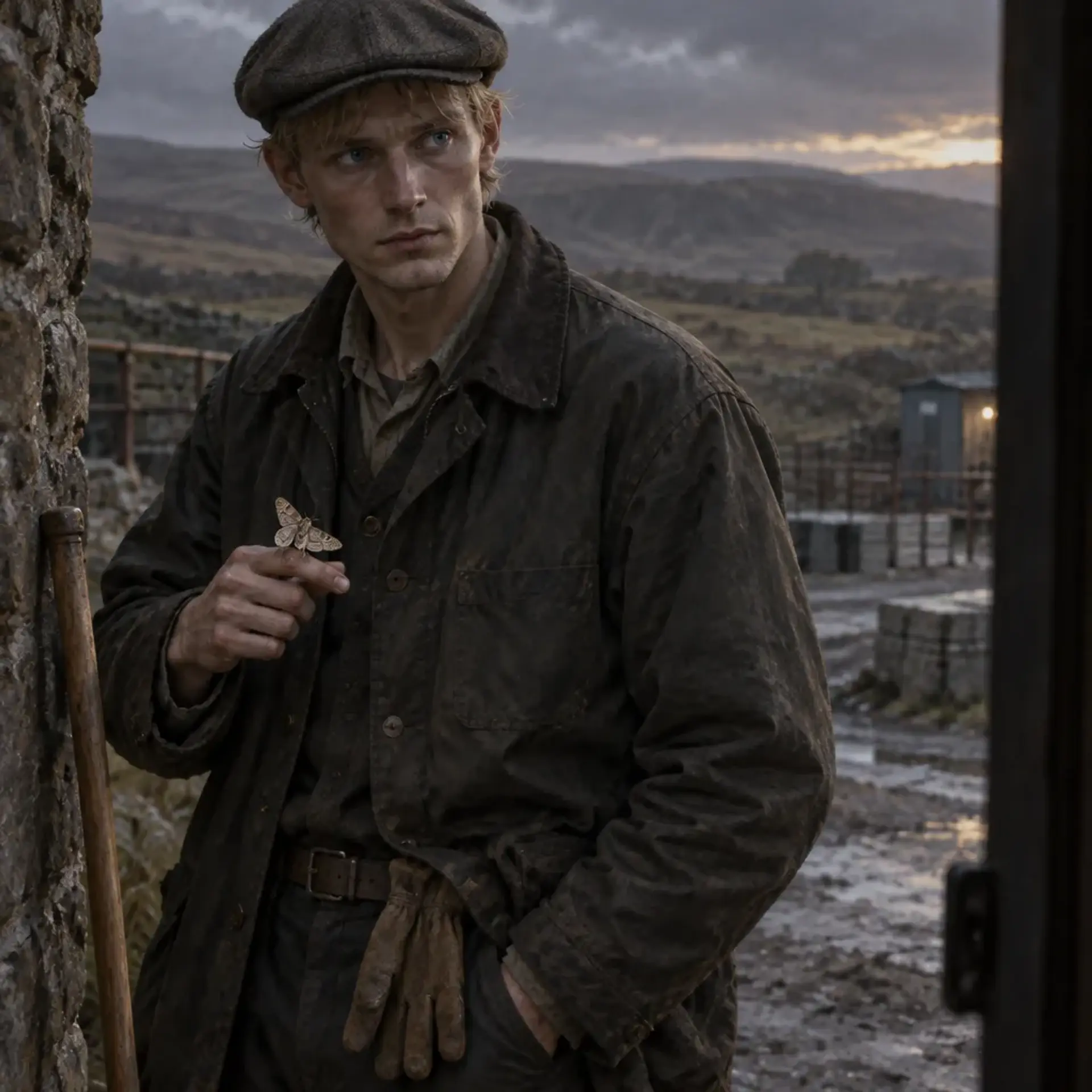
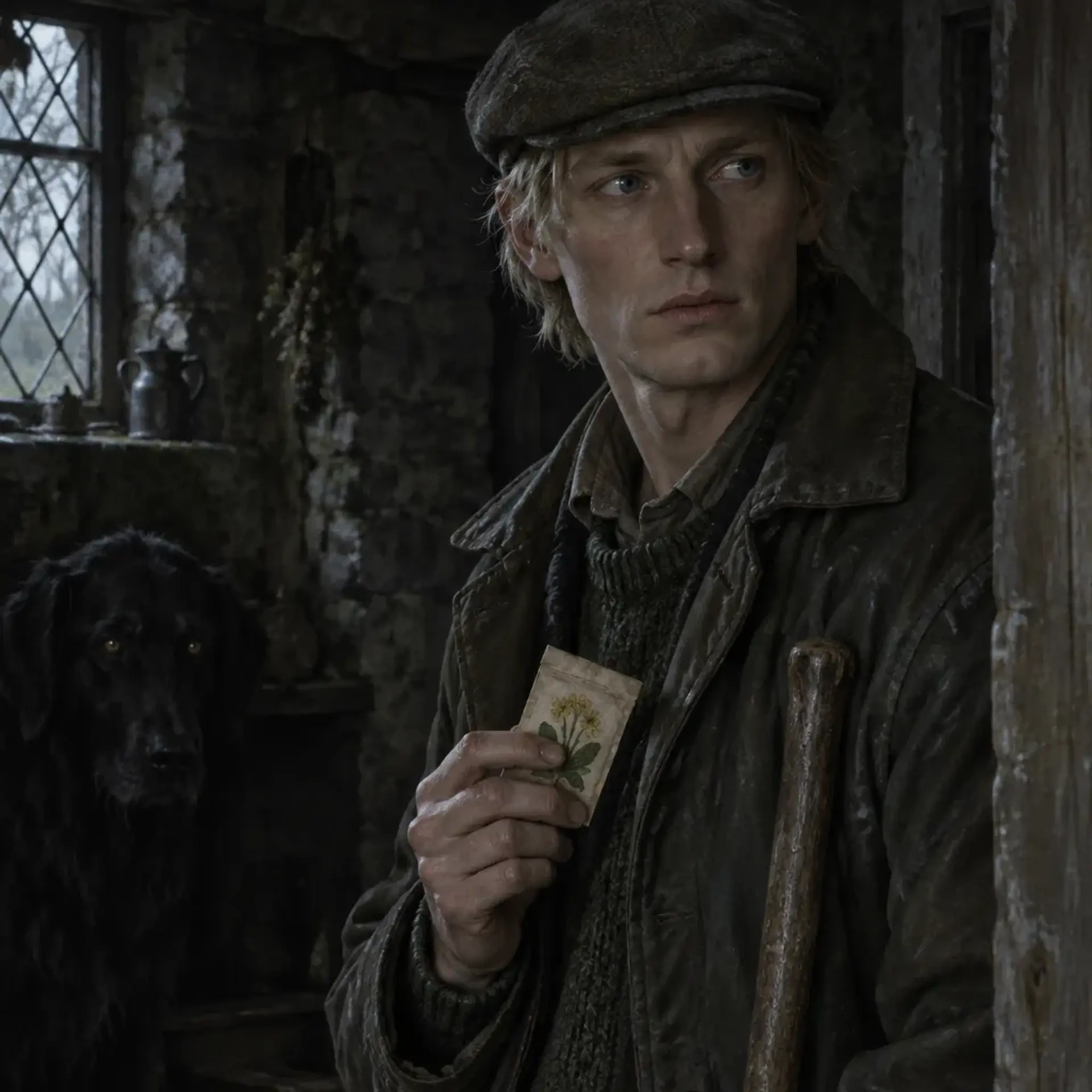
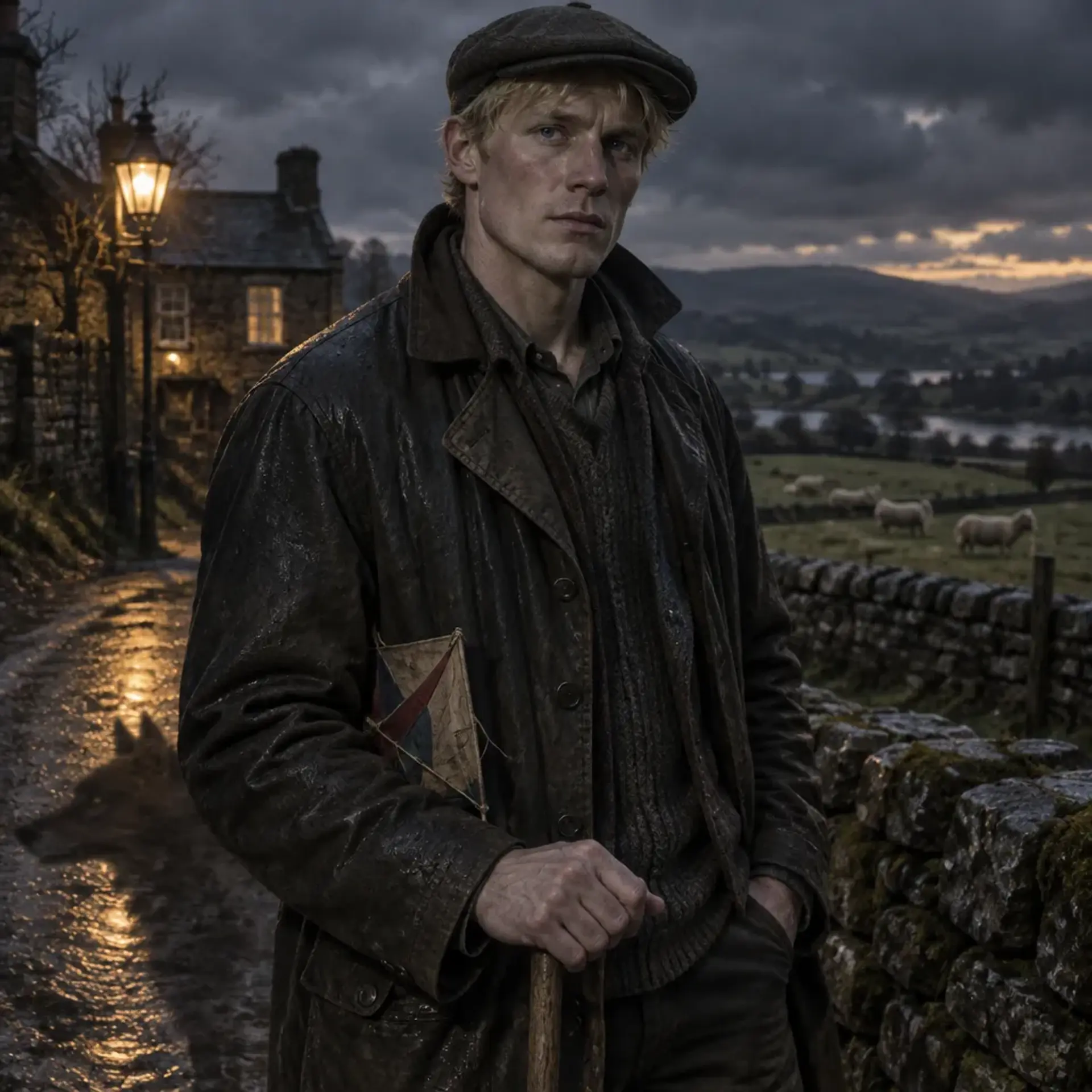
Ewan is six feet tall, pale, and handsome in the unnerving, unweathered way of someone whose face has stopped keeping time. His straight blond hair falls neatly until rain or wind lifts it into fine, bright strands; his blue eyes burn with a cold, clear intensity that Mary remembers in William's eyes. His skin has the almost waxen pallor of someone who sleeps badly, though his body is hardy and strong from years of farm work and later military service. He moves with a careful, economical tread, placing his feet as if he is listening to the ground before trusting it. In company he often takes up less room than his height suggests, folding his shoulders inward; when the fae pull rises, he suddenly fills a doorway and forgets that other people need space. His broad, strong jaw and square front teeth show plainly when he laughs, a warm expression that can turn strange when the teeth seem a little too sharp in lamplight. He has a flat cap, a plain modern coat, and the stubbornly ordinary clothes of a man trying to pass unnoticed. The unexpected detail: despite his years as a soldier and a farmhand, he keeps a small, carefully mended paper kite in his coat, and flies it whenever a clear wind comes off the hills.
Clothing
In 2026 he wears practical, weatherproof clothes suited to a rural commute: sturdy boots, dark trousers, a plain coat, and a flat cap he keeps despite changing fashions. He owns no conspicuous weapon and carries small everyday items rather than dressing like an adventurer.
Body language
In ordinary company he keeps his shoulders slightly drawn in and turns his broad frame sideways through crowded spaces. He rubs the heel of one hand with his thumb when he is choosing what not to say. When threatened, his jaw sets and his weight shifts forward onto the balls of his feet. In May his posture opens, his smile arrives too quickly, and he seems to watch things just outside other people's sight.
- Height
- 6 feet
- Build
- Lean, long-limbed, and wiry with the durable strength of a farmer and a soldier.
- Eyes
- Clear, burning blue
- Hair
- Pale blond
- Skin
- Very fair, with a pale, slightly weathered complexion
- Age
- Appears 20; his true age reaches back to the Danelaw, and his body has barely changed since he met Mary Hirst.
- Gender
- Male
- Size
- Medium
Distinguishing features
Personality
20 traits and drivesEwan is kind in practical ways and shrewd in ways that can feel like evasiveness. He will mend a gate, walk someone home, or sit through a long silence, but he rarely volunteers the history behind his choices. His warmth is not softness: he has survived violence, loss, and the company of beings who do not share human morals. He prefers peace, yet can turn frighteningly decisive when a creature crosses a boundary or threatens a child. He wants Mary and William's memory to remain tender, but sometimes distances himself from them because tenderness opens the way to guilt. He changes with season and circumstance. Most days he is dry, watchful, and gently sociable, calling people love as naturally as he breathes. At work he is efficient but bored, resenting how a life that once crossed centuries has narrowed to shifts and errands. Around the dead he becomes patient and formal, as if handling a difficult neighbor rather than a ghost. He dislikes their demands, calls some of them dribble, then still listens. Around people who remind him of William, his patience becomes almost painful; he gives them time but may overprotect them or make decisions on their behalf. May is the month when his inner balance fails. The first three days can fill him with a joy that feels beautiful and dangerous. He wants to run, dance, follow lights, open gates, and welcome strangers. He can recognize the impulse as fae, but recognition does not make it easy to resist. In 2026, a gust of wind set flower baskets swaying above a street and he followed them toward a path that should not have existed. A delivery driver interrupted him. Ewan's face was open with an almost childlike delight; only after the driver spoke did he see how frightening that expression looked. He grounded himself by touching a shop wall and naming ordinary objects until his mind returned to the street. He dislikes being watched during these episodes, not because he is ashamed of joy, but because he fears someone might mistake it for harmlessness. All Saints' Night and Halloween bring a different strain. The dead approach with requests, while fae and other night-creatures test the boundaries. Ewan becomes more focused but less rested, moving between graves, roads, and doorways as if he has a duty roster no one else can see. In a recent modern encounter, a dead woman asked him to find her living son while strange shapes moved along the road. Ewan agreed to try, guided her to the boundary, and stayed out through the night to stop other visitors following her. The living driver who saw him there thought he was speaking to himself. Ewan let him think that. By dawn he was exhausted and resentful, but he still intended to keep his promise. Christmas once steadied him. He remembers sitting with Mary, William, Thomas, Hugh, Edward, and Rose, hearing ordinary family complaints and letting the warm room make him human for a few hours. Church service helped more than he liked to admit. William asleep against him remains one of his clearest memories. That family is gone, and the absence has changed Christmas from refuge into a reminder of what cannot be recovered. He still attends a service when he can, but leaves before people try to make him part of their celebrations. Ewan's deepest contradiction is that he wants to remain human while believing that his human life is over. He speaks gently of the people he once loved, but acts as if attachment is a debt that must eventually be paid in loss. His kindness survives anyway. He has not become harmless, and the fae nature in him is not a costume that can simply be put away. He is trying, with uneven success, to choose what kind of neighbor he will be.
- Alignment
- Protective and compassionate, but increasingly governed by fae instincts that do not fit human ideas of fairness.
Quirks
Habits
Traits · 6
Flaws · 5
Fears · 5
Wants and needs · 4
Combat
HP 34 · Custom: 30 feet walking in human form; the same ground speed in hound form.Ewan avoids fighting if a boundary, bargain, or warning can resolve the danger. If forced, he uses his reach and knowledge of the ground, drives opponents away from bystanders, and changes into the Barguest only when the threat is severe or supernatural. He does not attack a creature he considers a neighbor or ally without first trying to communicate. Worked iron is a meaningful weakness: pain and disrupted concentration can limit his powers.
Ewan Armitage
Actions
Reactions
Services they sell
Rewards they can give
Equipment
- Walking stick (tool)An ordinary modern walking stick, useful on uneven ground and in a fight.
- Mended kite (personal keepsake)A repaired paper kite folded carefully to fit inside his coat.
- Flat cap (clothing)A flat cap worn out of habit, even when a hood would be more practical.
Possessions
Background
Ewan Armitage is the name he uses in the present day. Long ago, in the Yorkshire dales under the Danelaw, he was born Oswin Hirst, the child of a human mother violated by Viking raiders. He remembers being human in a way that feels less like a story than the smell of wet wool beside a hearth: his mother's rough sleeve against his cheek, the crack of turf on the fire, and the terror of being small in a world where adults could not keep danger out. He learned Old Norse and Old English early, then the common tongues of the English lands as he traveled. Later he learned other languages from the dead and from things beyond the boundary. He calls those forbidden tongues, and refuses to speak them even when he knows that a word might make a bargain easier. As a young man he roamed the dales and beyond, following work, trouble, and roads that did not always return to the same place. He met the dead often enough to learn that a ghost's request was not always a human request, and encountered devils and fae that treated names, promises, and grief as negotiable things. His memory of the Other Side is vivid and precious: a country of blue-black grass, streams that reflected unfamiliar stars, and a feast where every guest was welcomed but no one could remember how long they had been there. He remembers the music as pressure in his bones, not a tune. He came away knowing that some part of him had been claimed or altered. Over the centuries he understood that he could become a black hound, the feared Barguest of local stories. He is not sure whether he became the creature, inherited it, or was remade by long exposure to the fae world. He knows only that people saw a hound where he stood, and that some nights the shape felt more like home than his own skin. He learned the customs of the Yorkshire night-creatures and took on the unwelcome task of keeping them away from human boundaries. Some were predators; some were merely dangerous neighbors. He knows which road to leave open for a certain wandering spirit and which churchyard gate must never be shut after midnight. He has friendly relations with a few of these beings, which can make him hesitate when people expect him to strike. His kindness is real, but his idea of kindness can be alarming: he has let a creature go because it promised not to take a child, then stood watch all night to ensure it kept its word. In time he settled into the life of a sheep farmer and married Mary Pickles, later Mary Hirst. He had a good house for a man of his station, a flat cap, work to do, and for a while the great, ordinary comfort of being expected at supper. Mary remembers his stories of roads and adventures, and notices that his youthful face and body never change. He told her it was good fortune, then later blamed it on his habit of avoiding iron. He used church doctrine and the new sciences he read about to reassure her that the dark was only dark. Yet he slept poorly when the old seasons came around, and Mary noticed his fear of worked iron. She kept iron scissors on her and an iron thimble near their son after William's birth. William was born with black hair though both parents were blond, and with Ewan's burning blue eyes. The village called him Black William or Blackby. He was slow to meet the milestones other children reached and needed more care than Ewan knew how to give. Mary wondered if the Barguest had fathered him, not knowing that Ewan himself was the hound. Her pregnancies after William often failed; one child was born sickly and died soon after birth. These losses left both parents guarded in different ways. Ewan gave time to Mary and William even during the difficult seasons, but hid what he was and tried to manage his fae nature alone. Mary's father, Thomas Pickles, suspected Ewan and quietly intended to turn the secret to his family's advantage. Thomas was clever, patient, and covert rather than openly cruel. He hoped to learn how Ewan's nature might improve the family's fortunes and eventually won control of the farm, reducing Ewan's household to the Pickles cottage. Mary's brothers Hugh and Edward each responded differently: Hugh distrusted Ewan's evasions and kept an eye on the household, while Edward was more willing to share an ordinary kindness with him. Their sister Alice died of a winter fever. On the morning after Thomas saw a black hound, Ewan was left in a graveyard with Edward amid the grief and cold. Ewan never forgot the contrast between a family mourning a real child and neighbors treating his shape as an omen. Rose Pickles, Mary's mother, tried to keep the family from turning sorrow into suspicion. She recognized Ewan's care for Mary and William even when she could not accept his explanations. Christmas was once the one season when Ewan could most convincingly be a man. He sat with the Pickles family, listened to Rose make sure everyone ate, and let Thomas's complaints about the weather pass without answering them. Church at Christmas steadied him; the fae pull seemed to recede, provided he kept to the service and its familiar rituals. He remembers one Christmas when William fell asleep against his shoulder and Mary watched them both by the fire. He has no family table now, no child asleep against him, and no one to call him back from the threshold. The memory is not a comfort so much as an ache he keeps returning to. May is the opposite. The first three days of the month bring the fae nature down upon him with the force of a hammer. He becomes unreasonably delighted by small, bright things, feels a fierce urge to follow music or invite strangers over a boundary, and briefly finds human caution ridiculous. In the past, Mary saw him laughing at an empty lane, then saw the laughter vanish when he realized what he had nearly done. In 2026, Ewan was walking home from a modern job he hates when the May wind turned the street's hanging flower baskets into a procession of swaying heads. He followed them toward a road that was not there the night before. A delivery driver called out, and Ewan turned with an expression of such unguarded joy that the driver stepped back. Ewan forced himself to touch the cold wall of a shop and name three ordinary things until the pull eased. He later found a primrose pressed into his coat pocket, though he had not picked one. All Saints' Night and Halloween bring the dead close. They ask him for errands, answers, and sometimes things he cannot give. In modern times, after a late shift, Ewan was approached near a cemetery by the shade of a woman who had died decades earlier. She asked him to find a son who was still alive but had forgotten her. At the same time, strange fae shapes moved along the road's edges. Ewan escorted the spirit to the boundary and promised to look for the living man, then spent the remainder of the night keeping the other visitors from following her. He was exhausted and angry at being needed by everyone, including the dead. He still did the work. He has served in both World Wars, though the experiences dulled rather than strengthened his gifts. Iron, machinery, and disciplined violence gave him long periods in which he had to behave like an ordinary man. In 2026 he is twenty in appearance, works an unfulfilling job, and keeps his past to himself. The old pull of the dales remains, but is faint and intermittent. His human family is long gone: Thomas took the farm; Mary eventually divorced him and married a stable man; William, whose unusual nature and distress worsened as he aged, was sent to an asylum. They all died long ago. Ewan has never forgiven himself for how little he understood about William, or for believing that concealment could protect Mary. He does not know that Mary once told her father about the night she became certain Ewan was the Barguest.
Role in the story
A guarded modern-day guide, reluctant supernatural protector, or morally complicated ally. Ewan can connect the party to the Yorkshire folklore of the Barguest, the dead, and the fae, while his family history gives those threats a personal cost.
“Long ago, in the Yorkshire dales under the Danelaw, he was born Oswin Hirst, the child of a human mother violated by Viking raiders.”
- Faction
- No formal faction. He serves as an informal keeper of the boundaries around the Yorkshire town and its surrounding lanes.
Known connections
Media
0 imagesNo images yet.
Turn Ewan Armitage into a sheet
A high-res, share-ready sheet you can post or print.