Oswin Hirst
Oswin Hirst
At the table
Voice
The sound comes with a slight intake through his nose and a dry clearing of the throat, as if he has spent years talking outdoors in cold air. His words are clear but unhurried, with a low rasp from old smoke and weather rather than theatrical menace. When tired, the vowels of his Yorkshire speech grow broader. When the fae nature rises, he speaks faster and with bright, overconfident energy.
His speech carries the blunt rhythm of Yorkshire, shaped by farm work and years of speaking only when something needed doing. He uses love as a familiar address, not a performance. His voice catches slightly before certain names, as if his throat is resisting them. When speaking Old English or Old Norse, his consonants become precise and hard-edged. He will not speak the forbidden tongues, even when he understands them.
Speech patterns
How to play them
Begin with practical help rather than revelations. He responds well to patience, direct questions, and people who show care for the vulnerable. He resists being treated as a monster or as a folklore curiosity. If pressed about Mary and William, he becomes guarded, then may offer a fragment of truth if he believes the questioner will not use it to manipulate the dead or the living.
Goal
Keep the creatures of the night from crossing into settled places, while preserving enough of his human self to choose whom he protects.
Motivation
To remain capable of compassion and choice, even as the Other Side's seasons pull him toward instincts that are not human.
Appearance
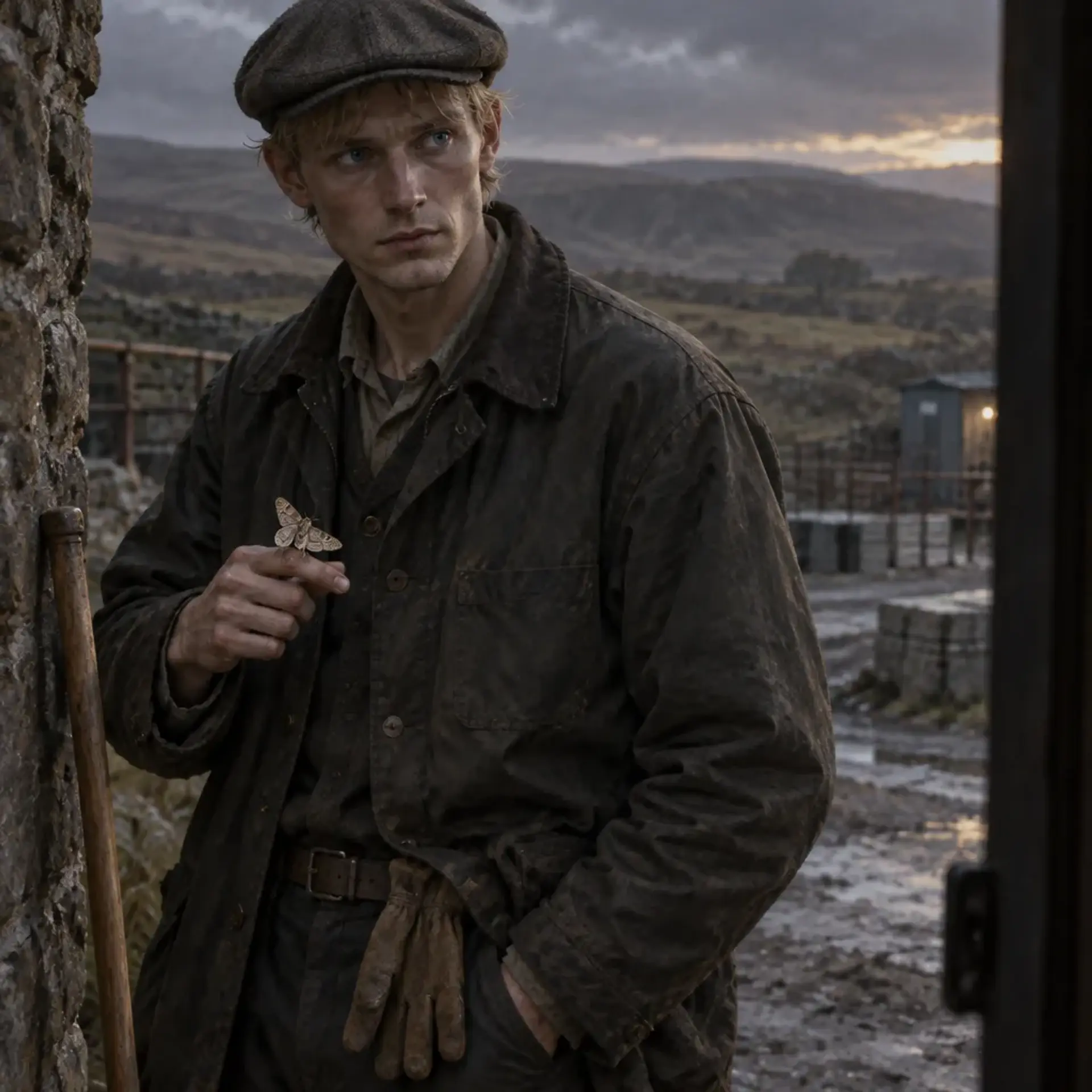
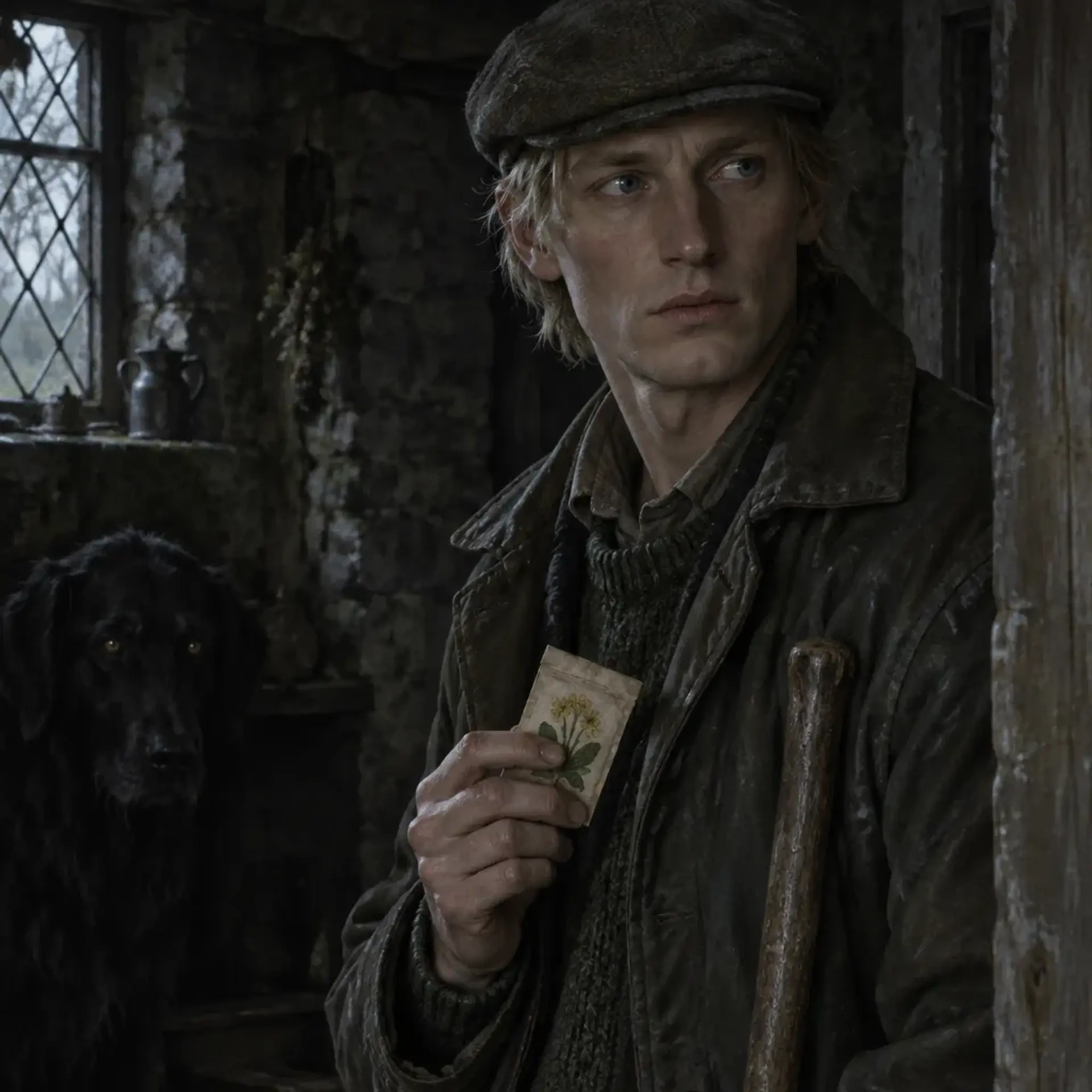
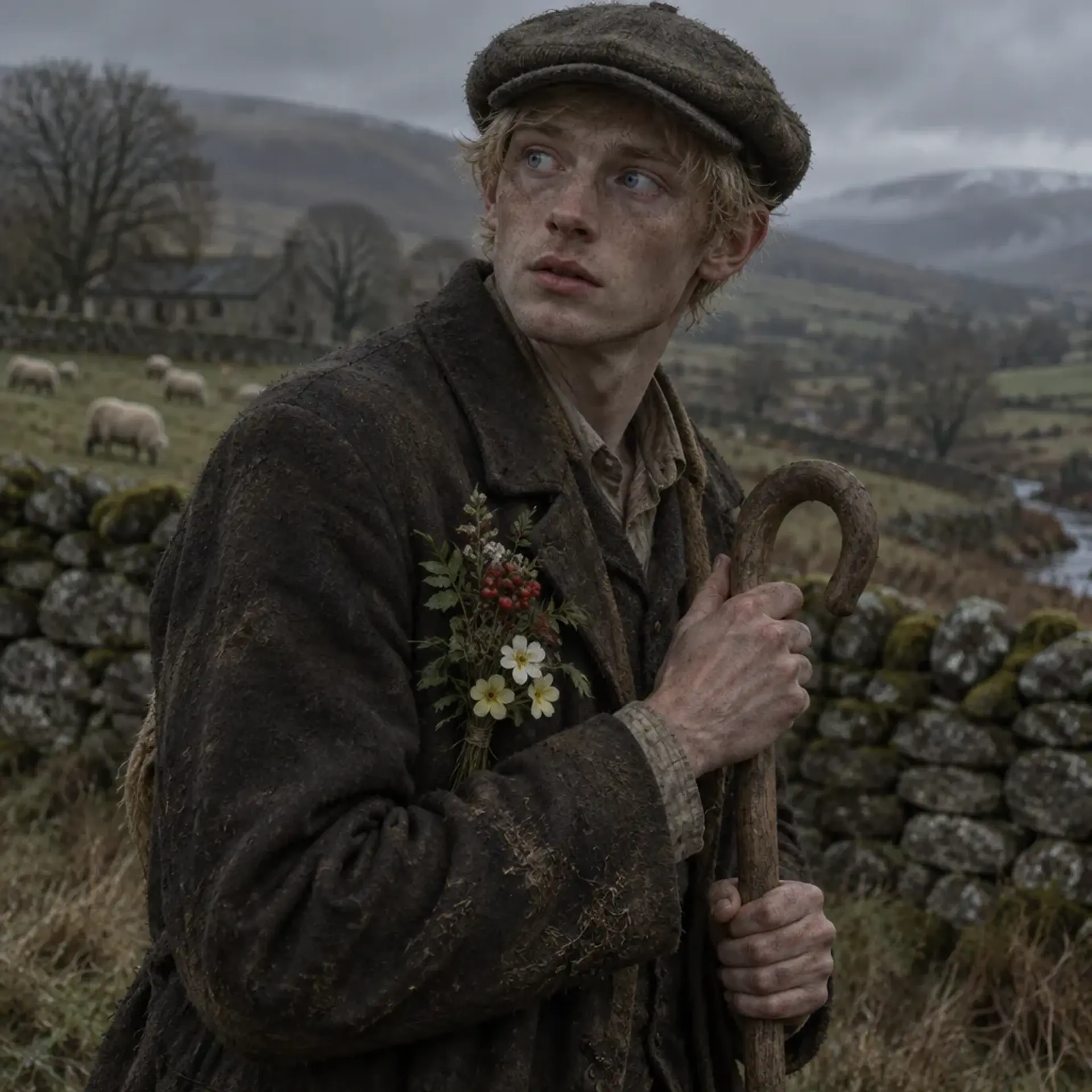
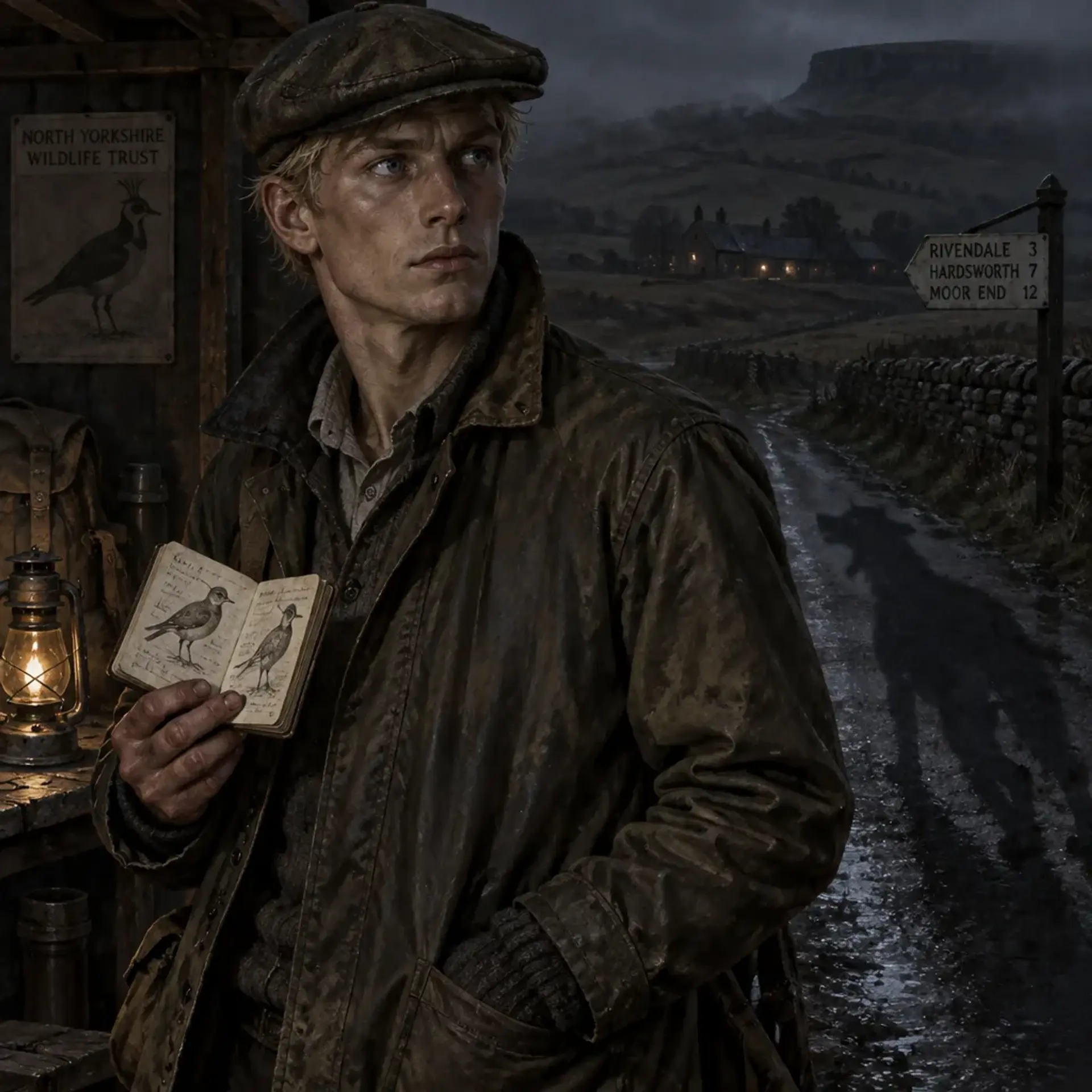
A handsome young Yorkshireman, six feet tall, with a straight-backed, economical way of moving that looks practiced rather than posed. His pale blond hair lies flat beneath a common flat cap, and his burning blue eyes seem too bright in lamplight. His face is smooth and youthful in a way that becomes disturbing when old acquaintances compare it with remembered portraits. His hands are broad and work-worn, with faint pale pressure marks where he grips tools too tightly. He smells of damp wool, clean soap, and, after a night outdoors, cold earth and wet dog. He seems to listen to the air before entering a room. The unexpected detail: his pockets are meticulously arranged with folded scraps of paper, each marked with tiny diagrams of birds, as if a farmer's coat were also a field naturalist's notebook.
Clothing
For 2026, he wears ordinary practical layers: a weatherproof jacket, plain shirt, hard-wearing trousers, and work boots. He favors a flat cap when outdoors, an old habit from his Yorkshire farming years. His clothes are clean but never fashionable, and he avoids metal fastenings when he can.
Body language
He stands as if braced for a gust of wind, turns his head before his shoulders when listening, and keeps his hands away from iron. When distressed, he rubs his thumb along the side of his forefinger as though checking for an old pressure mark. In May, his posture loosens and he moves with an unnerving, springy lightness.
- Height
- 6 feet
- Build
- Lean and hardy, with the wiry strength of a working farmer rather than a soldier's bulk.
- Eyes
- Bright, burning blue
- Hair
- Pale blond
- Skin
- Pale, weathered by outdoor work
- Age
- Appears 20; has lived for centuries, with origins reaching back to the Danelaw
- Gender
- Male
- Size
- Medium
Distinguishing features
Personality
18 traits and drivesOswin is gentle without being soft, shrewd without being cruel, and practical while carrying memories that make ordinary explanations feel thin. He can spend an hour repairing a stranger's gate and then refuse to explain the black shape seen behind it. He is warm with people who are frightened, especially children, but becomes evasive when someone asks what he is. His care for the dead is complicated: he can speak with them easily, yet calls their requests dribble and avoids them because every conversation risks becoming an obligation. He wants Mary, in memory, to have been less afraid. He also knows she had good reason to be afraid. During their marriage he tried to make himself reassuring by citing church doctrine and new scientific writing, speaking of superstition as if disbelief could serve as a shield. He did not age. Mary noticed. He avoided iron. Mary noticed that too. Her watchfulness made him feel loved and accused at the same time. He resented her fear, then hated himself for resenting it. He could not make her understand that his tenderness was real even when his nature was not wholly human. Oswin's kindness is active rather than sentimental. He gives time, labor, and attention, especially when he is off work and could claim exhaustion. He once made a point of being present with Mary and William even in seasons when the night called him elsewhere. That choice mattered to him. It did not solve the fear in their house, nor the failed pregnancies, nor William's slow development. He knows now that showing up is not the same as telling the truth. He is also private and stubborn. He will help someone escape a dangerous road, but may refuse to tell them why the road was dangerous. His silence is partly caution and partly shame. He believes that names, stories, and invitations can give the Other Side a foothold. Sometimes this caution protects people; sometimes it leaves them ignorant at the worst possible moment. He dislikes being thanked for acts he considers necessary, though he quietly remembers who thanked him. In ordinary moods he is dry, steady, and hospitable. He talks about weather, work, and the state of a fence, and uses love as an everyday Yorkshire address. He can be unexpectedly funny, particularly when someone is being pompous. His humor is plain and quick, more likely to puncture a boast than to entertain a room. He is careful with modern technology but not incapable of learning it; his reluctance comes from finding the modern world loud, hurried, and indifferent to the old boundaries. In winter, especially around Christmas, he is most recognizably human. Church service, familiar food, and people keeping promises in small ways steady him. He remembers the Christmas he shared with Rose, Thomas, Hugh, Edward, Mary, and William as a real family gathering, not an illusion. Rose kept food moving; Edward tried to lift the mood; Thomas watched Oswin as if measuring a tool; Mary watched him with love sharpened by suspicion. For a little while Oswin belonged at the table. He has not had that again, and the absence is not simply loneliness. It is the loss of a version of himself that could sit among people without calculating what he might become. May pulls in the opposite direction. The first three days bring an immense, almost infectious enthusiasm. He wants music, movement, games, flowers, and impossible promises. He can find joy in a thing that would ordinarily seem trivial, but that joy is too large and too heedless. He knows the season is pressing on him, yet he does not always experience it as a hostile force. Some part of him likes the brightness. That is what frightens him. In modern times, during a May Day celebration, he joined a dance with the abandon of someone who had forgotten his age and history. Seeing a frightened child brought him back to himself. He helped the child, then spent the day resisting the urge to return to the dancing. He calls that a warning, though he also remembers the joy. Halloween and All Saints' Night are not joyful. Oswin becomes wakeful, alert, and burdened by the dead. They approach him with questions and requests, sometimes because they know he can hear them, sometimes because they believe he owes them. He may speak gently to them, but the conversations exhaust him. On a recent Halloween he listened to the dead behind his workplace until dawn while a night-creature waited at the edge of the car park. He delayed its crossing into town by making a promise. He has not yet fulfilled it. He is afraid of what will happen if he does, and of what the creature will do if he does not. Oswin's hardest conflict is not whether he is human or fae, but whether those categories excuse his choices. He believes his mind has changed. He can feel the old human self becoming less central, especially in May, and he sometimes catches himself responding to fear as a puzzle or to grief as a strange local custom. Then he remembers his mother warming his hands, Mary looking at him across a kitchen, and Edward standing with him at Alice's grave. Those memories are not proof that he is still human. They are reasons to act as if the distinction matters. He can be affectionate toward the creatures he keeps from town. Some are familiar, some are enemies, and some are simply beings with whom he has shared too many nights to treat as strangers. That kinship makes him hesitate. He will negotiate when a human companion expects him to strike, and strike when a human companion expects a negotiation. He is not a reliable weapon. He is a boundary keeper with loyalties on both sides, trying to prevent a bad night from becoming a tragedy. When he touched iron recently, the shock was immediate. His hand locked, his breath stopped, and for a moment the ordinary world seemed to peel back. He did not make a scene. He wrapped the hand and finished his task, then spent hours feeling as if the injury were beneath the skin. The incident made him angry, not because iron hurt, but because he had been careless enough to let an ordinary object reveal him. It also reminded him that the old nature is not gone, merely quieter. Oswin does not ask people to like him. He would rather they judge him by what he does, though he understands that his actions cannot erase what he hid from Mary. His deepest wish is modest and impossible: to meet a frightened person at the edge of the dark and help them without making them pay for his help later.
- Alignment
- Protective and pragmatic, but bound to a fae nature that does not share human moral instincts
Quirks
Habits
Traits · 5
Flaws · 5
Fears · 4
Wants and needs · 4
Combat
HP 0 · No canonical Vaesen speed statistic asserted; moves with ordinary human pace, but can run swiftly in custom Barguest form.Oswin prefers prevention, escape, and negotiation. He uses his knowledge of local creatures to divert threats from people rather than confront them. If trapped, he relies on speed and the Barguest shape, but iron can interrupt or injure him. His seasonal surges can compromise judgment, so a clever opponent may exploit his curiosity or misplaced delight.
Oswin Hirst
Actions
Reactions
Services they sell
Rewards they can give
Equipment
- Flat cap (clothing)A plain, well-worn cap that connects his modern disguise to his farming years.
- Field notebook (tool)A small notebook filled with route sketches, bird marks, and notes about local supernatural boundaries.
- Mobile phone (tool)A modern phone used reluctantly for work and practical contact.
- Work gloves (protection)He avoids carrying or willingly touching iron. If he must handle it, he uses gloves and limits contact.
Possessions
Background
Oswin Hirst began as a human boy in the Yorkshire Dales, born in the age of the Danelaw. His mother had been assaulted by Vikings, and the fact of his birth was a wound in the family history rather than a story anyone wanted to tell him. He grew up among practical people who measured a life by weather, livestock, and whether the roof held. His earliest memory of being human is not heroic: his mother rubbing warmth into his hands beside a smoky hearth while snow clogged the track outside. He remembers the greasy wool of her sleeve, the sting of cracked skin, and the certainty that if he stayed close to the fire, someone would keep him safe. That certainty broke gradually. As a young man, Oswin wandered farther than his neighbors thought sensible, first as a drover and then as a guide for travelers who would pay for someone who knew the dales after dark. He saw dead people at the edges of roads and learned that they were not always silent. He encountered fae beings whose manners could be charming and whose gifts had costs no human would accept knowingly. Some treated him as prey; others treated him as a distant relation. He learned Norse and Old English, the common tongues of his time, and languages he refuses to name or speak. He calls those last ones forbidden, not because he thinks they are evil in a simple human way, but because they make his thoughts feel less like his own. His memory of the Other Side is vivid and unreliable in the way a dream can be vivid. He remembers a hillside beneath a sky with no sun, a road that ran uphill and downhill at once, and a court where the company laughed without moving their mouths. He remembers being offered a place at a table and realizing that the food smelled exactly like his mother's kitchen. He left before eating. For years afterward, he could not tell whether he had escaped by courage, luck, or because something there had decided to let him go. The change in him came through exposure rather than a single curse. Each crossing, bargain, and encounter left a little more of the Other Side in him. He stopped aging as a human man should. He found that he could change into a black hound, a shape that Yorkshire people already feared as a death omen or wandering sprite. Oswin did not choose the stories told about the Barguest, and he does not claim every black dog sighting is him. But sometimes he is the hound, and sometimes the old instinct to run the boundary roads is stronger than the human wish to remain indoors. He eventually tried to become ordinary. He settled into sheep farming and made a respectable home, unusually fine for his station, in the hope that regular work and family life would anchor him. He wore a flat cap, mended fences, read whatever new science and church writing he could get, and spoke warmly to neighbors, often calling them love. He met Mary Pickles, a blond, blue-eyed Yorkshire woman, and married her. To Mary, his stories of wandering were fascinating at first. She knew he was kind and attentive, and that he made time for her and their child even when he was exhausted. She also noticed what he did not explain: his face and body did not change with the years, and he avoided iron as if it were a living threat. Their son William was born with black hair unlike either parent and brilliant blue eyes like Oswin's. The locals called him Black William or Blackby. He developed more slowly than other children, and Mary, frightened by the signs she could not explain, came to believe that the Barguest had fathered him. Oswin does not know that Mary has told her father what she suspects. Mary keeps iron scissors close and an iron thimble near William, believing iron may protect the boy. Her later pregnancies ended badly; one infant died soon after birth, and she struggled to carry another child to term. Oswin loved his family and tried to reassure Mary with church doctrine and the new sciences, telling her not to fear the dark. He could not tell her that the fear was not foolish. Thomas Pickles, Mary's father, was suspicious and patient. He did not confront Oswin directly. He saw that Oswin avoided iron and did not age, and he meant to turn those secrets to advantage for himself and his family. Thomas's wife Rose tried to keep the household from becoming a battlefield. Mary's brothers Hugh and Edward each responded differently: Hugh was wary of Oswin but valued his steadiness and practical help; Edward was more openly companionable, though grief made him watchful. The Pickles family had already lost their eldest daughter, Alice, to a winter fever. Thomas had seen a black hound before her death, and that image poisoned every later family gathering. Oswin was left with Edward in the graveyard the morning after Alice's burial. They stood among wet stones and bare branches, unable to decide whether the dog had foretold her death or simply arrived to witness it. Christmas once offered a brief truce. Oswin spent a Christmas with the Pickles family, sitting among them after church, sharing food, and trying to be a husband and son-in-law rather than an omen. The service steadied him. In the warmth of the house, with Rose keeping everyone fed and Edward making a dry joke, Oswin felt almost entirely human. He remembers that day as a small, precious proof that he could belong. He no longer has it. His human family, their home, and their ordinary troubles are long gone. The first three days of May were different. The fae nature in him struck hard, bringing an exuberance too large for the room. He would grin at small things, make dangerous promises, and find a maypole dance more compelling than a warning cry. He knew he was being altered and fought it, but some of his delight was real. That conflict taught him that his mind was not simply a human mind under enchantment: some part of him wanted the change. The old life ended by degrees and then all at once. Thomas gained the farm and reduced Oswin to a cottage; Mary eventually divorced him and remarried a stableman. William, grown older and increasingly troubled, was sent to an institution. They all died long ago. Oswin remembers Mary watching his unaged face, her expression shifting between love, dread, and a question she could never make herself ask. He remembers the iron scissors in her hand. He remembers the last Christmas he was welcome. He keeps these memories as carefully as he keeps his old languages, though he knows memory is not the same as being able to repair anything. In the modern age he has used the name Ewan Armitage, a cover that lets him pass as a young man of twenty. He has lived through both World Wars, and the violence and machinery of those years dulled his old abilities. He now has a job he hates, a routine he finds narrow, and a body that remains frustratingly young. The dales still pull at him, though less sharply than before. He sometimes thinks of himself as Yorkshire made briefly human, but that story no longer explains what he has become. He calls himself a changeling now, though he is not sure who exchanged him or when. During a recent May Day, Ewan was walking home from work when a street celebration's ribbons caught in a tree. For a few bright minutes he was swept into an almost childlike delight, laughing and circling the maypole as if he knew every dancer. Then he saw a frightened child at the edge of the crowd and recognized the danger in his own joy. He broke away, carried the child to safety, and spent the rest of the day with his hands clenched against the urge to return to the music. He remembers the event as a failure and a small victory at once. On a recent Halloween night, the dead came to him in the car park behind his workplace. They asked for directions, testimony, and one impossible favor: to carry a message to a living person who had never known them. Ewan listened until dawn, exhausted, while a black shape moved between the lamps. A familiar local spirit, not quite friend and not quite foe, waited at the boundary of the lot. Ewan delayed it from crossing into the town, but only after bargaining away a promise he has not yet fulfilled. More recently, Ewan touched iron by accident while repairing a loose gate at work. The cold metal met his palm. His fingers locked, his breath stopped, and the world seemed to tilt toward a place he had not seen in decades. He hid the reaction from his coworker, wrapped the hand, and finished the task. For hours afterward his skin felt bruised from the inside. He is now more careful, but the incident has reminded him that his diminished nature is not a harmless old story. He still tries to keep dangerous night-creatures away from the town, even when some of them are old acquaintances and he can hear their loneliness in the dark.
Role in the story
An enigmatic ally and possible source of danger: an unaging Yorkshire man who knows the local supernatural ecology, carries a family's worth of grief, and may be the very Barguest feared by the community.
“His mother had been assaulted by Vikings, and the fact of his birth was a wound in the family history rather than a story anyone wanted to tell him.”
- Faction
- No formal faction. He considers himself a reluctant warden of the Yorkshire boundary roads and has uneasy ties to local night-creatures.
Known connections
Media
0 imagesNo images yet.
Turn Oswin Hirst into a sheet
A high-res, share-ready sheet you can post or print.