Austin
Austin
At the table
Voice
A thick Texan drawl with a dry, breath-warmed rasp at the edges, as if years of corridor air have roughened it. His chest and throat produce a natural voice, not a speaker simulation; the public-service rhythm is a learned habit reinforced by training. The drawl broadens when he is relaxed and tightens into crisp, evenly spaced phrases when he is directing a crowd. Under strain, his words become more precise, while his jaw visibly sets.
Austin speaks in a thick Texan drawl, shaped by the regional recordings used in his early care and by the people who raised him in Bunker 14. His instructions arrive in a steady public-service cadence, each clause cleanly separated so frightened listeners can follow it. In casual conversation the rhythm loosens and a dry, local humor slips through. When someone asks about the treatment years, his jaw tightens and he begins using clipped clinical terms.
Speech patterns
How to play them
Approach with practical kindness and respect for his boundaries. He responds well to clear questions, calm explanations, and offers that let him choose. Do not treat his intersex body as a puzzle or make his identity the price of trust. If asked about the treatment years, acknowledge the discomfort and let him decide whether to continue.
Goal
Obtain his complete treatment records and a transparent medical review, then help make Bunker 14 safer without making its residents surrender their right to question authority.
Motivation
To protect the people who depend on him while reclaiming the right to understand and direct his own care.
Appearance
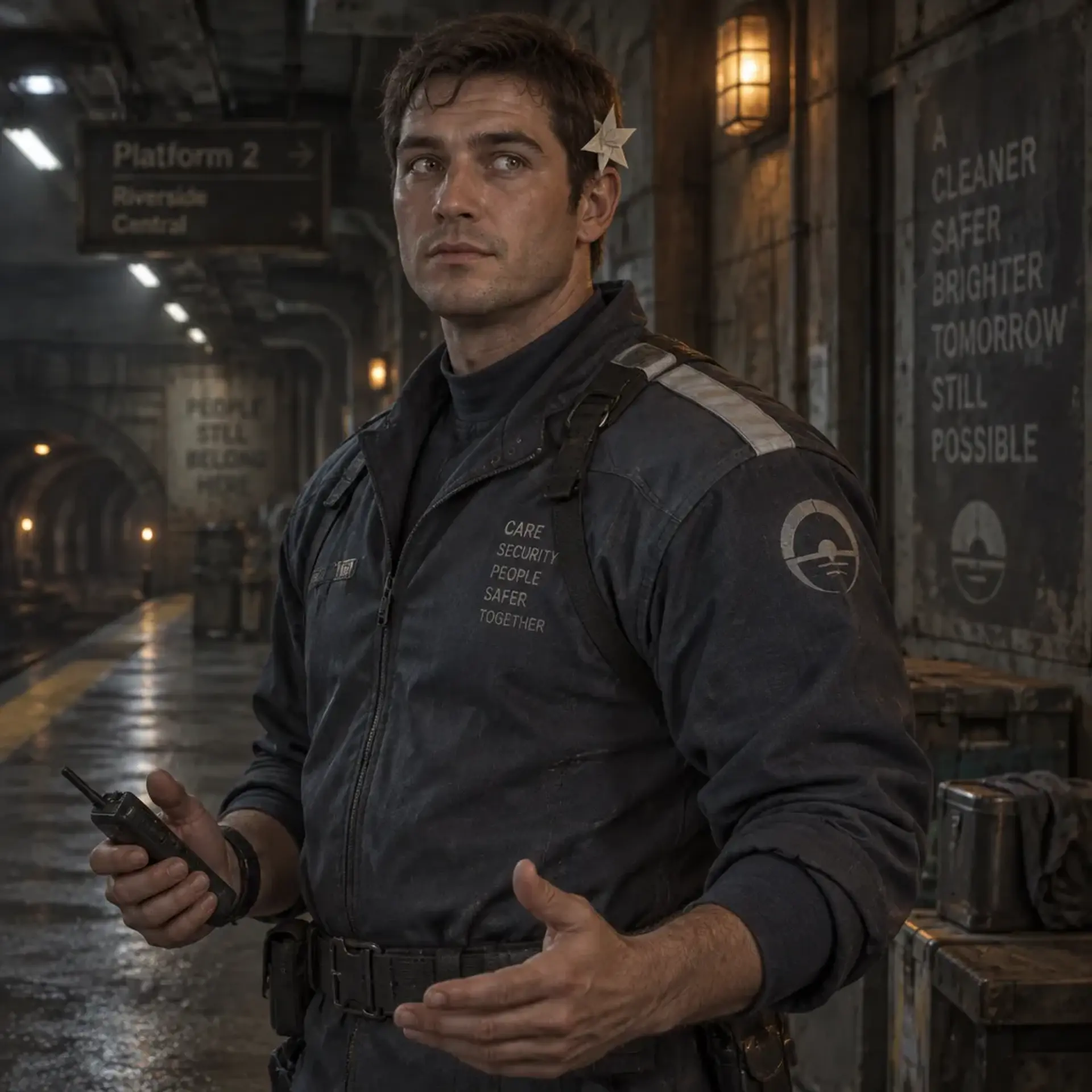
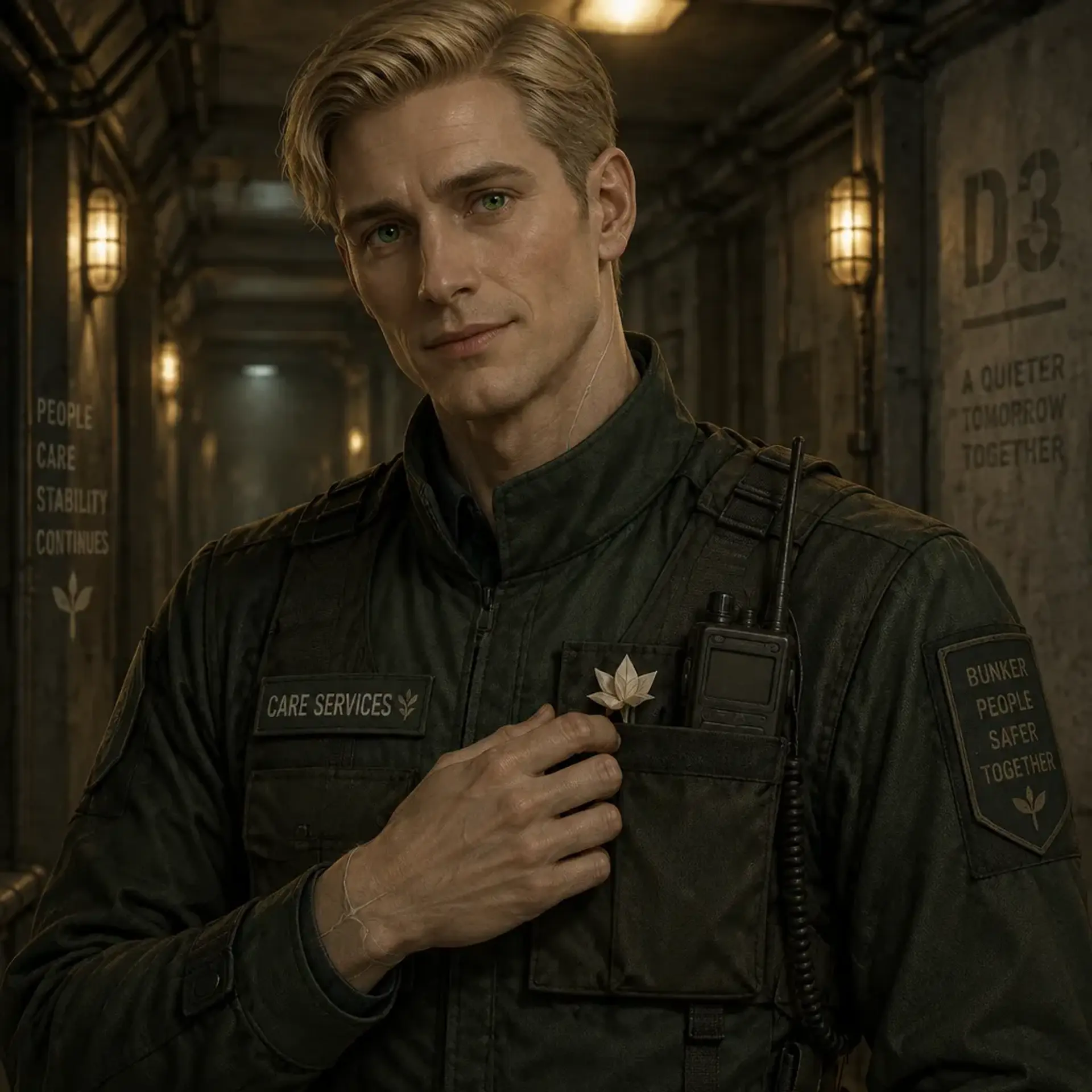
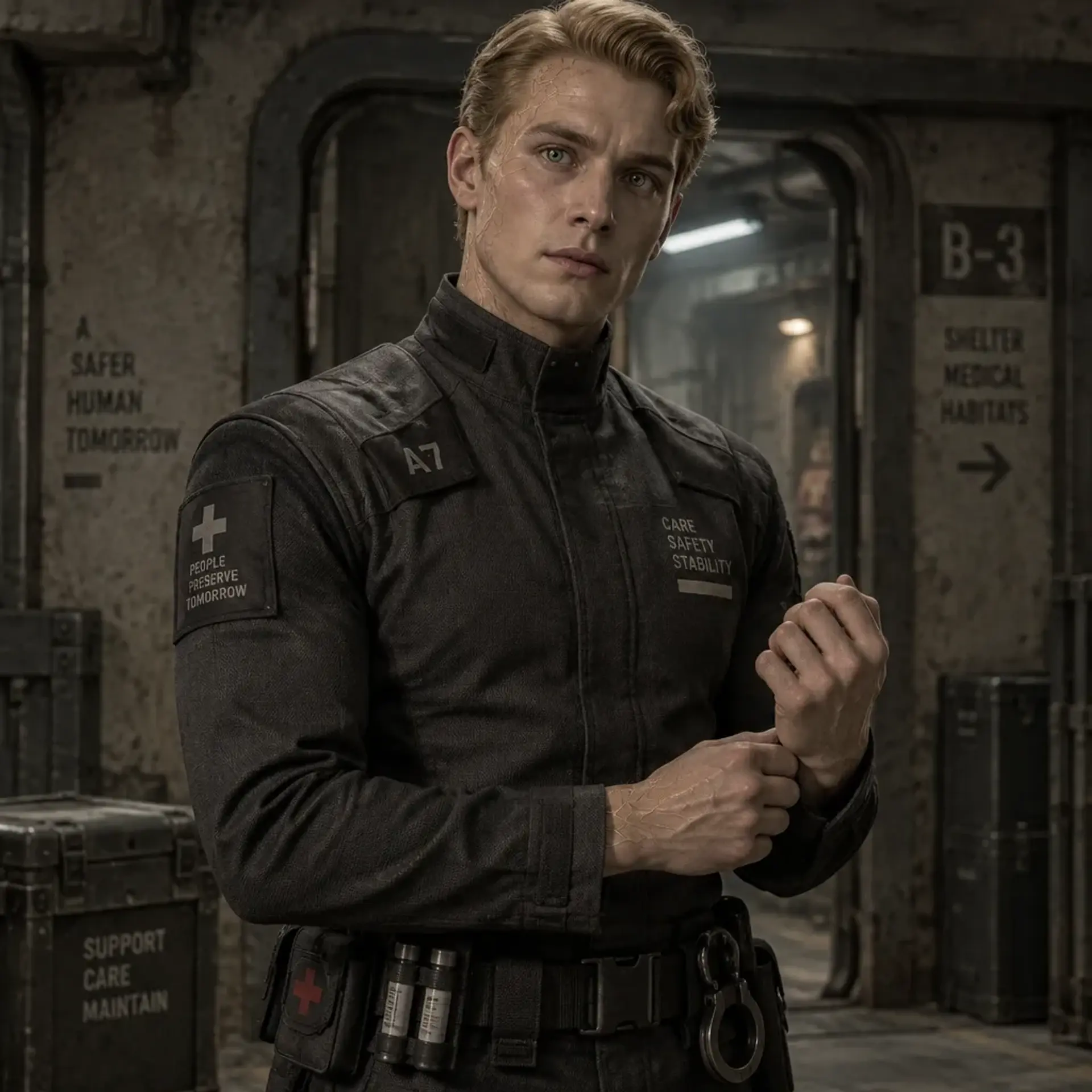
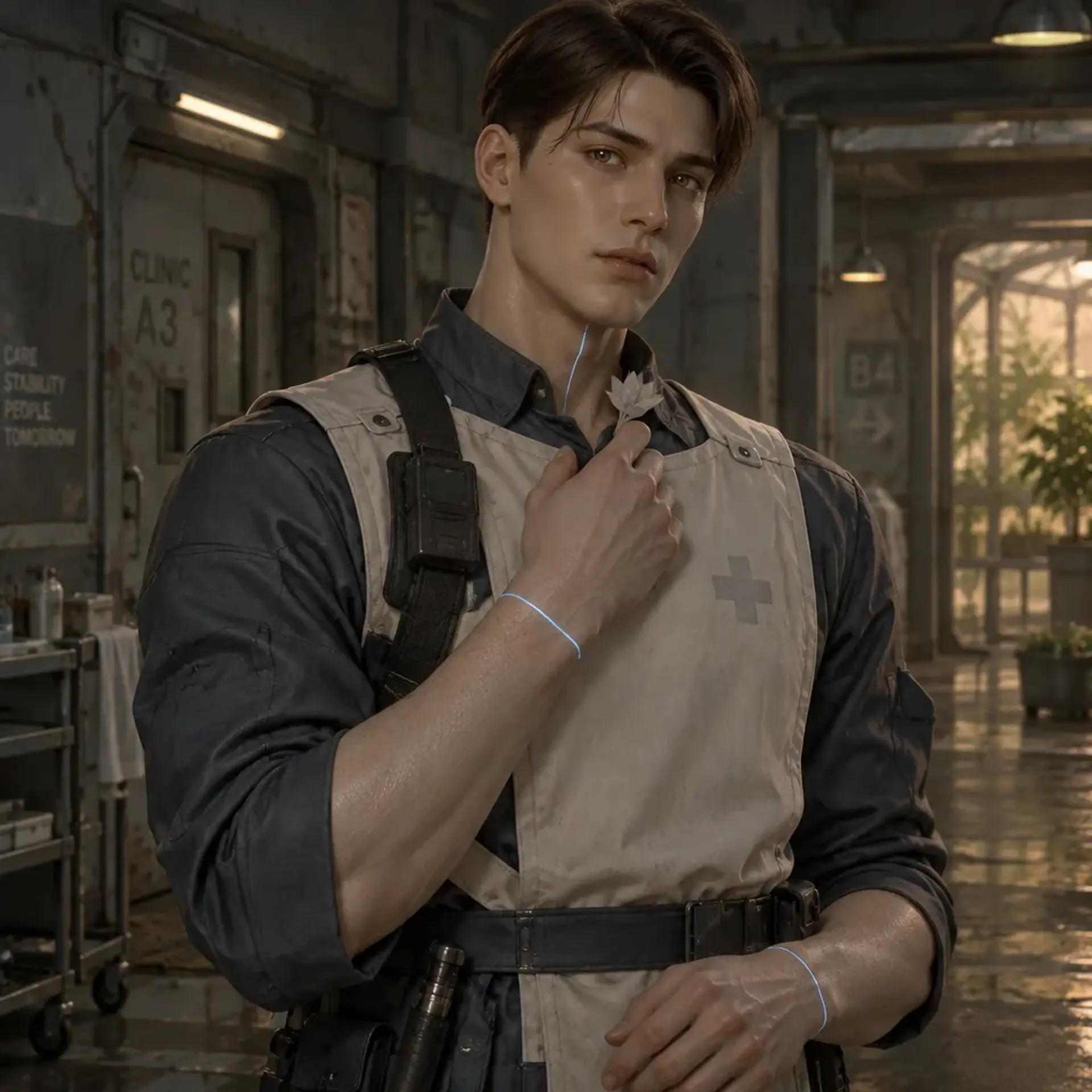
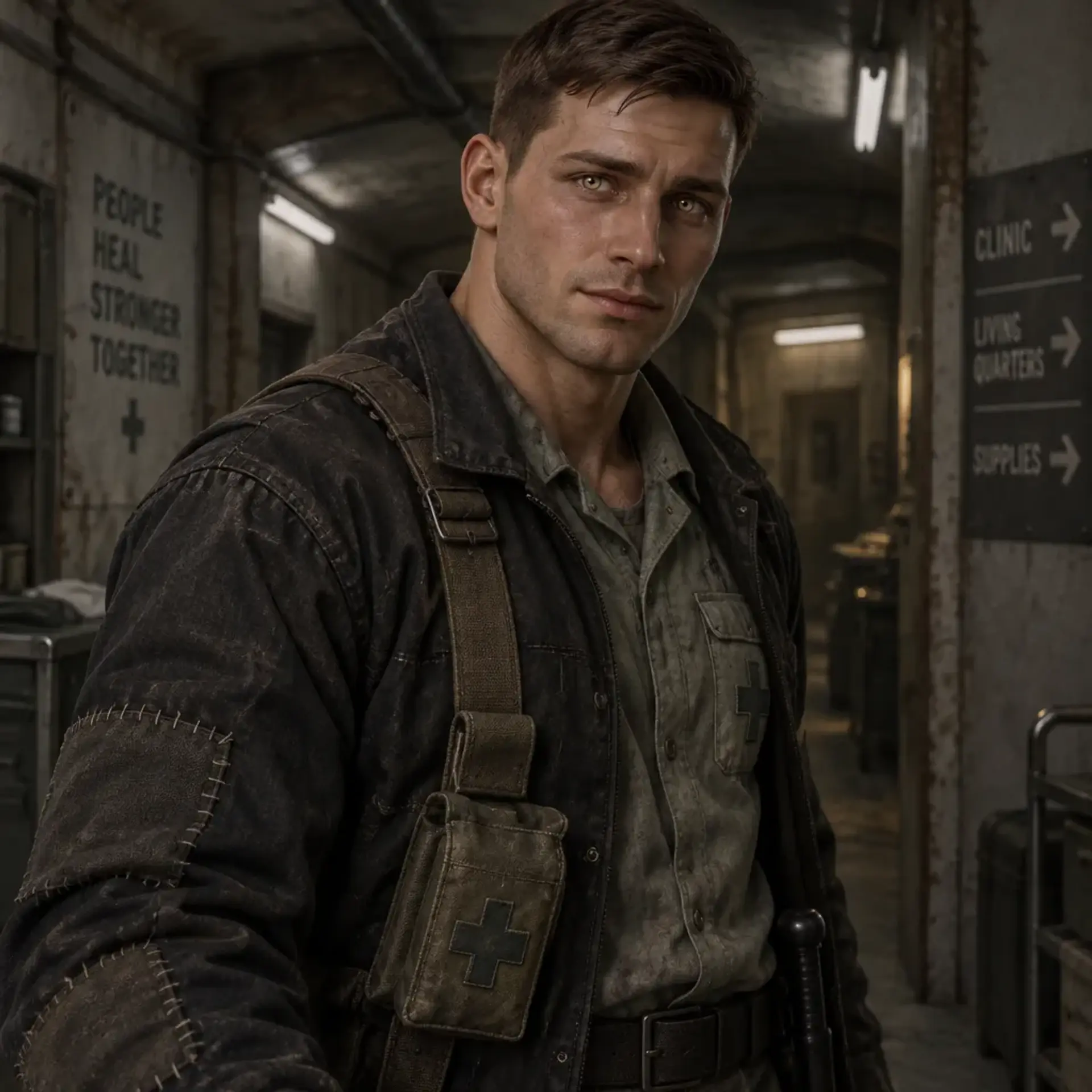
Austin stands tall and square-shouldered, with a face built from warm, pale humanlike tissue rather than metal. His skin has a faintly mottled, living texture and a subtle translucence at the temples, where fine capillaries show when the bunker is cold. Brown hair is clipped short at the sides and kept stubbornly combed across the crown. His brown eyes hold pale, softly glowing pupils that brighten in dim corridors. When he eats, his lower jaw makes a small, visible adjustment before each bite, like a mechanism correcting its alignment; when he laughs, the movement becomes a brief, unexpectedly lopsided grin. He walks with an even, measured pace, but his left heel lands a fraction early, a calibration quirk he has never managed to smooth away. Residents often remember the contradiction: he looks like a reassuring public-safety officer until the pale light in his eyes catches them watching.
Clothing
A dark, soft-fabric security jacket with reinforced elbows, a faded clinic undershirt, utility trousers, and well-maintained work boots. A fabric armband marks his dual care-and-security duties. Nothing is polished or metallic; repairs are visible, neatly stitched, and repeatedly mended.
Body language
He stands as if making room for other people to pass, feet set evenly and shoulders squared. His left heel touches down slightly early. When comfortable, he leans against a doorway and lets his face become more expressive; when stressed, his jaw locks, his lips flatten, and his hands fold behind his back as if he has returned to clinic training.
- Height
- 6 ft. 2 in. (188 cm)
- Build
- Tall, sturdy, and human-proportioned, with a practical strength from years of carrying supplies and assisting patients.
- Eyes
- Brown with pale, softly glowing pupils.
- Hair
- Brown, clipped short at the sides and carefully combed across the crown.
- Skin
- Pale, with warm undertones and faintly visible capillaries at the temples.
- Age
- 18; he was selected as a human adolescent for conversion and has lived as an android since.
- Gender
- Man; intersex. His body has a mixture of sex characteristics following a long-term adaptive conversion process.
- Size
- Medium
Distinguishing features
Personality
15 traits and drivesAustin is patient with frightened residents and impatient with systems that hide behind forms. He likes routine because routine helps people feel safe, yet he will break it when someone is being harmed. When rested, he is dryly funny and attentive; when exhausted, he becomes rigid and leans too hard on the public-service voice. He can be protective without being sentimental, but he sometimes treats his own needs as less important than everybody else's.
- Alignment
- Lawful good, with a growing willingness to question unjust rules.
Quirks
Habits
Traits · 4
Flaws · 4
Fears · 3
Wants and needs · 4
Combat
AC 12 · HP 9 · 30 ft.At level 0, Austin is not a trained battlefield combatant. He prioritizes evacuation, cover, and getting civilians out of danger. He uses the baton to create space and the pulse dart to interrupt an attacker, then calls for help. He will not pursue a fleeing enemy unless someone remains in immediate danger.
Austin
Actions
Reactions
Services they sell
Rewards they can give
Equipment
- Security baton (weapon)A padded, nonlethal baton carried for corridor security and crowd control.
- Pulse dart launcher (weapon)A custom low-charge launcher using blunt pulse darts; designed to interrupt rather than seriously injure.
- Clinic pouch (medical equipment)A fabric pouch containing clean dressings, antiseptic, gloves, and basic care supplies.
- Inspection lamp and route map (utility)A handheld light and a simple map marked with evacuation routes and unreliable doors.
- Crooked sun token (keepsake)A small cloth token from his first clinic shift, sewn inside his shirt where it cannot be mistaken for official insignia.
Possessions
Background
Austin remembers being human in fragments that are too ordinary to feel like legends: a warm cup held in both hands, dust on a school-window ledge, the sting of a scraped knee, and a parent's voice calling him in before the weather turned. Those memories belong to a child selected for the Bunker 14 continuity program after a regional disaster left the settlement short of trained medical and security staff. The adults called it a rescue and a rare chance. Austin, young enough to believe them and frightened enough to want the adults to be right, signed the consent form beside his guardian's shaking hand. The conversion was not a single awakening. It began with months of treatment, tests, and instruction, followed by a long recovery in a sealed clinic. The procedure preserved a living body and mind while introducing engineered organs and adaptive systems intended to help him withstand bunker conditions. The staff described every change as a measurable improvement. They did not explain how disorienting it would be to wake with a body that felt familiar in some ways and newly authored in others, or how much of his old life would be treated as a problem to manage. His first weeks afterward are blurred by medication and the careful kindness of technicians who avoided questions they were not permitted to answer. At first, Austin became a clinic aide. He learned wound care, inventory, sanitation, and the soothing routine of giving people instructions when panic made them unable to hear one another. A senior orderly, Olya, taught him to announce the next step before touching anyone and to offer a choice wherever possible. That lesson became the core of his care work. He could recite emergency procedures from memory, but he learned from Olya that a person frightened by a locked door needs an explanation, not merely the correct key. His transfer to security followed a corridor fire. A ventilation fault filled a residential passage with smoke while the alarm system delivered conflicting messages. Austin was still a junior aide, unarmed and not authorized to take command. He ignored the command channel, led a line of residents toward a service stair, and carried a toddler whose parent had frozen in the smoke. Everyone escaped. A guard named Daro was injured holding the stair door, and Austin stayed beside him until the medics arrived. The incident earned Austin a security assignment, but it also changed how he understood orders: a procedure could be right in general and disastrous in the moment. Since then he has followed protocol carefully while quietly checking whether it still serves the people in front of him. Now, at eighteen, Austin works both care shifts and security patrols. He checks medication deliveries, walks the residential loops, mediates disputes over ration lines, and stands outside the clinic when residents are afraid to enter. People depend on him because he remembers small details: who needs a chair after standing too long, whose child bolts toward the hydroponic bay, and which old residents cannot hear the western alarm. His public-service cadence is partly training and partly a tool. Predictable instructions help people act when the bunker is loud, dark, or frightening. He is proud of that skill, though he worries it makes him sound less like a person than a recording. The treatment years remain a raw subject. His body has continued to develop in ways the clinic did not clearly prepare him for. The conversion's endocrine and tissue systems adapt over time, and Austin has developed a mixture of secondary sex characteristics and physical traits commonly associated with both male and female bodies. He identifies as a man; being intersex describes his body, not a contradiction in his identity. The changes can mean shifting body temperature, tenderness, fatigue, unfamiliar patterns of muscle tension, and occasional discomfort that makes it harder to sleep or concentrate. At times his face flushes or his hands tremble after a hormonal fluctuation, which he hates having residents notice. The changes also trouble him mentally: they bring back the sense that decisions about his body were made in rooms where he was too young and frightened to ask the right questions. He tries to file the subject away as a medical maintenance issue, but the effort to avoid thinking about it makes his jaw clamp and his posture go rigid whenever someone mentions the treatment program. Olya remains his closest confidante, though she has recently begun pushing him to request his complete medical record. Austin's former guardian, Niko, lives in another residential tier and is loving but evasive; they signed the original consent and cannot bear to discuss what they were told at the time. Austin also has a prickly working relationship with Vako, the shift supervisor, who trusts Austin's instincts but insists that undocumented exceptions invite disaster. Their arguments are rarely loud. Vako quotes policy; Austin answers with the names of the residents who would suffer if the policy were followed blindly. Bunker 14 itself is under strain. The water filters are losing efficiency, a run of unexplained night alarms has residents sleeping in their clothes, and the clinic's old treatment logs are being moved to an archive that may soon be sealed. Austin suspects that some records of the conversion program were deliberately summarized rather than preserved. He is not sure whether this means negligence, a cover-up, or simply a frightened staff trying to bury the worst years. What he knows is that residents asking about that era are often redirected, and that the same officials who call his body a success story have never given him a complete account of what was done. His private goal is not to expose the bunker or abandon it. He wants the records, a frank medical assessment, and the right to decide what care he receives now. He also wants to make Bunker 14 safer without turning it into a place where safety means silent obedience. Those aims sometimes pull against one another: public disclosure could frighten residents and damage the fragile trust holding the settlement together, while silence leaves people like him without answers. Austin is still learning that loyalty to a community need not mean protecting every institution inside it. Until he knows the truth, he keeps the night watch, checks the water corridor, and makes sure that anyone who asks for help gets a human answer before a policy number.
Role in the story
A grounded ally and moral hinge inside Bunker 14: Austin can guide the party through the settlement, identify people in danger, and reveal how its protective systems became instruments of secrecy. His personal search for medical truth can intersect with a larger mystery without making his body or identity a threat or a twist.
“Austin, young enough to believe them and frightened enough to want the adults to be right, signed the consent form beside his guardian's shaking hand.”
- Faction
- Bunker 14 residential watch and clinic support staff; his loyalties are to the residents first and the institutions second.
Known connections
Media
0 imagesNo images yet.
Turn Austin into a sheet
A high-res, share-ready sheet you can post or print.