Austin
Austin
At the table
Voice
A thick Texan drawl with a slightly breathy, lived-in texture, shaped by long shifts speaking over an old corridor intercom. His public instructions have the steady rise, pause, and clear landing of an evacuation announcement. In personal conversation, the cadence loosens and his humor comes through. When the treatment years are mentioned, his jaw sets; his words become shorter and more exact, but his volume does not necessarily change.
A thick Texan drawl delivered with the measured rhythm of a public-service broadcast. He spaces instructions cleanly, gives locations before warnings, and repeats important steps without sounding theatrical. His everyday voice has a dry, breathy edge from years of speaking through corridor communicators. Under strain, his jaw tightens and he may switch to clipped, formal phrases; he does not automatically become softer or more polite when angry.
Speech patterns
How to play them
Treat Austin as a capable care worker rather than a puzzle to solve. He responds well to direct questions, patience, and practical offers of help. Do not press him to disclose intimate medical details; if trust develops, he may choose to explain what the treatment years cost him. Demonstrating that residents can handle difficult truths makes him more willing to share them.
Goal
Recover his sealed conversion records, understand who chose him and why, and decide how to share what he learns without endangering Bunker 14.
Motivation
Protect the people who depend on him while reclaiming the right to understand and make choices about his own life.
Appearance
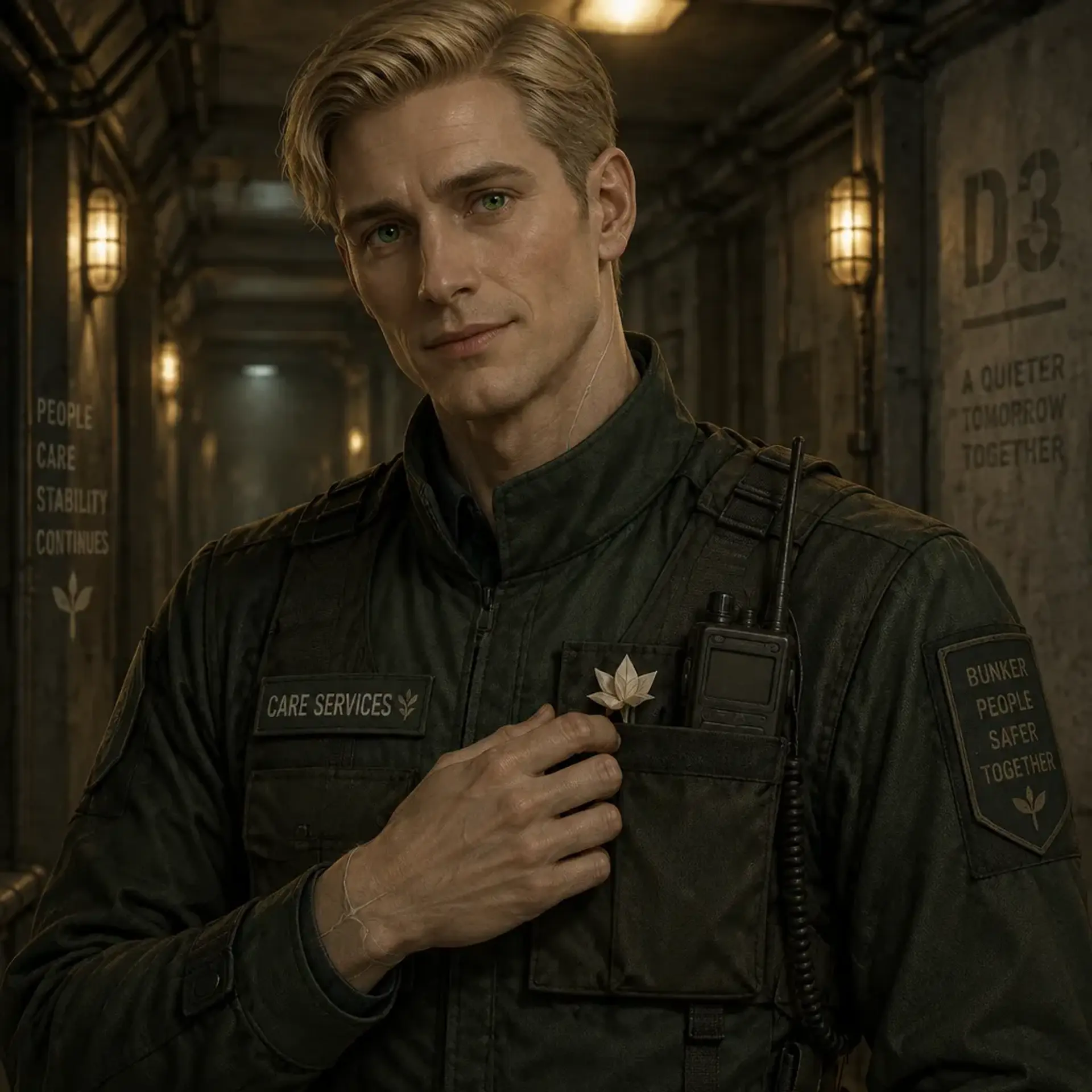
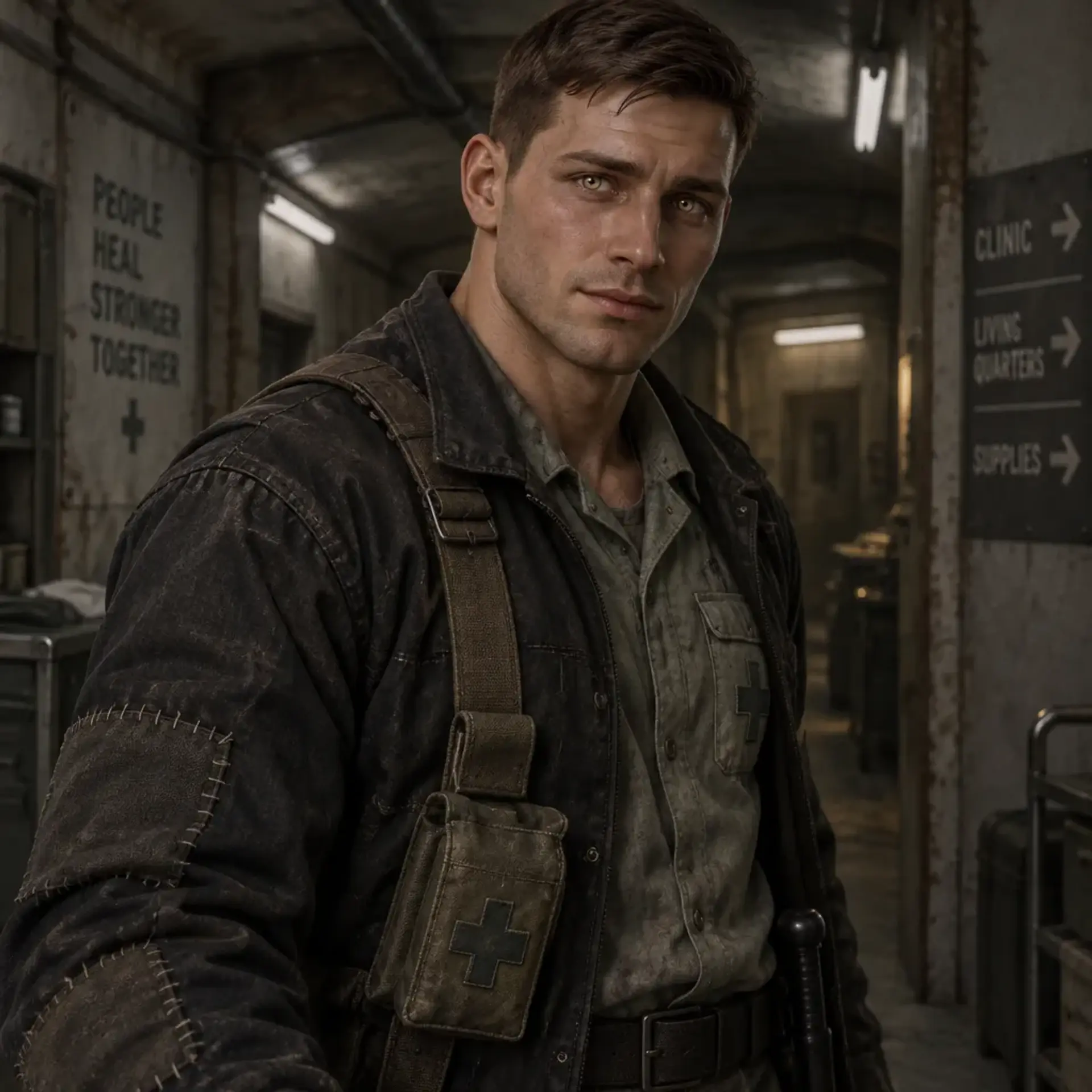
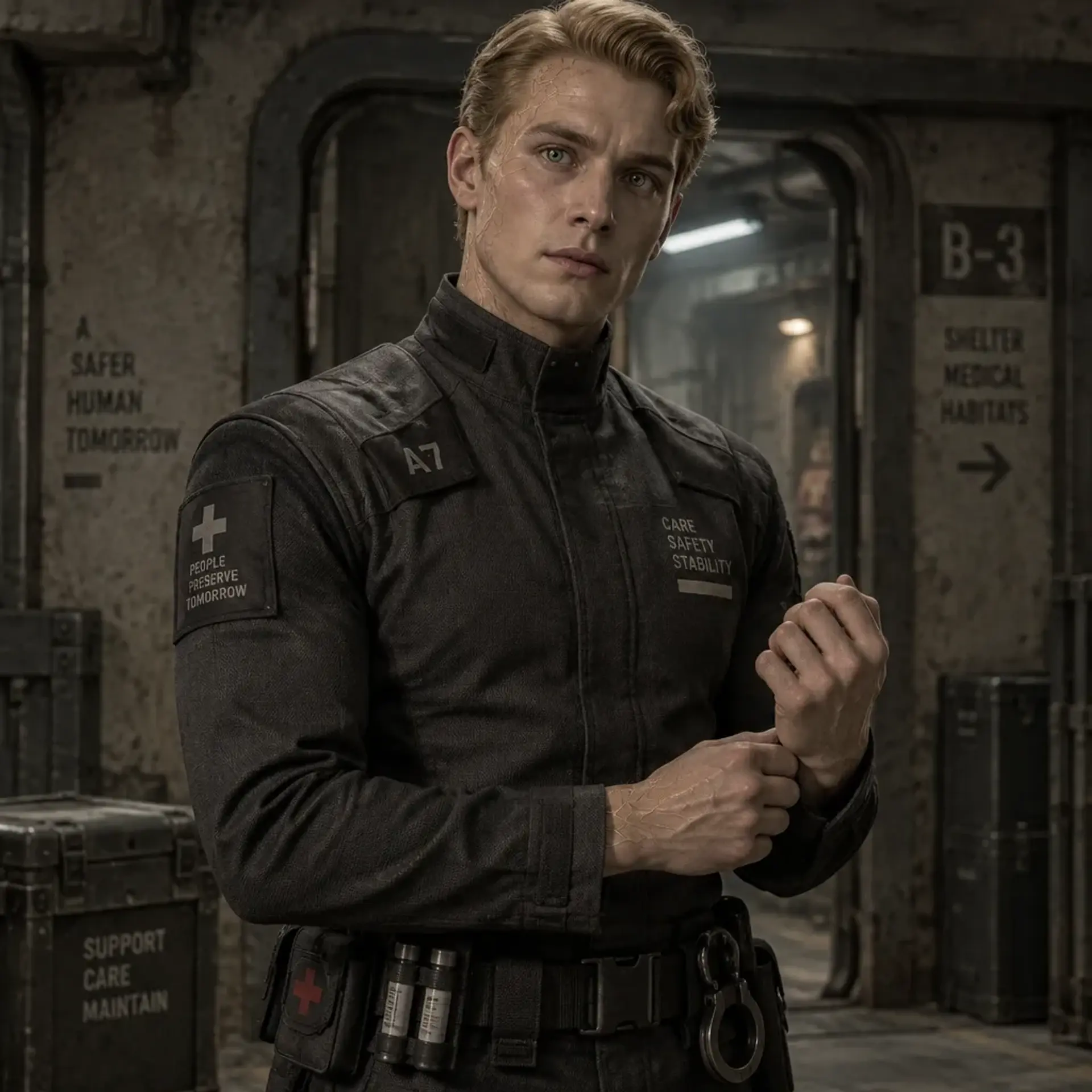
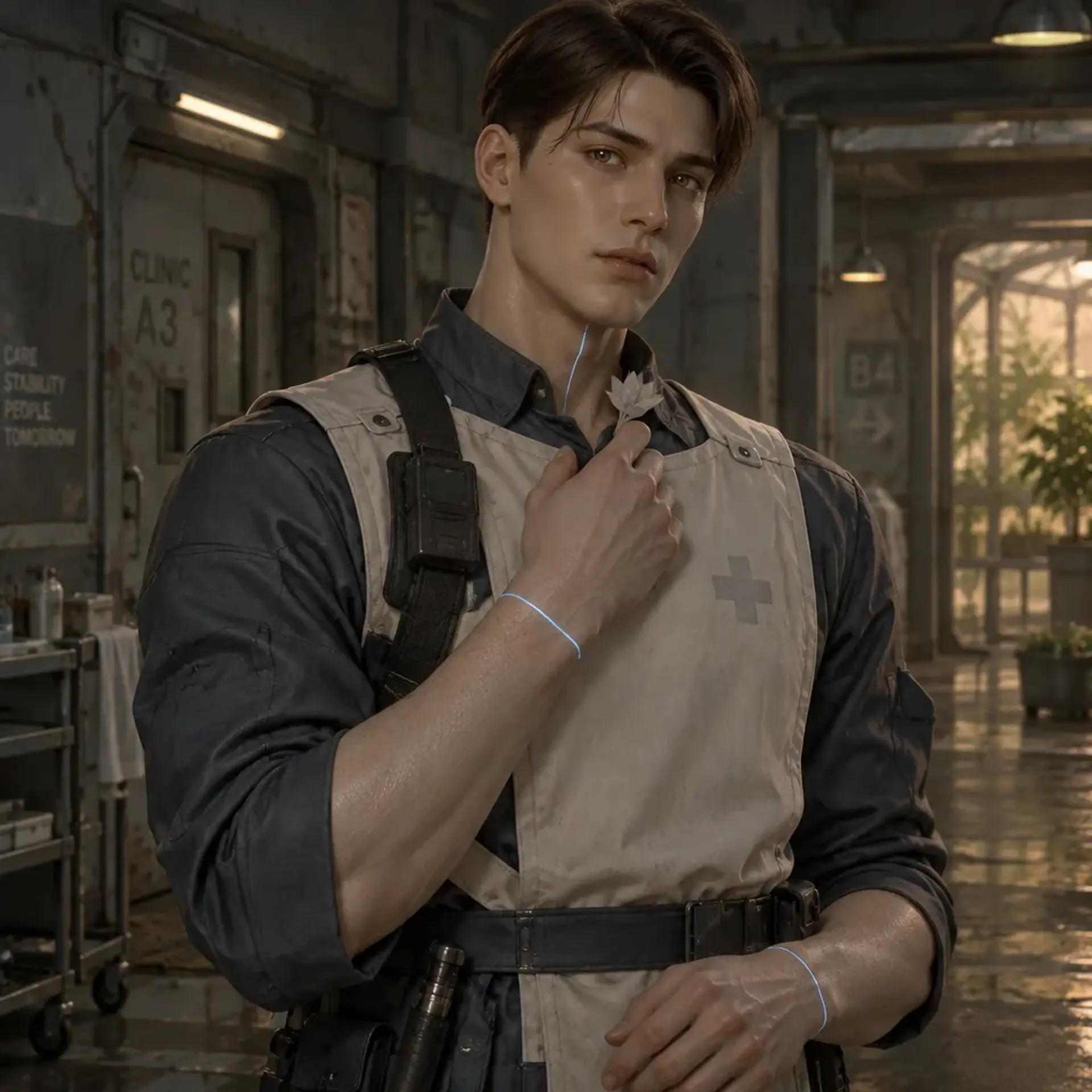
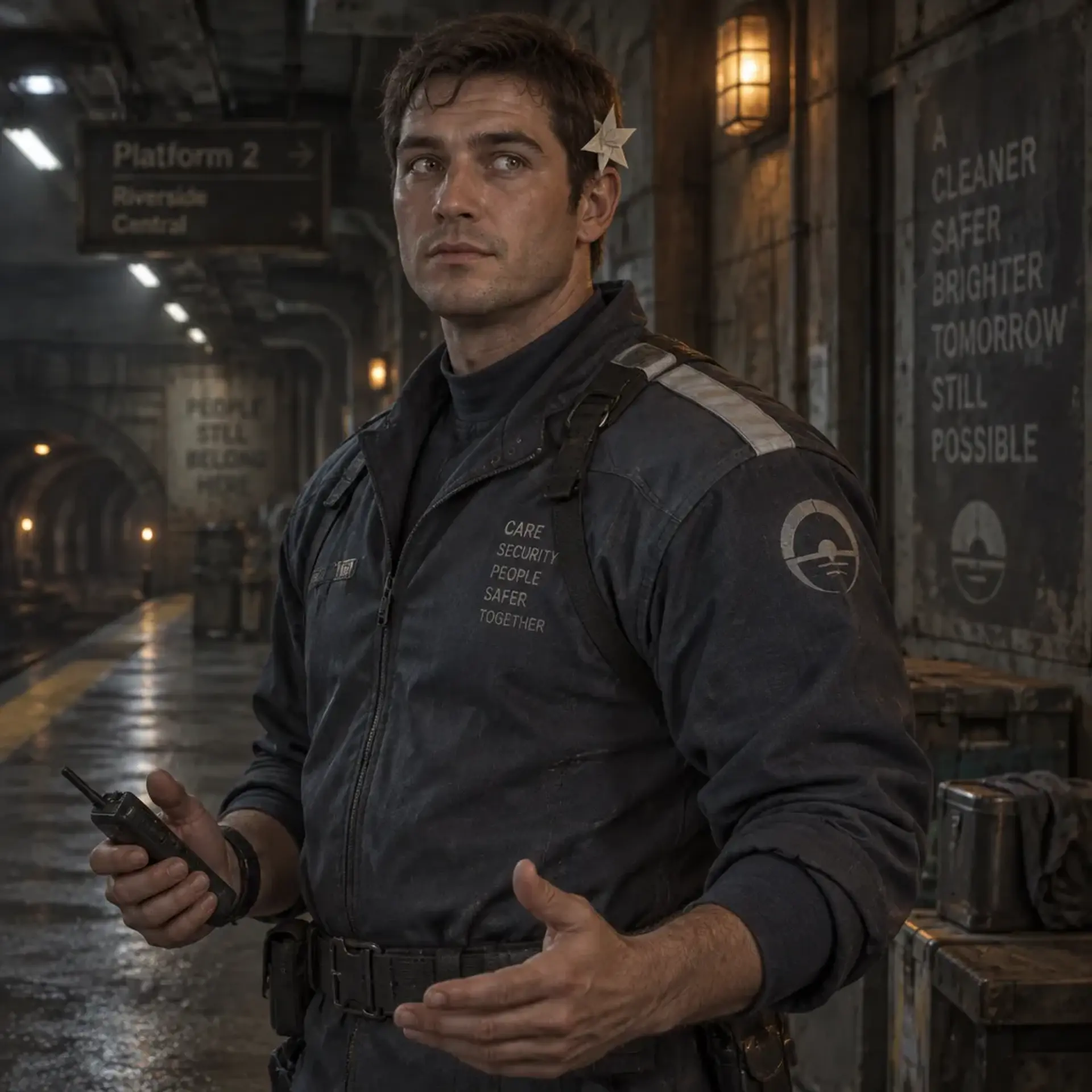
Austin is tall, with a pale, warm-toned complexion that has the faintly satin sheen of living skin over a biomechanical body. Fine pores, tiny freckles, and soft creases make him look human at conversational distance; beneath the skin, subtle cords of muscle shift with an almost too-even precision. His brown hair is clipped short at the nape and kept in a combed, practical wave that never quite stays flat after a shift. Brown eyes sit beneath pale, softly luminous pupils. In a room, his gaze checks hands, doorways, and the people standing behind the person speaking, then returns to the speaker as if he has just remembered that being watched can feel like being inspected. His jaw is broad and mobile, with a neat row of slightly squared teeth. When he eats, he cuts food into exact small pieces and chews with conspicuous care; when he laughs, his jaw opens wider than expected and the laugh arrives in a bright, unguarded burst that surprises people who know him only on duty. He moves with a long, quiet stride, placing each foot as if the floor might be carrying sleeping children. His body has a more feminine silhouette than he wants: a rounded chest, softer waist and hips, and proportions that make some residents misread his role or gender. He wears compression layers for comfort and privacy, not as armor. The unexpected detail is a tiny, immaculate paper star tucked behind one ear, folded from a resident's old medical-chart wrapper; he keeps replacing it whenever a shift knocks it loose.
Clothing
A slate-blue care-and-security uniform with reinforced seams, washable panels, and a pale service stripe at the shoulder. Under it he wears a soft compression layer for comfort and privacy. His boots have quiet, flexible soles. A paper star is usually tucked behind one ear, an unofficial exception to the uniform rules.
Body language
His posture is upright without being rigid, shoulders squared as if he is trying to make himself a dependable landmark. He angles his body between a distressed resident and a crowded doorway, but avoids blocking anyone's exit. When asked about the treatment years, his jaw tightens and his lower teeth press briefly against his upper lip. When he is comfortable, he leans one shoulder against a wall and lets his hands rest open.
- Height
- 6 ft. 2 in. (188 cm).
- Build
- Tall and long-limbed, with a softly rounded, more feminine silhouette that he finds difficult to inhabit comfortably. His living biomechanical tissues are strong enough for routine restraint work but not built for prolonged heavy fighting.
- Eyes
- Brown irises with pale, softly glowing pupils.
- Hair
- Brown, clipped short at the nape and combed into a practical wave.
- Skin
- Pale, warm-toned skin with a faint satin sheen, natural-looking pores, and fine freckles. His body is biomechanical but has no exposed metal.
- Age
- 18
- Gender
- Man; intersex, with mixed sex characteristics. Austin's gender is his own, and his distress centers on imposed bodily changes and lack of informed choice, not on being intersex.
- Size
- Medium
Distinguishing features
Personality
18 traits and drivesAustin is reassuring in a crisis and guarded in a quiet room. He can be warmly attentive to a frightened resident, then stubbornly evasive when someone asks how he himself is doing. He believes rules prevent panic and injury, yet the memory of breaking a lockdown protocol to save residents makes him distrust rules that protect an institution more than a person. He likes being useful but resents being treated as equipment. When tired, he grows formal and literal; when safe, his dry humor and unexpectedly exuberant laugh emerge.
- Alignment
- Neutral Good. Austin follows procedures because they can protect people, but will break them when they become a threat to residents.
Quirks
Habits
Traits · 5
Flaws · 4
Fears · 4
Wants and needs · 5
Combat
AC 12 · HP 9 · 30 ft. walkingAustin prioritizes evacuation, cover, and restraint over injury. He gives a clear warning, positions himself between a threat and residents, and uses his baton or impact launcher only when someone is in immediate danger. If outnumbered, he retreats toward a defensible corridor and calls for help rather than pretending he can win alone.
Austin
Actions
Reactions
Services they sell
Rewards they can give
Equipment
- Padded service baton (weapon)A short, padded restraint baton intended to control movement with minimal injury.
- Impact capsule launcher (ranged weapon)A compact launcher that fires soft impact capsules; limited ammunition and intended for emergency interruption.
- Care pouch (medical gear)A small kit of wraps, antiseptic, dressings, and basic diagnostic tabs for first aid.
- Bunker communicator (communication gear)A handheld receiver for corridor alerts, resident check-ins, and public-service messages.
- Star tin (personal keepsake)A personal tin holding folded paper stars and a reprimand notice from his first unauthorized rescue.
Possessions
Background
Austin remembers being human in fragments rather than in a clean sequence: a school corridor smelling of wet coats, the sting of disinfectant, his mother humming while she counted pills into a weekly case. He was selected for conversion at thirteen, after a respiratory illness and a long period of hospitalization made him an easy candidate for the Bunker 14 continuity program. The program promised that a child with a rare compatible physiology could be preserved, strengthened, and returned to a community in need. Austin remembers a signed consent form, but not signing it. He remembers adults telling him it was temporary, and a technician named Orua saying that the body would be his again when the work was finished. By then, the people who made the decision had already decided what “his body” meant. The conversion did not leave him as a metal machine. Bunker 14’s engineers rebuilt him with living, lab-grown tissues, flexible synthetic nerves, and a designed internal support system that resembled human biology closely enough to fool ordinary examinations. The first years were measured in rehabilitation: relearning balance, swallowing, temperature, pain, and how to tell a false alarm from a real one. He had to practice smiling in a mirror because his first new expressions were too symmetrical. He was frightened of the technicians, but even more frightened that the fear might be a programmed response. His only reliable comfort was a stack of public-service recordings. He memorized their reassuring cadence, then used it to calm himself through physical therapy. At fifteen, Austin began asking what had been changed beyond the visible repairs. The answers were vague: “adaptive tissue,” “long-term stability,” “not relevant to your duty.” His body was changing in ways the clinic's charts did not explain. A redesigned endocrine-like system and the ongoing growth of his living tissues produced a mixture of sex characteristics, some conventionally male and some conventionally female. The changes were gradual: his chest developed, his hips and waist softened, and his face and voice retained traits that people read as masculine. His body is intersex; that is a natural description of his mixed traits, not a sickness or a flaw. He was not given a meaningful choice about the changes, their pace, or how much he would be told. What troubles him is not that intersex people exist, but that he was made to live inside a body whose development was handled as a maintenance decision by people who would not answer him. The physical effects are ordinary in some moments and exhausting in others. Compression garments can chafe during long patrols, and his engineered temperature regulation sometimes makes the skin over his chest feel too warm or too numb. His body’s shifting signals can leave him distracted by a sudden ache, tenderness, or unfamiliar fatigue. He has no reliable map of which changes are finished. Stress worsens his awareness of the mismatch between how he wants to be seen and how residents interpret his silhouette. He often calls it “the treatment years” rather than naming the changes, then hates himself for pretending they are not real. He does not regard his identity as a malfunction, but he resents the people who made intimate decisions for him and left him to manage the consequences alone. The experience that changed him came during a night alarm when he was sixteen. A ventilation fault filled one residential corridor with chemical smoke. Austin had been trained to lock the section until an inspection team arrived. Instead, he heard a child coughing behind a sealed door and broke protocol, guiding seven residents through a service passage. One of them was an elderly cook who had once mocked his public-broadcast voice; she later told him that he sounded exactly like someone who knew where the exit was. The clinic marked the incident as a security failure. Austin kept the reprimand folded in his locker, not as a badge of honor but as a reminder that procedure is only useful when it serves living people. Now he divides his time between resident care and security rounds. He checks bandages, settles arguments over water allotments, walks children to lessons, and takes the late shifts because the quiet is easier than the dayroom. He has a strong working relationship with Orua, the former rehabilitation technician who still tends the infirmary. Orua cares for him, but was part of the system that selected him and has never explained what she knew. Austin visits her office with practical questions and leaves before asking the question that matters. He is also close to Nali, a young hydroponics apprentice who brings him damaged seedlings to diagnose and treats his body as unremarkable. He is protective of Nali, sometimes to the point of deciding what risks she should be allowed to take. Bunker 14 is a settlement built around an old underground transit station. The community's survival depends on a strained water recycler, strict limits on outside excursions, and a council that prefers calm reports to complicated truths. Austin knows the recycler has been failing more often than the public notices. He also knows the clinic has sealed records from the early conversion program in a storage room below the infirmary. Both facts are connected to the same quiet culture of withholding information “for everyone's stability.” Residents trust him because he gives clear instructions and remembers who needs their medication, but some distrust him because he has access to restricted doors and repeats official announcements. Austin wants to retrieve his records, learn who chose him, and find out whether the changes to his body were expected, accidental, or deliberately concealed. He does not intend to expose every private detail about himself to the settlement. He wants the truth without being turned into a warning, a symbol, or a public lesson. At the same time, he is considering whether the records might reveal how to repair the water recycler. If the truth risks breaking the fragile trust that keeps Bunker 14 functioning, he may delay again. That is his central conflict: he believes people deserve honest information, but he has learned to fear what truth can cost when a community is already frightened. Away from duty, Austin folds paper stars from discarded wrappers and labels each one with a resident's name before hiding them in a tin. He claims this is a mnemonic system for people he has helped. The tin is nearly full. He has not decided whether it is a memorial, a promise, or simply proof that the people around him are more than entries in a care log. He is eighteen, still learning what choices belong to him, and trying to build a life that is not just a continuation of the program that made him.
Role in the story
A dependable settlement caretaker whose personal history ties Bunker 14's everyday safety to its concealed conversion program. He can become an ally, a source of practical help, and a living reason for the party to question who gets to decide what counts as protection.
“The program promised that a child with a rare compatible physiology could be preserved, strengthened, and returned to a community in need.”
- Faction
- Bunker 14's resident care and security staff. He follows the council's emergency chain of command but places residents' immediate safety above institutional convenience.
Known connections
Media
0 imagesNo images yet.
Turn Austin into a sheet
A high-res, share-ready sheet you can post or print.