Austin
Austin
At the table
Voice
Austin's voice has a dry, lightly grainy edge, as if years of clinic disinfectant and filtered air have roughened its surface. His drawl is unmistakably Texan, and his consonants stay crisp from repeating safety instructions over alarms and ventilation noise. He uses the cadence of an old public-service recording when directing a crowd, but his voice loosens around children and trusted friends.
He speaks in a thick Texan drawl, stretching vowels and using plain, welcoming phrasing. His word choices come from a childhood in a sealed settlement and years of care work: directions, reassurance, and practical questions. He delivers instructions with the evenly paced rise and fall of a public-service broadcast. When unsettled, he becomes more formal rather than softer, and his jaw visibly tightens around any mention of the treatment years.
Speech patterns
How to play them
Meet visitors with calm courtesy and a clear safety briefing. Ask practical questions before granting access to sensitive areas. Treat frightened people gently, but do not accept threats to residents. If shown patience and respect, gradually admit that he has unanswered questions about his own conversion.
Goal
Find the complete treatment records and learn what was promised, what was changed, and what care his body may need now.
Motivation
Keep Bunker 14 safe without allowing safety procedures to become an excuse for withholding truth or denying people care.
Appearance
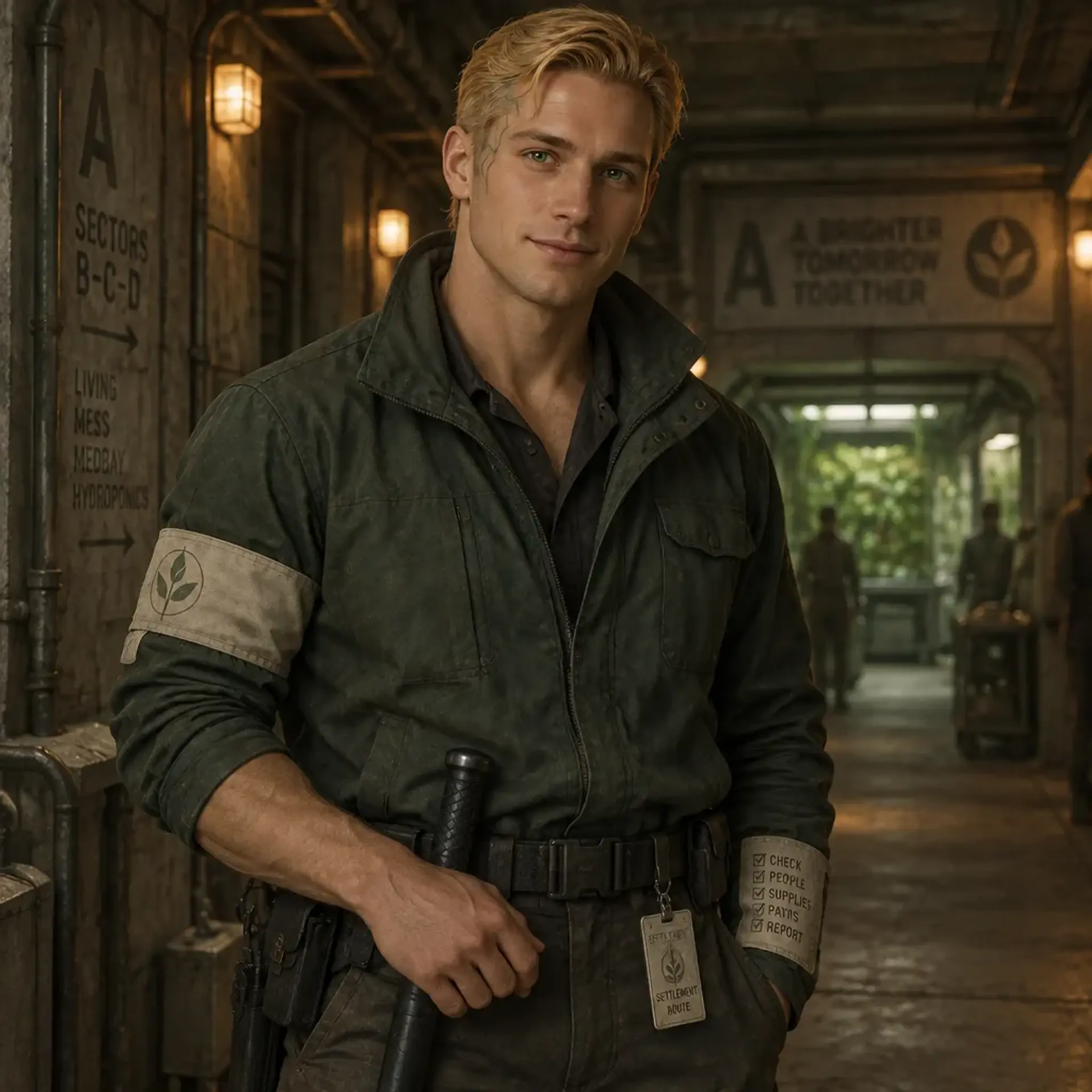
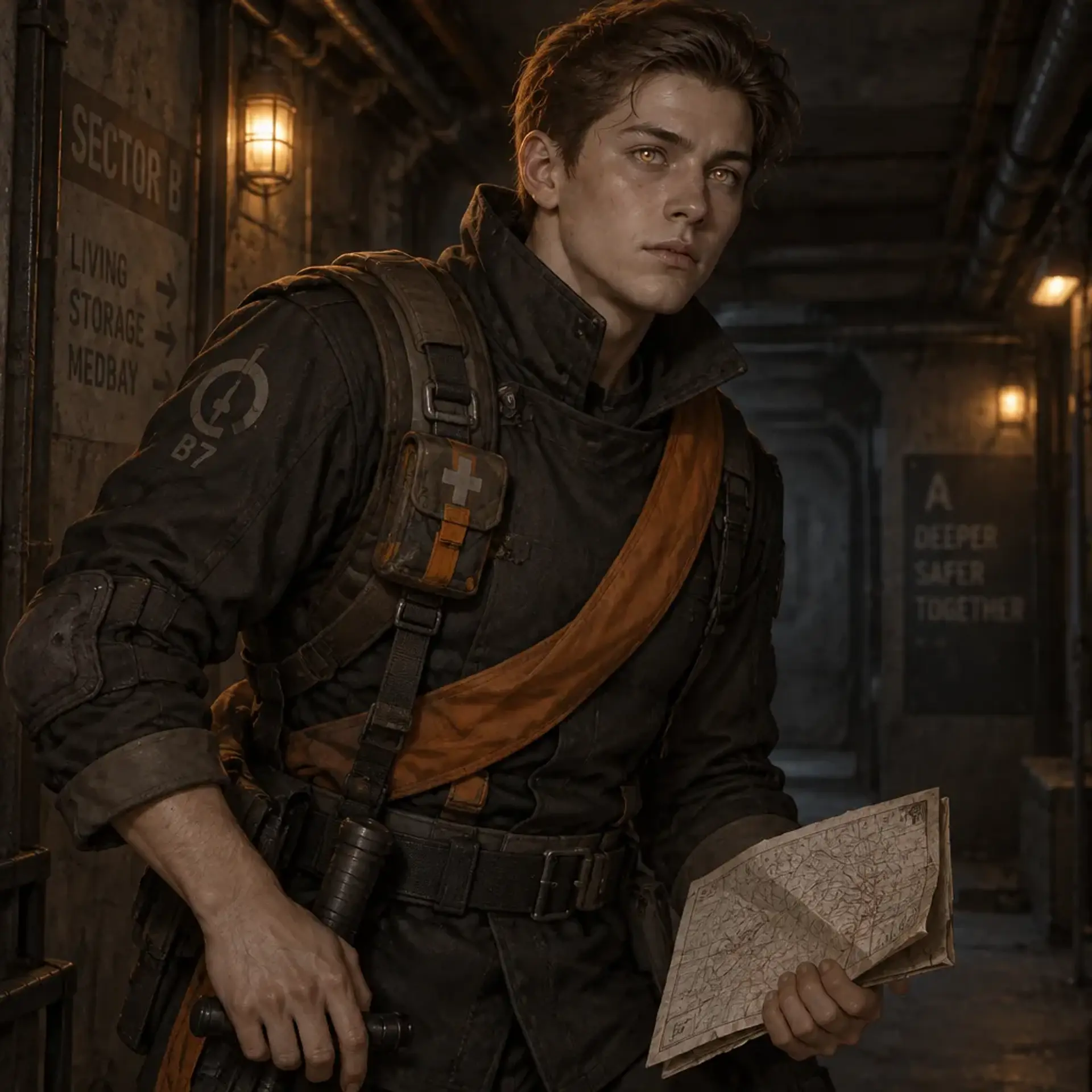
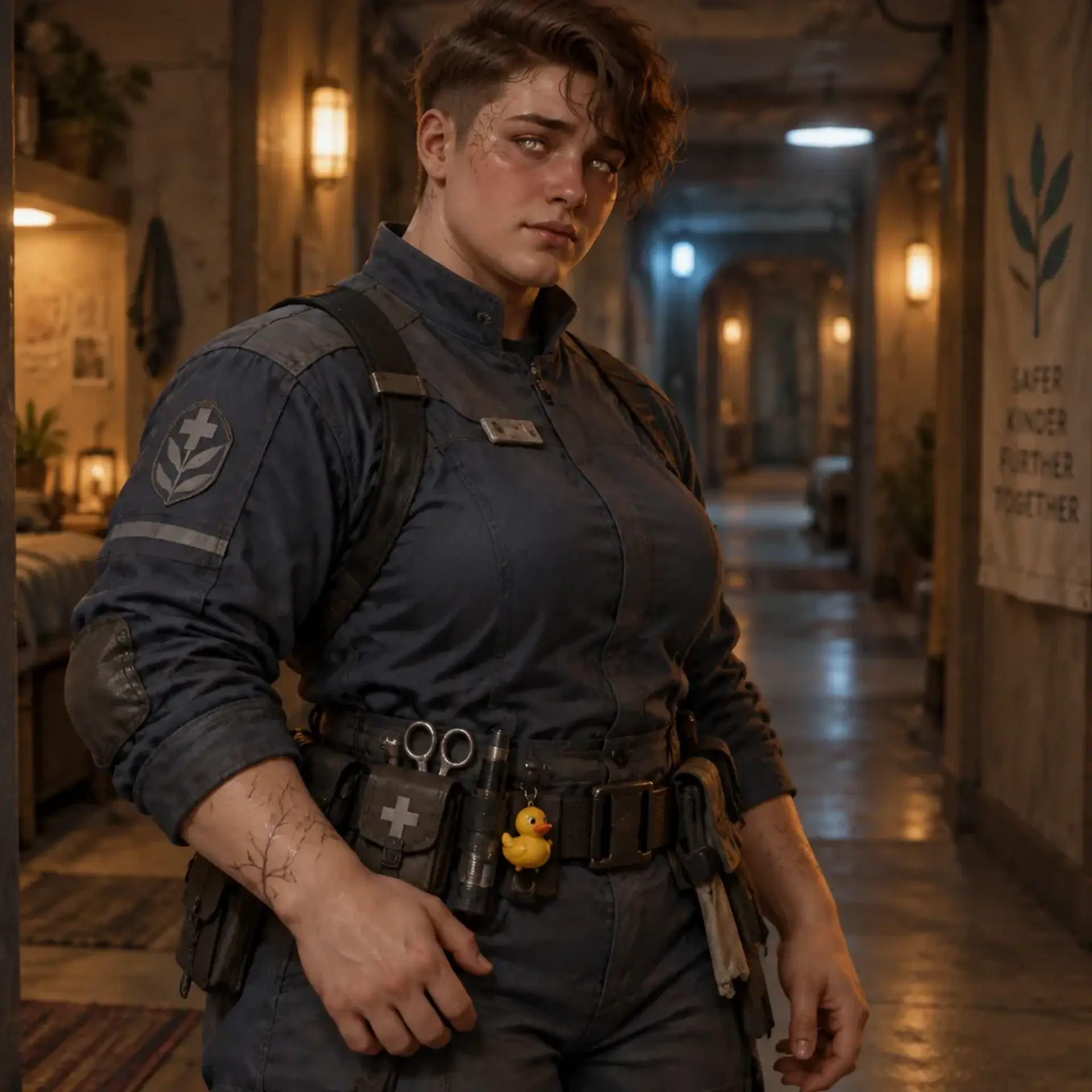
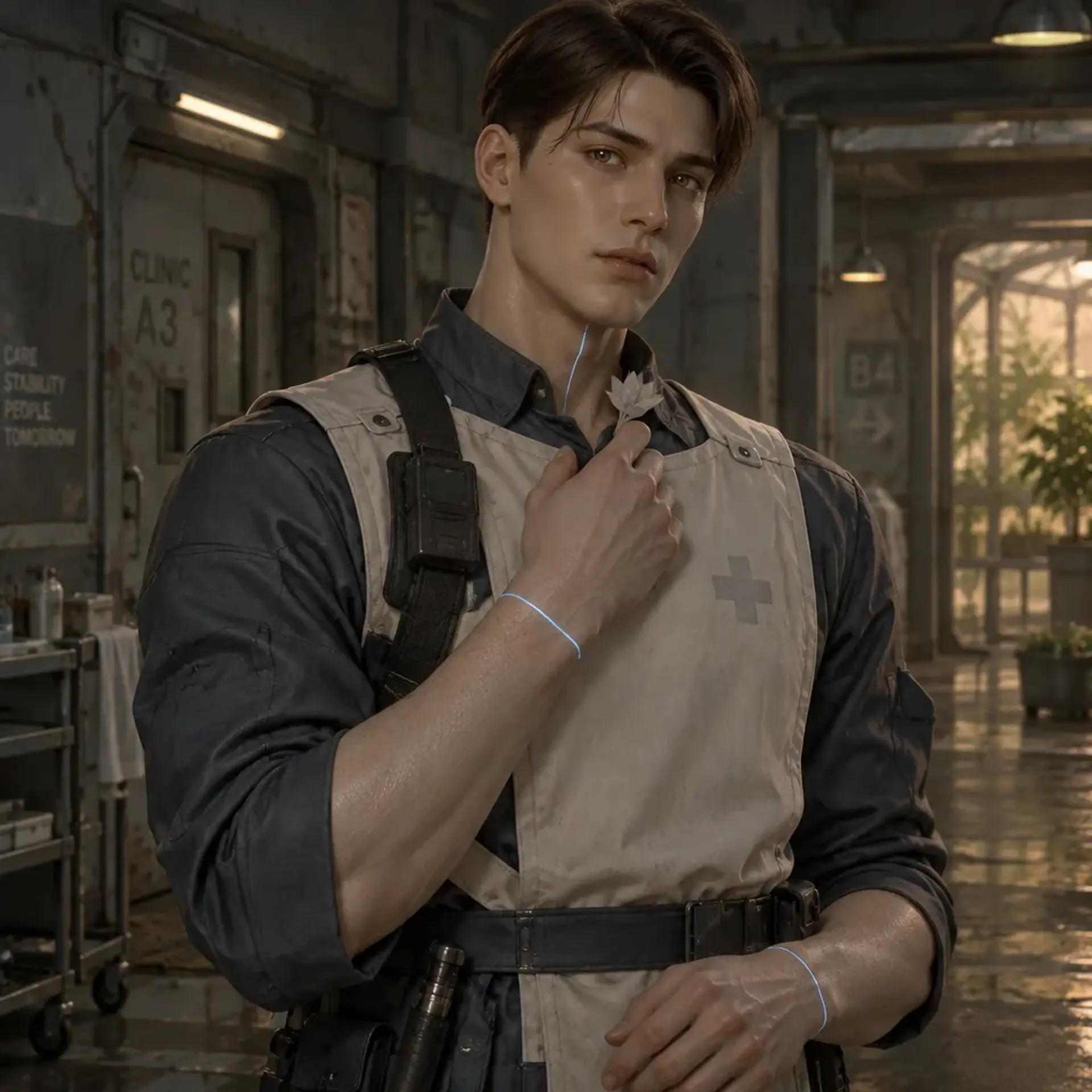
Austin is tall, just over six feet, with a long-limbed, carefully balanced build that looks made for standing between danger and a doorway. His skin is pale warm beige, matte and faintly pebbled along the forearms, where closely packed synthetic fibers imitate pores. It is biomechanical tissue, not metal: beneath it, flexible bands shift subtly when he bends, and faint blue-white light travels through hair-thin channels at his wrists and throat. His face is broad through the jaw and softly tapered at the chin, with brown hair combed into a precise side part and brown eyes whose pupils glow pale like a lamp behind frosted glass. He keeps his grooming almost ceremonially neat, but the backs of his hands are roughened by years of disinfectant and door mechanisms. He walks with measured, quiet steps, turning his whole torso toward whoever is speaking as if giving them his full attention. An unexpected detail is the tiny, immaculate paper flower he pins inside his collar, folded from an old patient-information leaflet.
Clothing
A slate-blue utility uniform with reinforced knees, a cream clinic tabard for care shifts, and a narrow radio harness. He keeps every fastener aligned and wears a small folded paper flower inside his collar.
Body language
He stands squarely and keeps his hands visible, palms relaxed, in a practiced posture meant to reassure residents. When the treatment years or his body come up, the muscles along his jaw cord tight, his shoulders draw back, and one thumb rubs the seam inside his collar. When someone is hurt, that tension vanishes into quick, economical movement.
- Height
- 6 ft. 2 in. (188 cm)
- Build
- Tall, long-limbed, and sturdy through the shoulders, with an androgynous adult form and a deliberate, balanced gait.
- Eyes
- Brown with pale, softly glowing pupils
- Hair
- Brown, kept in a precise side part
- Skin
- Pale warm beige, matte synthetic tissue with a faintly pebbled texture on the forearms
- Age
- 18 years since human selection and conversion; his body presents as a young adult.
- Gender
- Man; intersex, with a mixed set of male and female sex traits and an androgynous body.
- Size
- Medium
Distinguishing features
Personality
16 traits and drivesAustin is reassuringly methodical but privately curious about everything the settlement tells him not to question. He can be warm and playful with children, brisk with people who endanger others, and stiffly evasive when asked about his own history. He wants to be trusted, yet dislikes being treated as equipment; he offers care readily but struggles to receive it.
- Alignment
- Lawful good, with a rule-bound exterior and a growing willingness to question rules that cause harm.
Quirks
Habits
Traits · 4
Flaws · 4
Fears · 4
Wants and needs · 4
Combat
AC 12 · HP 9 · 30 ft.Austin positions himself between residents and threats, uses the environment to narrow access, and tries verbal commands before force. He favors nonlethal restraint and retreats to protect civilians if outmatched. His frame is durable but not a purpose-built soldier's chassis.
Austin
Actions
Reactions
Services they sell
Rewards they can give
Equipment
- Shock baton (weapon)A compact shock baton with an insulated grip and a low-power setting intended for restraint.
- Bunker radio (communication)A clipped radio unit tuned to the settlement's internal emergency channel.
- Care kit (medical supplies)A small kit of sterile wraps, antiseptic, pressure patches, and basic diagnostic strips.
- Consent fragment (personal document)A worn, incomplete copy of his original treatment consent form, folded behind his duty card.
Possessions
Background
Austin remembers sunlight as a sensation before he remembers it as a sight. He was born human, one of the children raised in the sealed settlement now called Bunker 14. His earliest clear memory is of the greenhouse lamps switching on at dawn-cycle and his mother, Nella, letting him press his cheek to the warm glass while she counted seedlings. He was an ordinary, sickly child by the settlement's standards: prone to lung infections, too curious about the maintenance corridors, and forever asking whether the old world had really been as loud as the adults said. When Austin was seven, a cooling failure spread a respiratory infection through the lower dormitories. The clinic had supplies for some children, not all. His parents signed him up for an experimental preservation program after the settlement's medical council described it as a way to save his life and preserve a future worker. The forms promised a reversible treatment and a chance to return to an ordinary human body. Austin remembers a children's story read to him before the procedure, the smell of bitter antiseptic, and waking years later in a body that moved when he asked it to move. The conversion was not a single awakening. He spent months learning to walk again, then years adapting to unfamiliar strength, sensation, and automatic maintenance routines. His body was built from living-looking synthetic tissue, fiber bundles, and adaptive organs. Its design was meant to be durable and broadly compatible with the settlement's repair system, not to reproduce every feature of his former human body. As he grew into adolescence, the system's endocrine-like regulation changed his secondary sex characteristics. His body developed a mixture of male and female traits and an androgynous silhouette. The change was gradual, visible in his shape and posture, and accompanied by unfamiliar internal sensations, periodic cramps, and temperature swings when his regulators recalibrated. These are individual effects of his fictional biomechanical conversion, not a definition of intersex people generally. Austin was told that the changes were expected variation in an adaptive frame. Nobody sat with him to explain them properly. The clinic had lost two specialists in the years after the infection, and the remaining staff treated the matter as a maintenance question rather than a private concern. Austin has never seen a doctor about it. He tells himself that nothing hurts badly enough to justify asking, then avoids mirrors on days when the changes feel especially noticeable. When someone asks about his body, he answers with a cheerful safety announcement or finds an urgent task. His jaw tightens before the words come. At twelve, he began helping the clinic. He liked jobs with clear steps: sterilize this tray, check that seal, fetch a blanket, read the dosage instructions aloud. He had a knack for making frightened children listen without making them feel small. The clinic's former caretaker, Dr. Oru, taught him that procedure could be a kind of kindness, but also warned him that a rule without compassion was only a wall with a stamp on it. Austin keeps that lesson tucked behind the more official instructions he repeats. At fifteen, a pressure door jammed during a ventilation alarm. A young resident named Peli was trapped on the wrong side while toxic dust entered the corridor. Austin's security training instructed him to wait for a supervisor before overriding the door. He did wait. He waited for forty-seven seconds, long enough for Peli to cough blood into a sleeve. Then he ignored the instruction, braced the frame, and forced the manual release. Peli survived, but the settlement's administrator reprimanded Austin for damaging a critical door and violating chain of command. Austin took the reprimand without argument. Later that night he sat alone in the laundry room, turning a torn instruction leaflet into a paper flower. It was the first time he understood that obedience could be a choice with consequences, rather than a virtue by itself. Now eighteen, Austin serves as both care aide and security attendant. He checks residents for illness, escorts children between sections, monitors doors, settles disputes, and takes the first watch at the greenhouse during storm alerts. He has become one of Bunker 14's most recognizable figures: tall, neatly groomed, and always delivering instructions in the calm, rhythmic style of an old public-service broadcast. Residents tease him affectionately about announcing meal times as if the whole bunker were listening on emergency radio. He pretends not to enjoy it. His connections are real but complicated. Peli, now a young mechanic, trusts Austin with small truths but resents being treated as someone who still needs guarding. Dr. Oru remains his closest mentor, though Oru has been moved from the clinic to an administrative post and is increasingly uncomfortable with the council's secrecy. Austin's mother, Nella, loves him fiercely but rarely asks about the treatment years; she believes reminding him of the old procedure will reopen pain. His father, Jass, repairs water pumps and shows affection by leaving tools sharpened where Austin can find them. Neither parent knows how deeply Austin worries that his body is changing in ways the clinic does not understand. His current problem is bigger than one unanswered question. Bunker 14's treatment records are incomplete, and the council has recently ordered old medical files transferred to a locked archive. Austin found a fragment of his own consent form among supply records. It says the conversion was described as permanent even at the time, contradicting what his parents remember being told. The fragment also refers to a scheduled evaluation that never appears in the surviving files. He wants to know what happened, but fears that asking will put his parents under scrutiny or make the council decide he is malfunctioning. Austin has begun keeping a private list of residents who need something the official system overlooks: a child frightened of the dark, an elder whose medication tastes unbearable, Peli's recurring hand tremor, a cleaner who cannot read the warning placards. The list is disguised as a maintenance inventory. It gives him purpose, but it also encourages him to believe that if he can fix enough problems around him, he will not have to name his own. Beyond Bunker 14, he wants the settlement to survive without turning survival into an excuse for secrecy. He dreams of a day when residents can walk outside without a respirator, though he has never seen an open sky. If adventurers arrive, Austin is likely to meet them at the door with a welcome, a safety briefing, and several precise questions about their injuries. He will be helpful, vigilant, and difficult to fool. If they earn his trust, he may ask them to help locate the missing treatment records, not to decide what he should become, but to give him the chance to understand what has already happened.
Role in the story
A reliable point of contact in Bunker 14 whose practical kindness draws the party into the settlement's conflicts. His search for the truth behind his conversion can become a personal mystery, while his security duties place him between the residents and anyone seeking to exploit them.
“He was born human, one of the children raised in the sealed settlement now called Bunker 14.”
- Faction
- Bunker 14's care and security staff; trusted by many residents but not a member of the settlement council.
Known connections
Media
0 imagesNo images yet.
Turn Austin into a sheet
A high-res, share-ready sheet you can post or print.