Caedran Justicar
Caedran Justicar
At the table
Voice
A deep, restrained baritone like a bronze bell beneath rain
His voice is low, clear, and measured, with the resonance of a bell heard through courthouse walls. He pauses before names, never before titles. When moved by compassion, his voice becomes softer but not warmer, as if kindness itself must be carefully protected from sentimentality.
Speech patterns
How to play them
Caedran offers players a hearing rather than a quest. He asks what they saw, what they assumed, what they benefited from, and what they are willing to repair. He rewards honest uncertainty more readily than confident righteousness. Characters who admit wrongdoing may gain his assistance, while characters who conceal harm may find doors, witnesses, and magical advantages closing around them. He never demands worship as the price of aid, but he does demand accountability.
Goal
To prevent his faith from becoming a cult of punishment and establish a living code of judgment that includes restitution, context, and mercy
Motivation
To make justice accessible to the powerless without allowing mercy to become favoritism
Appearance
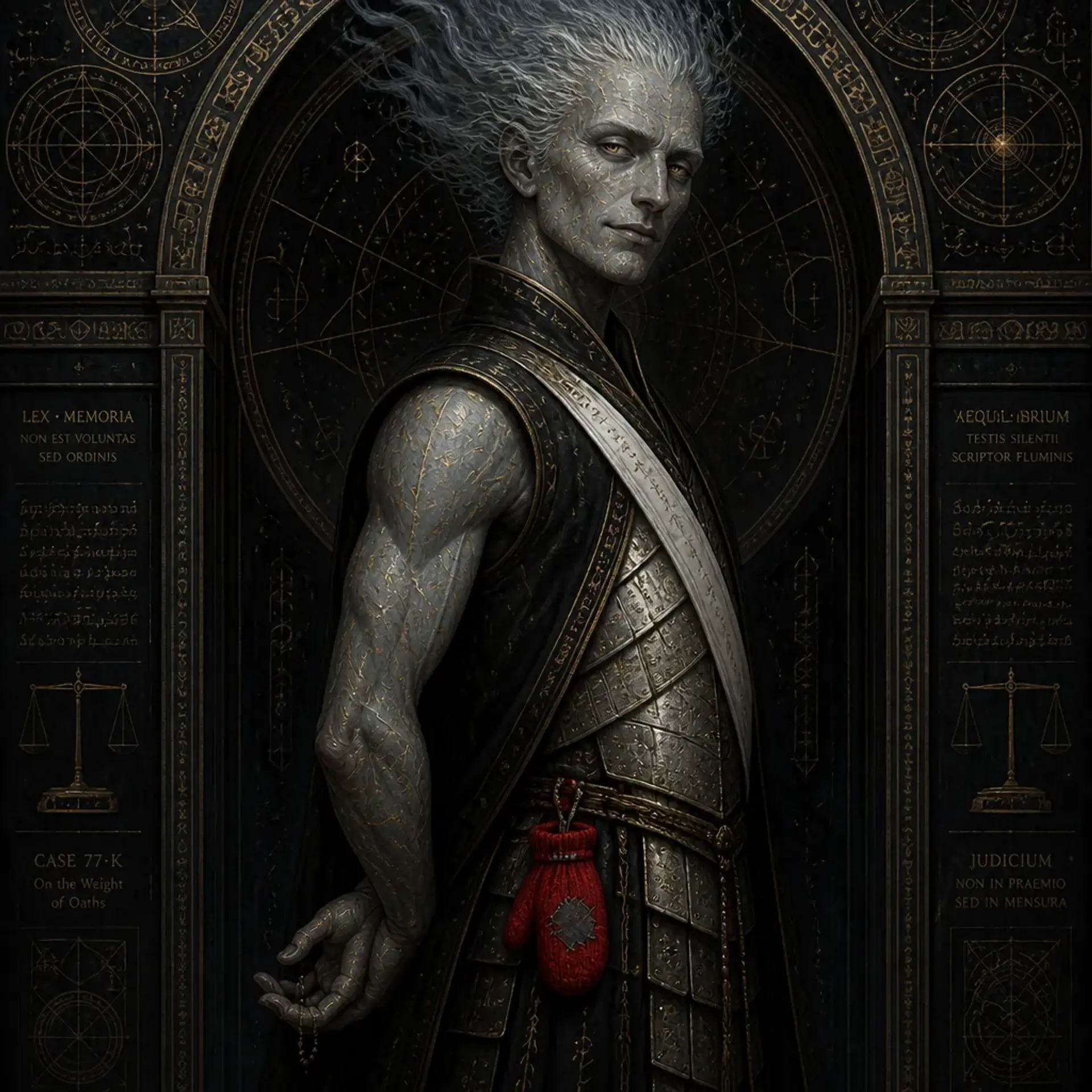
Caedran appears as a tall, narrow-shouldered outsider whose body seems assembled from dusk, tarnished silver, and faintly luminous parchment. His skin has the texture of cool river stone, veined with thin gold lines that shift whenever someone nearby speaks an intentional falsehood. His movements are exact and economical, with each turn of the head resembling the careful motion of a magistrate examining evidence. His face is severe and almost handsome, except that his mouth is slightly crooked, as though he is perpetually resisting a smile. His shadow points toward the person in the room with the greatest unacknowledged guilt, even when the light comes from another direction. Despite his austere presence, he carries a tiny red knitted mitten tied to his belt, a surprisingly tender object that clashes with his otherwise monumental appearance.
Clothing
A sleeveless black judicial mantle layered over overlapping plates of dull silver inscribed with obsolete laws. A white sash crosses his chest and bears no symbol, title, or name. His boots are made from dark lacquered wood and leave faint ink-like footprints. The tiny red mitten at his belt is worn, patched, and unmistakably handmade.
Body language
Caedran stands with his hands folded behind his back, fingers moving as though counting invisible beads. He turns his entire body toward whoever is speaking, never merely his head. When someone invokes rank or divine favor, he tilts slightly to one side, as though the speaker has placed an uneven weight on a scale. His rare smiles are small, startled, and immediately hidden.
- Height
- 8 feet 2 inches
- Build
- Lean and towering, with the tensile strength of a drawn bow and the stillness of a statue
- Eyes
- Pale amber, with rectangular pupils resembling narrow windows
- Hair
- White-gray, fine as spun wire, drifting upward as though underwater
- Skin
- Cool gray stone with faint gold veins that move like writing beneath the surface
- Age
- Older than the oldest surviving legal code, though he appears to be in his early fifties
- Gender
- Male-presenting
- Size
- Large
Distinguishing features
Personality
19 traits and drivesCaedran is precise, stern, and deeply concerned with fairness. He distrusts secret authority because he has seen hidden decisions become unanswerable cruelty. He can seem cold while weighing evidence, yet he regards impartial judgment as one of the highest forms of compassion. With strangers, he is formal and unexpectedly patient. With his followers, he is demanding and sometimes severe because he believes devotion should never excuse misconduct. Around children, grieving witnesses, and people who have been ignored by institutions, his reserve softens into careful gentleness. He is generous with second chances when they include meaningful repair, but merciless toward those who mistake forgiveness for freedom from consequences.
- Alignment
- Lawful Neutral with compassionate impulses
Quirks
Habits
Traits · 5
Flaws · 5
Fears · 4
Wants and needs · 5
Combat
AC 21 · HP 178 · 40 feet, hover 40 feetCaedran begins by identifying the most influential combatant and stripping away advantages based on authority, concealment, or deception. He uses Open Court to prevent escape and Weigh the Heart against enemies who manipulate allies. He avoids killing whenever possible, preferring restraint, public confession, and reparative bargains. If innocents are threatened, he becomes dramatically more forceful, using Accusation Made Flesh and his legendary actions to disable leaders first. He will accept a tactical retreat if remaining would cause collateral harm.
Caedran Justicar
Spells
Actions
Reactions
Legendary Actions
Services they sell
Rewards they can give
Equipment
- Verdict Blade (divine weapon)A narrow silver sword engraved with the names of people wrongly condemned throughout history
- The Unbribable Scales (divine focus)A pair of black iron scales that balance according to intent, consequence, and remorse rather than physical weight
- The Last Witness (sacred keepsake)A red knitted mitten made by the child's mother before the Trial of Nine Ashes
- Ledger of the Unheard (relic)A blank book whose pages fill with the names of people denied a fair hearing
Possessions
Background
Caedran was not born as a god. He began as the final surviving witness to the Trial of Nine Ashes, a public judgment in which a city sacrificed an innocent child to preserve the reputation of its ruling council. Caedran's mortal name has been deliberately erased from history, but his refusal to accept the verdict became so powerful that it attracted the attention of forgotten cosmic principles. He died standing in the courthouse doorway, holding the child's red mitten, and rose three nights later as a lesser deity of impartial judgment. In his first century of divinity, Caedran dismantled secret tribunals, exposed hereditary corruption, and forced several benevolent rulers to answer publicly for necessary but cruel decisions. His greatest formative experience came when a revolution he supported executed hundreds of minor officials without distinguishing coercion from guilt. Caedran realized that fairness without mercy could become another instrument of tyranny, and since then he has struggled to temper exact judgment with context. He now maintains the Hall of Open Doors, a wandering courthouse that appears wherever power is being exercised without accountability. His current crisis is a growing faction of priests who want to turn him into a god of punishment rather than judgment.
Role in the story
Caedran can serve as a demanding patron, a neutral judge between rival factions, or a dangerous obstacle when the heroes seek to conceal a necessary crime. He may summon the party to testify about an event they thought was unrelated to divine politics. Later, they may discover that Caedran's greatest enemy is not a villain but the increasingly punitive interpretation of his own faith. The players might help him recover Little Red's spirit, expose the Ors Vey conspiracy, or force him to confront a judgment he has avoided for centuries.
“He died standing in the courthouse doorway, holding the child's red mitten, and rose three nights later as a lesser deity of impartial judgment.”
- Faction
- The Concord of Open Doors, the Hall of Open Doors, independent judges and whistleblowers, and a small but influential cult of restorative justice
Known connections
Media
0 imagesNo images yet.
Turn Caedran Justicar into a sheet
A high-res, share-ready sheet you can post or print.