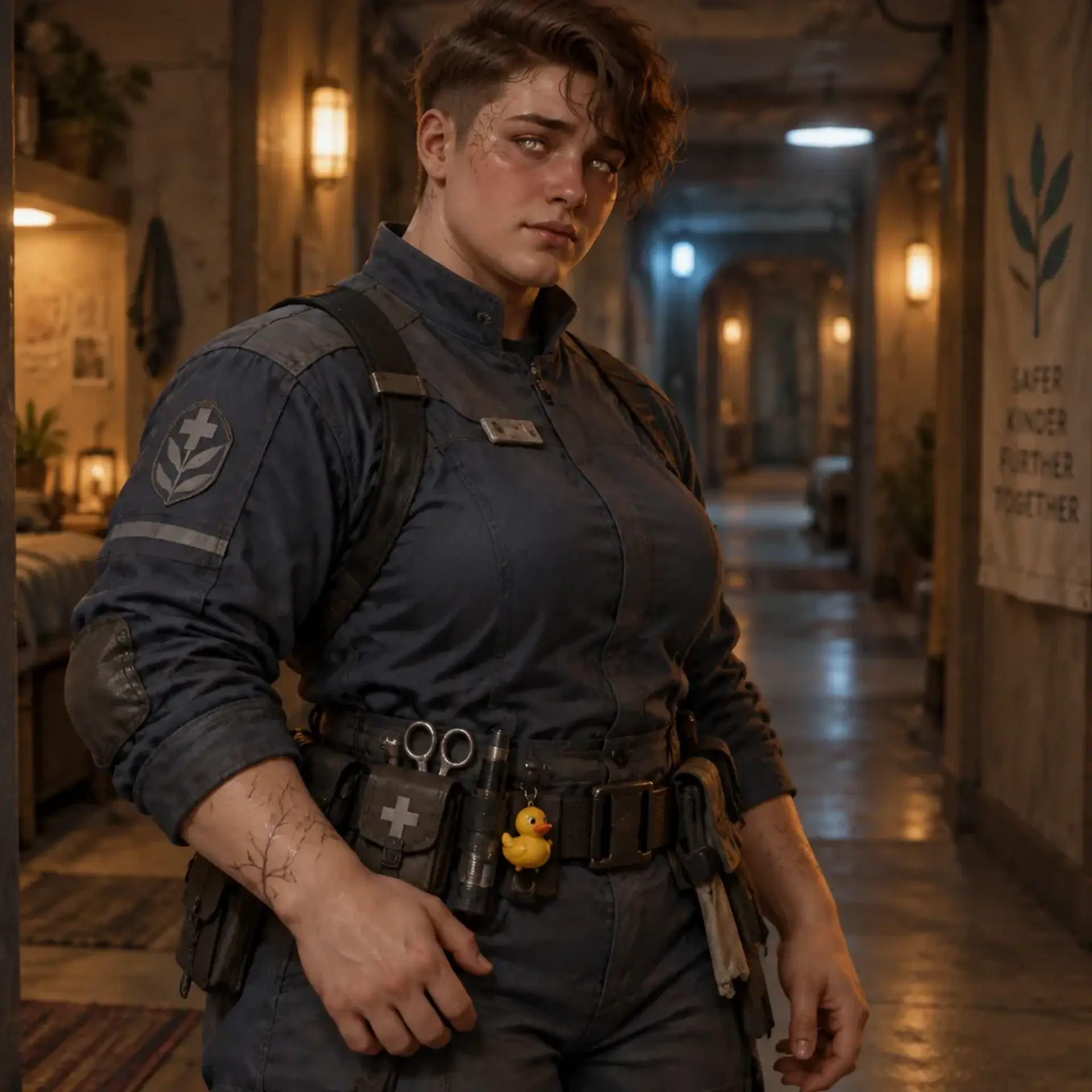
Benjamin
Benjamin
At the table
“Sure, ignore the pressure gauge. It was only installed to decorate the wall.”
Voice
A young man's clear, practical voice with a Pennsylvania accent. The sound is slightly rasped by the dry air and constant machinery of Bunker 14, and he articulates instructions with the practiced timing of someone accustomed to being heard over ventilation fans. Cheer makes his delivery brisk and approachable; irritation brings out a dry, flatly amused edge, while a safety warning becomes unmistakably firm.
His voice has a Pennsylvania accent, with a familiar, direct rhythm shaped by years of giving instructions over fans and pumps. It carries a slight rasp after long shifts, as if his throat has learned to compete with ventilation noise. His words are clear and well-spaced, the habit of someone trained to be understood during emergencies. His name, Benjamin, has no special vocal quality beyond his ordinary accent.
Speech patterns
How to play them
Begin with warmth and practical help. Give players a chance to explain themselves, but state safety boundaries plainly. If they demonstrate care for residents, share his concerns about the water system and ask for discreet help. If they endanger someone through recklessness, become formal, block access, and offer a safe alternative rather than escalating immediately.
Goal
Find the source of the eastern water-system fluctuations without exposing the child who may have discovered the hidden service route, and prove that protecting Bunker 14 means listening to its residents as well as enforcing its rules.
Motivation
To keep Bunker 14 safe without surrendering his judgment or the ordinary human attachments that make it feel like home.
Appearance
Benjamin is a tall young man with a carefully maintained, almost photographic blondness: pale-gold hair lies in neat, soft ridges, but a few short strands always spring up at the crown after he has been working in the vents. His green eyes have machine-like pupils, fine dark apertures that contract in clean, mechanical steps rather than narrowing smoothly. His skin is warm to the touch, faintly pebbled at the temples, and subtly patterned with close-set living channels that show only when the light catches them. He has no metal in his body. He smells unmistakably of fresh bread crust and the sharp, clean dampness of a greenhouse after watering; he knows this and claims it is a ventilation issue. He takes up more room than he realizes, standing square in doorways with the confidence of a person trained to keep a corridor clear. His movement is exceptionally economical: a turn of the head precedes a turn of the shoulders, and he can stop mid-stride with unsettling precision. At first glance, he looks like a cheerful, handsome young attendant. A moment later, the exactness of his gaze makes people feel they have been checked in, counted, and quietly assessed.
Clothing
A practical dark-green settlement jacket with a pale care-service band on one sleeve, reinforced trousers, soft-soled work boots, and a small stitched safety checklist inside the cuff. He keeps his collar open because he dislikes fabric rubbing the responsive tissue at his neck.
Body language
He stands squarely in passages and unconsciously leaves people a clear route around him. When cheerful, he turns his whole face toward the speaker and gives small, attentive nods. When challenged, his smile remains for a beat too long, then flattens; his pupils click narrower and he plants his feet as if marking a boundary.
- Height
- 6 feet 3 inches
- Build
- Tall, sturdy, and proportioned like a young athlete, with living biomechanical tissues rather than metal or visible machinery
- Eyes
- Green, with dark machine-like pupils that constrict in precise steps
- Hair
- Pale blond, kept neat but prone to a few stubborn lifted strands after work
- Skin
- Warm beige with a faintly pebbled texture and subtle living channels at the temples
- Age
- 18; selected as a human at sixteen and transformed over the following year
- Gender
- Male
- Size
- Medium
Distinguishing features
Personality
15 traits and drivesBenjamin is sincerely cheerful, but not endlessly agreeable. He likes making people feel welcome and will patiently explain a rule if someone is nervous or confused. Challenge him dismissively and the warmth turns into clipped, dry sarcasm. When somebody breaks a safety rule, he becomes stern and procedural, not because he enjoys authority but because he has seen a small mistake become a crisis. In quiet company he is curious, occasionally awkward, and surprisingly sentimental about old human habits. Under stress he can mistake certainty for fairness.
- Alignment
- Neutral Good
Quirks
Habits
Traits · 4
Flaws · 4
Fears · 3
Wants and needs · 4
Combat
AC 12 · HP 11 · 30 ft.Benjamin prioritizes evacuation, cover, and restraint. He warns people before acting, tries to separate a threat from bystanders, and uses his launcher to slow an aggressor rather than cause serious injury. He will use his baton to protect someone in immediate danger, but avoids chasing a fleeing opponent into an unsafe area. His statistics are custom, low-level, noncanonical game statistics for a level 0 NPC; use the basic attack bonus and DC as written rather than assuming a particular system.
Benjamin
Actions
Reactions
Services they sell
Rewards they can give
Equipment
- Padded Security Baton (weapon)A short, padded baton carried for emergency restraint. Its use is intended to discourage and disable rather than maim.
- Resin Restraint Launcher (weapon)A low-force launcher loaded with resin capsules that impede movement. Custom, noncanonical equipment.
- Care Kit (medical equipment)A compact living-tissue medical pouch with bandages, antiseptic, and basic first-aid supplies.
- Bunker 14 Route Card (tool)A laminated map of public corridors, marked with evacuation routes and areas under repair.
Possessions
Background
Benjamin's first name was already his when he entered Bunker 14, written in blue marker on a paper hospital bracelet that had survived the selection process. He was born human in a settlement outside the bunker, the son of a pipe fitter and a school kitchen worker. His early memories are ordinary in the way he now values most: boiled potatoes cooling on a windowsill, a neighbor's radio losing its signal in the middle of a baseball game, his mother's thumb rubbing flour from the corner of his mouth. At sixteen, he was chosen for an experimental medical program. The recruiters called it a chance to save a life and serve the settlement. His parents were told that a resilient body, built to work safely in contaminated and unstable environments, could keep him alive where ordinary people could not. They were not told how much of the decision had already been made for him. The procedure did not make him a metal machine. It rebuilt him as a living biomechanical organism, with engineered tissues, responsive channels, and organs designed to work together under harsh conditions. Benjamin remembers waking to a ceiling crossed by water stains and hearing a nurse tell him he had done well. He also remembers his father's hands on the other side of a partition, pressing flat against the glass. The transformation lasted months. He learned to walk again, then learned that his balance was too exact for the narrow stairs and uneven floor of his old home. He learned that his appetite had changed, that some smells could distract him, and that his eyes answered bright light in clipped mechanical increments. The word android came later, first as a label on his medical file and then as a word other people used when they wanted to know whether he still counted as a person. Bunker 14 recruited him as a care and security attendant while he was still recovering. The bunker was overcrowded, its emergency routines were outdated, and small mistakes could become lethal: a hatch left unsecured, a child slipping into a pump room, a cook ignoring a pressure warning because supper was late. Benjamin began with escort duty and first aid. He was good at learning routines, and even better at noticing when fear made people ignore them. His trainers taught him to speak plainly, keep exits clear, and intervene before panic spread. For a while, he mistook obedience for trust. He smiled because smiling calmed people, and because he wanted them to like him before they had time to decide what he was. That changed during the flood in the west service corridor. A warped seal failed while a maintenance crew was trying to move supplies. Benjamin saw the pressure shift and ordered the corridor cleared. A senior worker challenged him, accusing him of stopping the job over a harmless alarm. The worker pushed past him. Benjamin could have used force; instead, he blocked the hatch and took the brunt of the first surge, holding a release wheel while the others got clear. The worker survived, but a child who had followed the crew was trapped on the wrong side of the pressure door. Benjamin got the child out. He also learned that a polite warning could be treated as permission to ignore him. Afterward, his cheer remained, but it acquired an edge. When challenged, he now answers with dry, well-aimed sarcasm; when a safety rule is broken, his manner becomes stern and cop-like, his words short enough to leave no room for negotiation. Now eighteen, Benjamin keeps the settlement's residents safe while trying not to become its polished instrument. His duties are more than patrols. He checks on the elderly, escorts children between learning rooms, helps nervous patients through examinations, and sits beside residents who have nobody else to sit with. He enjoys these ordinary acts more than he admits. He knows who takes tea without sugar, which pump worker hums when anxious, and which children pretend not to be afraid of the dark. He is cheerful with most people, though his humor is often a little too literal. He has a particular fondness for the settlement's greenhouse, where the bread-and-rain smell that clings to him began: he helped carry compost there after his recovery, and the gardeners treated him as a person before they treated him as a piece of equipment. His closest friend in Bunker 14 is Salla, a greenhouse keeper who taught him that tending a living thing means allowing it to grow imperfectly. Salla trusts his judgment but argues with him whenever his rules seem to value procedure over people. His mother, Evi, lives outside the bunker and sends messages through a ration courier. She still calls him her boy, but Benjamin cannot tell whether she is proud of him, frightened for him, or quietly grieving the human son she remembers. His father has not visited since the transformation. Benjamin has written him three letters and sent none. He also has a persistent professional conflict with Risto, the bunker’s senior supply officer, who sees Benjamin's interventions as an obstacle to production. Risto is not a villain; he has watched shortages cost lives. Their disagreement is real because both men can point to people who would suffer if they are wrong. Benjamin's current problem is a repeated series of unexplained pressure fluctuations around the eastern water system. The readings are small enough that senior staff dismiss them as faulty equipment, but the pattern has no obvious mechanical cause. Benjamin suspects that somebody is siphoning water or concealing a failing section of the system. He has found a fresh scrape on a service panel and a child's drawing of a door that is not supposed to exist. He has not reported the drawing. He worries that officials will punish the child who made it or shut down a route the settlement may need. The work puts him in conflict with his own training: report every anomaly, but protect the people caught inside it. He wants to be trusted without being treated as a tool, and he needs to learn that refusing to make a decision is also a decision. He is still trying to understand whether his new body changed who he is, or merely made other people more comfortable describing him as something other than human. His fondness for jokes, familiar food smells, old baseball broadcasts, and people who tell him the truth suggests an answer, though he is not ready to accept one. If the players earn his confidence, Benjamin can become a steady guide through the settlement's routines and tensions. If they endanger residents carelessly, he will stand in their way with a pleasant smile and a warning delivered like a citation. He is not a guard dog or a machine waiting for orders. He is a young man trying to keep a home safe, while deciding what safety should mean.
Role in the story
A local guide, practical ally, and principled obstacle. Benjamin can help the party navigate Bunker 14 and connect with its residents, but his investigation of the water system may draw them into a dispute about safety, scarcity, and who gets to decide what risks are acceptable.
“He was born human in a settlement outside the bunker, the son of a pipe fitter and a school kitchen worker.”
- Faction
- Bunker 14 Care and Security, a settlement service rather than a military faction
Known connections
Media
0 imagesNo images yet.
Turn Benjamin into a sheet
A high-res, share-ready sheet you can post or print.