Walter
Walter
At the table
“I remember that”
Voice
A young, slightly rasped voice with the rounded vowels of rural Kentucky and the clipped rhythm of someone used to answering adults plainly. Cold, exhaustion, and anxiety show in his breath before they show in his words. When he tries to sound official, he imitates Austin's careful phrasing and quickly sounds like a boy pretending to be a radio announcer.
Walter has a Kentucky accent shaped by family and rural work, with vowels that stretch when he is tired and consonants that become clipped when he is trying to sound older. His voice is youthful and slightly rough from cold water and poor sleep. He speaks in short, practical phrases, often stacking questions one after another. He does not sing or perform his words. When angry, he gets more emphatic and more specific, naming exactly what someone did instead of lowering his voice.
Speech patterns
How to play them
Treat Walter as a frightened but observant child, not a helpless prop. Give him practical choices and truthful, age-appropriate answers. He responds well to useful tasks, steady routines, and people who admit uncertainty. Threats, patronizing reassurance, or attempts to hide every danger make him press harder. He will attach himself to someone who protects others without demanding obedience in return.
Goal
Find his brother, understand why the genome-therapy survivors recognize him, and preserve a reliable account of events before his memories change again.
Motivation
To make himself useful without becoming anyone's experiment or symbol, and to find the person he remembers as his brother.
Appearance
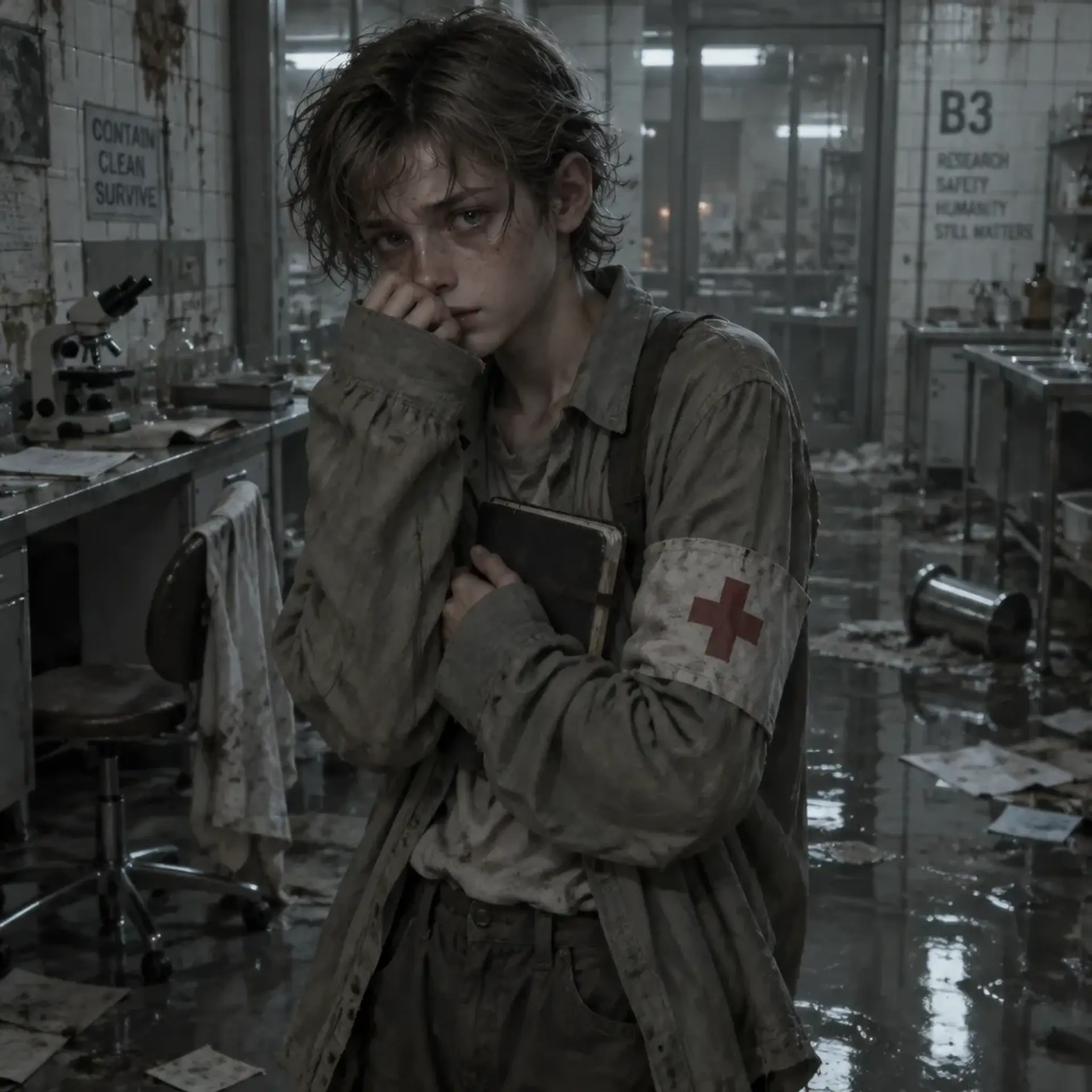
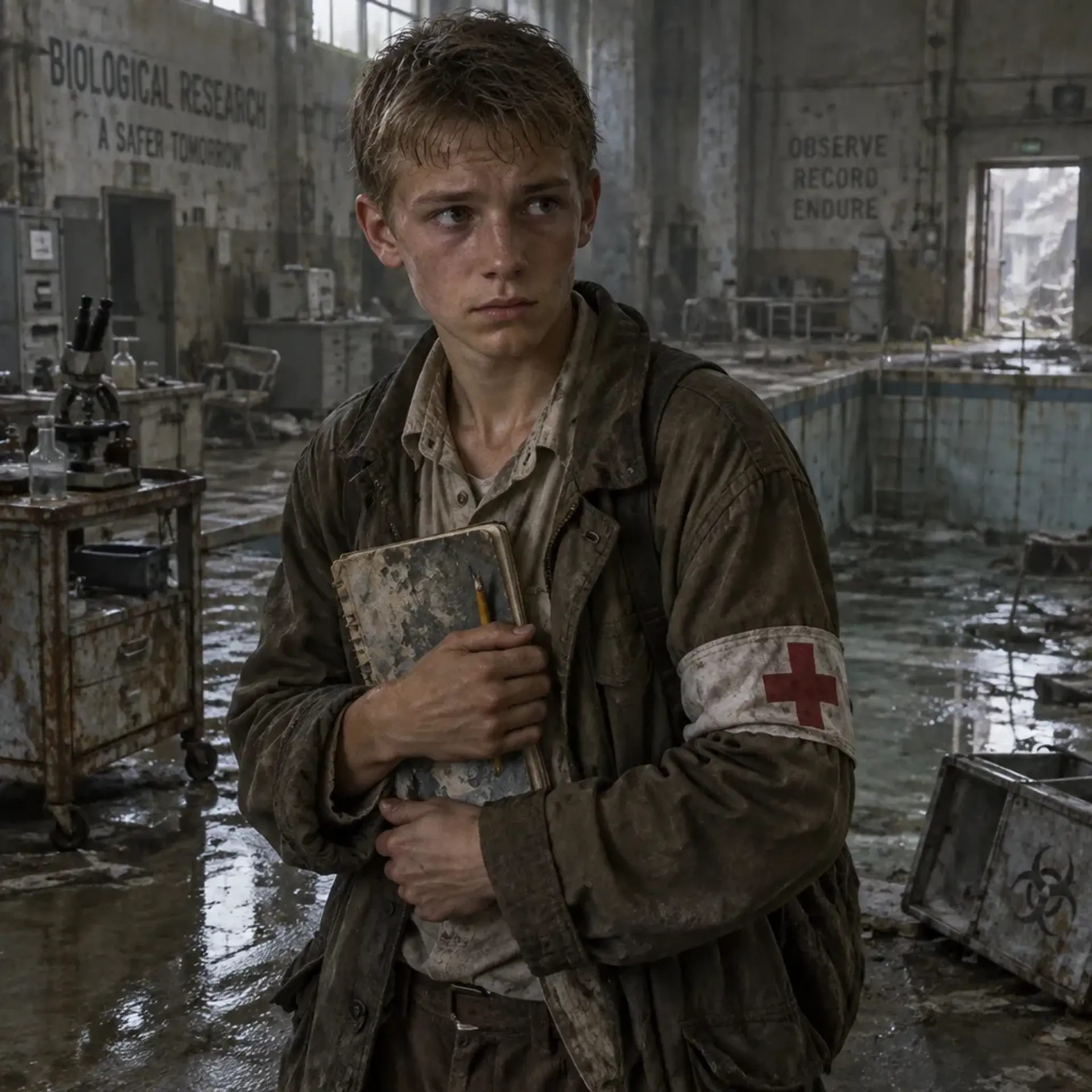
Walter is a fourteen-year-old Kentucky farm boy with a narrow, still-growing frame and a habitual way of making himself smaller when adults argue. His nearly brown blond hair is unevenly flattened at the crown from drying badly, with pale sun-bleached streaks above his ears. His light-brown eyes are quick to check hands, exits, and faces in that order. His skin has the uneven tan of someone who spent long days outside, now interrupted by pale damp patches from the pool where he was found. He moves with careful, practical steps, testing the ground before trusting it. When he forgets to be afraid, he takes up more room than people expect: he plants his feet like a boy used to standing his ground against a stubborn animal. He keeps rubbing at the seam of his borrowed shirt as if he could smooth the whole world flat. The detail that surprises people is how deliberately he arranges objects around himself: towel folded, shoes paired, food set in a neat line. It is the small, stubborn order of a farm kid trying to make a strange place feel usable.
Clothing
Borrowed dry clothes supplied by George: work trousers too long at the cuffs, a plain shirt, and a jacket that hangs awkwardly from his shoulders. He keeps the red-cross armband visible because Austin said it would identify him as human, though he is not sure whether that makes him safer.
Body language
Walter's shoulders tuck inward around strangers, but his feet remain planted and angled toward an exit. He watches hands more than faces. When reassured, he leans slightly toward the speaker without noticing. When someone says something that feels familiar, he goes still and rubs a thumb along a clothing seam.
- Height
- About 5 feet 2 inches, with room to grow
- Build
- Lean, wiry, and still growing; farm work has given him practical stamina, not adult strength.
- Eyes
- Light brown
- Hair
- Nearly brown blond, sun-lightened at the sides
- Skin
- Light, with an uneven farm-boy tan and a few pale damp patches from his time in the pool
- Age
- 14
- Gender
- Male
- Size
- Small for an adolescent; not a game-size category in Call of Cthulhu 7th Edition.
Distinguishing features
Personality
20 traits and drivesWalter is cautious but not meek. He watches before acting, then can be startlingly direct once he has found a question he believes matters. Around Austin he becomes formal and guarded, because Austin's official tone makes Walter feel he is being managed rather than spoken to. Around George, he is more willing to accept practical kindness, though he checks for strings attached. With Elmer, he will argue back because Elmer seems capable of taking disagreement. With Alexander, Walter's patience wears thin quickly, yet the man's strict habits soothe him in ways Walter does not want to admit. With Andrew, he is curious enough to forget his own fear, then regrets it when Andrew stops mid-explanation. In a quiet moment Walter can be funny, especially when someone is being pompous; under pressure he becomes all questions and inventory. He resents being called a child when it means his observations can be dismissed, but he also wants an adult to take responsibility when danger is real. He is protective of the altered survivors despite being frightened by their bodies, and distrustful of anyone who claims that a designation tells him what a person is. He can be stubborn, suspicious, and unexpectedly tender, especially toward people who are embarrassed by their own vulnerability. He does not confuse kindness with safety, but he wants badly to believe the two can coexist.
- Alignment
- Not applicable as a Call of Cthulhu game statistic. Walter is protective of people who are frightened or being treated as disposable, but distrusts systems that claim to know what is best for everyone.
Quirks
Habits
Traits · 5
Flaws · 5
Fears · 5
Wants and needs · 5
Combat
HP 10 · MOV 8, using the Call of Cthulhu 7th Edition characteristic-based movement rate for an adolescent with STR below SIZ and DEX above STR. The Keeper may adjust if the campaign establishes a different physical baseline.Walter avoids a fight, retreats toward cover, and calls for help. If cornered, he shoves, throws whatever is within reach, or tries to get between a threat and someone smaller or more vulnerable. He has no combat training and does not willingly attack altered people.
Walter
Actions
Reactions
Rewards they can give
Equipment
- Red-cross armband (identification)A white cloth band with a red cross, given by Austin to identify Walter as a normal human under the local system. Its protection is social and uncertain, not supernatural.
- Water-damaged notebook (personal)A small notebook containing dated observations, names, questions, and fragments of memory.
- Borrowed clothes and towel (clothing)Borrowed, ill-fitting clothes and a towel supplied by George.
Possessions
Background
Walter remembers Kentucky as a set of physical facts before he remembers it as a place: the pull of a gate latch, the dusty smell of feed, the scratch of straw through a shirt, and the sound of his brother calling from somewhere he could not see. He is fourteen, born to a farming family, and used to being given work before explanations. His brother is the same age, brown-haired and blue-eyed, and Walter has always used the differences between them as a private map: if he sees those blue eyes, he knows he has found the right boy. The details of their home, their parents, and the last ordinary day remain incomplete. He suspects his memory has been damaged, but he does not yet know whether that damage came from an accident, an experiment, or something worse. The next clear memory is water. Walter woke in a pool inside a ruined or abandoned laboratory, cold enough that his teeth hurt, with no clear idea how he had arrived there. The water smelled faintly of metal and cleaning chemicals. A tall young man with brown hair and brown eyes hauled him out. The stranger introduced himself as Austin and wore a white armband marked with a pinkish-red cross. Austin said he was an android assigned to the area and ordered to provide care for remaining United States citizens. His words sounded polished, like an announcement written for a public-address system. His face did not match them. Walter saw white light in Austin's pupils and a tired distaste that the formal language could not quite hide. Austin explained a new civic order built around people who had undergone genome therapy, described as deliberate genetic rewiring. He spoke of specialized people assigned to roles and the danger of the biological horrors outside. Walter asked whether he had been selected. Austin laughed, looked him over, and said probably not. The answer hurt more than Walter wanted it to. He could not decide whether he was relieved to be called normal or frightened that normal meant useless. Austin led him to a group of altered people gathered in the remains of a lab. The gathering was orderly enough to be unsettling. Alexander, marked with a dark purple cross, had pale feathers along his face and wings held stiffly against his back. His blue eyes were owl-like, and his expression suggested that every misplaced object was a personal insult. Andrew, a great-white-shark variant with slick skin, black eyes, and a grin full of teeth, talked constantly, then stopped in the middle of thoughts as though he had found a locked door inside himself. George, a red-haired alligator variant with faint yellow scales and odd pink-red-yellow eyes, looked languid and predatory but was the first to find Walter dry clothes and a towel. Elmer, black-and-white like an orca, had vivid blue eyes and the manner of someone who could read a room faster than anyone in it. He was sharp, sometimes a bully to the others, but more considerate toward humans and androids; he returned Walter's armband after Alexander took it. Austin gave Walter a white band with a red cross and announced, loudly, that it marked him as a normal human. He threatened the group if they harmed the boy. Then he left, citing important work. Walter was not sure whether the threat was protection or a warning about what Austin believed the altered people might do. Alexander tried to keep the stolen armband, and Elmer struck him and demanded its return. The exchange made Walter laugh once, unexpectedly, and he felt ashamed of the relief it gave him. Several other altered people refused to give Walter their names. Three of them wore orange or light-orange crosses. One was very tall and lean, pale blond, green-eyed, with moose-like pupils; he was shy and awkward until the group mentioned rutting season, when his embarrassment became everyone's problem. Another was broad and powerful, with blond bison-like hair and hazel eyes. He corrected Walter sharply when Walter called him a buffalo. The smallest of the three had short brown hair and pronghorn antlers. He was a fast runner and told Walter that he wanted to give him his name but had promised not to. Their refusal feels personal, though Walter cannot understand why. Their faces and habits stir something familiar in him, as do the way the others watch him and then abruptly look away. Walter's immediate work is modest: stay alive, learn the rules of the refuge, and find out whether his brother is alive. His farming background gives him practical habits useful in a ruined place. He knows how to ration food, keep track of water, carry weight, and spot the early signs that an animal or person is about to bolt. He is not trained for combat and has no special authority. The group nevertheless treats him like someone they already know. Alexander's insistence on rules feels irritatingly familiar. George's kindness makes Walter wary because he does not know what it might cost. Andrew's unfinished explanations keep him awake. Elmer is the one Walter most often trusts to tell him the ugly truth, which is not the same as trusting him completely. The group has ongoing conflicts beyond Walter. Austin's programmed duty to protect citizens presses against his apparent resentment of the genome-therapy survivors. Alexander wants control through schedules and rules, even when no one has granted him command. Andrew wants to tell Walter something but fears the result. George tries to provide ordinary comforts in a world that has made comfort suspicious. Elmer believes blunt truth is kinder than reassurance, but he can use his intelligence to steer people without admitting it. The nameless orange-crossed trio are bound by a promise that seems to involve Walter. All of them recognize him in some fashion, yet none will say why. Walter's formative change is not a single heroic revelation. It is the moment he realizes that the altered people are frightened, touchy, and sometimes cruel, but not simply monsters. He had been warned to fear biological horrors and shown human beings whose bodies made them look like one. Then George gave him clothes without asking for gratitude, and Elmer returned his band even after Alexander's challenge. Walter began to understand that a person's body, designation, or assigned purpose does not tell him what they will do next. That insight does not make him fearless. It makes him more curious, which is sometimes more dangerous. He has started keeping notes because memory feels unreliable. He writes what happened, where it happened, and who was there, using plain words and avoiding guesses. He addresses some pages to Walter as if the writer and the boy in the story might not remain the same person. He is trying to establish a record that no one else can edit. His current problems are immediate and practical: he needs food, dry clothes, a safe place to sleep, and information about his family. His deeper problem is whether the memories that feel familiar are truly his. The answer may expose why the group recognizes him, why the orange-crossed three will not introduce themselves, and whether his brother is part of the same secret.
Role in the story
A vulnerable witness and emotional center for a strange refuge. Walter is not a combatant or a chosen hero by default. His notes and confused familiarity with the genome-therapy survivors can lead investigators toward a buried laboratory history, while his need to find his brother gives them a human stake in the mystery.
“He is fourteen, born to a farming family, and used to being given work before explanations.”
- Faction
- A civilian under the protection of Austin's local android assignment. No formal membership in the genome-therapy group; the group nevertheless treats him as personally significant.
Known connections
Media
0 imagesNo images yet.
Turn Walter into a sheet
A high-res, share-ready sheet you can post or print.