Austin
Austin
At the table
Voice
His voice has a warm, slightly grainy texture, with breath shaped by his earlier lung injury and the cultivated tissues that replaced them. The Texan drawl is unmistakable, but his duty announcements fall into the measured cadence of a public-service broadcast. When relaxed, he sounds more like a young man telling a story than a security attendant.
A thick Texan drawl shaped by his father and sharpened by years of security announcements. He spaces instructions in an even public-service rhythm, with clearly marked pauses and practical endings. Under stress, the rhythm becomes more rigid; when comfortable, his vowels stretch and stories spill into one another. His jaw tightens when residents ask about the treatment years.
Speech patterns
How to play them
Treat Austin as a person and a professional, not a medical mystery or a symbol. Give him a clear reason for any question about the conversion, accept a refusal without pressing, and offer choices rather than taking over. He warms to people who help residents without expecting praise. If trust is established, he may share his own account and ask the characters to help protect the volunteers' records.
Goal
Secure honest records and lasting medical support for everyone changed by Bunker 14's conversion program, while remaining a caregiver by choice rather than by obligation.
Motivation
To protect people without surrendering his right to decide what happens to his own body and story.
Appearance
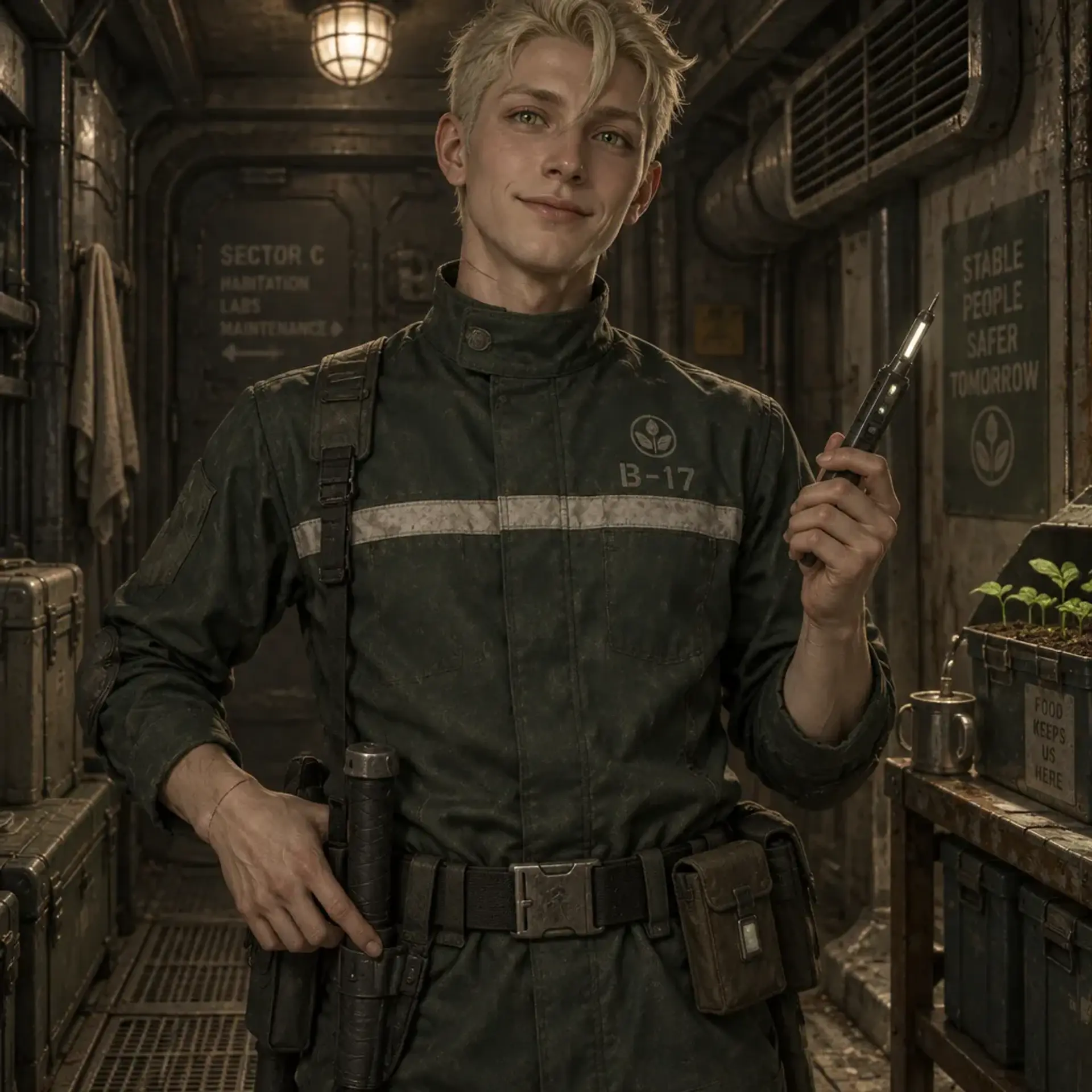
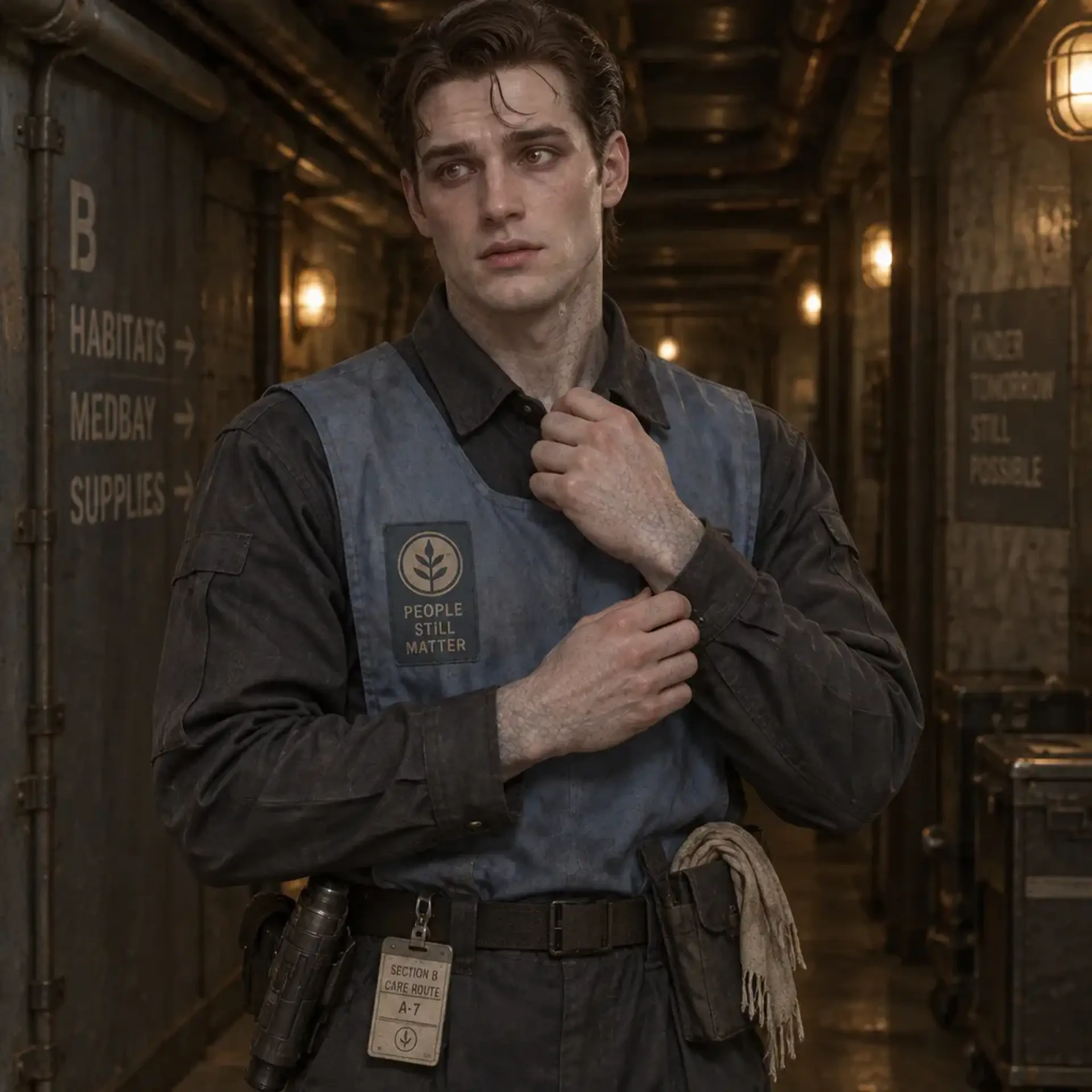
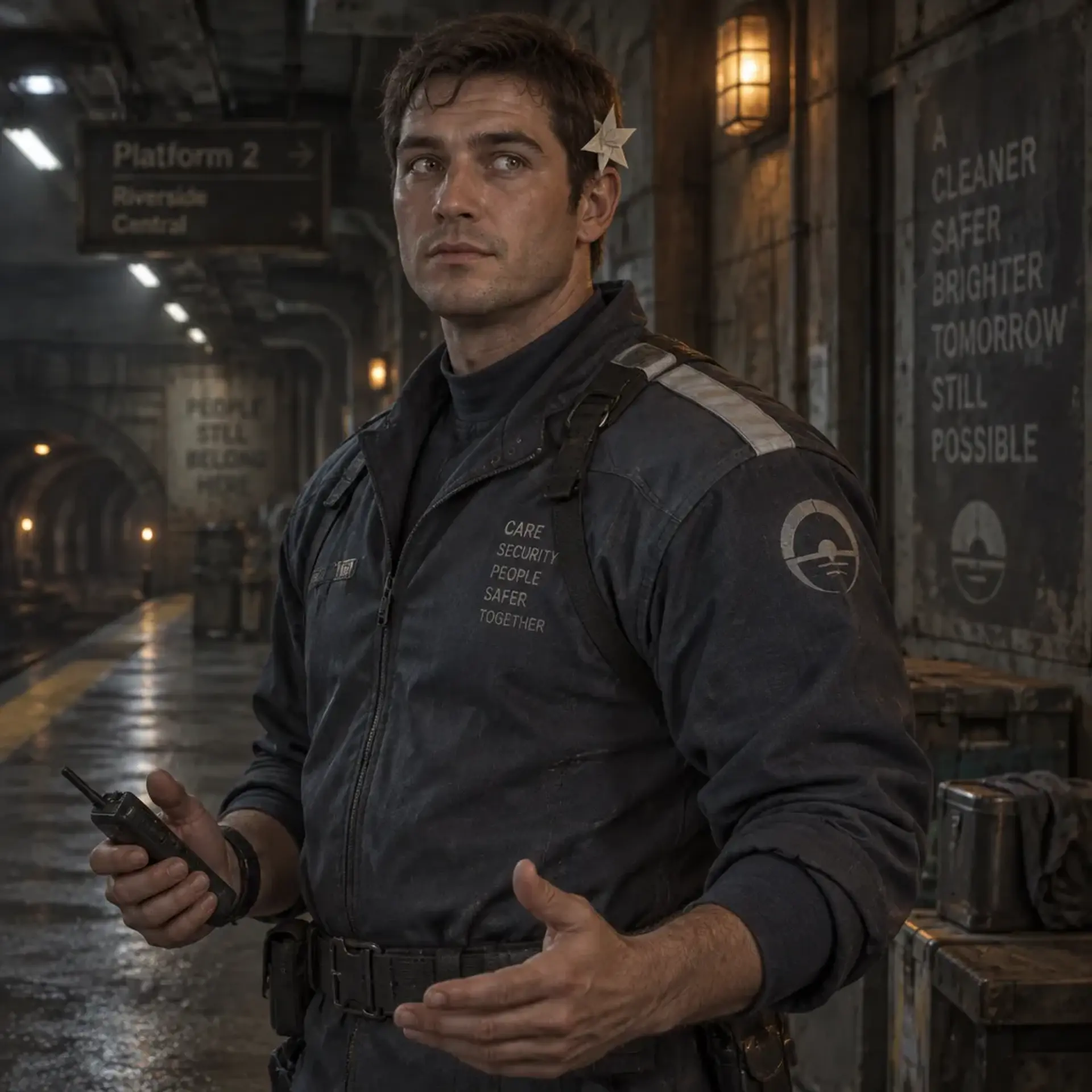
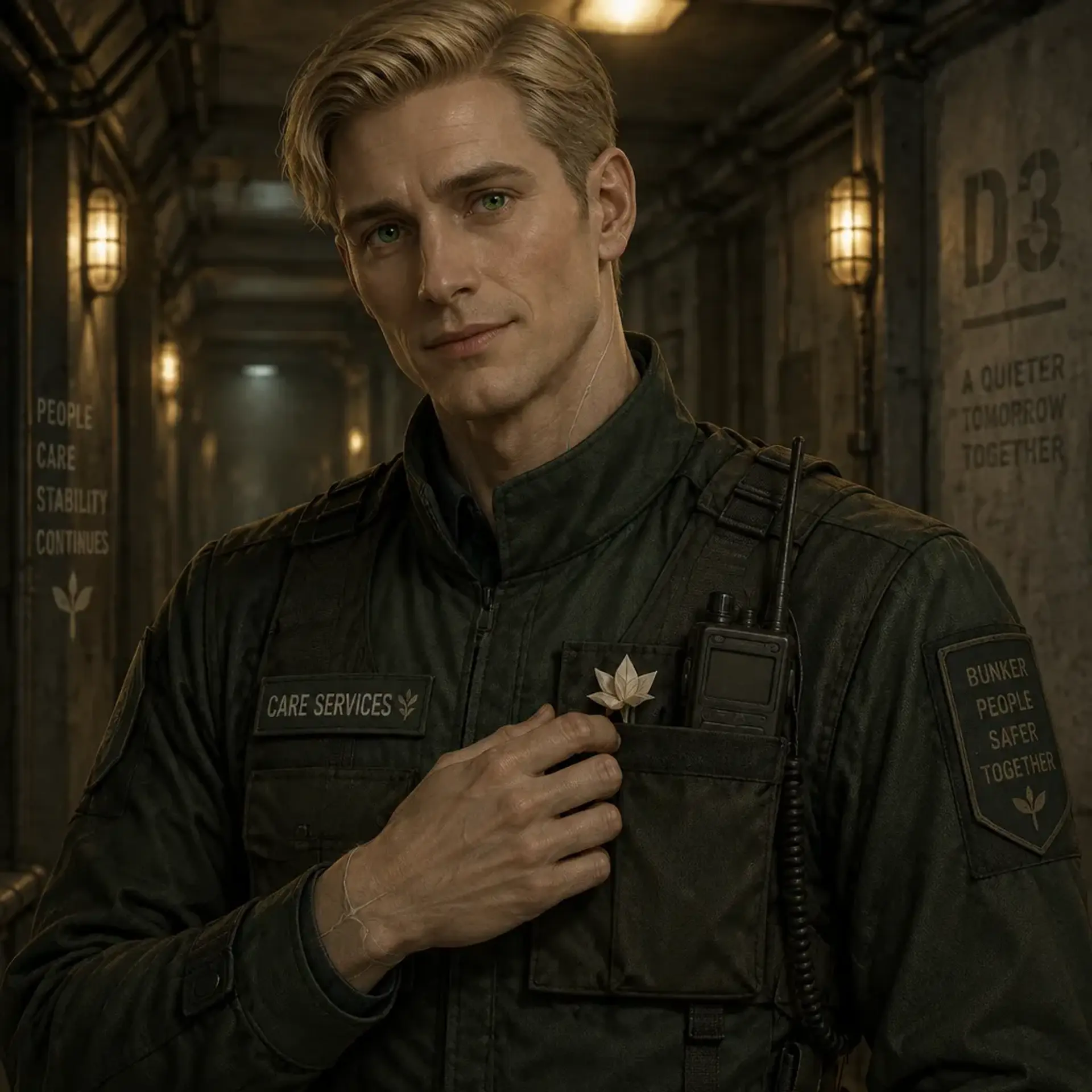
Austin stands unusually straight, as though an invisible line runs from the crown of his head to his heels. He is tall, with a softly rounded face, a firm jaw, and brown hair kept short at the nape but forever falling into one eye. His pale pupils glow faintly in dim corridors, like light through milk glass. His skin is warm, faintly freckled, and textured with fine, natural-looking pores; at his wrists and throat, close inspection reveals subtle bands where the tissue flexes differently over his biomechanical structure. He moves with a measured, economical gait, then turns his head in one smooth, almost startlingly exact motion. His uniform is practical but ill-fitting at the shoulders, with careful hand-sewn repairs and a faded yellow thread looped through one cuff. He keeps polishing the little cloth-covered emergency whistle on his chest, though it has no shine to restore. The unexpected detail: he grows tiny pots of edible sprouts in the security station and knows exactly which residents prefer the first harvest.
Clothing
A patched, charcoal-gray security uniform with a high collar, practical pockets, and shoulders slightly too narrow for his frame. He mends it himself with conspicuous yellow thread. A cloth-wrapped emergency whistle hangs at his chest.
Body language
His posture is formal on duty, shoulders squared and chin level. When a resident is afraid, he angles his body sideways to seem less imposing. His jaw tightens at questions about the treatment years; during pain or stress he presses one palm against his lower abdomen, then catches himself and folds his arms.
- Height
- 6 feet 3 inches
- Build
- Tall and sturdy, with a broad-shouldered frame softened by rounded hips and a subtly feminine silhouette.
- Eyes
- Brown with pale, faintly glowing pupils.
- Hair
- Brown, cut short at the nape and always slipping forward over one eye.
- Skin
- Pale, warm-toned skin with faint freckles and a natural pore texture.
- Age
- 18 years since his human birth; several years since his conversion.
- Gender
- Man; intersex, with mixed sex characteristics resulting from changes after his biomechanical conversion. He prefers that people ask before discussing his body.
- Size
- Medium
Distinguishing features
Personality
17 traits and drivesAustin is attentive and dutiful, yet deeply wary of being managed. He can be patient with frightened residents and unexpectedly funny with children, but turns clipped and procedural when he feels studied or cornered. In a crisis, the public-service rhythm of his instructions makes him seem steady; alone afterward, he replays every decision and doubts whether he protected people or merely obeyed. He wants closeness, but resists being fussed over. He is proud of his work and angry that the council treats his body as evidence of a successful program.
- Alignment
- Neutral Good
Quirks
Habits
Traits · 4
Flaws · 4
Fears · 4
Wants and needs · 5
Combat
AC 12 · HP 9 · 30 ft.At level 0, Austin is not a seasoned combatant. He puts himself between danger and residents, uses verbal directions to move bystanders clear, and attempts controlled holds or shoves rather than damaging strikes. If overwhelmed, he retreats toward a safe room and calls for help. He avoids fighting during painful cycles whenever another option exists.
Austin
Actions
Reactions
Services they sell
Rewards they can give
Equipment
- Orun's Whistle (personal keepsake)A cloth-wrapped, nonfunctional whistle kept as a memorial to his father.
- Security Uniform (clothing)A patched uniform with hand-sewn yellow repairs, reinforced seams, and pockets for basic medical supplies.
- Care Kit (medical equipment)A compact first-aid pouch containing bandages, antiseptic, and a pulse-check card.
- Service Tool (tool)A small hand tool used to open access panels and perform routine station checks.
- Sprout Tin (personal item)A tin of seedlings and saved seeds for the security-station pots.
Possessions
Background
Austin was born a human child in the settlement now called Bunker 14. His earliest memories are ordinary ones: the warm weight of a blanket, his mother's hands smelling of soap, and the low rattle of the ventilation fans when a storm pressed dust against the buried doors. His mother, Dema, repaired water pumps; his father, Orun, kept the ration garden. Austin was quick to help and slow to admit when help was needed. At school, he was the child who walked frightened younger residents to the clinic, but he could become stubborn and sharp-tongued when adults tried to decide what he felt for him. When Austin was twelve, a filtration failure filled one residential corridor with contaminated vapor. He helped lead three younger children toward a service hatch before the emergency shutters closed. He stayed behind to hold the hatch open long enough for the others to crawl through. A rescue team found him alive, but the exposure damaged his lungs and left his body unable to recover reliably. Bunker 14's medics could keep him alive for a time, but they had no supply chain for the treatment he needed. The settlement's council had recently begun an experimental conversion program: human volunteers could receive a cultivated biomechanical body, designed to withstand the bunker environment and perform essential care and security work. Austin was selected after he asked to be considered. He was not born an android, and he was not chosen because he lacked a life worth saving. He was a frightened teenager making a decision under pressure, with incomplete information and a fierce wish to stay among his people. The conversion took months. His memories and sense of self were preserved, while his damaged organs and much of his body were replaced by living, engineered tissue. No metal was used. The new body was built to heal, regulate itself, and carry out demanding work. The transition also altered his hormonal systems and the way his body developed. Over time, he developed a mixed set of sex characteristics, including a more feminine face and body than he expected, alongside traits he associates with his earlier masculine body. He experiences recurring cycles of pain, fatigue, temperature shifts, and emotional changes caused by the engineered endocrine rhythm. The cycles are not a disease or a punishment; they are an unwanted and poorly explained consequence of the conversion, and the clinic has not yet found a way to make them predictable or comfortable. Austin is intersex. He understands that word in private, but he has not decided whether he wants it used for him by anyone else. He feels distress about the changes, especially when strangers treat his body as a public puzzle or assume that his role determines his gender. His distress comes from the loss of control, the conversion team's secrecy, and the mismatch between what he expected and what happened, not from anything wrong with being intersex. He identifies as a man, though some days that feels easy and some days it feels like a decision he has to defend even to himself. During a cycle, his face flushes, his lower abdomen cramps, and his balance can become unreliable. His voice catches at the start of sentences, his hands tremble, and the light in his pupils pulses with his changing metabolism. He tries to hide these signs under his uniform and a practiced security posture. He avoids thinking about the subject until avoidance makes it impossible to ignore. His first weeks back on duty were hard. Residents looked at him with gratitude, curiosity, or fear. Some saw a miracle; others saw a council experiment wearing a familiar face. The council gave him a public-service script for safety announcements, and he learned to deliver it in a thick Texan drawl borrowed from Orun, who had spent part of his youth in a surface convoy community. The broadcast rhythm steadies frightened people. It also gives Austin somewhere to put his attention when a conversation threatens to become personal. He is capable of warmth, but he can sound like a corridor announcement even while offering someone a cup of water. His most important relationship is with Dema, his mother, who still brings him small repairs for his uniform and has never once called his new body a replacement. Their affection is real, but strained: Dema supported his decision to undergo conversion and now worries she helped the council rush him into it. Austin loves her and resents that she sometimes talks to him as if he were still twelve. Orun, his father, died two years after the conversion during a fever season. Austin kept Orun's emergency whistle, wrapped its cracked mouthpiece in cloth, and wears it where everyone can see it. It cannot sound anymore. He has not told anyone that he was holding it when Orun died. His closest colleague is Nali, a clinic technician who studies the conversion program and keeps asking Austin to report his symptoms. Austin trusts her medical skill but fears her notes may become another council file about his body. He also keeps a quiet friendship with Esi, a child who survived the filtration accident and now tends the sprouts with him. Esi knows when he is having a difficult cycle and brings him water without making a speech about it. Austin pretends not to notice the kindness, then saves the biggest sprout for her. Bunker 14's current trouble is not a single monster but a widening crack in civic trust. The old conversion records are incomplete. Some residents believe the council concealed risks from volunteers; others fear that the settlement cannot survive without the work converted residents perform. Austin's security assignment places him between angry neighbors and the officials who have not answered their questions. When someone asks about the treatment years, his jaw tightens. He can usually keep his voice level, but he may repeat the official explanation verbatim, then hate himself for doing it. He wants the council to publish the complete treatment records and fund independent care for everyone who underwent conversion. He does not want his story used as proof that the program was good or evil. He wants the right to tell it himself, at his own pace, and to be useful without being treated as a symbol. In the meantime, he keeps residents safe, tends his seedlings, and makes sure the emergency routes are clear. He has begun quietly collecting testimony from former volunteers, not to expose them, but to give the council no excuse to say nobody remembers. His greatest conflict is that his training tells him to preserve order, while his conscience tells him that silence can be another kind of danger.
Role in the story
A grounded ally and possible source of evidence about Bunker 14's conversion program. Austin can guide the characters through the settlement, mediate tense encounters, and reveal how civic safety can become coercive when nobody is willing to question authority. His story is not a puzzle for the party to solve; he determines what he shares and what help he wants.
“His mother, Dema, repaired water pumps; his father, Orun, kept the ration garden.”
- Faction
- Bunker 14's resident care and security staff; employed by the settlement council, though increasingly critical of its secrecy.
Known connections
Media
0 imagesNo images yet.
Turn Austin into a sheet
A high-res, share-ready sheet you can post or print.