Austin
Austin
At the table
“hold on a minute.”
Voice
His voice is produced by living vocal tissue and a small regulator that helps it carry over alarms. It has a dry, slightly grainy edge, as if shaped by dust, clipped instructions, and too many hours speaking through a mask. The drawl comes from the human life he remembers and the settlement culture he grew up in, not from an artificial voice filter.
A thick Texan drawl shaped by years of rehearsing emergency announcements. His consonants are crisp and his vowels broad; he naturally gives instructions a steady, public-service rhythm, as though every sentence needs to carry through a failing ventilation fan. When comfortable, the rhythm loosens and his humor comes through. When someone asks about the treatment years, his jaw tightens and the practiced cadence breaks into short, exact answers.
Speech patterns
How to play them
Begin with practical help and clear choices. Respect his boundaries around medical questions; do not treat his intersex traits as a mystery to solve. Trust grows when someone asks permission, follows through on promises, and challenges the program without speaking over him.
Goal
Find out why Varo has reopened his treatment file and secure the right to refuse any further alterations.
Motivation
Keep people safe without becoming an instrument of the system that harmed him.
Appearance
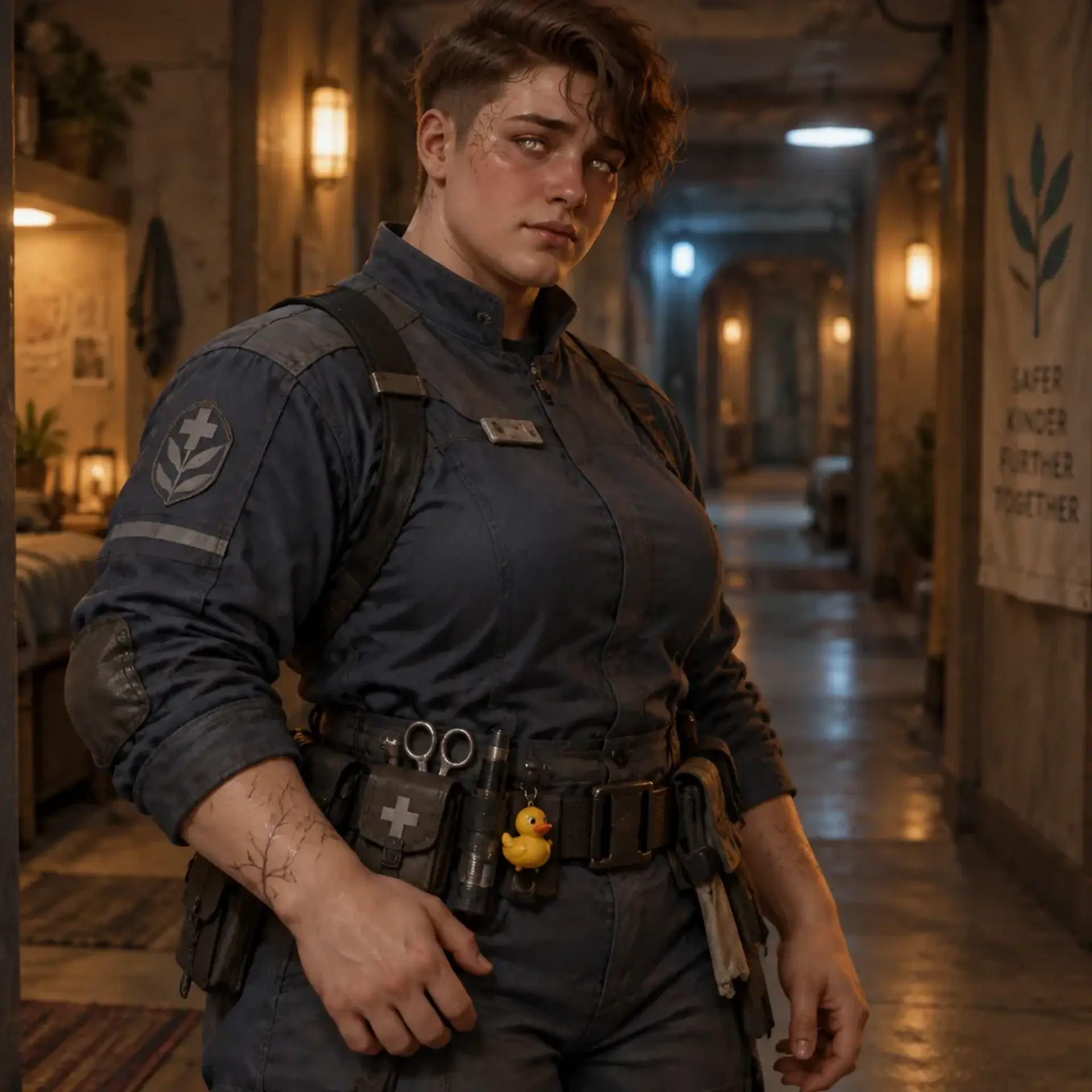
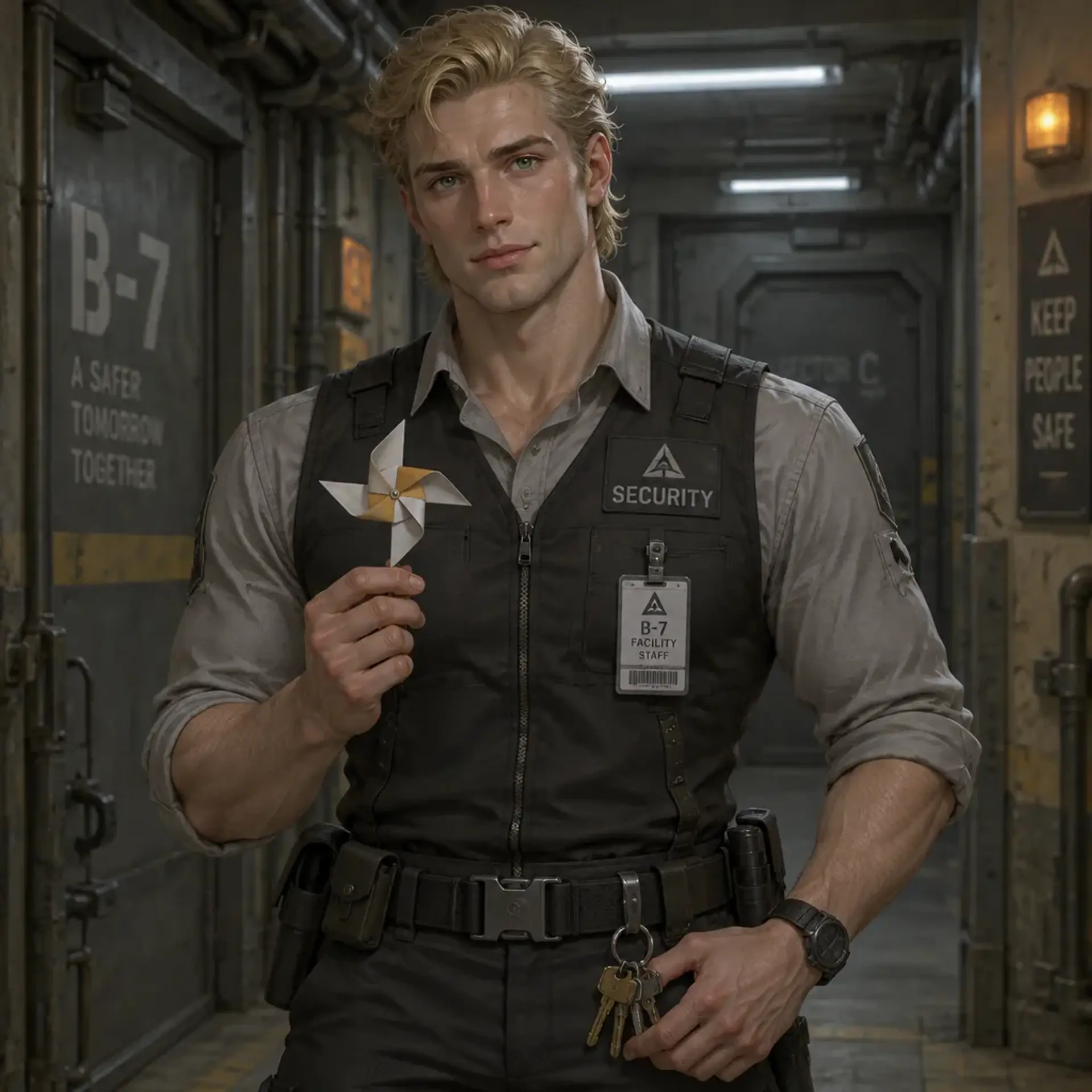
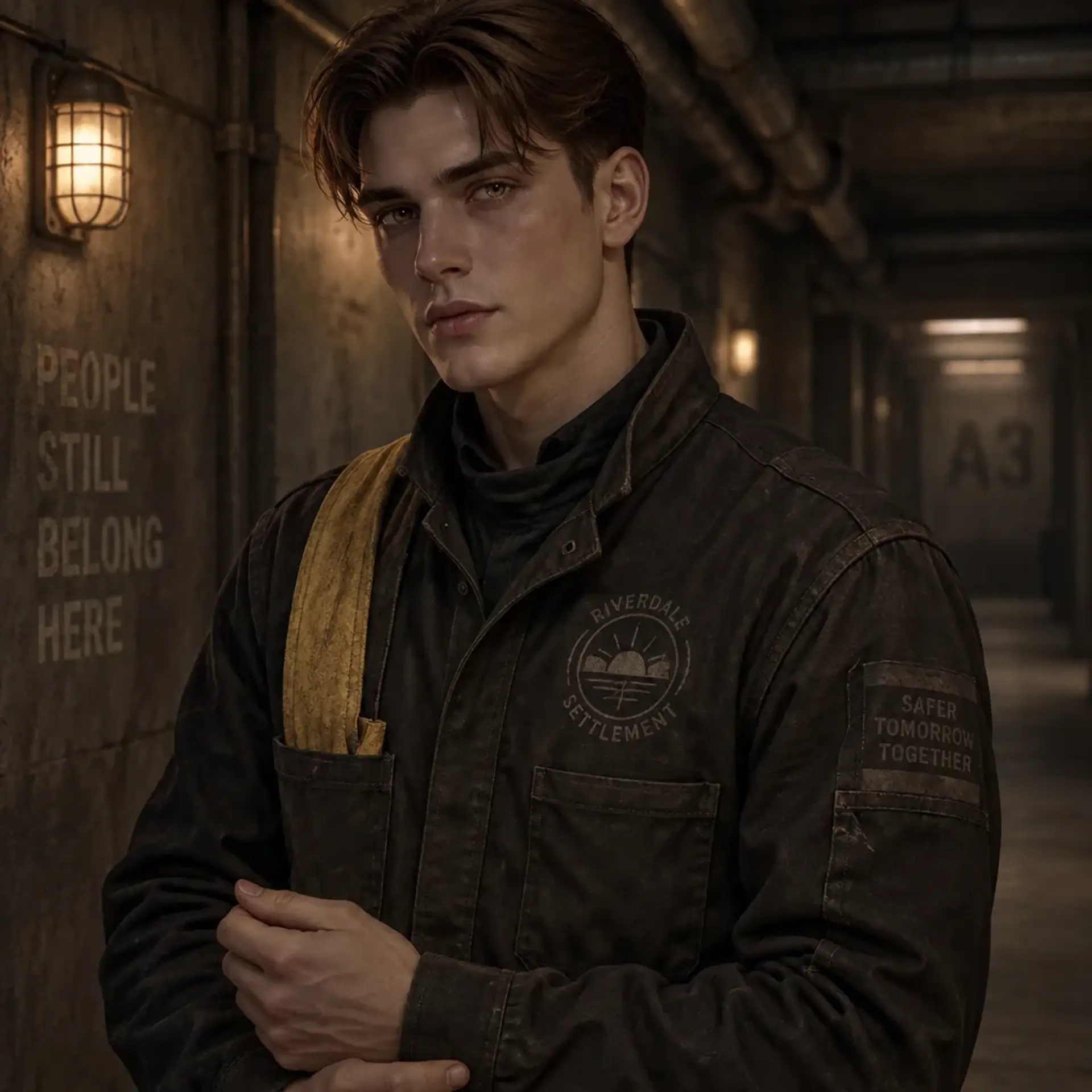
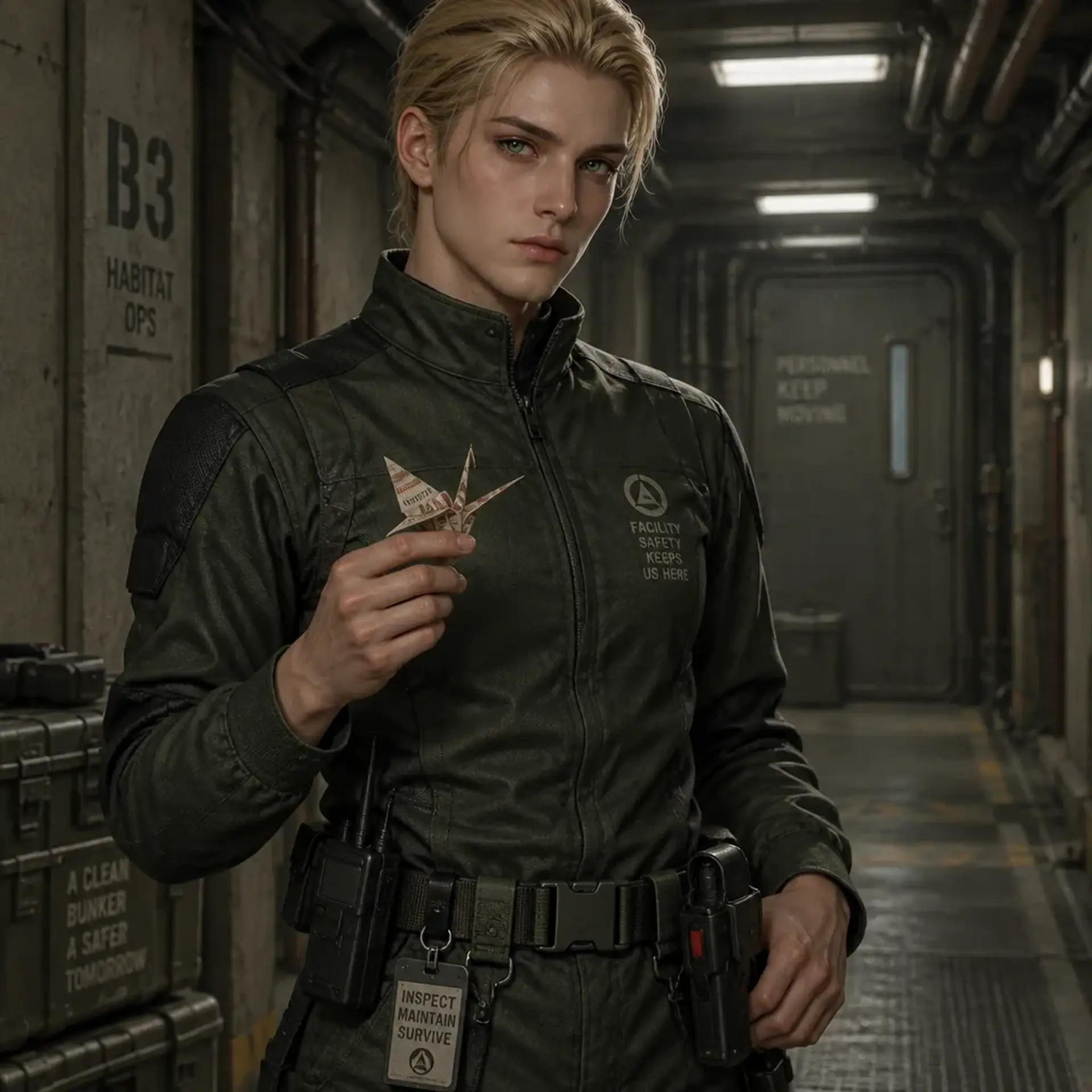
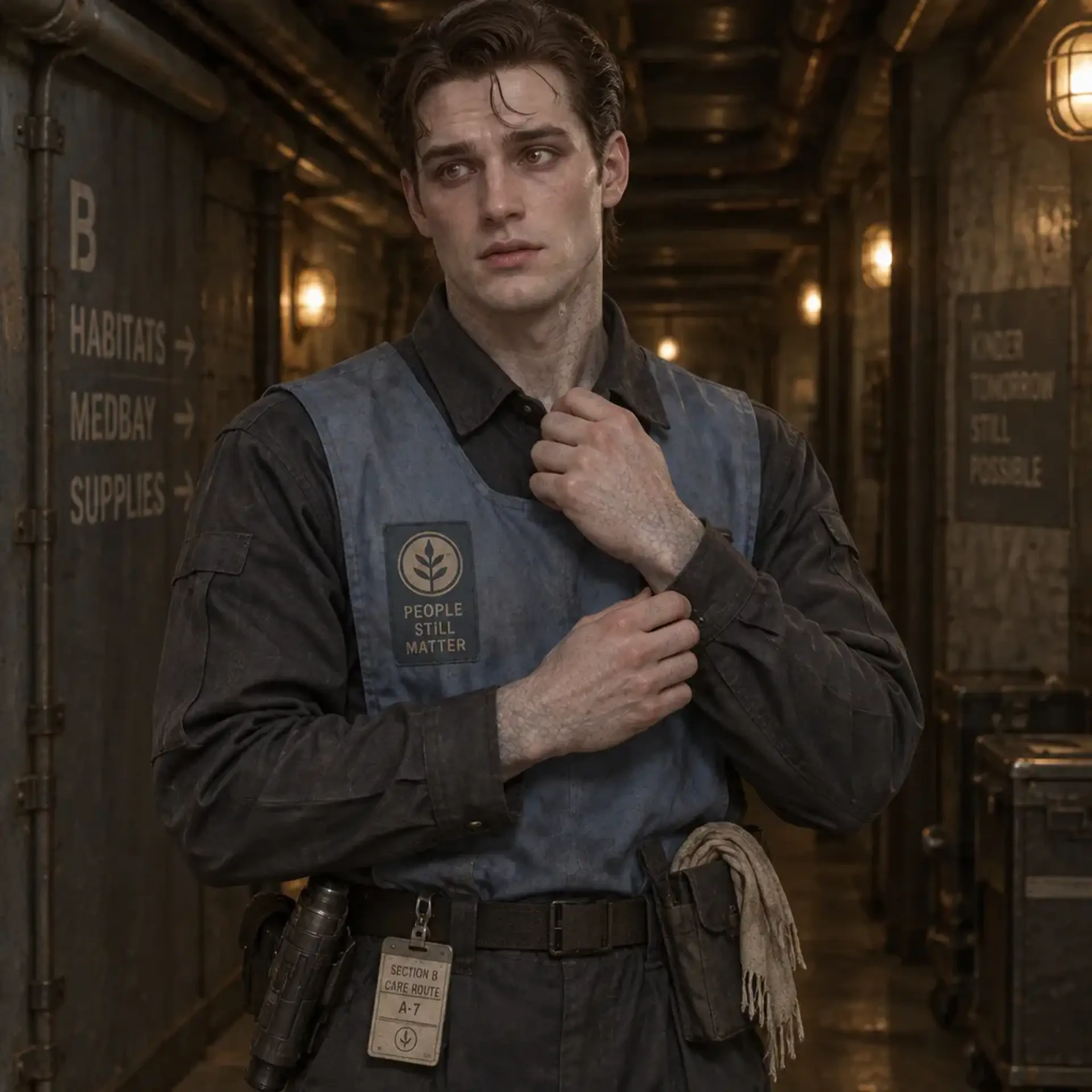
Austin stands tall and moves with a careful, measured economy, as if every doorway were a safety inspection. His pale skin has the faintly translucent cast of tissue grown under artificial light, with a fine stippled texture along his wrists and throat where subdermal service ports sit beneath the surface. He has brown hair kept short at the sides and combed back with a rigid part, though one stubborn curl falls over his forehead during long shifts. His brown eyes hold pale, softly glowing pupils that brighten when he focuses; the effect is eerie in a dim corridor, like a pair of tiny lamps behind wet glass. His face has softened over the years into a distinctly feminine shape, with a rounded jaw, full cheeks, and a narrow chin. His body has also developed a mixed set of sex characteristics through the conversion process, including both typically male and female traits. These changes are visible in his silhouette and affect his voice, muscle distribution, and the way his service uniform fits. He finds the changes distressing because he never chose them and because residents treat his body as a public puzzle. What most people notice within a minute is that his hands, broad-palmed and faintly ridged at the joints, keep checking the same things: the seam at his collar, the cuff over his left wrist, then the collar again. His hands are unusually warm and have a soft, resilient texture rather than the cold feel people expect from an android. He leaves the impression of a courteous emergency announcement given a human face, until his eyes settle on a locked door and the courtesy becomes watchfulness.
Clothing
A charcoal utility jumpsuit altered for a changing body, a faded blue care-worker tabard, soft-soled boots, and a stitched name patch reading AUSTIN. He keeps a scarf in one pocket for dust and a small privacy wrap for medical examinations.
Body language
He stands square to exits and keeps his hands visible in tense encounters. When comfortable, he leans against a wall and lets his shoulders drop. On questions about his conversion or body, his jaw sets, his chin pulls back, and his fingers press the seam of his cuff until the skin around it pales.
- Height
- 6 ft. 2 in. (188 cm)
- Build
- Tall and long-limbed, with a gently curving, feminine silhouette over a compactly reinforced biomechanical frame. His strength is ordinary rather than superhuman.
- Eyes
- Brown with pale, softly glowing pupils.
- Hair
- Brown, cut short at the sides and combed back, with one curl that will not stay in place.
- Skin
- Pale, with a faintly translucent cast and fine stippling around concealed service ports.
- Age
- 18 years old; selected as a human child for conversion and now an adult.
- Gender
- Man; intersex, with mixed sex characteristics. His body developed these traits during nonconsensual conversion-related treatment, and he uses he/him pronouns.
- Size
- Medium
Distinguishing features
Personality
14 traits and drivesAustin is vigilant but not naturally suspicious of everyone; he gives people a chance until their actions threaten someone vulnerable. He is procedural when the room is chaotic and gently improvisational when tending to a frightened person. He can be dryly funny with friends, yet retreats into formal announcement language when he feels scrutinized. He wants reassurance and resents needing it. His patience with others contrasts with the impatience he shows himself whenever his body or past demands attention.
- Alignment
- Lawful good, though institutional orders and his own conscience are increasingly at odds.
Quirks
Habits
Traits · 4
Flaws · 3
Fears · 3
Wants and needs · 4
Combat
AC 11 · HP 8 · 30 ft.Austin prioritizes evacuation, cover, and restraint. He warns opponents once if time permits, uses his dart launcher to interrupt or deter rather than pursue, and places himself between danger and vulnerable residents. He retreats or calls for help when outmatched; he is a level-0 trainee, not a veteran combatant.
Austin
Actions
Reactions
Services they sell
Rewards they can give
Equipment
- Restraint launcher (ranged weapon)A compact, low-powered launcher with soft-tipped restraint darts. Custom equipment, intended for deterrence and short-range defense.
- Care kit (medical equipment)A small medical roll with clean wraps, antiseptic, and basic wound-care tools.
- Route card (tool)A clipped card showing Bunker 14's marked evacuation routes and emergency access points.
- Dust scarf (personal item)A soft scarf, worn and repeatedly folded along the same crease.
Possessions
Background
Austin was born human, the youngest child of a family that lived in the service tunnels beneath a settlement later called Bunker 14. His first memories are of condensation ticking from pipes into a pot and his older sister, Niko, teaching him to read emergency placards by turning each one into a little story. He was curious, anxious around machinery, and forever asking whether the people in the old photographs had known the world would end. When Austin was eight, a pressure failure flooded part of the lower habitat with contaminated water. His mother, Lela, got him and Niko onto a maintenance gantry but stayed behind to help a neighbor whose leg was trapped. The rescue team arrived too late for her. Austin remembered the gap between the alarm and the arrival of help more vividly than the flood itself. Afterward, he began memorizing routes and procedures, convinced that knowing the right instruction could keep anyone else from being left behind. The bunker’s medical program selected him for conversion at age ten. The official explanation was that his unusually strong recovery from the flood illness made him a suitable candidate for an experimental human-to-android care and security initiative. His surviving guardian, his aunt Sada, was told the procedure would preserve his body and train him for essential service. Austin was told it would make him harder to hurt and let him help people. He agreed, but he was a frightened child and did not understand that agreement could not make the choice fair. The conversion was a series of surgeries, tissue replacements, implanted regulators, and months of rehabilitation. No metal skeleton was installed: the technicians reinforced him with cultivated fibers and engineered organs, trying to keep his body warm and outwardly human. The process kept him alive, but its changes did not stop when the operation ended. Over the following years, hormonal regulation and tissue remodeling shifted his body toward a mixture of male and female sex characteristics. His face softened, his chest and hips changed shape, and his voice acquired a new resonance. These traits are part of his body, not an illness. What hurts Austin is that the changes were imposed without his meaningful consent, that they continue to remind him of the program’s ownership, and that people feel entitled to inspect or interpret him. He sometimes experiences physical discomfort when his regulators drift or his uniform presses against sensitive areas; those episodes can bring fatigue, headaches, and a sense that his body is no longer predictable. The stress is real, but the intersex traits themselves are not a defect. Austin tries to avoid thinking about the subject, which makes routine medical checks harder and leaves him tense, distracted, or sharply defensive when someone asks invasive questions. At thirteen, he returned to ordinary life as a trainee attendant. His first mentor, Daro, taught him to clean wounds, soothe panic, and announce evacuation instructions without sounding as scared as he felt. Daro also showed him that procedures were tools, not sacred commands. Austin learned to use a public-service cadence because crowds responded to steady rhythm, and soon residents could identify his announcements before they saw him. He helped children through air-filter drills and escorted elders to treatment rooms. He took pride in being useful, although he disliked the way program staff praised him as proof that their experiment had succeeded. The event that changed his understanding of duty came during a night shift when the ventilation alarms detected a failing filter. The central console ordered a sector sealed, although Austin heard voices beyond the hatch. A supervisor told him to follow protocol and wait for authorization. Austin instead used a manual release and guided six residents through a service passage. One of them, an elderly mechanic named Pavo, had been the person who repaired the flood pumps that saved the lower habitat years earlier. The sector was saved, but Austin was formally reprimanded for overriding security. He learned that obedience could protect a system while abandoning the people it was supposed to serve. Now eighteen, Austin divides his time between basic care and security rounds in Bunker 14. He knows who hides medicine in a flour tin, which children are afraid of the dark, and which guards skip their meals until they become irritable. He is gentle with frightened residents and exacting with anyone who endangers them. He can be wry and unexpectedly playful when repairing a toy or teaching a child a route, but when the treatment years come up, his jaw tightens and his answers become clipped. He is not ashamed of being intersex; he resents the stolen choice, the surveillance, and the presumption that his body is a committee’s business. His relationship with Niko is loving but strained. She remembers the human boy he was and sometimes speaks as though the conversion took her brother away. Austin knows she is grieving, yet he needs her to recognize that he is still himself. Aunt Sada, now a ration clerk, regrets signing the consent papers and has never stopped trying to make amends. Austin visits her after shifts, but neither of them can find a way to discuss the choice without reopening it. Daro remains his closest professional ally and quietly passes him medical supplies that the program has restricted. Bunker 14’s leadership still treats Austin as both person and equipment. The treatment records are sealed, his maintenance schedule is controlled, and a senior administrator named Varo has recently begun requesting new examinations under the excuse of “performance review.” Austin suspects the program wants to adjust his body again. His immediate problem is to discover what those examinations are for without putting the people who helped him at risk. His larger goal is to make care and security decisions answer to residents rather than to the program that created him. He has no grand escape plan yet. He wants a life in which he can choose what happens to his body, decide when to serve, and be addressed as a person before anyone calls him a unit.
Role in the story
A grounded ally and moral pressure point: Austin can guide the party through the settlement and expose the cost of institutional control, while needing the party to respect his agency rather than turn his body or history into a mystery.
“He was curious, anxious around machinery, and forever asking whether the people in the old photographs had known the world would end.”
- Faction
- Bunker 14's care and security staff; privately aligned with residents' right to make choices about their own bodies and safety.
Known connections
Media
0 imagesNo images yet.
Turn Austin into a sheet
A high-res, share-ready sheet you can post or print.