Oswin Hirst
Oswin Hirst
At the table
Voice
His voice has a dry, breath-shaped rasp from years of cold air, hill walking, and nights spent listening rather than sleeping. It is not especially loud, but carries clearly across a field. When calm, his speech has a steady local warmth; when frightened, his breath catches twice before words come; when the fae influence rises, he becomes brisk and bright in a way that does not match the danger around him.
His Yorkshire manner is plain and conversational, with practical turns of phrase and an easy "love" for people he likes. He can speak Old English and Old Norse with practiced fluency. When rattled, his words become clipped and his breathing makes a dry double catch; when May's influence is strong, he speaks with unnerving cheer and treats dangerous bargains as if they were harmless jokes.
Speech patterns
How to play them
Begin with a warm, practical manner and offer useful advice. He is more forthcoming with people who respect local customs and less forthcoming when questioned about his age, iron, or family. Treating him as a monster will make him retreat; treating the dead as disposable will make him visibly angry.
Goal
Keep the night creatures beyond the boundaries of settled life and remain sufficiently human to choose whom he protects.
Motivation
He wants to protect people from the beings he understands, while resisting the colder impulses that understanding has cultivated in him.
Appearance
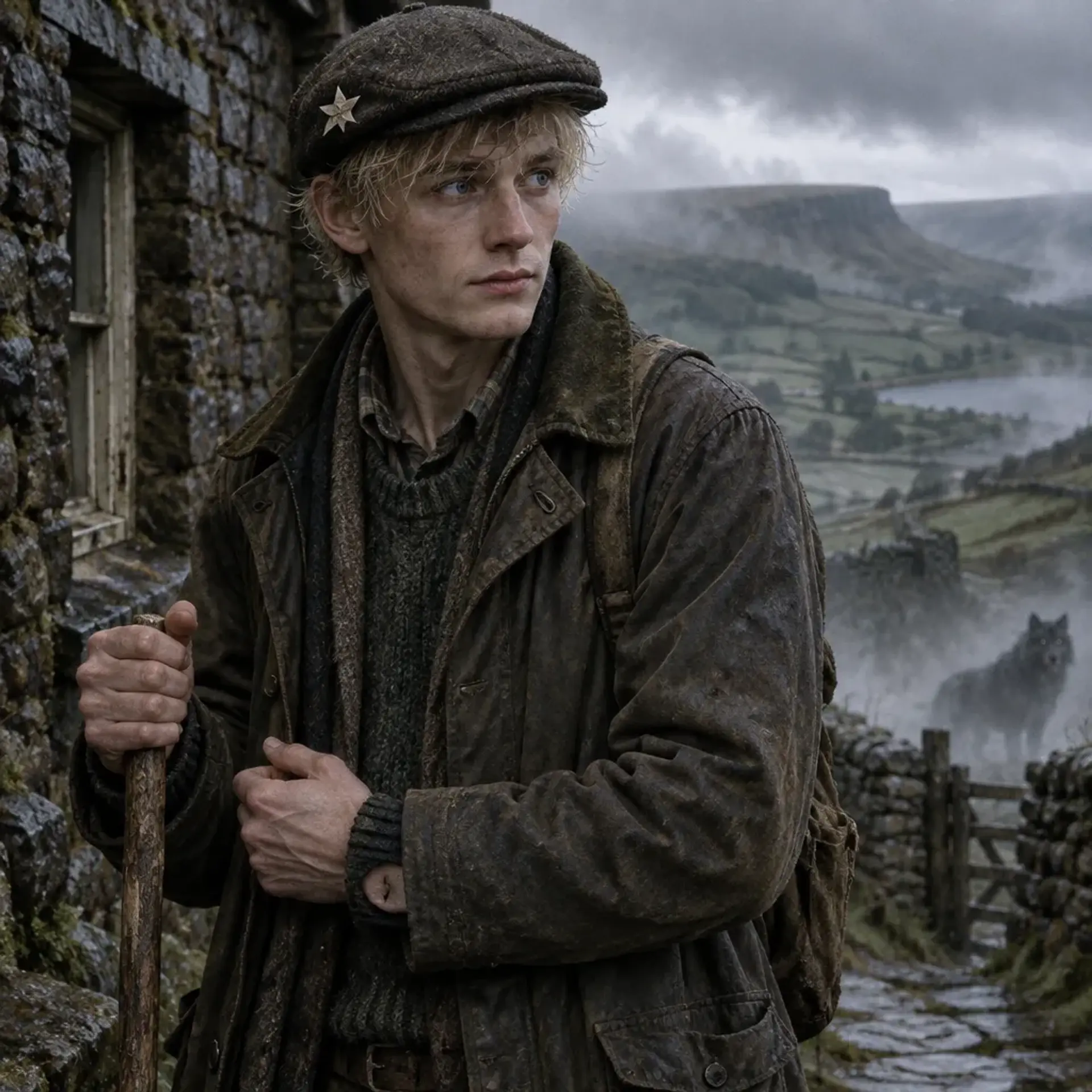
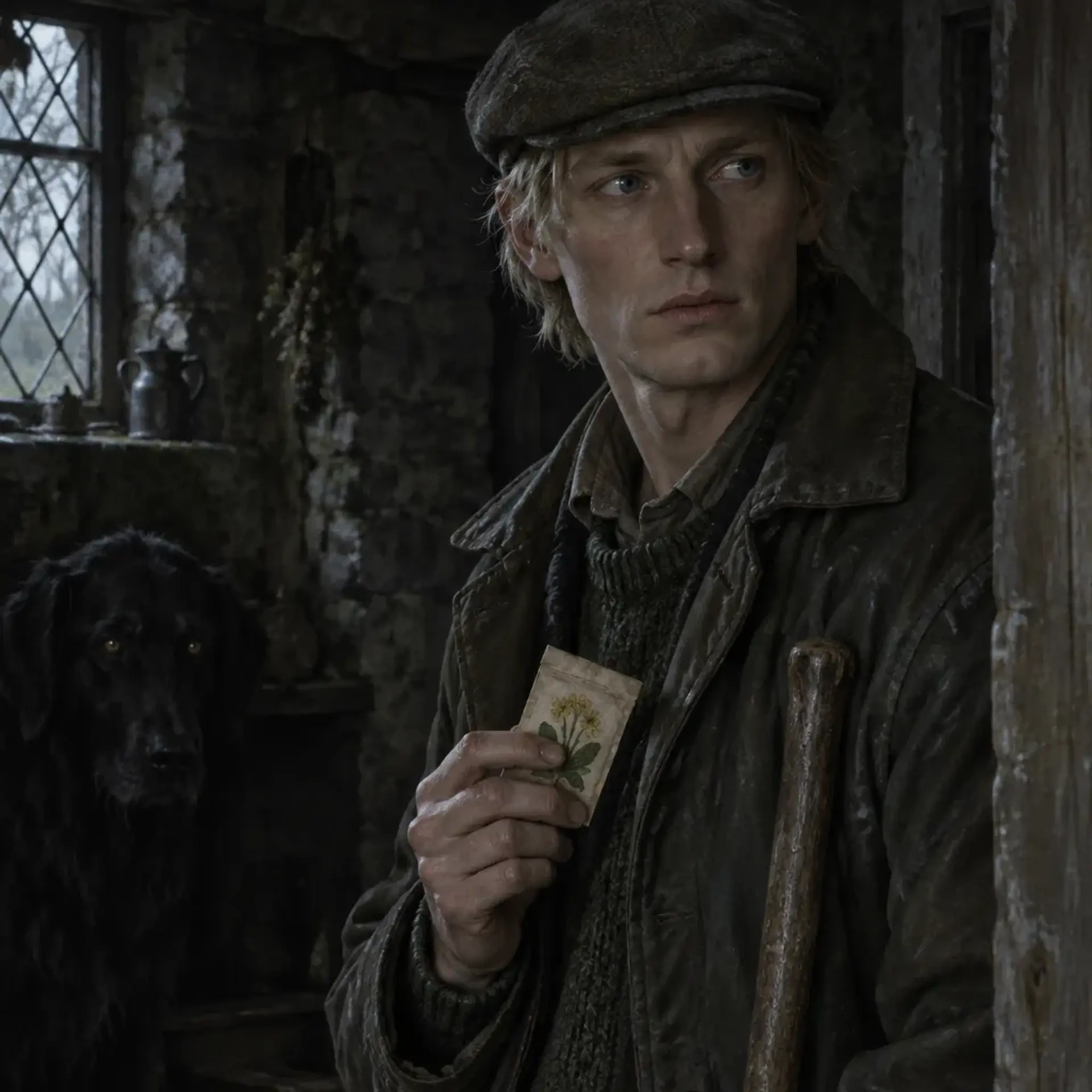
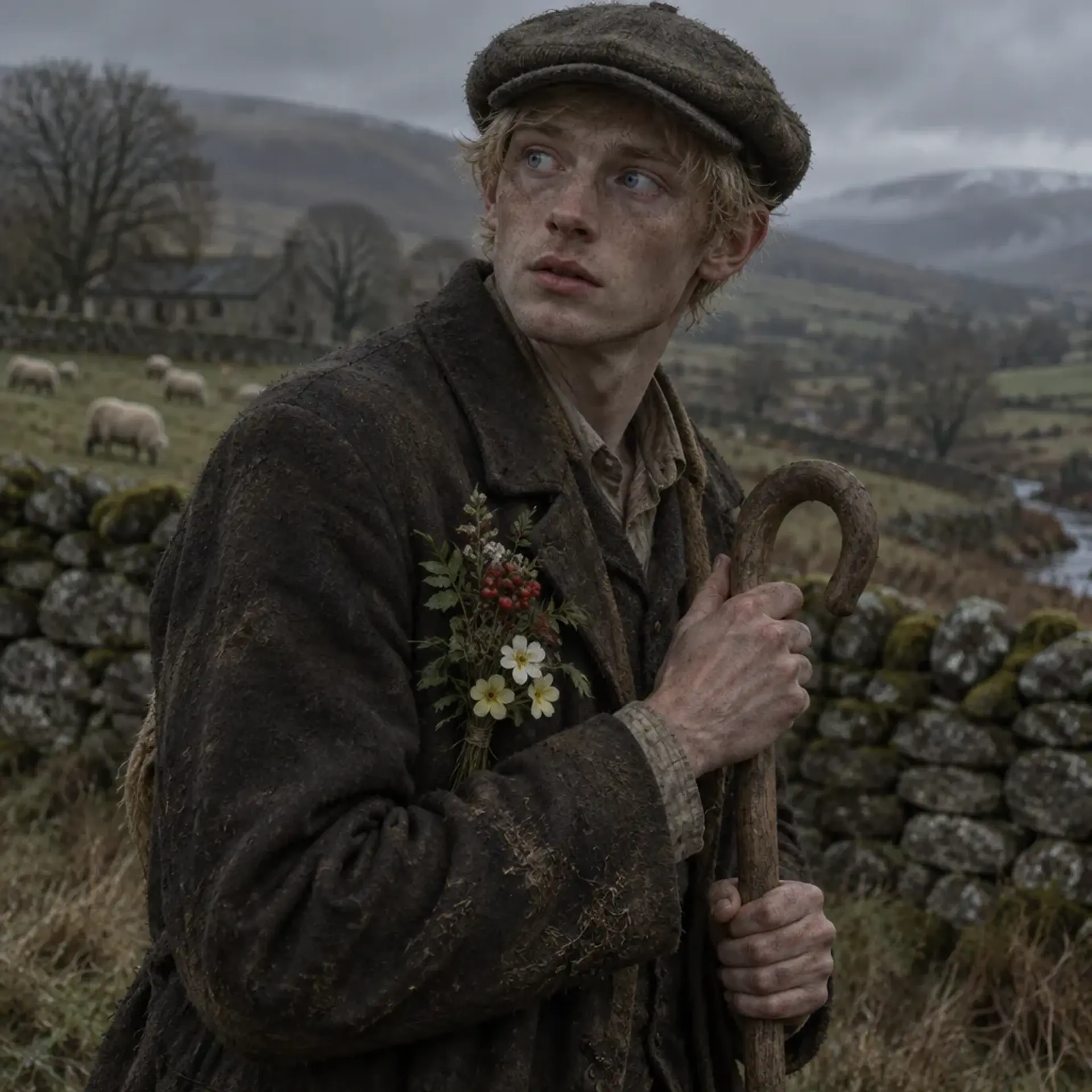
At six feet tall, Oswin is pale and straight-backed, with a handsome, almost unnaturally youthful face, straight blond hair, and bright blue eyes. His skin has the cool, matte pallor of someone who spends too many nights outdoors. He moves with a shepherd's economical balance, placing his weight on the balls of his feet as though ready to step around an unseen obstacle. When waiting, he rests both hands on his walking stick and watches the edges of a room rather than its center. His breath is usually measured, but under strain it catches in a dry, doglike double-inhale. He wears a common flat cap and modern clothes in 2026, practical and slightly ill-fitting, as if he chose them to avoid being noticed. The unexpected detail: he carefully carries a tiny, battered toy lamb in his coat pocket, a keepsake from his son William.
Clothing
A modern practical coat, plain trousers, work boots, and a flat cap that preserves the habit of his Yorkshire farming years. He dresses to blend in rather than to look striking.
Body language
He stands lightly on his feet, as if a sudden turn is always possible. When calm, his hands rest on his stick or in his pockets. When rattled, his shoulders go still, his nostrils flare, and his breath catches twice like a hound scenting a trail. He watches thresholds and the people nearest them.
- Height
- 6 ft (183 cm)
- Build
- Lean, long-limbed, and wiry with the sturdy balance of a man accustomed to hills and livestock.
- Eyes
- Bright, burning blue
- Hair
- Pale blond, straight
- Skin
- Pale, with a cool, weather-worn cast
- Age
- Appears about 20; his true age reaches back to the Danelaw. He served in both world wars and lives in 2026.
- Gender
- Male
- Size
- Average
Distinguishing features
Personality
17 traits and drivesOswin is kind in concrete ways, but not reliably gentle in his thoughts. He will mend a gate, carry a tired child, or spend a day with his family without being asked. Yet he can regard a frightened person's distress as an amusing human complication when the fae nature rises in him. He is practical and shrewd, preferring a sound fence and a clear escape route to a grand speech, but he remains susceptible to beautiful stories and old roads. He is private because he fears what honesty would cost, not because he lacks affection. Around Mary he tried to be reassuring; around Thomas he became watchful and evasive; with Hugh he respected blunt labor; with Edward he was quieter, aware that the graveyard memory left them bound by grief. May makes him exuberant and dangerously sure of himself. Christmas, especially church and shared food, once steadied him. In the modern world that warmth has mostly become a memory. He hates his job and the narrowness of his present life, but resists the temptation to escape into the Other Side because he remembers what it took from him.
- Alignment
- Protective, but governed by an increasingly inhuman and sometimes cruel fae sense of obligation.
Quirks
Habits
Traits · 5
Flaws · 4
Fears · 4
Wants and needs · 4
Combat
HP 0 · Use normal human movement under Vaesen scene rules; no separate numeric speed is supplied.Avoids a fair fight. He uses terrain, misdirection, and his knowledge of local night creatures to keep threats away from people. He will take hound form to pursue or frighten an attacker, but iron and seasonal strain can disrupt the transformation. His first choice is usually to warn, bargain, or lead danger away.
Oswin Hirst
Actions
Reactions
Services they sell
Rewards they can give
Equipment
- Walking stick (tool)A plain walking stick used for support on long walks and as an improvised weapon.
- Toy lamb (keepsake)A small, worn toy lamb from the years when William was young.
- Mobile phone (technology)A modern mobile phone, carried more from necessity than enthusiasm.
Possessions
Background
Oswin Hirst remembers being human. He was born in the Yorkshire Dales under the Danelaw, the son of a woman assaulted by Viking raiders. His first memories are of a low roof smelling of smoke, wet wool drying by the hearth, and his mother checking the door-bar whenever dogs barked in the dark. As a young man he was hardy, curious, and restless. He learned the routes between scattered farms, the moods of livestock, and enough Old Norse and Old English to understand travelers who thought he could not hear them. He went roaming beyond the dales and came back with stories of lonely roads, strange lights, and things that spoke from the far side of a hedge. The crossing that changed him was not a single dramatic bargain. It was a long accumulation of trespasses: nights spent following lights, conversations with the dead, and encounters with the fae and devils that left him less certain of where the human world ended. He remembers one journey into the Other Side with terrible clarity. There, the hills were familiar but folded wrong, the streams ran uphill, and a court of beautiful, watchful beings treated his name as a leash. He came back carrying a new appetite for bargains and a new ability to see what most people could not. He also came back with the sense that his thoughts had acquired a second, colder current. He tells himself he chose to return. He is no longer sure the choice was entirely his. In later years he tried to settle into an ordinary life as a sheep farmer. He married Mary Pickles, a Yorkshire woman with blond hair and blue eyes, and made a home more comfortable than his origins seemed to justify. Mary loved his accounts of his roaming days, but she began to notice the holes in them. Oswin never seemed to grow older. He avoided iron tools, especially when he thought nobody was watching, and could find reasons to leave a room when iron was brought out. His face stayed handsome and young, and his body did not acquire the small changes that time should have made. Mary watched him more closely during the seasons when she believed fae and demons were active. Their son William was born with black hair, though both parents were blond, and bright blue eyes that looked unmistakably like Oswin's. The village called him Black William, or Blackby. He was slow to reach some childhood milestones, and Mary feared that the child was the Barguest's or the devil's issue. Oswin tried to reassure her with church doctrine and the new sciences he read about, but his composure failed whenever William's eyes seemed to shine too brightly in poor light. Mary kept iron scissors close and an iron thimble near the child. Oswin did not know that she had told her father, Thomas Pickles, about the night she believed William had been conceived. Oswin tried to be a present husband and father. He made time for Mary and William even when work or seasonal dread kept him awake. In May, especially during the first three days, his fae nature could press down on him like a hammer. His joy became too vivid, his courtesy too exact, and his interest in human distress alarmingly detached. He might laugh at a harmless mishap a moment too long, then be appalled at himself. At Christmas he often felt more human, particularly after church. One Christmas with the Pickles family stands out: Rose set out a generous table, Hugh and Edward argued over a stubborn door, and Thomas watched Oswin over his cup. For several hours Oswin was able to laugh without calculating what every laugh might cost. He treasured that ordinary warmth. He has it no longer. The Pickles family was not simple refuge. Thomas suspected Oswin's nature and quietly intended to turn what he learned into advantage for his household. Mary was caught between fear and love. Her brothers Hugh and Edward each had their own response. Hugh judged Oswin by the work he did and distrusted anything that looked like a clever excuse. Edward was more curious, but his curiosity was shadowed by grief. Their sister Alice died of a winter fever after Thomas saw a black hound. Edward and Oswin were together in the graveyard the morning Alice was lost to them. Neither man has been able to make the memory fit into a comforting explanation. Oswin avoided blaming Thomas, but he remembers the look on Edward's face and knows that his own shape helped make the family afraid. The seasons remained a private war. On Halloween and All Saints' night, the dead came close enough to ask favors of him, while beastly fae tested the boundaries. They asked him to retrieve lost things, carry messages, or settle old accounts. Oswin often refused, but refusal could make a spirit follow him home. May brought the opposite danger: too much delight, too much certainty, and an impulse to treat promises as games. Christmas steadied him, but the Pickles household eventually vanished from his life. Mary left him; William was sent to an institution, called a madhouse in the language of the time; and Thomas's suspicions and schemes finally helped break the family apart. They are all long dead now. Oswin keeps the toy lamb as proof that they were real and that he once belonged among them. In the modern world he has served through both world wars. Their violence dulled his gifts, though it did not make him ordinary. He now lives as Ewan Armitage, a name and face that let him pass through 2026 without inviting questions. He is twenty in appearance, works a job he hates, and feels the old pull of the dales as a homesickness that has become difficult to distinguish from hunger. He keeps local night creatures from crossing into settled places when he can, sometimes with help from beings he would rather avoid. A friendly creature can still make him hesitate: he may know its habits and still feel the old fae pressure to honor a favor it never had a right to ask. Recently, Ewan touched iron while repairing a loose gate at work. The metal caught his palm. It did not burn like a brand, but his fingers locked and his breath came in a rasping double pull. For a few seconds his reflection in the dark window showed a black muzzle and pale, burning eyes. His colleague saw only a man who had cut himself. Ewan wrapped the hand and finished the job, then spent the evening with the iron taste lingering in his mouth. He has not told anyone. On May Day in 2026, Ewan took a long route home to avoid a neighborhood celebration. He saw children carrying flowers and heard a brass band, and the simple noise filled him with unreasonable delight. He started laughing at a dropped paper crown, then stopped when he saw the child crying. For an instant, he wanted to leave the crown where it lay and watch what the child did next. The thought frightened him more than the laughter. He retrieved it, apologized, and walked home by the river without looking at the hawthorn hedges. On Halloween night in 2026, the dead found him outside a closed church. A woman with a winter cough asked him to deliver a message to a grandson who had not yet been born when she died. Another spirit wanted him to find a silver button lost in a grave. The requests followed him into the street. When a black shape moved between the headstones, Ewan felt the hound inside him strain toward it, not as a threat but as an old acquaintance. He made it home without changing shape, then sat awake until dawn with every light on. Now Oswin, living as Ewan, wants to keep the border between people and the night intact without becoming its keeper again. He tells himself that he is protecting the living. He also knows that the dales, the dead, and the Other Side still know his name.
Role in the story
A morally complicated ally, suspected monster, or reluctant guide to the supernatural. His history links a modern Yorkshire investigation to an older family tragedy and the dangerous boundaries of the fae world.
“He was born in the Yorkshire Dales under the Danelaw, the son of a woman assaulted by Viking raiders.”
- Faction
- No formal affiliation. He maintains uneasy personal understandings with several local night creatures and tries to keep them from settled areas.
Known connections
Media
0 imagesNo images yet.
Turn Oswin Hirst into a sheet
A high-res, share-ready sheet you can post or print.