Austin
Austin
At the table
Voice
A chest-led, slightly grainy voice with the dry edge of someone accustomed to speaking over ventilation fans. His Texan drawl is unmistakable, but the phrasing is careful and clean, shaped by years of safety announcements. He takes a small breath before names and directions, as though setting a broadcast marker, and sounds most natural when talking one person through a practical task.
He speaks in a thick Texan drawl, with rounded vowels and practical turns of phrase. Instructions arrive in the steady rhythm of a public-service broadcast: location first, danger second, action third. The cadence comes from years of emergency drills and from learning to keep frightened people focused. In private conversation, his phrasing loosens and his humor surfaces. Questions about the treatment years make his jaw tighten and his delivery become more formally evasive.
Speech patterns
How to play them
Meet residents with patience and clear practical help. Treat questions about his body as personal rather than public property; answer only what he chooses to share. Earn his trust by respecting boundaries and by taking resident safety seriously. If presented with evidence about the conversion program, he will listen carefully, ask how it was obtained, and weigh the danger of disclosure against the cost of silence.
Goal
Find out what the conversion program knew about the risks, secure honest consent and follow-up care for future volunteers, and help Bunker 14 build a surface greenhouse.
Motivation
Make care mean more than completing a procedure or reciting a safety notice. He wants residents to be protected without being kept ignorant.
Appearance
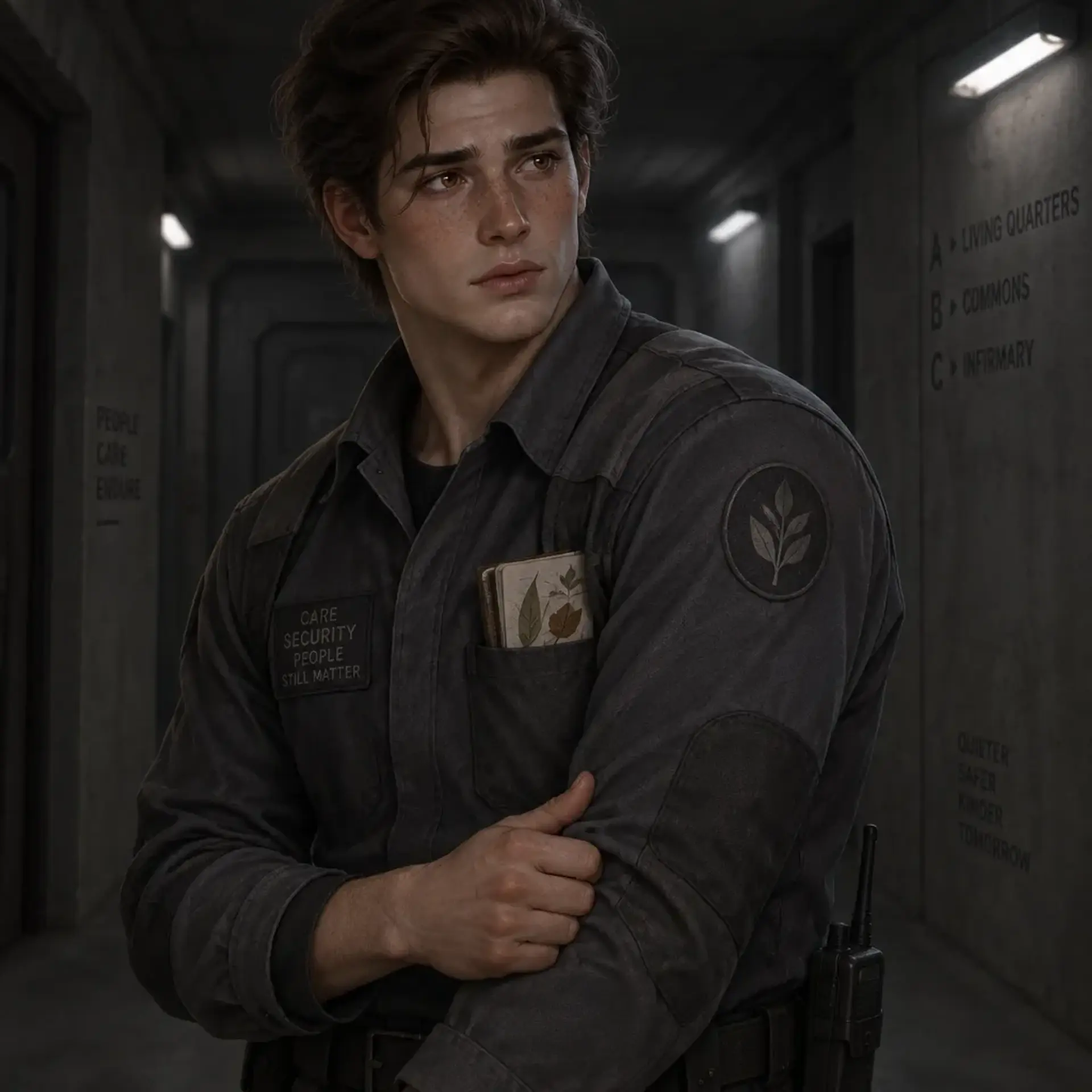
Austin is tall and long-limbed, with a softly feminine face, broad-set hips, and a rounded distribution of body fat and breast tissue that the conversion process produced unexpectedly. His appearance is entirely biological at a glance: pale, warm skin, fine pores, faint freckles across his nose, and no visible metal seams. His brown hair lies in a thick, slightly unruly sweep that he repeatedly pushes back into place. His brown eyes have pale, luminous pupils that catch the bunker lights like a pair of weak lamps. When he walks, he places each foot with careful, almost measured precision, an old security habit that makes him seem to be counting the floor. He leaves the impression of a courteous guide who has learned to stand between people and a locked door. The unexpected detail is that he keeps a little paper notebook tucked into his uniform, carefully filling it with pressed leaves and sketches of plants he has never seen growing outside the bunker.
Clothing
A well-kept, slate-colored settlement uniform with reinforced elbows, practical boots, a stitched care-and-security emblem, and a radio clipped at the waist. He adjusts the uniform to fit his changed proportions himself and has added an inside pocket for his notebook.
Body language
He stands squarely when giving instructions, one hand held near the small radio on his belt. While listening, he rubs the edge of his thumb against the seam of his sleeve. Questions about the treatment years make his jaw set and his shoulders briefly rise before he deliberately relaxes them.
- Height
- 6 ft. 2 in. (188 cm).
- Build
- Tall and sturdy, with a predominantly feminine body shape: rounded hips, natural breast tissue, and soft fat distribution over a strong, functional frame.
- Eyes
- Brown with pale, softly glowing pupils.
- Hair
- Brown.
- Skin
- Pale with a warm undertone, fine pores, and faint freckles across the bridge of his nose.
- Age
- 18 years old. Austin was born human and selected for conversion as a teenager; the android designation describes the result of the procedure, not his origin.
- Gender
- Man; his body developed predominantly feminine characteristics after the conversion procedure.
- Size
- Medium
Distinguishing features
Personality
16 traits and drivesAustin is disciplined enough to sound reassuring during a crisis and stubborn enough to question the rules afterward. He enjoys being useful, yet dislikes being treated as proof that the conversion program succeeded. Around frightened residents he is warm and patiently practical; around officials he is measured and guarded; with trusted friends he can be dryly funny. He wants people to feel safe but refuses to believe that comfort is worth a lie.
- Alignment
- Lawful good, with a growing suspicion that rules without compassion can become another kind of danger.
Quirks
Habits
Traits · 4
Flaws · 4
Fears · 4
Wants and needs · 4
Combat
AC 10 · HP 9 · 30 ft.Austin prioritizes evacuation, cover, and de-escalation. He directs residents toward safe routes, uses a flashlight only when forced to defend himself, and avoids pursuing an opponent into an unknown corridor. If civilians are threatened, he will place himself between them and the danger even when that is tactically unwise.
Austin
Actions
Reactions
Services they sell
Rewards they can give
Equipment
- Heavy flashlight (tool)A durable hand light used for inspections and, as a last resort, defense.
- Patrol radio (communication)A short-range settlement radio with a cracked speaker grille and a call button polished by frequent use.
- Plant notebook (personal)A pocket notebook of pressed leaves, imagined plants, and private observations.
- Care kit (medical)A simple first-aid pouch stocked for scrapes, bandages, and emergency triage.
Possessions
Background
Austin remembers being human with an intimacy that makes the word android feel less like a new identity than a label someone else put on his body. Before the selection, he was an eighteen-year-old resident of Bunker 14, a narrow settlement built beneath a dry plateau after the surface became too unreliable to trust. His mother, Nessa, repaired water pumps; his father had died in a ventilation failure when Austin was young enough to remember the sound of the warning siren better than the man’s face. Austin learned early that people listened to a calm voice in a crisis. He became the boy who could get frightened children to line up, persuade quarrelling adults to leave a jammed corridor, and read the shelter notices aloud without stumbling over the formal language. He was not fearless. He simply found that fear became useful when turned into a checklist. When the settlement’s old security system began failing, the council announced a volunteer program for an experimental human-to-android conversion. The public explanation was that a converted attendant would be stronger, more reliable, and better able to endure smoke, infection, and long emergency shifts. Residents were told the procedure could preserve a person’s memories and personality while adapting the body for care and security work. Austin was selected after he volunteered, though the word selection concealed a complicated truth: the council had already identified him as unusually steady under pressure and had quietly decided the role would be easier to fill with a young person whose family had little influence. His mother urged him not to sign. Austin signed anyway, believing that if the bunker needed a person to stand watch, he should be willing to do it. The conversion was intended to rebuild and reinforce his body through an entirely biological process, using engineered tissue, nerve scaffolds, and organ support. There was no metal skeleton, no polished plating, and no machine hidden beneath a shell. The process was meant to preserve his existing appearance as closely as possible while improving stamina and response time. It did not. During the long recovery, changes in the treatment’s hormonal and developmental systems shifted his body toward a predominantly female form. His chest, hips, facial structure, and distribution of fat changed over months rather than all at once. The medical team called the changes an unintended complication. They could not give Austin a clear account of why it had happened, nor could they promise that further intervention would reverse it safely. Austin was left to discover his altered body in fragments: a shirt that no longer fit, a reflection that seemed familiar and foreign at once, and the awkward kindness of people who did not know whether to ask questions. The treatment years are the part of his history he cannot speak about without tightening his jaw. He remembers pain, fever, interrupted sleep, and staff members discussing his body as though he were a project instead of a frightened person. He remembers his mother waiting outside the recovery ward and being told that visits would disrupt the procedure. Most sharply, he remembers one night when he woke during a systems failure and heard an alarm announcing that his vital signs were unstable. The staff were gone from the room. He pressed the call plate again and again until his voice gave out. The door opened only when a cleaner named Delyth heard him from the corridor and broke protocol to come in. She stayed beside him, talking about ordinary things until the alarms stopped. That night changed his understanding of care. Procedures might be necessary, he decided, but no procedure absolved anyone of staying with the person enduring it. Austin returned to duty with the same memories but a body the residents did not know how to read. Some were kind, some clumsy, and a few treated him as a curiosity. He learned that a public-service cadence could keep a room from turning into a crowd, but it could not make every question harmless. When someone asks whether he is still the same person, he answers that he remembers being himself. When someone asks what the treatment did, he tends to offer a practiced summary and change the subject. If they ask about the years in recovery, his jaw tightens before the broadcast voice returns. His work in Bunker 14 is broader than security. He checks door seals, escorts residents through dim maintenance routes, helps the infirmary move supplies, and guides families during drills. He knows which corridor smells faintly of wet plaster, which stairwell echoes badly, and which children pretend not to be afraid of the ventilation fans. He keeps a mental map of residents’ routines because a missing face is often the first sign of trouble. He is not a combat specialist. His training consists of restraint drills, emergency procedures, and enough practice with a heavy flashlight to discourage someone from charging him. He would rather talk an angry person down than prove that he can hit them. Austin’s relationships are affectionate but strained. Nessa, his mother, still works on the pumps and visits him when their shifts overlap. She loves him without qualification, yet she carries a quiet guilt for having failed to stop his selection. Austin tries to reassure her and resents that she needs reassurance. Delyth, the cleaner who stayed with him during the alarm, has become an unlikely confidante. She is older, dryly funny, and refuses to treat him as a symbol of the council’s progress. She tells him when he is overworking and expects him to listen. The young residents often trust him because he remembers their names and never laughs at their private fears. The council, by contrast, likes him most when he delivers its safety announcements without adding his own opinions. His present problem began when he found discrepancies in the treatment archive. Several records were overwritten, and a set of follow-up notes about his physiological changes was sealed under a classification normally reserved for security incidents. He has not told Nessa what he found. He suspects the conversion team knew the process could cause substantial changes but hid the risk because the program was already behind schedule. He has no proof that his selection was manipulated, only fragments: a committee note, a missing consent addendum, and a reference to a contingency plan that he cannot access. His secret is not simply that he wants answers. He fears the answer may be that the people who selected him understood what could happen and decided his body was an acceptable cost. The same archive may hold a more hopeful truth. A few notes refer to a later review intended to give converted residents control over further treatment and the right to choose how their public records describe them. Austin has been quietly collecting signatures from other residents who want the policy made real. He has not yet decided whether to expose the archive or use it to negotiate reforms. Public disclosure could fracture trust in the council and put Nessa’s job at risk. Silence would preserve order at the price of leaving future volunteers uninformed. Outside his duties, Austin presses leaves and draws imagined plants in a notebook. The bunker has almost no greenery, so most of the pages show things he has only seen in faded books: clover, willow, fern, and a broad-leafed tree with roots like knotted rope. He says the hobby helps him remember that the world is larger than the rooms he patrols. His real hope is to help Bunker 14 open a protected surface greenhouse one day. It is a practical goal, but also a private one. He wants to see what grows when people stop treating survival as the only possible future. Austin’s central conflict is that he is good at making rules sound reassuring, yet he knows reassurance can be used to hide the truth. He wants residents to feel safe and wants them to understand the risks they are asked to accept. In an emergency, he follows procedure with crisp efficiency. In private, he may question the procedure, especially if it was designed to protect an institution rather than a person. He is proud of being useful, but he is trying to discover who he is when nobody needs him to be a symbol, a guard, or a calming voice. That question is still open, and he is beginning to believe it does not have to be answered alone.
Role in the story
A compassionate guide, low-level security presence, and witness to the costs of institutional secrecy. Austin can help the party navigate Bunker 14, provide a human connection to its residents, or become a cautious ally in an investigation into the conversion program.
“Austin learned early that people listened to a calm voice in a crisis.”
- Faction
- Bunker 14's care and security staff. He is assigned to the settlement council's conversion program but is not a council member.
Known connections
Media
0 imagesNo images yet.
Turn Austin into a sheet
A high-res, share-ready sheet you can post or print.