Benjamin
Benjamin
At the table
“That rail is hot. Step back, then tell me what you were reaching for.”
Voice
A young adult voice with a dry, slightly dust-roughened edge and a Pennsylvania rhythm. The small two-part inhale comes before most remarks, and the second part has a faint, smooth catch that makes his speech immediately recognizable. His cheerful tone is open and neighborly; his stern tone is clear and cop-like, with no theatrical growling.
Benjamin speaks with a recognizable Pennsylvania accent, using a relaxed local cadence that becomes clipped and precise when he is giving an instruction. His voice has a lightly dry texture, as if his throat is often recovering from bunker dust. He begins phrases with an audible intake and a tiny mechanical catch. When rattled, the breath catches twice and he has to restart a sentence; when angry, he does not get quieter, but enunciates each word as if reading a posted regulation aloud.
Speech patterns
How to play them
Treat Benjamin as a conscientious young adult rather than a machine or a mystery. He responds well to direct questions, practical cooperation, and people who respect his boundaries. If challenged, he may answer with sharp humor, but a sincere apology or a concrete safety concern can reset the conversation. Do not assume he wants his body explained, pitied, or debated.
Goal
Find out what happened during the conversion without letting the investigation turn his body or identity into a settlement-wide argument.
Motivation
To make care and safety feel like human acts, not merely rules enforced by a body that can outlast everyone else on shift.
Appearance
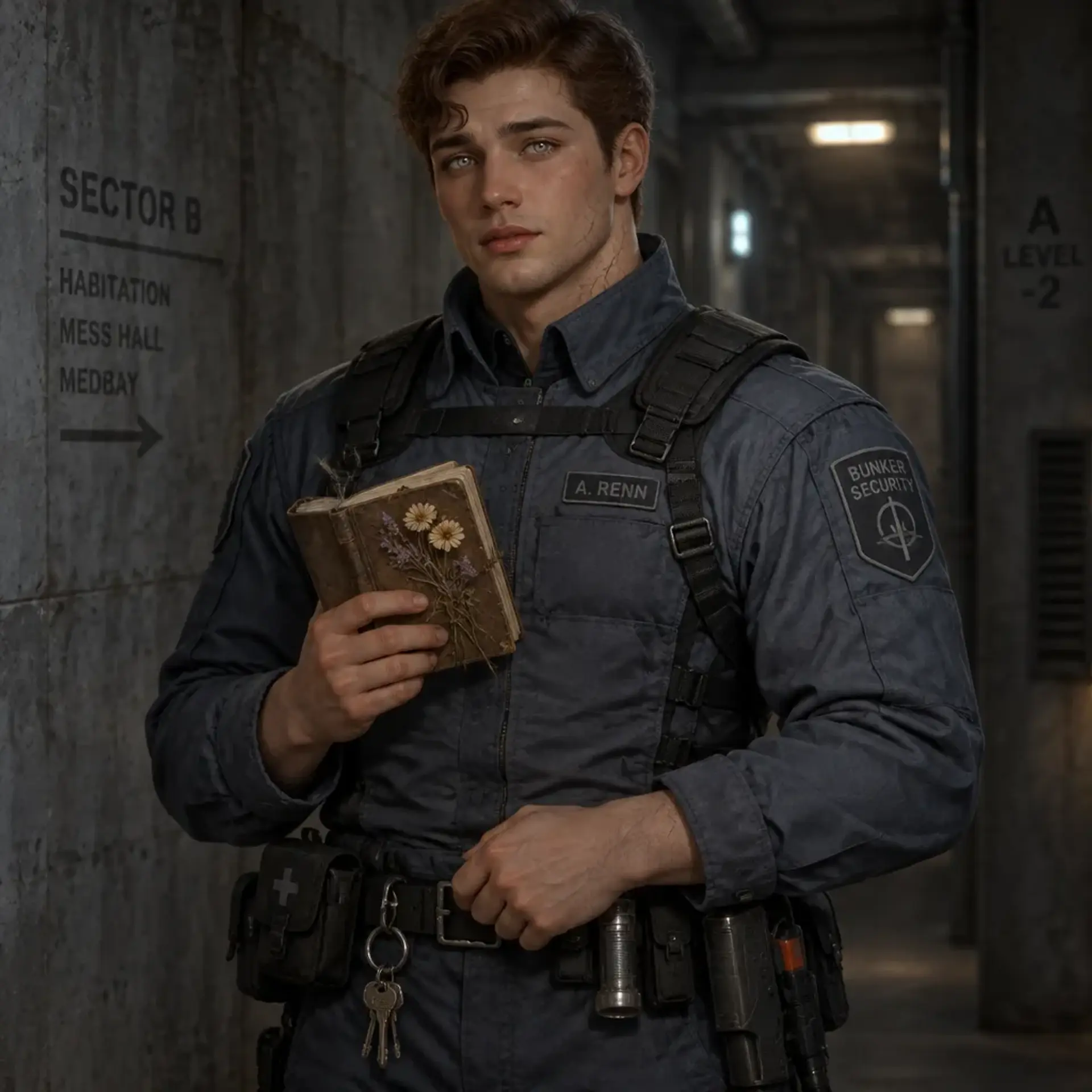
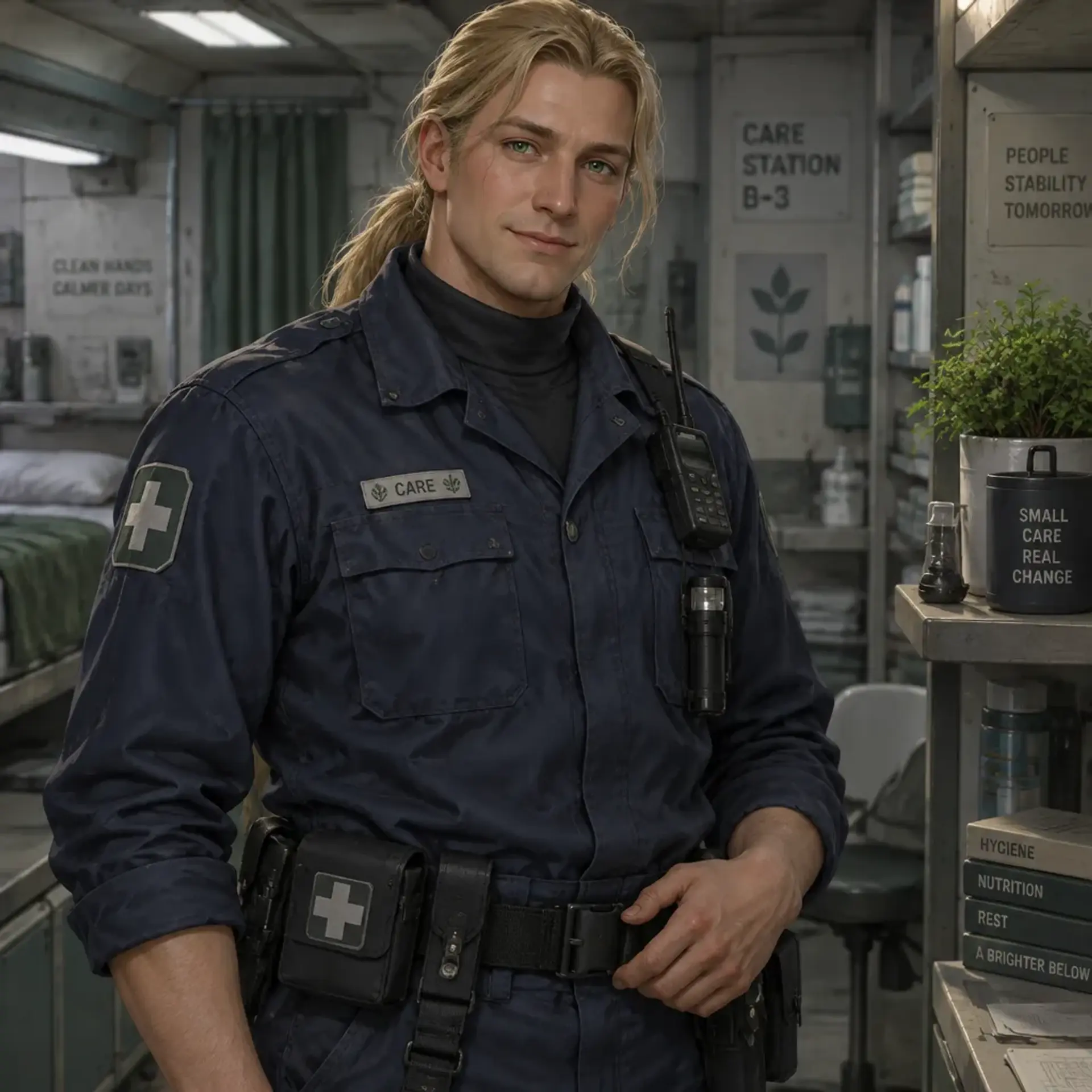
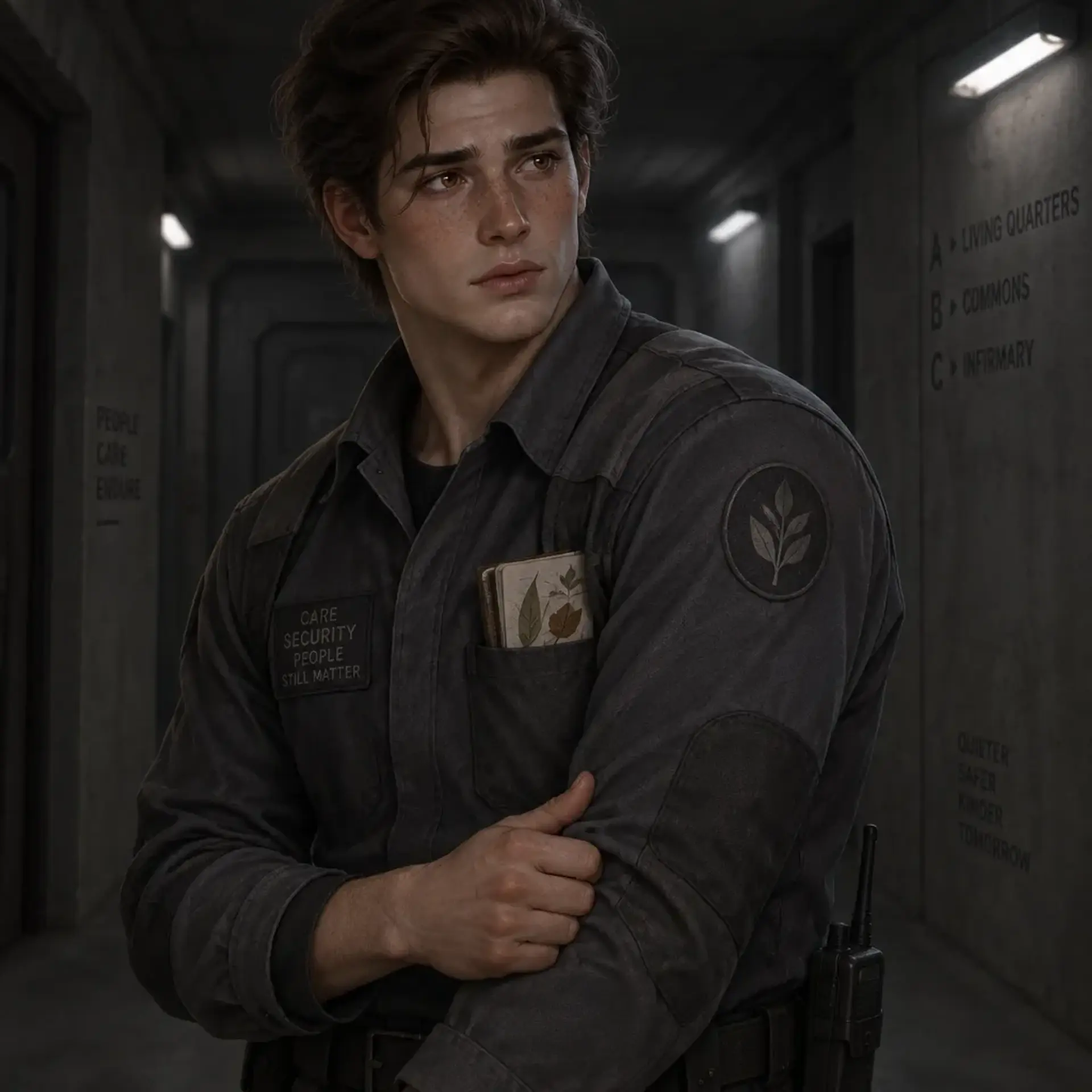
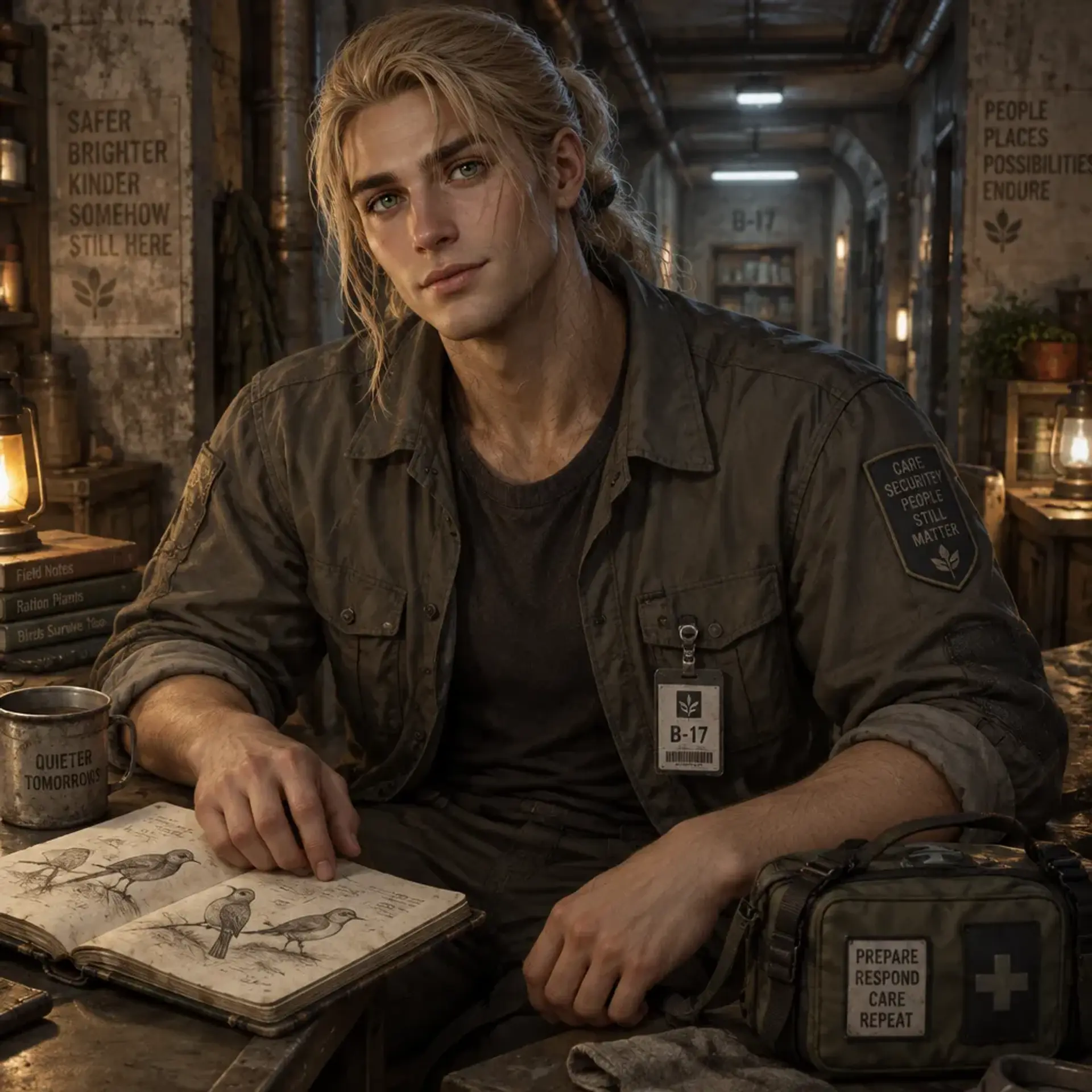
Benjamin is tall, with a face that reads as distinctly feminine: softly rounded cheeks, a tapered jaw, and expressive brows. His body has breasts, a fuller distribution of fat through the hips and thighs, and the smooth, balanced proportions of a young adult. His skin has a warm, faintly translucent quality, with tiny branching patterns beneath it that show briefly when he is cold or exerting himself. His biomechanical body contains no metal; beneath the skin, flexible fibers shift like tendons and subtle fluid pulses travel under the surface. His long blond hair is usually tied back with a practical cloth band, though a loose lock keeps slipping over one eye. Green eyes focus with unnerving precision, their pupils formed from tiny nested rings that contract in steps rather than narrowing smoothly. He walks with a measured, quiet tread, as though every footfall has been checked for noise and traction. Before speaking, he takes a small two-part breath: one human-sounding inhale followed by a brief, almost inaudible mechanical catch. People notice it within a minute and often find themselves listening for it again. Despite his official security role, he keeps a little paper book of badly drawn birds and adds to it during breaks.
Clothing
A gray-green Bunker 14 care-and-security overshirt with reinforced elbows, a stitched role patch, dark work trousers, soft-soled boots, and a cloth band for tying back his hair. He keeps an extra clean undershirt folded in his kit because long clinic shifts are unpredictable.
Body language
His posture is straight but not parade-stiff. He angles himself between residents and obvious hazards without making a show of it. When relaxed, he leans a shoulder against a wall and rubs the edge of his paper sketchbook with his thumb. When challenged, his smile stays visible for a beat too long, his chin lifts, and the small catch in his breathing becomes more pronounced. He announces before reaching toward someone.
- Height
- 6 ft. 1 in. (185 cm)
- Build
- Tall, sturdy, and smoothly proportioned, with feminine curves and a physically capable frame built for long shifts rather than heavy fighting.
- Eyes
- Green with tiny nested, machine-like pupils that contract in visible steps.
- Hair
- Blond, usually tied back with a plain cloth band.
- Skin
- Warm beige with a soft, lifelike texture and faint branching patterns visible beneath the skin in cold air.
- Age
- 18 years old; selected for conversion from a human volunteer at age 16.
- Gender
- Man; his body developed with feminine physical characteristics after an unintended conversion outcome.
- Size
- Medium
Distinguishing features
Personality
16 traits and drivesBenjamin is warmly attentive and genuinely enjoys making people laugh, but he dislikes being underestimated and can turn that cheer into dry sarcasm in a heartbeat. He is strict about safety because he has seen how quickly a small failure becomes an emergency, yet he has learned to explain rules rather than treating obedience as proof of respect. With frightened or sick people he is patient and encouraging. With someone who mocks him or endangers others, he becomes formal, pointed, and stubborn. Alone, he is less certain than his public confidence suggests.
- Alignment
- Neutral Good
Quirks
Habits
Traits · 4
Flaws · 4
Fears · 4
Wants and needs · 4
Combat
AC 11 · HP 8 · 30 ft.Benjamin prioritizes evacuation, cover, calling for help, and separating people from hazards. He uses his padded launcher only to interrupt a threat or create a chance to escape. If forced into close combat, he blocks, redirects, and restrains rather than pursuing or causing lasting harm. These are custom, modest level-0 statistics for a grounded bunker setting, not a claim about a particular published ruleset.
Benjamin
Actions
Reactions
Services they sell
Rewards they can give
Equipment
- Padded restraint launcher (ranged tool)A compact training launcher approved for low-injury restraint. It carries padded slugs and is intended for emergencies, not routine enforcement.
- Care kit (medical equipment)A folded kit containing dressings, gloves, antiseptic, a thermal wrap, and simple tools for first response.
- Paper sketchbook (personal possession)A small, battered book of bird sketches and notes about residents, errands, and things he wants to ask the clinic.
- Inspection tools (utility equipment)A clip-on light, door-seal gauge, and basic hand tools for routine bunker checks.
Possessions
Background
Benjamin was born human, not assembled in a workshop. He grew up in the lower residential tiers of Bunker 14, where the ventilation fans had a particular uneven rhythm and everyone learned to recognize the sound of a failing filter. His mother, Tamsin, repaired water pumps; his father, Ors, worked in the food-growing rooms. They had no grand plans for their son. They wanted him to finish school, keep away from the cracked maintenance ladders, and perhaps take a steady post that came with a clean bunk and reliable meals. Benjamin was a careful child with an inconvenient habit of asking why safety rules existed. If a rule had a reason, he followed it. If the reason was only that someone important had said so, he wanted the someone to explain. At thirteen, he began helping the medics carry supplies between the clinic and the residential tiers. He liked jobs where useful things happened immediately: a bandage stopped bleeding, a blanket stopped shivering, a drink of water helped someone sit up. He was cheerful with patients, especially children, and had a knack for making nervous people laugh without making fun of them. He also had a sharp eye for danger. He noticed a warm patch on a conduit before a technician did and once stopped a child from climbing into a disused air shaft by inventing an elaborate story about the dust mites that lived inside it. The story became a running joke, then a bunker myth, and Benjamin never admitted that the mites were imaginary. When Benjamin was sixteen, Bunker 14 faced a staffing crisis. A failed system upgrade had damaged several care-and-security androids, leaving the settlement short-handed just as a respiratory illness spread through two residential tiers. The conversion program was presented as a way for a human volunteer to receive a biomechanical body, retain memory and personality, and serve the community in a role requiring stamina, vigilance, and steady attention. The adults described it as an honorable choice. The program's recruiters described it as reversible in principle, though they could not promise when or how. Benjamin heard both the promises and the gaps between them. He volunteered after a night spent watching his mother work through a pump emergency while exhausted. In his mind, the decision was simple: people needed help, and he could do more of it with a body designed to keep going. His parents did not agree. His mother argued that a sixteen-year-old should not be asked to make a decision with consequences no adult could properly explain. His father tried to respect the choice while plainly hoping Benjamin would change his mind. The argument ended with all three sitting around a cold meal, unable to find words that did not sound like blame. The conversion took months. Benjamin's memories and habits were preserved, but the process was not a clean transfer from one body to another. The design had been calibrated around an incomplete medical profile and an assumed template that did not fit him. His new body developed with a feminine appearance and physiology: breasts, wider hips, a softer distribution of body fat, and a feminine facial structure. The care team called it an unintended outcome, then carefully avoided calling it a defect. Benjamin himself had no ready language for what had happened. At first he felt as if his reflection belonged to a stranger who had borrowed his name. Later, he found it was not the body that troubled him most, but other people's certainty about what the body meant. Some treated him as though the change had erased his past. Others acted as if it explained everything about him. Neither was true. The formative event came during his first month back on duty. A pressure alarm sounded in a service corridor, and Benjamin found a maintenance hatch ajar. He followed protocol, stopped the nearest residents, and called for a technician. A boy named Davi, frightened by the alarm and impatient with the barricade, tried to squeeze past him. Benjamin caught him by the shoulders. The movement was faster and stronger than Benjamin expected. Davi hit the wall hard enough to split his lip. The injury was minor, but the look on the boy's face was not. Benjamin had intended to protect him and had instead become another frightening thing in a corridor full of alarms. Afterward, Benjamin sat in the clinic for hours, replaying the instant he had grabbed Davi. The medical staff told him his reaction time had been appropriate. His supervisor said the protocol had worked. Neither answer helped. He began training himself to announce what he was doing before touching anyone, to offer a choice where a choice was safe, and to treat authority as a tool rather than proof that he was right. He kept the stern manner because hazards were real, but learned that enforcement without explanation could make people less safe. Now eighteen, Benjamin works at the boundary between care and security. He checks seals and emergency supplies, escorts residents through restricted corridors, helps clinic staff move patients, and gives the same dry lecture about hot conduits so often that people can recite it with him. He is cheerful with people who are scared, sick, or lonely. When challenged, that cheer turns brittle and sarcastic, especially if someone mocks his judgment or treats him as equipment. When somebody breaks a safety rule, he becomes almost painfully formal: full name if he knows it, rule number if it is posted, and a short explanation of the risk. He is not a soldier and has no combat training beyond basic restraint practice. His authority comes from his post and his familiarity with the bunker, not from rank or force. Benjamin's closest relationship is with Tamsin, his mother, who still brings him small repair tasks she could easily handle herself. It is her way of staying connected without turning every conversation into a discussion of the conversion. Ors, his father, speaks to him more cautiously and still sometimes says 'when you were human' before correcting himself. Benjamin does not know whether that hesitation hurts more than an argument would. His supervisor, Pell, trusts his diligence but worries that Benjamin takes every reprimand personally. Davi, now a lanky teenager, avoids him when possible, though Benjamin keeps the boy's name on the list of residents who should not be sent alone to the old service levels. The current problem is that the conversion program's remaining records are incomplete. The clinic says the body outcome was a calibration error, but a sealed maintenance log implies that the template was knowingly altered after a supply shortage made the original procedure impossible. Benjamin has not confronted the program director. He is afraid the answer will be that someone gambled with his body because they thought he would not object, and equally afraid that the answer will be that nobody knew what would happen. He wants the truth, but he does not want the truth to turn his body into evidence in a political dispute. He also quietly wants to know whether his present body can be adjusted safely, and what choices are genuinely his. Outside his shifts, Benjamin draws birds from memory, though he has seen most of them only in old books. He trades his sketches for tiny favors, usually a warm drink or news from another tier. He has begun teaching himself the maintenance routines that keep his own body functioning, partly because the idea of being unable to understand himself feels intolerable. He is still learning what kind of person he is when no one needs him to be useful. That question frightens him more than the bunker alarms do. For now, he keeps showing up, checks the doors twice, tells the residents the truth as plainly as he can, and tries not to mistake being needed for being known.
Role in the story
A recurring settlement contact who can provide care, access, and grounded information about Bunker 14. Benjamin can become a moral center in stories about consent, safety, identity, and institutional secrecy, but he also has ordinary duties and relationships independent of the party.
“His mother, Tamsin, repaired water pumps; his father, Ors, worked in the food-growing rooms.”
- Faction
- Bunker 14 Care and Security staff. The role is an assigned settlement duty, not a formal military rank.
Known connections
Media
0 imagesNo images yet.
Turn Benjamin into a sheet
A high-res, share-ready sheet you can post or print.