Mark
Mark
At the table
Voice
Clear and young, with a slight rasp from poor sleep and a dry, chalky catch when he has been pacing or speaking for a long time. His diction is careful and faintly formal, shaped by a desire to be taken seriously. Under pressure he becomes brisk and plain-spoken, not softer.
His voice is a young man's, clear and properly articulated, with a slight rasp from restless sleep and the dry catch of someone used to breathing damp air. His speech carries the careful diction of someone trying to sound educated and respectable, but the edges roughen when he is tired or angry. The voice belongs to Kent's face and body, not to Mary's remembered presentation. He does not sing, whisper in anger, or soften his voice automatically; when upset, he speaks more directly and may interrupt.
Speech patterns
How to play them
Treat Mark as a person rather than a curiosity or a medical puzzle. Offer concrete choices, respect his need for privacy, and do not assume he can explain the change. He responds well to steady practical kindness, especially involving food, work, and the children. He becomes defensive if someone claims to know what he is better than he does.
Goal
Build a stable life with Trudy without abandoning the Bell children, find out what happened to Mary, and discover whether the missing heart can be kept from controlling him.
Motivation
To find a livable balance between the life he has become, the people who still need him, and the unsettling question of what happened to Mary.
Appearance
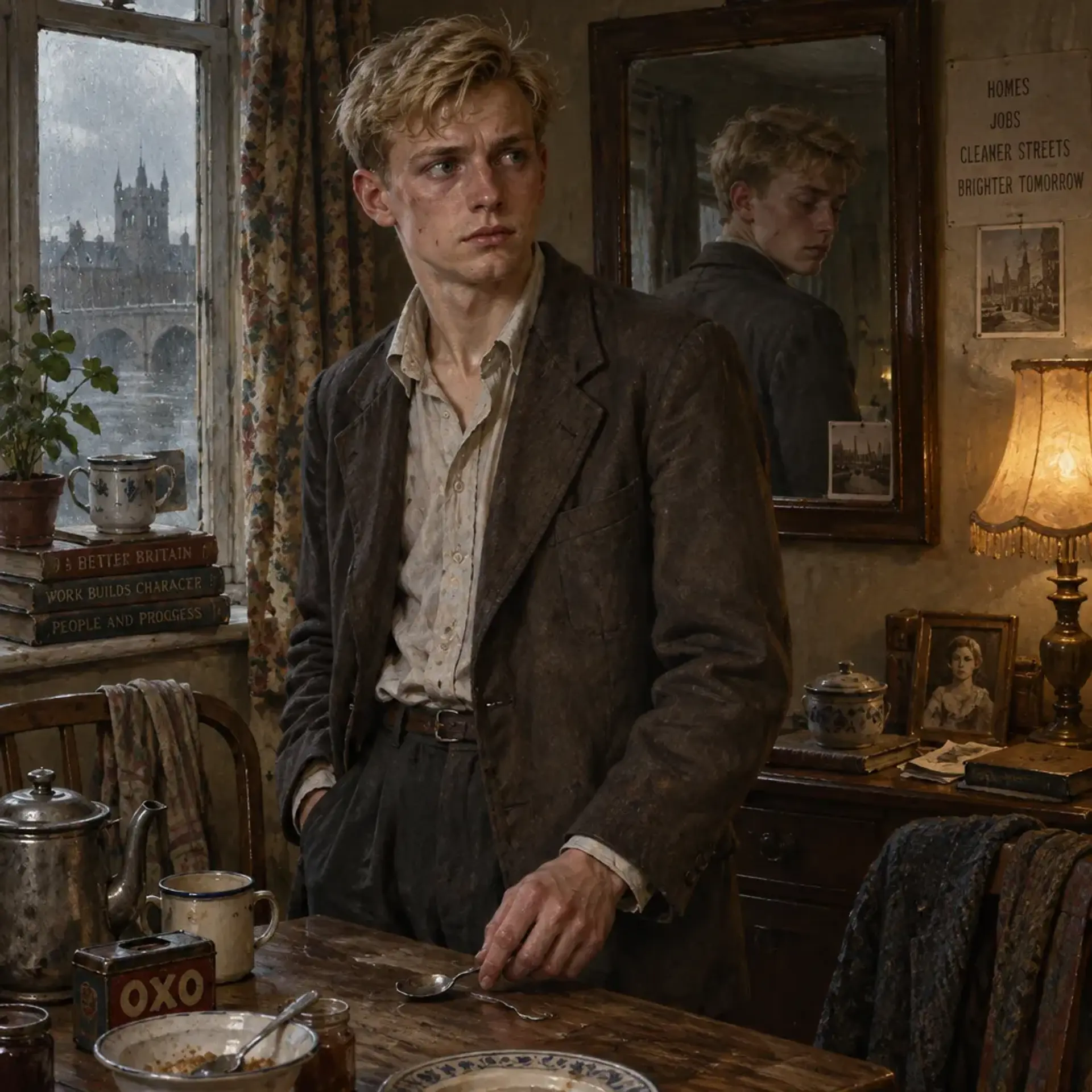
Mark's present face is Kent's: handsome in a clean-cut, almost carefully arranged way, with short bright blond hair, malachite-green eyes, and features that look wholly unlike Mary's. He stands taller than Mary did and carries himself as if his shoulders ought to fit a better coat. The body's skin has a faint, dry chalkiness at the temples and knuckles, but a close look finds ordinary warmth and the slight flush of exertion. He smells of damp wool, shaving soap, and a persistent mineral tang like wet chalk after rain; he knows about the soap, not the chalk. His movements alternate between a self-conscious, formal stride and sudden, startlingly sure physical reactions. On the morning of 30 May, Mary's familiar appearance seemed to loosen and peel away in a frightening, dry-sunburn-like shedding, leaving Kent's body beneath it. The family remembers the sound of fabric, Mary's cry, and a pale, papery residue on the floor. Mark does not have Mary's face or body, a fact that comforts and horrifies the household in equal measure. An unexpected detail: despite his finicky opinions about clothes, he is capable of making an impressively ugly, lopsided paper crown for a toddler and wearing it without complaint until the child falls asleep.
Clothing
Postwar practical clothes chosen for neatness: a collared shirt, a worn jacket, and trousers kept as tidy as circumstances allow. Trudy's gifted socks, undergarments, and shoes are serviceable but below his private standards. He is grateful and wears them. He has no settled wardrobe and sometimes has to borrow or make do.
Body language
He holds his shoulders square and his chin level, as if dignity can make an unfamiliar life orderly. Around strangers, he is formal and watchful; around children, he loosens into rough play but does not naturally anticipate their needs as Mary did. When embarrassed by Trudy's teasing, he straightens his cuffs, then forgets what he meant to say. Under threat, his body may move with abrupt, practiced force that leaves him as startled as anyone watching.
- Height
- Taller than Mary; exact height not established.
- Build
- Taller than Mary, with a lean, young man's frame and a posture that makes him seem more formal than strong. His movements can become unexpectedly forceful.
- Eyes
- Malachite green
- Hair
- Bright blond
- Skin
- Fair, with a faint dry chalkiness around the temples and knuckles that is easiest to notice in cold or damp light.
- Age
- 18
- Gender
- Male
- Size
- Medium
Distinguishing features
Personality
20 traits and drivesMark is earnest but not simple, proud but dependent, and curious about ordinary life while wary of anyone who asks too many questions. He wants to be treated as a respectable young man and can be fussy about clothes, manners, and the appearance of competence. At the same time, he accepts hand-me-downs from Trudy, sleeps on her couch, and is learning that dignity does not pay rent. He can be judgmental about Trudy's rebellious style, yet he trusts her more than anyone else and follows her out when she insists he cannot spend every day shut indoors. The part of him shaped by Mary is devoted, observant, and naive. He notices a child's hunger or cold before he notices his own, but he does not naturally know how to care for the younger siblings in Mary's old way. The part shaped by Kent is more formal, more interested in being seen as high class, and more comfortable with a quiet home than with a crowded family. Those tendencies do not sit neatly together. Mark may make breakfast for everyone, then refuse to be treated as the household's replacement daughter. He can roughhouse with the children, then be embarrassed when they ask him to comfort them as Mary once did. Around strangers, he tries to appear composed and correct. When frightened, he becomes blunt rather than meek. He dislikes doctors' questions because they make his own history sound like a case report, but he will cooperate when he believes the question is sincere. His temper is not usually loud; it is a stiff refusal, a locked jaw, or a sudden decision to walk away. If someone corners him or threatens a child, his body can respond with force and precision before his conscious mind has caught up. He is troubled by that response and does not think of himself as a fighter. Mark has a homebody's instinct for routine, yet he is restless at night and uneasy when left alone with his thoughts. He paces the flat, tries to arrange his small corner, and makes breakfast as a way to turn anxiety into something useful. He sleeps badly, sometimes thrashing as if caught in a dream. Trudy teases him for being a turtle, and he protests, but he often needs her to draw him back into the world. His attentiveness to her is genuine, sometimes overly formal, and tinged with a feeling he has not identified as a crush. Trudy's playful corrections keep that from becoming an entitlement. He is grateful for help but finds gratitude awkward. He may compliment a gift by noting that it is durable, then quietly take special care of it. He dislikes being pitied, though he needs support. He wants a life that belongs to him, but cannot dismiss the Bell children or the possibility that Mary remains somewhere within the confusion of their shared history. His kindness is real, but it is no longer Mary's automatic self-sacrifice. When the family expects him to take over her old chores, he can say no, and the refusal brings guilt as well as relief.
- Alignment
- Protective of vulnerable people, but increasingly self-directed; his conduct is shaped more by immediate loyalties than by a fixed moral code.
Quirks
Habits
Traits · 5
Flaws · 5
Fears · 5
Wants and needs · 5
Combat
HP 10Avoids violence and tries to leave, distract, or put himself between a threat and someone vulnerable. If cornered, he uses a sudden shove, grip, or pin with disproportionate precision. He is inexperienced at sustained fighting and may freeze afterward, disturbed by what his body did.
Mark
Actions
Reactions
Services they sell
Rewards they can give
Equipment
- Borrowed and gifted clothes (clothing)A small collection of practical clothing, including gifts from Trudy that he keeps carefully folded despite their poor fit.
- Trudy's shoes (clothing)A worn pair of shoes from Trudy, uncomfortable by his standards but important to him because she thought to provide them.
- Chalk heart (missing object)The fossil-like heart is currently missing. Henry says he stole and sold it; this has not been verified.
Possessions
Background
Mark's life began as Mary's, an eighteen-year-old in a crowded, isolated Kent household where affection and exhaustion were tangled together. She was the eldest of eight children and had learned to notice every small need before anyone else did: a missing blanket, a sibling's hunger, a parent too drunk to manage the morning. Her mother, Malinda Bell, was neglectful and often drunk; her father, Simon Bell, took distant work and was frequently absent. Mary did schoolwork when she could, found part-time work to help, and guarded Matilda from being turned into a replacement housekeeper. She tried to make time for little Hubert and the others, though there was never enough of it. Her friend Trudy, a short, wiry young woman who called herself a rebel and wore her hair and clothes in conspicuously alternative fashion for the period, sometimes helped with the children. The strange object entered the family as a birthday present. Malinda found it in a log and gave it to Mary, who liked curious stones. It looked like a human heart carved from Dover chalk, with barnacles and sea grass clinging to it. It had once been wrapped in newspaper and offered as payment for entry to the Hush House by the amateur alchemist Bartholomew Golden, who called it the Heart of England and claimed it could bring servants from the shadow of the land. Golden was never allowed near Brancrug again. The heart was thrown into the sea, washed ashore wet with salt and black ooze, and eventually picked up by Abraham Groff. It beat under his coat on the train home. It fell quiet when others looked at it, then revived in water, glowing a reddish pink beneath its rocky surface. Groff became frightened by the voices, footsteps, and moving doors that followed it. He sold it to William Windon, a local lad who had once seen it and had hidden it in a log after striking it with a hammer. The heart stopped beating then. Much later, Malinda found that same queer object and gave it to Mary. Mary did not know what she had been given. The stone began beating in time with her own heart. Then her reflection stopped being hers. In glass and mirrors she saw a young man with short blond hair, green eyes, and a handsome face, watching her with expressions that seemed to belong to someone else. The sight repulsed her, but she was too busy and tired to investigate. The image moved when it pleased, looked away when she stared, and seemed more like a presence than a simple reflection. Mary learned that sometimes she would wake in his body. She used those nights as an escape from the house: a chance to go to the beach, climb trees, explore abandoned buildings, and visit the pub. She treated these excursions as a strange convenience, not as a second life. She did not understand that the young man had his own manner, preferences, and responses. The first night began after a bad dream. Mary woke in an unfamiliar body, tall, male, and visibly not her own. Panic gave way to practical questions: where were the clothes, how could she get home, and would the change reverse by dawn? It did. That first outing became a furtive walk through the sleeping town, a careful climb over a garden wall, and a visit to the shore where the heart's salt smell seemed strongest. At the pub, the borrowed young man tried to look as if he belonged, sat too upright, and asked for a respectable drink with the manner of someone who thought the room beneath him. He was not cruel, but his preference for a proper collar and middle-class respectability showed through. Mary later remembered the night as an adventure; the body, in its silences and instinctive reactions, was already expressing a personality she did not entirely share. One early outing became a crisis when Simon returned home unexpectedly. Mary, in Kent's body, had to get back across the house without waking Malinda or frightening the children. Simon saw a strange young man moving near his home and challenged him. Mary could not explain herself without exposing the impossible. She fled through a side gate, cut across wet fields, and made a long, humiliating journey back to town in unsuitable clothes. Simon's voice followed her into the dark. For days afterward she avoided his eyes, while Simon grew more watchful and began to suspect there was a man visiting his daughter. Another night, Malinda encountered Mary as Kent while drunk. She mistook him for an intruder, then for a young man Mary had brought home, and finally for a person she could order to fetch a drink. Kent's stiff, offended dignity made the exchange worse. He did not understand that Malinda's insults and sudden tears were familiar to Mary; he responded as a man who expected a household to show basic manners. Mary got out before Malinda could wake the younger children. She returned to her own skin at dawn, shaken and privately angry that she had to manage her mother's behavior even when she was not herself. Trudy became the closest thing to a confidante. In a formative incident, she found Mary exhausted after a night out and helped her conceal the impossible change from a neighbor. Trudy did not demand a full explanation, but she watched closely and asked practical questions. She later recognized Kent's different habits: the formal posture, the disapproval of her rebellious dress, and the way he could stare at her too long without understanding why that felt intimate. Trudy teased him rather than indulging him. Once she rescued him from a mugging after he walked alone with an absurdly trusting air, then made him promise not to mistake politeness for safety. He tested Malinda's stories about cold iron on himself and burned or marked his left palm badly enough to leave a scar. Trudy made him swear never to repeat the experiment. On 30 May, the distinction between Mary's life and the visitor in her reflection broke. In an event resembling a grotesque shedding, Mary's old skin loosened and stripped away. The result was not a disguise or a costume: Mark remained in Kent's body, with Mary's naivety and devotion to her siblings muddled together with Kent's looks, desires, and feelings. The family did not receive an explanation, only a terrifying transformation in their home. Simon brought in Dr. Bronson, a young London psychiatrist fresh out of college, to study the case and assess Mark's mental health. Dr. Bronson is eager, conscientious, and quickly discovering that there is little material to interpret what happened. Dr. Grey, an older physician from Suffolk, examined Mark's body for surgery or rare medical conditions and found no ordinary explanation. Both doctors unsettle the household in different ways: Bronson's questions make Mark feel scrutinized, while Grey's clinical composure makes the impossible feel more real. The children reacted as children do, with fear, fascination, anger, and practical demands. Matilda tried to help, then became frightened when Mark answered in a man's voice and did not behave like her sister. Henry was resentful and watchful; he had grown cunning and rowdy, and the new situation gave him an opportunity to test boundaries. Chrissy and Olympia whispered about whether Mary was dead. Belladonna and the youngest children wanted familiar games and familiar comfort. Mark was not cruel to them, but he roughhoused, suggested games of sport, and did not instinctively take on Mary's old caretaking role. That difference wounded the children and relieved him. Simon was deeply concerned and wanted a rational account, but also feared that something had happened to Mary that he could not understand. Malinda's response shifted with her sobriety: suspicion, grief, denial, and an occasional attempt to treat Mark as a strange young man who had arrived without permission. Mark and Simon eventually fought. Simon tried to stop him leaving; Mark pinned him with unusual skill and strength, a movement that seemed to arrive before conscious thought. Matilda and Henry followed when Mark went out for a walk. Matilda was frightened but could not bear to let him disappear; Henry followed partly from concern and partly because he wanted to see what Mark would do. Mark did not set out to hurt Simon and was shaken by how easily he held him down. The three walked through the neighborhood in brittle silence. Henry challenged him with sharp questions, Matilda tried to make peace, and Mark kept moving until the pressure in his chest eased. The walk did not reconcile them, but it established that the household could not simply lock him away and call the matter solved. Mark could not remain comfortably at home. Simon wanted him examined and hidden from the town; Mark wanted a door he could close and a life that was not a medical appointment or a family argument. Trudy offered space, and he moved into her small rented flat. The arrangement is strained but workable. Mark sleeps on the couch and is slowly clearing a narrow place for his own things. Trudy gave him socks, undergarments, clothes, and shoes that are not up to his standards; he is grateful, though he tries to make gratitude sound like a considered judgment. He has found a modest job, doing practical work where punctuality and a steady pair of hands matter more than a settled history. He makes breakfast often, paces at night, and sometimes sleeps as if struggling through a fit. When his clothes are being washed, he has been known to walk about without a shirt, to Trudy's loud objections. He leaves shaving razors out, which she considers an unacceptable hazard, and comments on her rebellious nature as if it were a social failing. Trudy does not let him get away with it. She styles her hair in the morning and expects him to move out of her way, a working-class household routine he is slowly learning to respect. He is sometimes mistaken for Trudy's beau because he tags along when she goes out, escorts her after dark, and offers her his coat. He does not recognize that his attentiveness can look like a crush. Trudy finds this amusing, but she sets clear boundaries and reminds him that friendship is not a courtship contract. Mary's brothers dislike the assumption and correct people when they are present. Mark nearly fought one of Trudy's brothers after an awkward misunderstanding about a single woman sharing a flat with a man. Trudy stopped the situation before it became more than a furious exchange of words. She has learned to rouse Mark from his defensive, homebound stillness, calling him a turtle when he refuses to leave the flat. The chalk heart has gone missing. Henry claimed he stole and sold it, but Mark does not know whether that is true. Henry may be able to use it to influence the strange presence associated with Kent and, through that, Mark. The family is split between keeping the scandal quiet, searching for the heart, and trying to decide whether Mary has been lost. Mark's immediate problems are less grand: keeping his job, paying his share of the rent, finding a place for his belongings, and deciding what he owes the family whose daughter he once inhabited. He has a life beyond the mystery, but the mystery has not finished with him.
Role in the story
A displaced young man at the center of a domestic supernatural mystery. Mark offers the party a human view of the heart's consequences, a connection to the Bell family and Trudy, and an uncertain ally whose identity is still forming.
“Her mother, Malinda Bell, was neglectful and often drunk; her father, Simon Bell, took distant work and was frequently absent.”
- Faction
- No formal faction. He is tied by circumstance to the Bell family, Trudy's household, and the unresolved mystery of the Hush House heart.
Known connections
Media
0 imagesNo images yet.
Turn Mark into a sheet
A high-res, share-ready sheet you can post or print.