
D&D Homebrew Class Generator: A Full Class, Levels 1-20
A D&D homebrew class generator that writes the role, hit die, proficiencies and every level from 1 to 20, for 5e 2024, 5e 2014 and Pathfinder 2e.
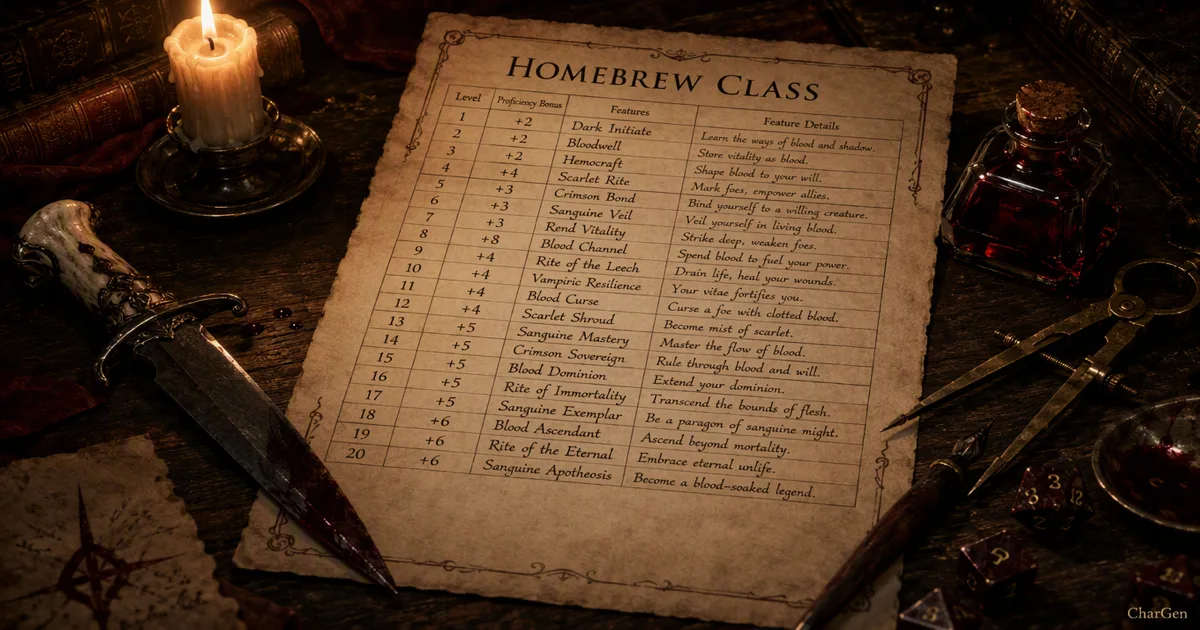
D&D Beyond will not let you build a class. That is not a bug or a missing beta feature. Wizards of the Coast publishes a support article called "No Homebrew Classes" confirming it, and the forum threads asking for the feature stretch back years. You can homebrew a subclass, a species, a spell, a magic item or a monster there. A base class is off the table.
So when you want a dnd homebrew class generator, you are not filling a small gap in your toolkit. You are replacing the one thing the biggest platform in the hobby deliberately does not do. That is the job CharGen's Class Generator took on.
Why a class is harder to homebrew than anything else
A homebrew monster is one stat block. A homebrew magic item is a paragraph and an attunement line. A class is twenty levels of interlocking decisions, and every one of them has to still make sense at the level above it.
Look at the shape of the official work. The 2024 Player's Handbook, released on 17 September 2024, carries 12 classes and 48 subclasses, four per class, alongside 10 species, 16 backgrounds and 75 feats. Each of those 12 classes is a twenty-row table where the hit die, the proficiency bonus, the resource pool and the feature list all have to move together. That is the baseline a player will compare your homebrew against, whether they say so or not.
The 2024 rules also changed where the subclass sits. Every class now picks its subclass at level 3. Under the 2014 Player's Handbook, that timing was uneven: clerics, sorcerers and warlocks chose at level 1, wizards and druids at level 2, and everyone else at level 3. If your homebrew class hands out its subclass at the wrong level for the edition your table runs, it reads as broken before anyone looks at the features.
That is a lot of structure to hold in your head at once. It is also exactly the kind of structure a generator is good at.
What the generator actually writes
I want to be specific here, because "AI generates a class" could mean a paragraph of flavour text. It does not.
A single pass produces a class or subclass laid out across four tabs: Overview, Progression, Roleplay and World.
Overview gives you the class identity. The role it plays at the table, the hit die, the armour and weapon proficiencies, the saving throws, and the resource system the class runs on. This is the part a player reads to decide whether they want to play it.
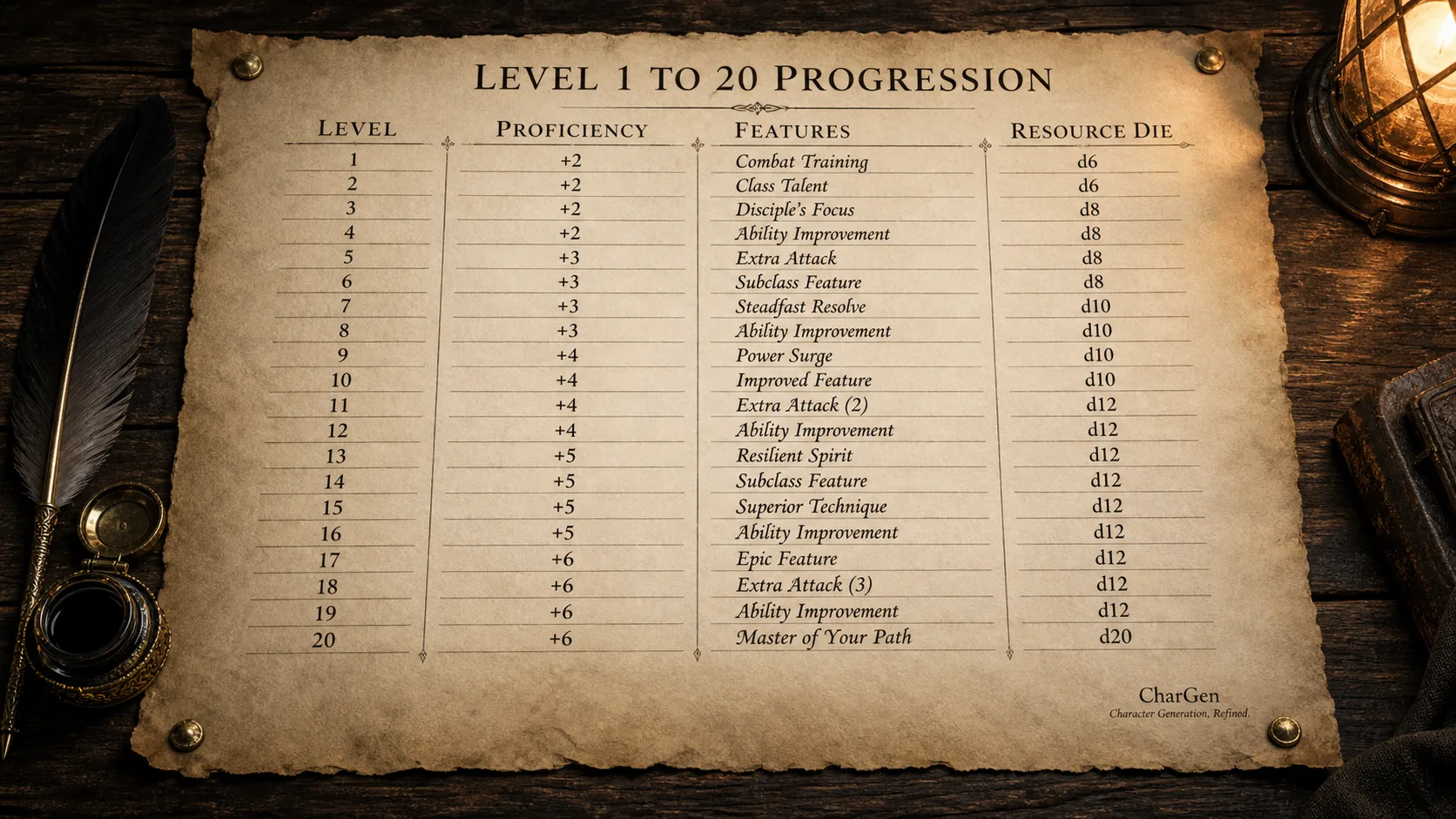
Progression is the twenty-row table. Features land on numbered levels for a full 1 to 20 run, with subclass stubs you can expand into complete subclasses later. It is the section that takes a person an evening and takes the generator one pass.
Roleplay covers what most mechanical tools skip: personality traits, playstyle tips, and character hooks a player can actually use to build a person rather than a spreadsheet.
World is the part I did not expect to use as much as I do. It gives you notable factions tied to the class, regions where it is practised, and famous practitioners. More on why that matters further down.
When a feature grants a choice from a named list, such as manoeuvres or invocations, the generator writes that list out with each option statted. Casters get a curated spell list by tier, and you can spin the class into a linked Spellbook in one click. There is also a PDF export, so the finished class leaves as a document you can hand round the table.
The seven fields that decide what you get
The form is short on purpose. Here is what each field actually changes.
| Field | Options | What it changes |
|---|---|---|
| What are you creating? | Full Class or Subclass | Whether you get a standalone chassis or an archetype that plugs into an existing class |
| Concept | Free text, optional | The fantasy, resource or hook. Leave it empty for a fully random class |
| Class Name | Free text, optional | Fixes the name so features can be written around it |
| Game System | D&D 5E (2024), D&D 5E (2014), Pathfinder 2e, Pathfinder 1e, or type your own | Subclass levels, advancement vocabulary and edition terminology |
| Base Class | The 13 SRD classes, your own homebrew, or a custom entry | Subclass mode only. Sets the progression the archetype has to fit |
| Role / Playstyle | Any, Martial, Full Caster, Half-Caster, Support, Skirmisher, Tank, Summoner, Hybrid | The mechanical lane, which drives the resource system and feature cadence |
| Balance Target | Standard, Gritty low-power, Cinematic high-power | How hard the features hit relative to official classes |
Balance Target is the field people skip and then complain about. If your table runs a low-magic game where a fireball is a rumour, generating at Standard and then wondering why the class outshines your party is a setup problem, not a generator problem. Set it to Gritty low-power and the resource economy tightens.
The Concept field rewards specificity. "A blood-ink half-caster who spends vitality to ward allies" produces a coherent class. "Cool warrior" produces a competent, forgettable one.
Subclasses are where most tools fall down
Subclass mode is the feature I would defend hardest.
Pick Subclass, and the Base Class field appears. You can point it at one of the 13 SRD base classes, at a custom class you type in, or at a homebrew class you generated earlier. That last option is the one that matters. When you pick your own class, the generator reads its actual progression and lands the subclass features on the levels that class grants them.
Think about what that avoids. You build a homebrew class with subclass features at levels 3, 7, 11 and 17. Two weeks later you want a second archetype for it. Any generic tool gives you a 5e-standard subclass at 3, 6, 10 and 14, and now you are hand-editing level numbers and hoping you caught them all. Reading the parent class removes that whole class of error.
It also handles the edition split correctly. Ask for a cleric subclass under 2014 rules and it knows the subclass arrives at level 1. Ask under 2024 rules and it arrives at level 3, like everything else.
Pathfinder 2e works differently again. It has no subclass slot in the 5e sense. Its equivalent runs through archetypes, which you enter by taking a dedication feat in place of a class feat, usually from level 2. Setting the Game System field to Pathfinder 2e changes the vocabulary the output uses, which is the difference between homebrew a PF2e table will read and homebrew they will bounce.
A worked example: the Vitalist
I generated a half-caster called the Vitalist. Concept: a blood-ink caster who spends their own vitality to ward allies. Role set to Half-Caster, Balance Target Standard, Game System D&D 5E (2024).
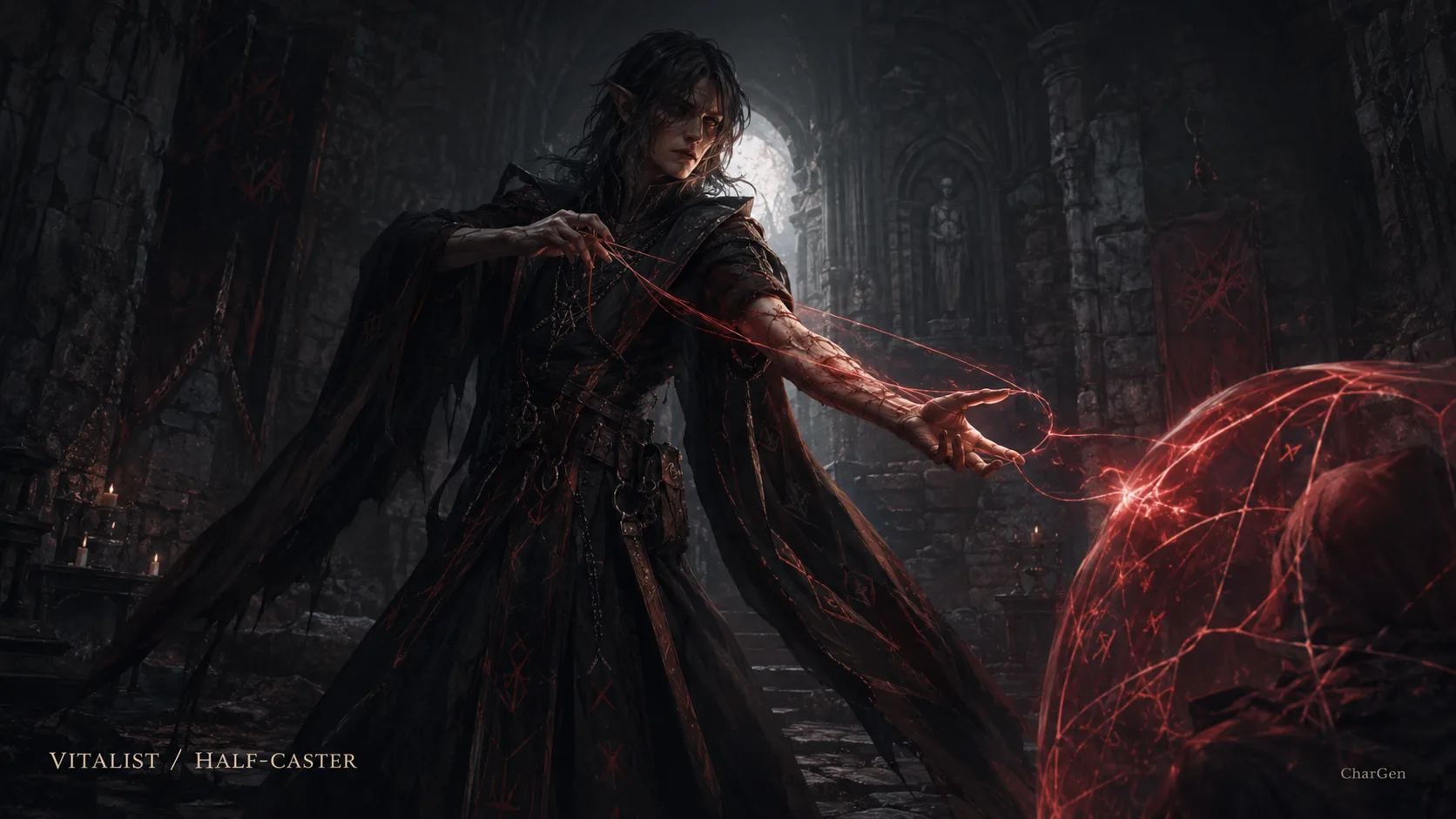
What came back: a d8 hit die, Constitution and Wisdom saves, light armour and simple weapons, and a resource the class calls Vitae, spent from the caster's own hit point maximum rather than from a slot pool. Spellcasting on the half-caster curve, so first slots at level 2 and a ceiling at fifth-level spells. Subclass at level 3, correct for 2024. Ward features scaling at 5, 9 and 13, and a capstone at 20 that lets the Vitalist spend accumulated Vitae to keep a downed ally standing.
Is it perfectly balanced? I would not claim that, and neither does the tool. The self-damage resource is the obvious pressure point, because a class that pays hit points for power gets stronger the more your cleric heals it. That is a real interaction I would want to test before a long campaign. But the class arrived readable, internally consistent and playable in about a minute, and the argument about the Vitae economy is a far better use of an evening than typing out twenty rows.
How it compares with what DMs already use
| Tool | Full class support | What it actually does | Cost |
|---|---|---|---|
| D&D Beyond | No, subclasses only | Official rules integration and a character sheet. Publishes a support article stating full classes are not supported | Free tier, paid content |
| Homebrewery | Yes | Markdown formatting that makes a document look like an official supplement. It does not write or structure the class for you | Free, open source |
| GM Binder | Yes | Document layout with the look of an official book. Strong presentation, steep formatting learning curve | Free tier, paid tier |
| r/UnearthedArcana | Yes | About 332,000 members sharing and critiquing homebrew since May 2015. Excellent feedback, no builder | Free |
| CharGen Class Generator | Yes | Writes role, hit die, proficiencies, resources, a 1 to 20 progression, and roleplay and world content | Free to generate |
The pattern is worth saying plainly. Homebrewery and GM Binder are typesetting tools. They make your class look official. They will not tell you what goes on level 11. r/UnearthedArcana will tell you what goes on level 11, in detail, but only after you have written a draft worth posting.
The generator sits before both of those. It produces the draft. You still owe the class a playtest, and you may well still owe it a Homebrewery layout if you want to publish it properly.
Rooting the class in your world
The World tab is the part I underrated. A homebrew class that exists only as mechanics is a class nobody has a reason to play.
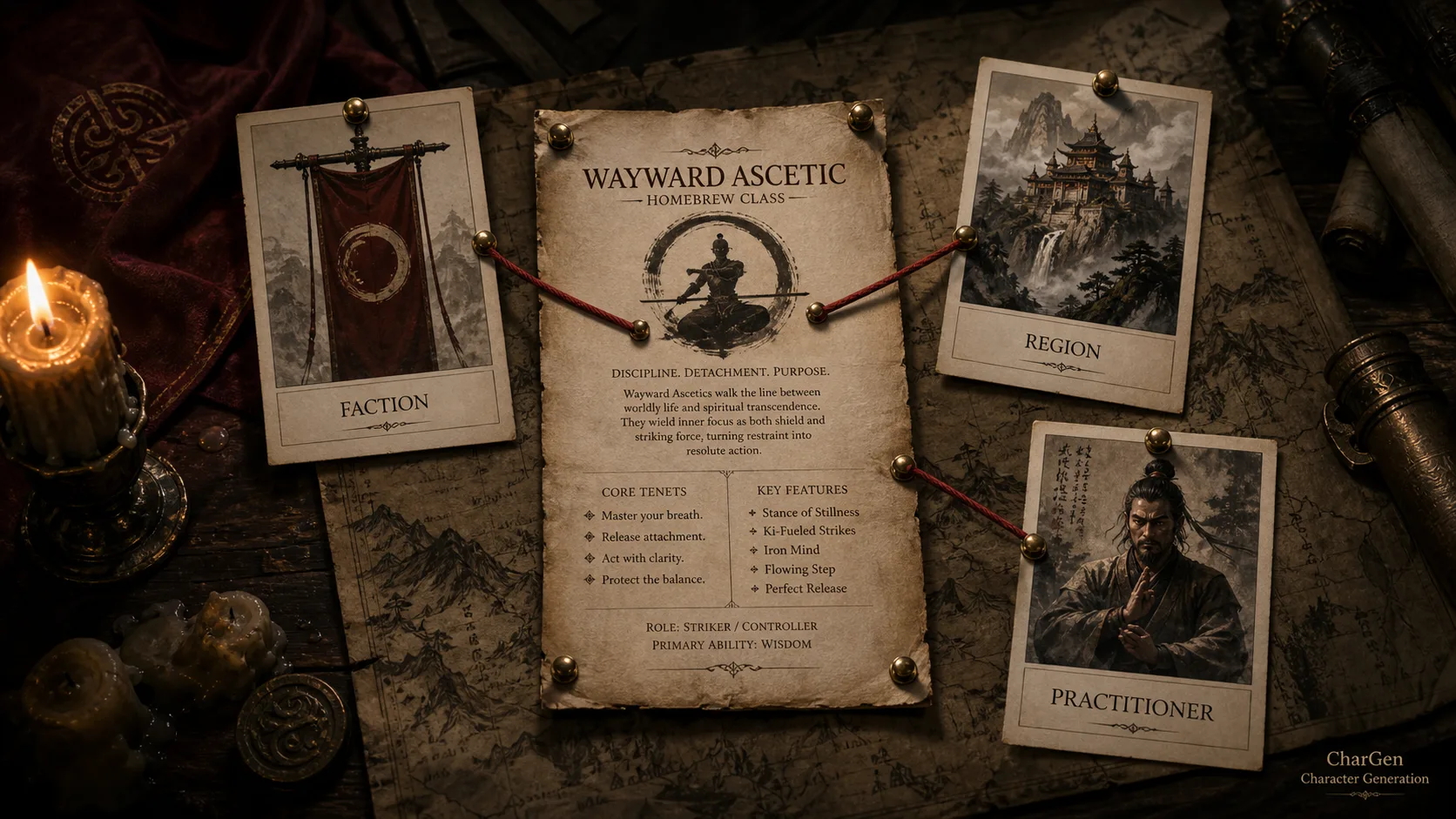
Getting a faction that trains the class, a region where it is practised and a couple of famous practitioners gives you three immediate campaign hooks for free. The order that teaches blood-warding has an opinion about the party. The mountain valley where they train is somewhere to send a level 4 party. The practitioner who went wrong is a villain with a built-in connection to your player.
That is the same reason the class links out to the rest of the toolkit. Pair it with the Species Generator for an ancestry that fits, then drop the finished class onto a sheet in the Character Builder.
What I would do before you let it near a table
Generate at the Balance Target your campaign actually runs at, not the default.
Read the level 5 and level 11 rows first. Those are the two power spikes where 5e homebrew usually breaks, and if the class survives both, the rest tends to follow.
Check the resource economy against your party composition. Anything that trades hit points, exhaustion or spell slots for power behaves very differently depending on who else is at the table.
Then run it for three sessions before you commit. The generator gives you a draft in a minute. The playtest is still yours, and no tool is going to do that part for you.
If you build classes and share them, the affiliate programme pays 25% flat on a referral's first payment with a 60-day cookie, which is a reasonable fit if your homebrew posts already send people looking for tools.
Start with a Concept sentence you would be excited to play, set the Game System to your actual edition, and generate. It is free, and the first draft costs you a minute instead of a Sunday.
Frequently asked questions
- Can D&D Beyond make a homebrew class?
- No. D&D Beyond publishes a support article titled 'No Homebrew Classes'. The platform supports homebrew subclasses, species, spells, items and monsters, but it has no builder for a full base class. That gap is why most homebrew classes live in Homebrewery documents, GM Binder pages or PDFs instead.
- What level do you pick a subclass in D&D 5e?
- Under the 2024 Player's Handbook, every one of the 12 classes picks its subclass at level 3. The 2014 rules were uneven: clerics, sorcerers and warlocks chose at level 1, wizards and druids at level 2, and the rest at level 3. A class generator has to know which edition you are on, because the subclass level moves.
- Does a homebrew class generator work for Pathfinder 2e?
- CharGen's Game System field offers D&D 5E (2024), D&D 5E (2014), Pathfinder 2e and Pathfinder 1e, and you can type in any other system. The advancement vocabulary follows what you pick. Pathfinder 2e handles its subclass-like options through archetypes and dedication feats rather than a subclass slot, so the output reads differently from a 5e class.
- Is AI homebrew balanced enough to play?
- Treat it as a first draft, not a finished product. CharGen aims at the balance target you choose, from Standard to Gritty low-power to Cinematic high-power, but it does not ship playtest notes or maths. Run the class through a few combats at levels 5 and 11 before you let it into a long campaign.
- Is the class generator free?
- Generating a class is free on every account. Editing a generated class afterwards, to rename features or adjust the progression, is a premium subscriber feature. There is no credit card needed to start.