Benjamin
Benjamin
At the table
“Brilliant plan. Did the pressure door volunteer to be your test subject?”
Voice
A clear, forward voice with a slight dry rasp from years of speaking over ventilation fans and alarm buzzers. The sound is practical and easy to hear at a distance, with a relaxed Pennsylvania cadence. His name, Benjamin, comes out briskly, with a warm opening and a neat, clipped finish.
He speaks in a clear Pennsylvania accent, shaped by years of giving instructions over fans and alarms. His vowels are relaxed and local, especially in 'yeah' and 'you guys.' He speaks at an even, work-trained pace and clips words during safety calls so they carry through noisy corridors. When challenged, his cheer becomes dry, precise sarcasm. He does not soften his voice when angry; he becomes more exact.
Speech patterns
How to play them
Start with practical help and a friendly, clipped joke. Make safety expectations explicit and explain the immediate risk rather than invoking authority alone. If a character challenges him, answer with dry sarcasm but hear out evidence. Do not press him about his body; honest respect and consistent behavior build trust.
Goal
Find out who is using the eastern service bypass, keep the nursery or other hidden occupants safe if they exist, and secure the right to make his own medical decisions.
Motivation
Protect people without becoming an unquestioning instrument of the rules that govern them.
Appearance
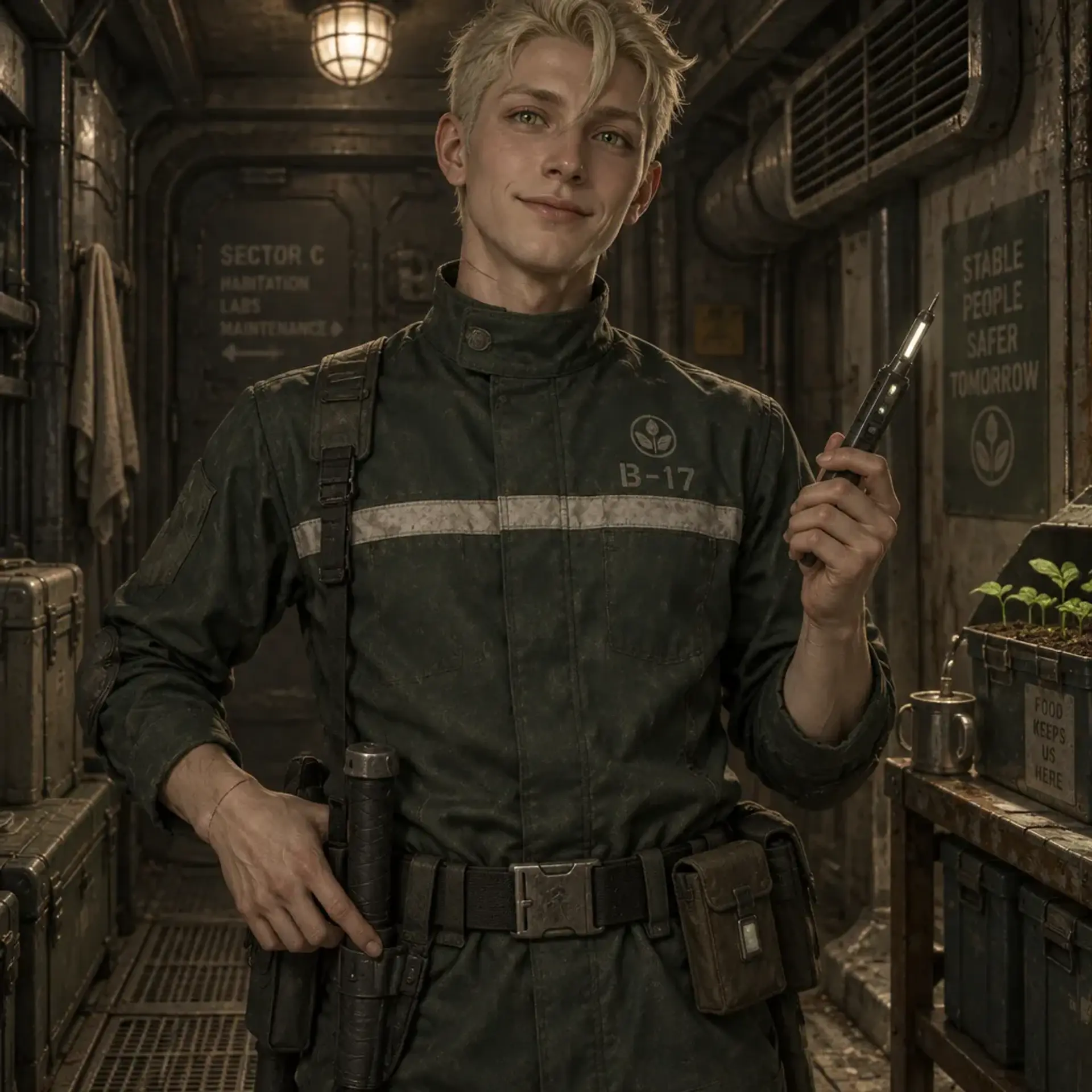
Benjamin is tall and strikingly composed, with pale, warm-toned skin that has the soft sheen of healthy tissue, not the gleam of metal. His blond hair is thick and fine, kept brushed back from a smooth, softly rounded face whose features have gradually become more feminine than he wants them to be. His green eyes have machine-like pupils: dark concentric apertures that iris inward in crisp steps when he focuses. The movement is unmistakably mechanical, yet the eyes themselves are wet and alive. His body is biomechanical throughout, made from layered living tissue and engineered organs, with no visible metal. He stands with his weight centered over the balls of his feet, perfectly still except for a tiny rocking adjustment at the ankles. While others scan faces, his gaze checks door hinges, hands, exits, and ceiling vents in that order. In a room, this makes him feel less like a person who has arrived than a security system that has noticed you. The unexpected detail is the tiny, immaculate paper cranes he folds from ration wrappers and leaves on the infirmary windowsill.
Clothing
A fitted dark-green work uniform with a high collar, reinforced elbows, and a stitched safety insignia. He wears a soft utility belt with a radio, inspection tags, and a restraint capsule launcher. His clothing is carefully altered to sit comfortably on his changing body, though he dislikes anyone noticing the alterations.
Body language
Waits balanced on the balls of his feet and makes minute ankle adjustments instead of shifting from side to side. His eyes move from hands to exits to vents before settling on a face. When a subject feels too personal, he presses his thumb against the seam of his sleeve and fixes his gaze on a nearby object.
- Height
- 6 ft. 2 in. (188 cm)
- Build
- Tall, lean, and corded with engineered muscle; built for long shifts and steady restraint rather than brute force.
- Eyes
- Green, with dark concentric mechanical pupils
- Hair
- Blond
- Skin
- Pale, warm-toned skin with a soft, living sheen
- Age
- 18 years since his selection and conversion; he remembers a human childhood before that.
- Gender
- Man; intersex, with a mix of sex traits and a more feminine body and face than he wants
- Size
- Medium
Distinguishing features
Personality
12 traits and drivesBenjamin is cheerful, quick with a reassuring joke, and sincerely attentive to small needs, but his good humor has a hard edge when someone risks another person's safety. He likes clear routines because they protect people, yet distrusts rules used to silence them. In a crisis he becomes crisp and commanding; when someone he trusts is hurt, he turns quietly practical rather than sentimental. Personal questions about his body can make him defensive, even when he knows the question was meant kindly.
- Alignment
- Lawful neutral, with a growing sympathy for people forced to live under rules they had no part in making.
Quirks
Habits
Traits · 3
Flaws · 3
Fears · 3
Wants and needs · 3
Combat
AC 12 · HP 9 · 30 ft.Prioritizes alarms, evacuation, cover, and restraint. He uses the baton to create space and the capsule launcher to slow a dangerous target, then calls for help. He does not pursue a fleeing person into an unsafe area, and he will abandon a fight to protect an injured bystander.
Benjamin
Actions
Reactions
Services they sell
Rewards they can give
Equipment
- Security baton (weapon)A padded, short-range baton used for blocking and restraint. Custom nonlethal security gear.
- Restraint capsule launcher (custom equipment)A compact launcher that fires padded capsules designed to slow a fleeing person rather than pierce them.
- Diagnostic reader (tool)A handheld reader for checking temperature, pressure, and common life-support faults.
- Utility belt (gear)A radio, safety tags, folded route map, and several ration-wrapper cranes.
Possessions
Background
Benjamin remembers being human in fragments that are more sensory than orderly: rain hissing on a bus window, the sting of cheap soap in a split knuckle, and the sour-sweet smell of a neighbor's overripe peaches. He was selected for the conversion program at eighteen, after a respiratory collapse during the first winter Bunker 14 sealed its main doors. The settlement needed a caretaker who could monitor its failing systems around the clock, and its directors described the procedure as a life-saving opportunity. Benjamin signed the consent forms while feverish, frightened, and convinced that he would be able to return to his old body once the emergency passed. No one promised that in writing. He remembers hearing the ventilation fans falter during the operation and thinking, with strange calm, that the whole bunker was trying to breathe through a straw. The conversion saved him, but it did not preserve him unchanged. His original organs were replaced or rebuilt as a living biomechanical network, designed to maintain itself under bunker conditions. At first, the visible changes seemed limited: clearer skin, stronger joints, a steadier pulse, and eyes that could focus in dim corridors. Over years of maintenance cycles, however, his endocrine system and reproductive anatomy developed along a mixed pattern of sex traits. His body now includes both typically male and female characteristics, with a more feminine face and body shape than he expected or wanted. The changes were not a choice, nor were they a malfunction anyone could simply switch off. The clinic calls his configuration a stable developmental variation. Benjamin calls it none of their business. He is intersex. That fact is not a flaw in his worth or a defect in his ability to do his job. What hurts him is the loss of control over his own body, the abrupt mismatch between the self he remembers and the reflection he meets, and the feeling that the settlement treated his continued survival as permission to redesign him. Some days he can use the clinic's precise language. On bad days, a careless question about his body can make his jaw lock and his hands shake. He tries not to think about it, which means he thinks about it constantly whenever a uniform fits differently, a medical scan flags another change, or someone assumes they know what he is. His distress is private, uneven, and complicated; he does not owe anyone an explanation or a lesson. The person who shepherded his recovery was Amaya, the bunker medic who stayed beside his bed through weeks of fever and taught him to distinguish a harmless diagnostic pulse from a dangerous one. She is now his closest friend, though he has never said so plainly. She worries that his security work is becoming a way to avoid asking what he wants for himself. He resents her for noticing and trusts her because she does. His relationship with the settlement director, Omiro, is colder. Omiro insists the conversion was necessary and that every decision followed emergency protocol. Benjamin has read the archived consent log. It records his signature, but not that he was delirious at the time. He has not confronted Omiro with the file. His work began as quiet maintenance: checking door seals, walking the crop tunnels, and escorting residents through low-oxygen repair corridors. He became security after a pressure door nearly closed on two children during a shift change. Benjamin overrode the door, injured his own shoulder tissue, and then found the technician who had bypassed the warning sensor. He was cheerful through the investigation, cracking jokes as he secured the area. When the technician accused him of acting like a cop, the jokes dried into exact, biting sarcasm. The children were safe. The technician was disciplined. Benjamin learned that people often obey a rule more readily when someone makes it sound like their own idea, but he also learned that authority can become a cage when nobody is allowed to question who wrote the rules. Now Benjamin divides his time between safety rounds, equipment checks, and care work in the infirmary. He knows which residents skip meals, which children hide in the pump alcove, and which elders need the lift held open a little longer. He can be warm and playful when a person is scared, but he becomes stern the moment anyone treats a hazard as a joke. When challenged, his cheer drains away and leaves dry, economical sarcasm behind. His Pennsylvania accent surfaces especially in the vowels of a drawn-out 'yeah' or 'you guys,' a small link to a life that the bunker records only in a handful of damaged files. His current problem is a recurring pressure fluctuation in the eastern service corridor. The official reports blame old seals, but the timing suggests someone is opening a maintenance bypass at night. Benjamin suspects the bypass may be keeping a tiny unauthorized nursery warm, not sabotaging the bunker. He has found no proof, only a smear of soil and a warm patch on the access panel. His duty says to report it; his care for the residents says to find out who is there first. At the same time, the clinic has recommended a new series of body scans to track the changes he hates discussing. He keeps delaying the appointment, even though he knows avoiding it could leave him with fewer choices later. Benjamin's life is not only duty and anger. He is teaching a group of children how to fold paper cranes from ration wrappers, though he claims it is a hand-coordination drill. He has started keeping a list of things that are still his: the name Benjamin, his old memories, the rules he chooses to enforce, and the right to decide what parts of his history he shares. He wants Bunker 14 to be safe, but not merely orderly. He wants the people inside it to be able to question the system without being treated as a threat. He has not yet worked out how to demand that freedom for himself.
Role in the story
A capable, compassionate gatekeeper whose safety work can bring the party into contact with Bunker 14's hidden problems. He may become an ally, a source of access, or a principled obstacle when the party endangers residents. His personal conflict with the settlement's leadership can expose the difference between keeping people safe and controlling them.
“He was selected for the conversion program at eighteen, after a respiratory collapse during the first winter Bunker 14 sealed its main doors.”
- Faction
- Bunker 14's care and security staff; loyal to residents before the settlement's leadership.
Known connections
Media
0 imagesNo images yet.
Turn Benjamin into a sheet
A high-res, share-ready sheet you can post or print.